




Abstract
This research, using data from the Community Criminal Courts where a majority of elderly offenders are tried and sentenced, investigates the socio-economic profile of elderly offenders and the factors influencing their criminal motivation in Singapore. It revisits conceptualizations of offending in older age which until now has received scant attention even in Asian societies where ties to conventional institutions are thought to be “protective.” The majority of elderly offenders in this study were “revolving door prisoners” and were never in possession of any efficacious social capital that would have prevented them from committing a crime or enabled their re-entry process, a problem compounded by the study’s findings that almost 70% of the sampled offenders had experienced mental health issues. This would have spelled adverse consequences for their desistance and, conversely, their recidivist behavior, a finding that was consistent with many other studies that had examined the association between psychosis and crime.
Keywords
Introduction
The observed relationship between age and crime is one which has a long-standing tradition in criminological theory. The body of knowledge and research has focused mainly on trajectories among youth and young adult offenders and their subsequent “aging out” of crime at later stages of the life course (Feldmeyer & Steffensmeier, 2007; Maruna, 2001). Studies have pointed to a general pattern across time, place, and types of offenses where the age-crime curve across most categories of crime reveals an upsurge in early adolescence, peaking in the late teens or early twenties, and then declining considerably (Farrington, 1989; Laub & Sampson, 2003). As Steffensmeier et al. (1989, p. 803) wrote, “the proposition that involvement in crime diminishes with age is one of the oldest and most wildly accepted in criminology.” This “social fact” (Greenberg, 1985) is often attributed to the elderly developing social bonds to conventional institutions such as marriage, parenthood, or employment (Laub & Sampson, 2003); yielding to social pressures and toward conformity (Sugie, 2017); or experiencing psychological, physiological, and social maturation (Moffit, 1997).
Given the weight of scholarly work that is keen to explain and account for desistance among the elderly, the phenomenon of increasing elderly arrest and conviction rates in aging societies, including Singapore, provides an unprecedented opportunity to revisit conceptualizations of offending in older age which until now has received scant attention even in Asian societies where ties to conventional institutions are generally thought to be stable and “protective” (Agnew, 2015). As a distinct population group, the elderly can be defined on the basis of various characteristics and attributes (Bows & Westmarland, 2018). There is no universal or uniform chronological age at which one becomes “elderly” but because offender populations are believed to age prematurely due to factors associated with lifestyle, health conditions, and impact of multiple or prolonged incarceration, the literature on offenders often defines older age as beginning at age 50 or 55 (Anno et al., 2004; Gross, 2007). The present study, however, defined older age as beginning at age 65 to be consistent with research guidelines in the general population and historical standards for retirement and Social Security benefits (Hardy, 2006; Kidman, 1988). In Singapore, both the Ministry of Health (MOH) and the Department of Statistics Singapore define an elderly individual as 65 years old and above. Additionally, the age when Singaporeans receive their monthly Central Provident Fund pay-out is set at 65 years old (Central Provident Fund Board, 2020). As Denton and Spencer (2002) observed: “Sixty-five has long been used to define the beginning of ‘old age’. . . it has come to be strongly associated with ‘normal’ retirement and the beginning of old age” (p. 350). As such, for the purpose of this paper, the elderly offender is defined as being 65 years old and above.
Due to improved health care and a higher quality of living, the number of elderly individuals globally is increasing (World Population Ageing, 2020). Proportionately, the elderly criminal population is expanding and more elderly individuals are being incarcerated worldwide (Kratcoski, 2018), though this could be the result of a growing intolerance toward old age criminality and greater willingness of criminal justice professionals to prosecute, convict and impose custodial sentences on elderly offenders. Chaneles and Burnett (1989, p. 4) wrote about the possibility of there being “data accumulation problems of accuracy and completeness associated with the social and political aspects of decision making.” Notwithstanding, in the United States, those aged 65 and above formed 1.5% of all arrests in 2019, a 0.9% point increase from 2005 to 2019 (U.S. Department of Justice, 2019). Australia witnessed the proportion of all persons found guilty who were aged 50 years and above increasing from 6.3% in 2000 to 12.2% in 2015; a 94% increase in 16 years (Stavrou, 2017). In Japan, there had been a steady rise in elderly crime between 1998 and 2018 where elderly offenders aged 65 and above committed 21.7% of all penal code offenses in 2018 which also saw a rise of 0.8% from the previous year (Ministry of Justice, 2019). In South Korea, the number of elderly South Koreans who committed crimes increased by 45% from 2013 to 2017 (Lee, 2018).
Singapore, too, with her aging population (Committee on Ageing Issues, 2006), witnessed a rise in offenses committed by individuals aged 65 and above with 196 offenders being charged in court in 2018—the highest in at least 3 years—and the number of elderly inmates aged above 65 more than doubling from 103 to 237 between 2013 and 2019 (Wong & Koh, 2019). With the estimation that one in five residents in Singapore will be aged 65 and above by 2030 (Committee on Ageing Issues, 2006), the rates of elderly crime and incarceration are likely to surge.
While there are global studies on elderly crime (Cullen et al., 1985; Feldmeyer & Steffensmeier, 2007; Kratcoski, 2018), local studies are limited and they are largely focused on the needs of the elderly population in prisons and the challenges they face after release (Singapore After-Care Association, 2018; Tan, 2014). Given the dearth of literature on understanding the factors of crime causation among elderly offenders, it is imperative, therefore, to investigate the context of elderly crime in Singapore, its etiology, and the varying cultural and country-specific variables that may have contributed to elderly individuals’ criminal motivation. As Kratcoski (2018) noted, crimes committed by elderly individuals can only be fully understood when the specific personal, social, and economic situation of the individual as well as the socio-political situation of the country and the temporal dynamics affecting elderly persons are taken into consideration. Given that much research is available only on Anglo-Saxon societies and a few Asian countries such as Japan, this research aims to investigate the socio-economic profile of elderly offenders and the factors influencing their criminal motivation in Singapore.
Literature Review
Historically and globally, crime rates are known to peak at adolescence and decrease with age (Greenberg, 1985; Hirschi & Gottfredson, 1983; Steffensmeier et al., 1989; Tittle & Grasmick, 1997). Studies also showed that the types of crimes committed by elderly people vary from property crimes, public order crimes to crimes against persons such as murder, rape, assault, and robbery (Cullen et al., 1985; Feldmeyer & Steffensmeier, 2007). Feldmeyer and Steffensmeier (2007) suggested that compared to younger offenders, elderly individuals commit less serious crimes, and Kratcoski (2018) attributed this to diminishing physical and cognitive functions and predicted a reduction in aggressiveness among the elderly. A study of elderly offenders in China, however, indicated that the elderly may actually turn more violent due to experiencing of physiological and psychological changes related to aging.
Hirschi and Gottfredson (1983) argued that economic needs may also contribute to crime by elderly individuals given their structural inability to access institutionalized means to achieving the cultural goal of material success. This was supported by Barak et al.’s (1995) study of first-time elderly offenders in Israel that showed a high rate of “financial” offenses amongst them as a bid to amass wealth for retirement. From a relative deprivation perspective, Van Alphen (2014) found out that some elderly offenders in Europe perceived their peers to be financially more secured than them and committed economic offenses to attain similar status. Yokoyama (2018), however, noted that some elderly individuals committed property crime not out of economic necessity but rather due to their alienated self and, in part, wanted to draw attention to themselves.
Legislated retirement and society’s views of the elderly individuals were also put forth as possible factors that caused strain leading to criminal behaviors (Ramos, 2017; Sugie, 2017). A study of elderly offenders in South Korea reported that reduced social roles and lack of pro-social leisure activities led the elderly individuals into meaningless lifestyles and feelings of hostility and frustration that predisposed them to crime (Lee, 1997). Although a dated study, Whiskin (1968) discerned that elderly offenders who committed sexual offenses such as child molestation and exhibitionism had difficulty engaging in “healthy” expressions of sexual desires because of society’s relative intolerance of any such expressions among the elderly. Laub and Sampson (2003) investigated “turning points” in an individual’s life that could help change their life course from criminal to conventional lifestyles, and vice-versa. They found that marriage emerged as a significant factor that helped individuals desist from crime as it acted as a form of social bond and social control. Conversely, a loss of significant relationships may influence the onset of criminal behavior in elderly individuals.
Mental health issues were also noted to affect criminal motivation among the elderly individuals (Liljegren et al., 2019; Yokoyama, 2018; Yorston & Taylor, 2006). Liljegren et al. (2019) illustrated the relationship between neurogenerative diseases and antisocial behaviors in a sample of patients aged between 57 and 74 where it was found that dysfunctions in neural structures adversely impacted domains such as executive functioning, emotional processing, self-awareness and sexual behaviors, and that such deficits led to criminal behaviors. This was further supported by a Japanese study which highlighted those elderly individuals who suffered from dementia and depression committed shoplifting due to senility and “unconscious impulse” (Yokoyama, 2018), a finding that was also replicated in a Hong Kong study by the Society of Rehabilitation and Crime Prevention (Ng, 2018). Moreover, research also found that elderly people who experienced delusions were at higher risk of committing violent crimes and that elderly perpetrators of homicide were more likely to have a mental disorder at the time of offense (Hunt et al., 2010; Paradis et al., 2000). The relationship between mental disorders and crime is also reinforced by the elderly offenders’ vulnerability to alcohol abuse (Meyers, 1984) that manifested in a range of crimes such as drink driving (Ghossoub & Khoury, 2018) and sexual violence (Fazel et al., 2002).
Theorizing Criminal Behavior in Elderly Individuals
In reviewing the literature on elderly crime, four inter-related theoretical paradigms emerged. These include the social capital framework (Bourdieu, 1986; Putnam, 2000), social control theory (Akers et al., 1984; Hirschi, 1969), life course theory (Arber & Evandrou, 1993; Payne & Gainey, 2009) as well as anomie theory (Ramos, 2017). Bourdieu (1986, p. 248) defined social capital as the “aggregate of the actual or potential resources which are linked to possession of a durable network of more or less institutionalized relationships of mutual acquaintance or recognition.” Coleman (1990, p. 302) viewed social capital as “a variety of different entities having two characteristics in common: they all consist of some aspects of a social structure, and they facilitate certain actions of individuals who are within the structure.” Like Coleman, Putnam (2000) considered social capital as “connections among individuals—social networks and the norms of reciprocity and trustworthiness that arise from them.” Consistent with the life-course theory’s emphasis on later life social bonds (Williams & Sickles, 2002), it may be that the gradual weakening or loss of attachments that comes with aging, such as death of a significant other, divorce, or retirement, place elderly individuals at a higher risk of offending. In the same vein, social control theory similarly describes how social connections function as a control on an individual and that the loss of significant relationships weakens an individual’s bond to society which frees a person to engage in delinquency (Akers et al., 1984; Hirschi, 1969).
Social strain theory or anomie provided another perspective on criminal behavior. Agnew (1992), and Kratcoski (2018) indicated that when individuals were unable to meet their goals such as social aspirations, monetary success, and fulfill their social roles (goals that are closely linked to social capital), this may create negative feelings such as anger, resentment, and disappointment which is termed as an “anomic state.” Kelly (2000) observed that an anomic state may result in individuals feeling alienated from society and in response, commit crime. In this article, inspired by Sugie’s (2017) work on elderly crime in Japan, we move away from a Mertonian conceptualization of anomie with its emphasis on material success and social aspirations as the precursor of crime to a Durkheimian notion of anomie where contextual and structural factors affecting levels of social integration and moral (de)regulation are examined to account for the rise in elderly crime in the Singapore context. Both concepts—integration and regulation—“are intimately related, where integration is the attachment people feel toward others, which provides meaning beyond personal troubles, and regulation is the behavioral norms and rules that facilitate integration” (Sugie, 2017, p. 21). The efficacy of these concepts also lies in their ability to leverage on and integrate existing theoretical constructs of anomie, social capital, and social control over the life course in an amalgamated framework (see Figure 1).
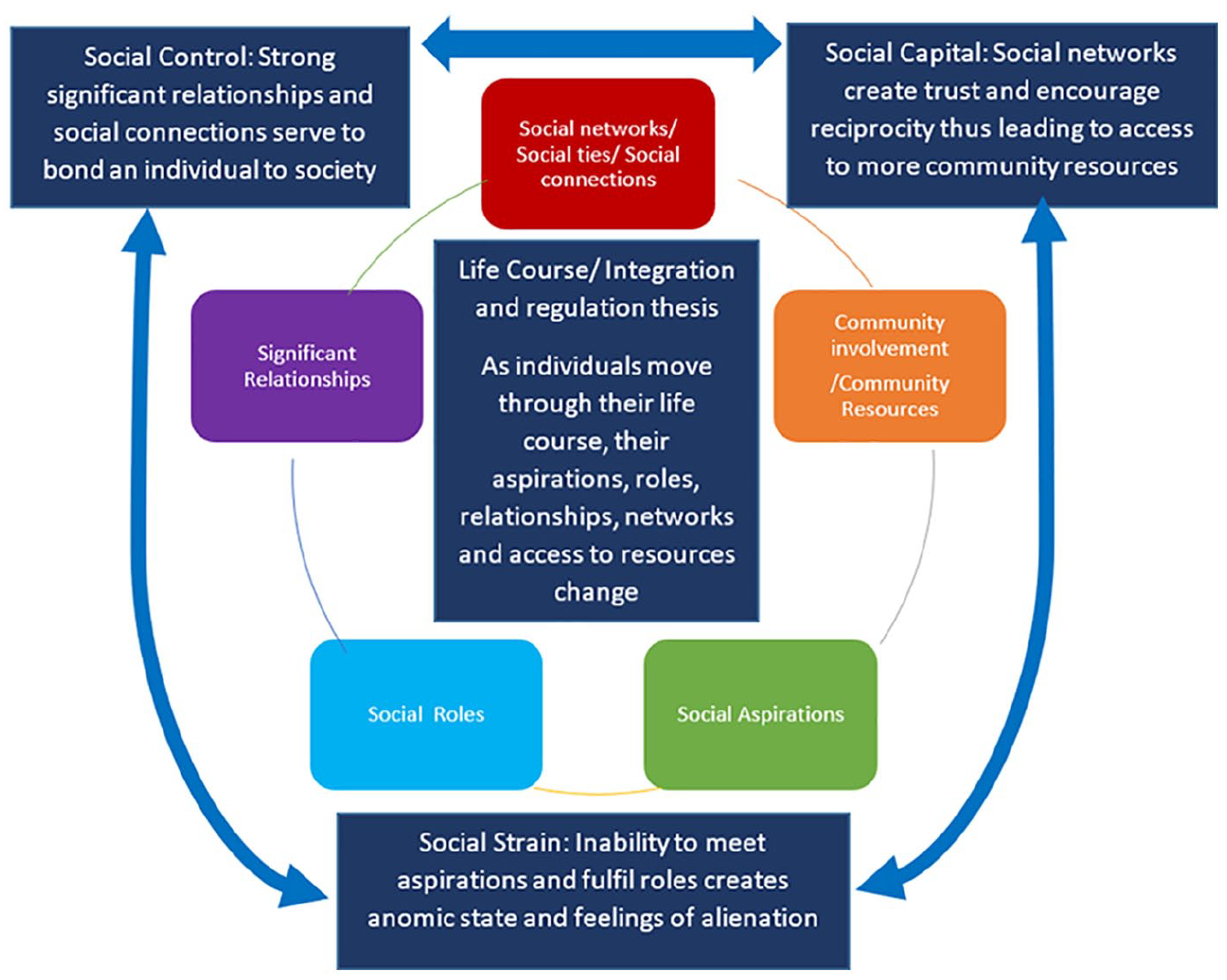
An integrated theoretical framework on elderly crime.
While the “integration-regulation” thesis was primarily developed by Durkheim (1951) to explain suicide in transitional societies experiencing drastic macro-level changes leading to desires exceeding the structural capacity of individuals to realizing them, the core of Durkheim’s philosophy rested on the premise that social integration and regulation together enabled societies to exert social control over deviant tendencies. In explicating the importance of the integration-regulation nexus, Crutchfield et al. (1982, p. 468) noted: “an integrated social system provides (1) a high degree of consensus in norms, values, and goals; (2) cohesiveness or social solidarity; and (3) a sense of belonging or ‘we feeling’ among persons living in the community in question.” By focusing on social integration, the level of analysis is able to transcend individual-level factors and incorporate a greater appreciation of the social, structural and cultural transitions. Nowhere is such an approach necessitated than in Singapore, a small but dynamic cosmopolitan city-state with one of the fastest aging populations in the world (Hirschmann, 2020) that also has to contend with a high Gini-coefficient—a measure of the income distribution of a nation’s residents—at .478 (Ye, 2016).
Community Courts in Singapore and Community Court Conference
The Community Courts are part of the State Courts of Singapore and were established on 1 June 2006 as problem-solving courts which hear special cases that require community resources to establish the root causes of offending behaviors and facilitate the successful re-integration of individuals into community settings. Where suitable, the Community Courts employ community-based sentencing options that allow offenders to undergo rehabilitation programs in the community instead of in prison. Categories of criminal cases heard at the Community Courts include, among others: (a) selected cases involving offenders aged 65 year and above (b) cases involving young offenders aged 16 up to 21 years old; (c) selected cases involving offenders with suspected or diagnosed mental disorders; (d) family violence cases; (e) abuse and cruelty to animal cases; (f) cases which impact race relations; (g) selected cases involving accused with chronic addiction problems; (h) shop theft cases; Figure 2 illustrates the process from arrest to offenders being seen for Community Court Conferences (CCCs). When offenders are arrested, the police and the Attorney’s General Chambers will decide if they should be charged. If they are charged, they will be first produced at the Criminal Mentions Courts where pleas are taken. If they claim trial, the Mentions Courts will fix the cases for Pre-Trial Conferences (PTCs) in order to ascertain if the cases are ready for trial. If offenders indicate they wish to plead guilty, their case would be transferred to the Plead Guilty (PG) Courts.
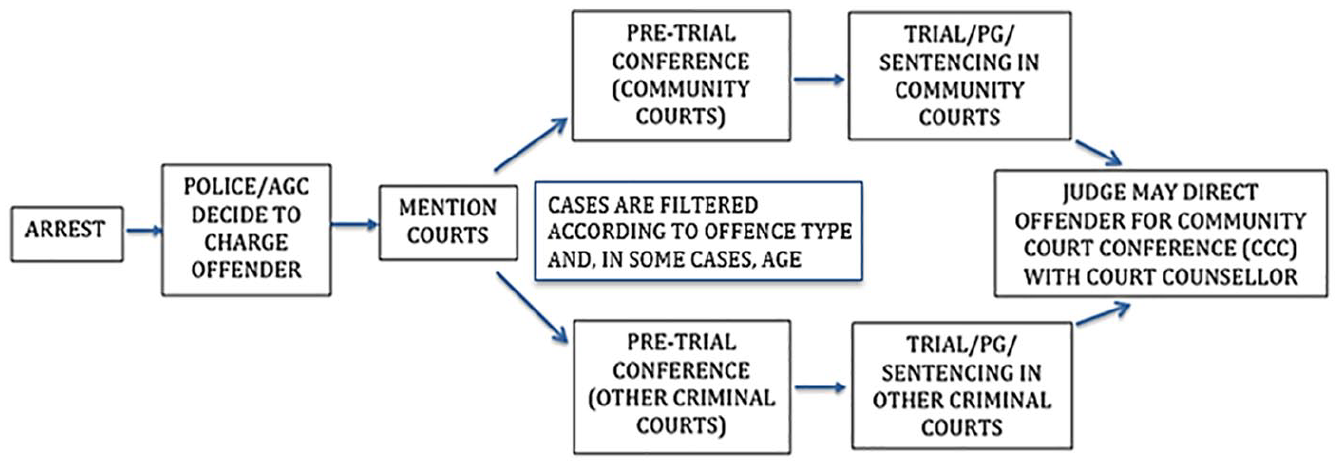
Process from first arrest to CCC.
The Community Courts work closely with the Center for Specialist Services (“CSS”), a multi-disciplinary team of psychologists, counselors and social workers referred to in this paper as CSS specialists. The Community Courts judges refer offenders to CSS for CCCs to be carried out if the offenders are suspected or diagnosed to have a mental health issue, addiction problems, or present with social issues that require further assessment and intervention. Whilst most CCCs are convened by the Community Courts, other Criminal Courts may also refer offenders to CSS if an assessment is deemed necessary.
Methodology
The current study relied on court data, official documents, and interviews with elderly offenders who had appeared in the Community Courts of Singapore between 2017 and 2018. 51 respondents were selected for participation in the study and they were interviewed either at the pre-sentencing or post-sentencing stage of their court case. Due to the various filters present in court processes from first mention to CCCs, random sampling for this study was not possible. Instead, this study adhered to “theoretical sampling,” a form of purposive sampling, where the “groups are chosen as they are needed rather than before the research begins” (Glaser, 1992).
These interviews were conducted in private interview rooms at the State Courts of Singapore. Apart from information collected during the interviews, the authors also relied on documents tendered to court including psychiatric reports, community rehabilitation suitability reports, and statement of facts generated by the police and/or the public prosecutor. Interviews were guided by a set of pre-established questions based on the Level of Service Inventory-Revised (LSI-R) (Andrews & Bonta, 1995) that explored various domains in the offenders’ lives such as criminal history (or antecedents), education/employment, alcohol/drug problems, companions, emotional/personal (or mental health), family/marital, attitudes/orientation, accommodation, leisure/recreation, and financial and these had been adapted for the purposes of addressing the research questions of this study.
Data Collection
Data for this study was obtained via a three-pronged approach. First, an exploratory survey adapted from the LSI-R was utilized; second, interviews were conducted to explore the life histories of the offenders, as well as to contextualize the responses to the questionnaire; and finally, data was triangulated with a range of other reports that had been tendered to court to supplement the narratives of the offender. The researchers recognized that the LSI-R scores were meant to assess risk of relapse and re-offending and that there were nuanced differences between assessing relapse and criminal motivation. Nevertheless, the researchers were of the view that the LSI-R domains could provide insights into underlying issues influencing the onset of criminality or recidivist behaviors.
Data Analysis
The reports tendered to court by the CSS specialists after their session with the offenders were studied by the research team. Content analysis was also carried out on documents submitted to the court such as medical and psychiatric reports, mitigation pleas, criminal records, statement of facts, and community rehabilitation suitability reports. To ensure objectivity, the analysis of the data was done independently by each researcher. The raw data was first consolidated according to the LSI-R domains and the themes were identified within each domain. The individual analyses were then extensively discussed by all researchers until convergence in the interpretation of the data was reached after a few iterations.
Limitations in Methodology
One of the limitations of this study is its inability to achieve generalizability given its adherence to purposive sampling. This study was bound by the unique court processes that guided each case management. “Filters” that were put in place introduced selection bias as it meant that cases that were routed to the Community Courts were limited to specific offense types. Further, only distinctive cases that were deemed by the Judicial Officer to possess psychosocial issues were referred for a CCC. As such, the population studied represented a specific subset of elderly offenders and was not representative of general population of elderly offenders.
Findings
Social Demographics of Participants
51 offenders were interviewed with the majority being males (92.2%) in their late 60s. Of the four (7.8%) female offenders, three committed theft while one committed rash act. As of 2019, the racial make-up of Singapore was 76% Chinese, 15% Malay, 7.5% Indian, and 1.5% others (Department of Statistics Singapore, 2019). Hence, while offenders who were Chinese formed the bulk of the interviewees, it was noted that Indian offenders were disproportionately represented at 15.7% given the racial make-up of Singapore. The majority of the interviewed offenders were Singaporean citizens but five (9.8%) of them were Stateless. This refers to those who were born during Singapore’s pre-independence and have been unable to prove their country of birth or those born to foreign nationals who are not recognized in their home countries.
It was observed that above 70% of the offenders represented in this study were of low social-economic status (SES). More than half of the offenders were not engaged in full-time employment and almost half reported experiencing financial difficulties and were reliant on formal assistance for their daily subsistence. Many of these offenders engaged in low-wage and ad-hoc employment.
Offense Types
The top offense types amongst the elderly offenders were violence (45%), theft (37.2%), and sexual offenses (13.7%). Four offenders committed more than one type of offense and were represented more than once in the data. Half of the theft offenses were atypical theft, defined as “a behavioral response to usually subconscious or unconscious psychodynamic factors” (Cupchik, 2002), which suggested that there were underlying reasons such as addictions for their theft behavior. They were also noted to have multiple previous theft antecedents.
In Case 45, the 65-year-old offender had stolen alcohol and admitted that he had committed the theft as he was addicted to alcohol and was experiencing financial difficulties. He stated that he had spent all his earnings from working as a cleaner on alcohol.
Of the elderly offenders who committed violence, their victims were predominantly family members and neighbors. About 50% of the first-time offenders had committed offenses against their neighbor while 33.3% had committed family violence offenses. Sexual offenses were largely directed at strangers.
In Case 10, the 66-year-old offender was charged with breach of protection order granted to his wife. He admitted to slapping his wife and attributed his actions to being short fused due to his high blood pressure.
In Case 37, a 73-year-old married man committed outrage of modesty against three female strangers over three occasions. He claimed that he had mistakenly “brushed past” these female strangers and denied the intention to insult their modesty.
In Case 29, the 82-year-old offender hit his neighbor due a long-standing dispute over the communal area. He reported that he had punched the neighbor because he “could not take it anymore.”
Criminal Antecedents
About half of the offenders had more than five antecedents with most of them committing their first offense when they were young adults to middle-aged, suggesting that they had spent a considerable amount of time in the justice system. Many offenders were also noted to commit offenses that were similar to their antecedents. About a quarter of the offenders had no criminal records until they were arrested and charged in their 60s.
Family and Marital Relationships
Of the 51 elderly offenders, 64.7% were living with their family, 9.8% with non-family such as flat mates or friends, 11.8% were living alone, and 9.8% were homeless at the time of their appearance at the Community Courts. However, while the majority of the elderly offenders were living with their family, narratives from more than 80% of them indicated that they had “uncaring” and “unsupportive” relationships with their family and reported signs of hostility and violence in the family or being estranged from their family. Of those who were married and divorced, only 11.8% indicated some positive marital relationship. Conversely, 50.9% indicated that they were in an “uncaring” and “unsupportive” marriage. Additionally, some of their spouses were “uninvolved” with the majority (33.3%) indicating that they were in a hostile or indifferent relationship with occasional violence. The case-study of an elderly offender who had poor relationship with his wife, while having to care for her with little or no support from other family members, is reproduced in the excerpt below:
Case 3 was a 66-year-old offender who had contravened the Personal Protection Order (PPO) by threatening to hurt his wife during a dispute. He reported he felt frustrated with his wife at times and did not know how to manage her. His wife had applied for PPO a few years ago and the offender had since been charged on several occasions for breaching the PPO and for criminal intimidation. While they had a conflictual and violent relationship, they appeared to be in a co-dependent relationship as his wife had informed that the offender was her caregiver as she had mobility issues.
Companions and Peer Association
In addition to poor relations within the family and between spouses, a significant proportion of the elderly offenders (51%) reported spending most of their time alone and had little to no social support in the community. About 17.7% of them had associations with negative and criminal peers which increased their risk of reoffending.
Employment and Financial Issues
About 11.8% of the 51 elderly offenders were employed full time, while 31.4% were engaged in ad-hoc or part time employment during the time of their offense. Based on guidelines provided by the Ministry of Manpower (2019), full-time employment referred to those who worked a minimum of 40 hours of work per week, while those who worked under 35 hours a week were classified under ad-hoc/part-time employment (Ministry of Manpower, 2019). The unemployment rate of 49% was unsurprising considering the life stage of the participants in this study, as the minimum retirement age in Singapore is 62 (Ministry of Manpower, 2019).
Accounts from 37.3% of the elderly offenders suggested financial difficulties, while 47.1% did not report any financial issue. The elderly offenders with financial difficulties were unable to independently sustain one’s living expenses and required financial assistance from community organizations. Those who did not report any financial difficulty were noted to depend on either their employment salaries, CPF /grants/government pay-outs, and/or financial support from their family.
Mental Health Issues
About 66.7% of the elderly offenders in this study demonstrated some form of mental health issues, including addiction, age-related cognitive impairments such as dementia, as well as psychiatric disorders like depression or schizophrenia. The struggles of Case 38 were evident:
Subject was a 67-year-old, single, elderly individual who had been charged with mischief. Institute of Mental Health (IMH) psychiatrist had diagnosed him to have Delusional Disorder. He presented with persecutory delusions of the authorities spying on him which led to his mischief offence of destroying the public property. He also reported drinking three to four bottles of alcohol daily, though he insisted that his consumption of alcohol had nothing to do with his offences. He had also committed a similar offence in 2016 and expressed that he “might do the same thing again if [he] found [the authorities’ surveillance] too unbearable.” While he was known to IMH, he was not compliant with treatment as he did not believe in western medicine.
It was noteworthy that 25.5% of the elderly offenders were observed to have a mental health issue but were not formally diagnosed. Case 37 illustrated an elderly individual who struggled with a combination of mental health issues that led to his offending behavior.
Offender was a 73-year-old who did not have any prior convictions. However, he began having a string of arrests since turning 70 for outraging the modesty of female strangers. His wife and son reported him to be forgetful and disorganized at home. His son also reported frequent alcohol use that would land him in trouble with others at the coffeeshop. He was diagnosed to have dementia secondary to alcohol misuse by the court sanctioned psychiatrist. The psychiatrist opined that his dementia lowered his inhibitions and contributed to his offending behavior.
Addiction Issues
A total of 64.7% of elderly offenders presented with past and/or current addiction issues: 35.8% presented with alcohol issues; 13.2% substance abuse; and 15.7% gambling issues. The following excerpt describes a case where gambling addiction had contributed to financial difficulties, familial conflict, and repeat offending.
Case 31 is a 70-year-old man with a history of gambling. His large amount of debts resulted in a strain on his family relationships, as his family member had to shoulder his debts and he would incessantly demand for more money. Despite his family member having a Personal Protection Order (PPO) against him, he continued to threaten his family member when his demands for money were refused and was eventually arrested and charged with criminal intimidation.
Discussion
It can be surmised from the literature that there exists three main classes of elderly offenders: (1) those who commit crime for the first time but much later in their life course; (2) those who grow old in prison after being sentenced to a deservedly long sentence for a serious crime such as manslaughter and rape; and (3) those who can be considered as “revolving-door” or “persistent” offenders who have long criminal histories and alternate between freedom and incarceration (McCarten, 2019). In analyzing these classes of offenders, Jefferson-Bullock (2018) reported that the first group might be less dangerous and more suited for diversionary programs since their transgressions may be fueled by substance abuse, mental decline, or financial troubles that occur later in life. The second group of offenders is subject to the most severe of criminal sanctions as their crimes have hurt the “conscience collective,” thus warranting the tenets of retribution and incapacitation. The final category of elderly offenders is viewed as “career criminals” with a higher propensity to engage in recidivist behavior.
In this current study, close to three quarters of the participants had two or more offenses. More than half of the participants had committed their first offense between the age of 18 and 55 years old and a third of the participants had committed their first offense after the age of 55. This suggests that the majority of elderly offenders in this study belonged to the last category of offenders who are termed “career criminals.” Many of the elderly offenders experienced substance abuse and mental health problems, the latter often undiagnosed, and had largely been socially marginalized. Their positionalities had grave implications for their integration, as envisaged by the “integration-regulation” thesis, at two levels: (a) family integration and (b) economic integration.
Family Integration
Family integration is a well-established key dimension of social integration. Weak ties with family not only compromise social norms, attitudes, and feelings of social solidarity but also vastly reduces the effectiveness of informal social control in governing social conduct and curbing deviant motivation and behavior (Sampson, 1987). Although about 85% of the research participants were living with their family members at the time of the offense, a majority of them reported having poor quality of relationship with their families with almost half of the sample having no support from them. Many described themselves as “social isolates,” a problem that would have been compounded by their marginality caused by their incarceration histories that dated back to their early twenties for a significant number of offenders. One respondent who committed theft despite not having financial difficulties, spoke “about a life lacking meaning and purpose” (case study 12). As a divorcee with no family, he shared that there is “not much difference between prison life and life outside.” Another respondent (case study 22) who was charged with public drunkenness, shared that he was “bored and lonely.” He was a divorcee, estranged from his two daughters and out of work, he did not have many friends nor other activities to engage in. He reflected that he had “turned to the bottle” due to his sense of isolation.
The multiple criminal antecedents observed in the participants for this research indicates high recidivism rates and that many may not have benefited from the rehabilitative process during their previous incarcerations and faced difficulties in their transition back to society (Petersilia, 2003). It raises the thorny issue of whether many of these elderly offenders had been integrated in conventional society in the first place (Raynor, 2001), a predicament attested to by the lived experiences of five of the offenders in the sample who were “stateless”; that in itself would have excluded them from accessing many of the social and economic benefits provided by the government and community institutions. In other words, for many of these elderly offenders they were never in possession of any efficacious social capital that would have prevented them from committing a crime or enabled their re-entry process. Recurrent periods of incarceration over the life course, coupled with the effects of institutionalization manifesting in interpersonal distrust and suspicion, social withdrawal and isolation, diminished sense of self-worth and personal value, among other psychological detriments (McCorkle, 1992), would have eroded whatever limited social capital in the form of family and community ties these elderly offenders had in their possession.
Hammond and Chayen (1963), in their study of elderly habitual offenders, noted that they having a small social network, being unable to hold legitimate employment for extended period of time and having no permanent accommodation, hinder the desistance process. The authors further acknowledged that frequent disruptions in the persistent offenders’ lives due to incarceration often led them to being more accustomed to the routines of living in a total institution, making it harder for them to transit to secondary desistance in conventional settings (Nugent & Schinkel, 2016). The problem of shrinking social networks and diminishing social capital was also pronounced among those elderly offenders who had committed their first crime much later in their lives. Wolk et al. (1963) described this typology of elderly offenders as “one who commits antisocial acts within his own specific social milieu, but whose previous social history is devoid of such behavior” (p. 653). Schichor and Kobrin (1978), in their analysis of elderly offenders, proposed that with the decrease in the range of the elderly offenders’ social interactions across social contexts, interpersonal relationships became more intense, thus increasing the likelihood for conflictual and violent situations to arise. This finding resonated with the present study where it was established that almost half of the offenses committed by the elderly offenders were violent offenses and, the victims were family members and neighbors in 70% of these cases.
Feinberg (1984), in constructing a profile of the elderly offender, also reported that violent crimes among the elderly were primarily associated with a history of excessive drinking and with the use of alcohol immediately prior to committing a crime. As McCarten (2019, p. 241) revealed: “The increasing likelihood that alcohol is involved when elders commit violent crimes reflects a pattern that a high incidence of alcoholism and unstable social relationships are descriptive of elderly inmate populations in general.” The findings from the present study, however, showed that only a third of the offenders had committed the offense under the influence. While explanations as to why elderly individuals commit alcohol-related crimes vary, most studies (Feldmeyer & Steffensmeier, 2007), nonetheless, had revealed that “illness, bereavement, and social isolation from family and friends are among the pressures” (Kidman, 1988, p. 137) affecting elderly offenders. Drawing on the contributions of previous psychiatric studies (Taylor & Parrott, 1988), we also reckon that certain mental disorders that sometimes accompany or result from old age may be related to or even be the cause of the antisocial behaviors among the elderly offenders. We found that almost 70% of our sampled offenders had experienced some form of mental health issues ranging from age-related impairment to psychiatric disorders such as schizophrenia. What was also concerning is that for almost a quarter of the offenders, their psychiatric condition was never formally diagnosed. This would have spelled adverse consequences for their desistance and, conversely, their recidivist behavior, a finding that was consistent with many other studies that had examined the association between neurotic disorder and crime (Taylor & Parrott, 1988; Yorston & Taylor, 2006).
Economic Integration
Economic integration is yet another key dimension of social integration. Living in impoverished, deprived, and disadvantaged communities is associated with high levels of involvement in criminal and deviant activities given the absence of or limited legitimate opportunities (Kubrin et al., 2006). Consistent with the data reported in the previous section, in a study conducted by Ye (2016), it was posited that many elderly offenders were economically marginalized due to economic restructuring and found themselves being disproportionally represented in manual and menial labor in their post-retirement years. At the time of their appearance in the community court, close to half were unemployed, six in full-time employment and the rest in either part-time or ad-hoc employment. Except for one who was employed in a “white-collar” profession as a salesperson, the rest were mainly employed as janitors earning meager wages. We do not have the data to determine their past employments but based on their long incarceration histories and their struggles with mental health and substance abuse problems, it is likely that many would have historically remained on the peripheries of the labor market. For example, a respondent (case 33) who was stateless and with no formal education reported that he struggled to find jobs, receive financial assistance from the government and make ends meet. He admitted to turning to crime, committing petty thefts to meet his needs that resulted in a vicious cycle of being incarcerated on 11 separate occasions for theft-related offenses. Another expressed that he was desperately searching for work but was repeatedly turned down by potential employers because of his age and past criminality. Additionally, he reported that after his daughter passed away 2 years ago, his three grandchildren came under his care that compounded his financial difficulties (case study 40).
The transition to retirement represented a unique challenge for the elderly offenders in our sample who had little or no social capital to begin with given their structural position in a class-stratified society such as Singapore (Teo, 2018; Ye, 2016). These older offenders faced a “dual transition” of both entering a new stage in their adulthood (“developmental transition”) and reintegrating into society beyond the prison (“correctional transition”) (Altschuler & Brash, 2004). A sense of moral deregulation, as understood from the “integration-regulation” perspective, accompanied role discontinuity and role strain particularly for men (Abrams & Tam, 2018), often finding expression in crime and drug abuse. The role-strain crisis could also be understood against two inter-related macro-structural factors affecting offending and recidivist behavior amongst the elderly offenders: first, Singapore’s conception of “successful aging” with its emphasis on the agentic potential of individuals and “ethos of self-reliance,” and second, the city-state’s economic restructuring efforts and its transition to a knowledge-based globalized economy (Ye, 2016). With regard to the former, Cavadino and Dignan (2006), in their study of penal systems of twelve contemporary capitalist countries to examine the association between imprisonment rates and methods of punishment, found that neo-liberal societies that were based on free-market capitalism and operated on an individualistic social ethos often assumed a more deterrent and retributive sentencing policy. They postulated that “in a neo-liberal society, economic failure is seen as being the fault of the atomized, free-willed individual, not any responsibility of society—hence the minimal, safety-net welfare state. Crime is likewise seen as entirely the responsibility of the offending individual” (Cavadino & Dignan, 2006, p. 448). Such an inclination toward a harsher criminal justice policy, as Cavadino and Dignan (2006) argued, is “embodied in the political economy, and as a result, embedded in society, helping to reinforce and reproduce the same cultural attitudes” (p. 448).
Singapore’s approach to welfare provision is also informed by a neo-liberalist agenda that requires its citizens to excise personal responsibility and self-reliance (Rozario & Pizzo, 2021). Indeed, Prime Minister Lee Hsien Loong in his National Day Rally speech underscored the importance of self-reliance as part of Singaporean’s cultural make-up (National Archives of Singapore, 2017, p. 777). He attributed the country’s economic success to its “culture of self-reliance and mutual support” (National Archives of Singapore, 2017, p. 777). However, Singapore is different from Western democracies, as Teo (2011) contends, in that the embracing of the neo-liberalist agenda is tempered by a strong communitarian ethos where Singaporeans are encouraged to depend on and provide support to their families and their amorphous community. Here, the government relies on an organizing principle of Many Helping Hands to ensure that its policies and programs serving older adults and their families are predicated on the principles of self-reliance and cultural exceptionalism (Rozario & Rosetti, 2012). In his 2011 speech, PM Lee encouraged Singaporeans to “take care of (sic) one another. . .[so] that no nobody is left behind. . .and for families to give mutual support to one another and to be able to look after themselves as much as possible” (National Archives of Singapore, 2017, p. 690). While there is a strong communitarian orientation to welfare programs, they do not always translate into tangible outcomes for returning offenders as Singapore Minister of Law Mr. Shanmugam highlighted that “inmates who are released often find themselves without social support, and may also face family troubles as well as difficulties finding jobs” (Ng, 2019). According to a Singapore Corporation of Rehabilitative Enterprises (SCORE) report, in 2017, 2201 inmates were provided with employment assistance, of whom, 97% secured jobs before their release (SCORE Employment Assistance, 2019). However, when triangulated with a statistical report released by the Singapore Prison Service, it could be deduced that of the total 9,545 convicted penal releases that year (Singapore Prison Service Annual Report, 2017), only 22% of inmates had found employment indicating that the rest may have had insufficient employment assistance. Though dated, a survey conducted in 2005 by SCORE also revealed that only 4% of 34% of companies who indicated their willingness to hire ex-offenders actually did (Goh, 2016).
The reality of the profile of the elderly offenders in this study—many with little formal education, a history of mental and substance abuse problems as well as lacking in social capital to harness ties with conventional institutions—may pose structural impediments to integration to the current knowledge-based economy that tends generally to value formal credentials. Recognizing these challenges, initiatives such as the Industrial and Services Cooperative Society Limited (ISCOS) which helps ex-offenders gain employment and the CARE (Community Action for the Rehabilitation of Ex-Offenders) Network which works with government and community agencies to help reintegrate offenders into society have existed since 1989 and 2000 respectively (Kim, 2011). Additionally, the Community Courts were established in 2006, and community-based sentencing options, such as Mandatory Treatment Orders, Day Reporting Orders, Community Service Orders, and Short Detention Orders, were also introduced by legislation in 2010 to “give more flexibility to the Courts for offenders where the rehabilitation principle plays a significant role” (Thirumaran, 2019). Still, reintegration of offenders, especially among the elderly, remains a challenge. When ex-offenders are unable to find employment, it would pose difficulties in affording basic necessities that impact other areas of their life (Goh, 2016).
Conclusion
The integration-regulation framework introduced in this study with its emphasis on diminishing or absence of social control and social capital is able to account for the criminal motivation and recidivist behaviors of the elderly offenders whilst enabling an appreciation of the socio-demographic profile of the “geriatric criminal.” Based on the data gathered in the current study, it can be inferred that many of the elderly offenders had predominantly hailed from and returned to deprived and disadvantaged communities where the prospect of achieving positive reintegration remained bleak. Their difficulties in (re)integrating into conventional society was compounded by their physiological and cognitive deterioration, and for many, their underlying psychiatric condition had been undiagnosed at least until their appearance at the Community Courts. Whether their psychiatric illness was a cause of their offending behaviors or a consequence due to being subjected to prolonged incarceration is a consideration for future research.
The profile of the elderly offenders does frustrate the retributive and utilitarian goals of punishment, thereby creating a legal and moral punishment quandary. Penned a “silver tsunami” (Jefferson-Bullock, 2018, p. 939), the rapid growth of the elderly offender population warrants a rethink of traditional jurisprudence where innovative diversionary and cognitive assessment measures, on fiscal, legal, and humanitarian grounds, are necessary in dealing with elderly offenders and in determining issues of culpability and punishment. In this regard, the setting up of the Community Courts is a good foundation where the judiciary is empowered to move away from restrictive sentencing considerations and assume a more holistic appraisal of the offense, offender, and the context of offending. Nevertheless, existing initiatives can be re-looked and enhanced to meet the unaddressed needs of elderly offenders as illustrated in this study to facilitate their rehabilitation and (re) integration into the community.
Footnotes
Declaration of Conflicting Interests
The author(s) declared the following potential conflicts of interest with respect to the research, authorship, and/or publication of this article: The views expressed in this publication are those of the authors and do not necessarily represent the views or official policy of the State Courts.
Funding
The author(s) received no financial support for the research, authorship, and/or publication of this article.