




Abstract
Where other types of protests are being closed down, street art is springing up, writes
“Graffiti is one of the most free and independent ways to express yourself,” said Russian artist RINO.Ink, who wrote “Content <<Freedom of Choice>> is not available in your region” in response to Putin’s move. RINO.Ink knew it was illegal but believed “it is necessary to do this in order to cover this topic as much as possible”.
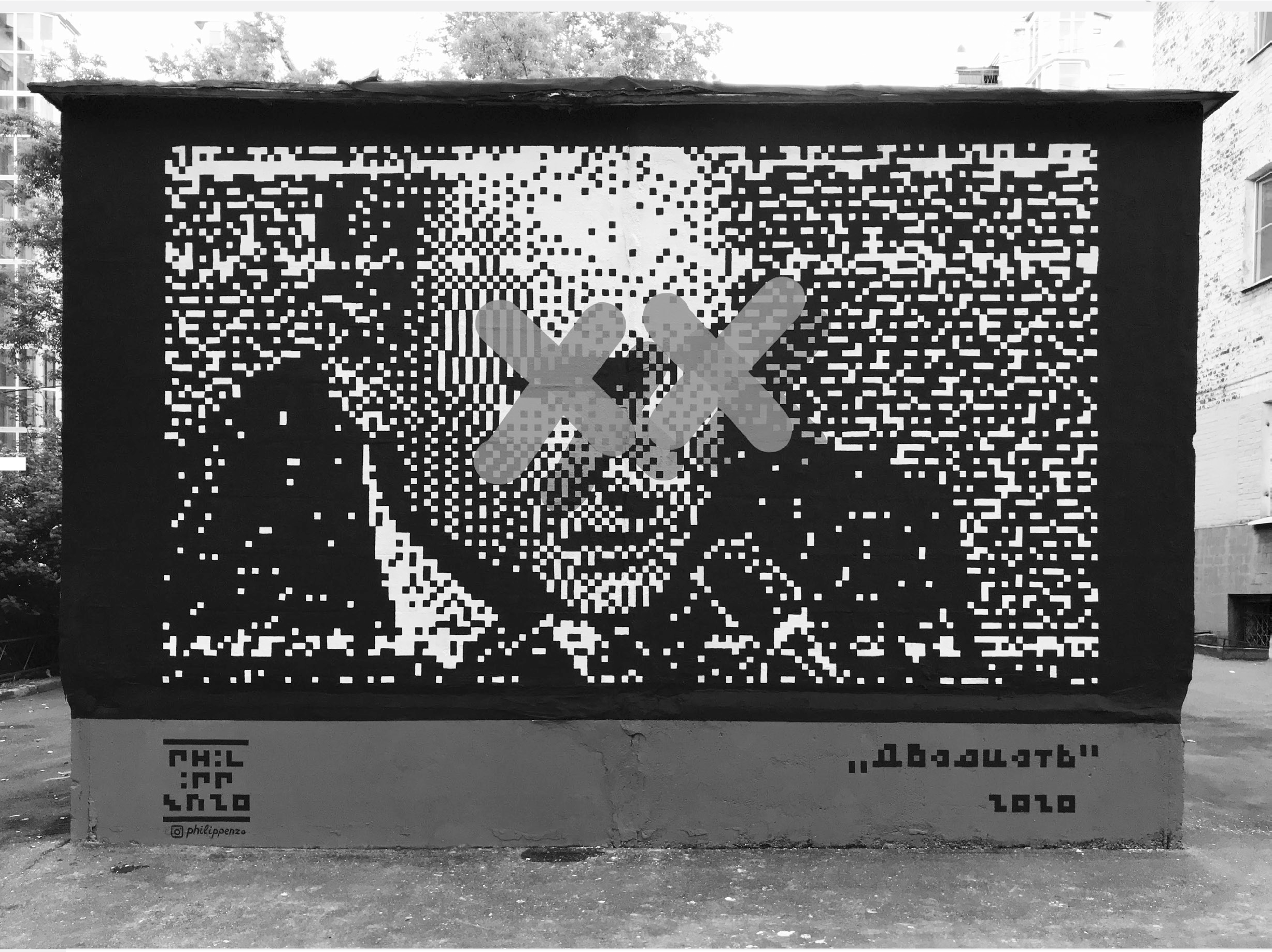
“I find art the best way to say important and risky things and not be put in prison. I try to stay within the borders of law and use gentle hints, allusions and Aesopian language,” added professional street artist Philippenzo Madonnaro, who lives in Moscow. Madonnaro tells Index that a week before the vote for the new constitution, he painted an artwork “Twenty” with Roman numerals to symbolise 20 years of Putin.
For Madonnaro, 20 years is too many years for someone to be ruling. He also added that he chose to mark this moment with the letters for 20 because “after 20 we get 21. And 21 is actually a blackjack, in Russian we call it “ochko”, that could also have the rude meaning of deep asshole”.
Russia’s activists are not the only ones increasingly turning to street art in order to voice discontent. If anything, Covid-19 has provided a perfect moment for it. With museums, galleries and other cultural spots closed, and with protests being banned – or less desirable, given social distancing – one of the few ways to challenge authority is through street art.
And in the virus they’ve found a topic ripe for vibrant and thought-provoking commentary. Banksy, perhaps the world’s most famous street artist, sprayed London’s underground system “If You Don’t Mask, You Don’t Get” featuring a rat holding disinfectant.
Some artists are concentrating on the positives of the crisis, such as the key workers putting their lives on the line, as seen in work by Amsterdam-based street artist FAKE, whose mural “Super Nurse!” features a nurse wearing a facemask emblazoned with the Superman logo. Others are more critical of politicians.
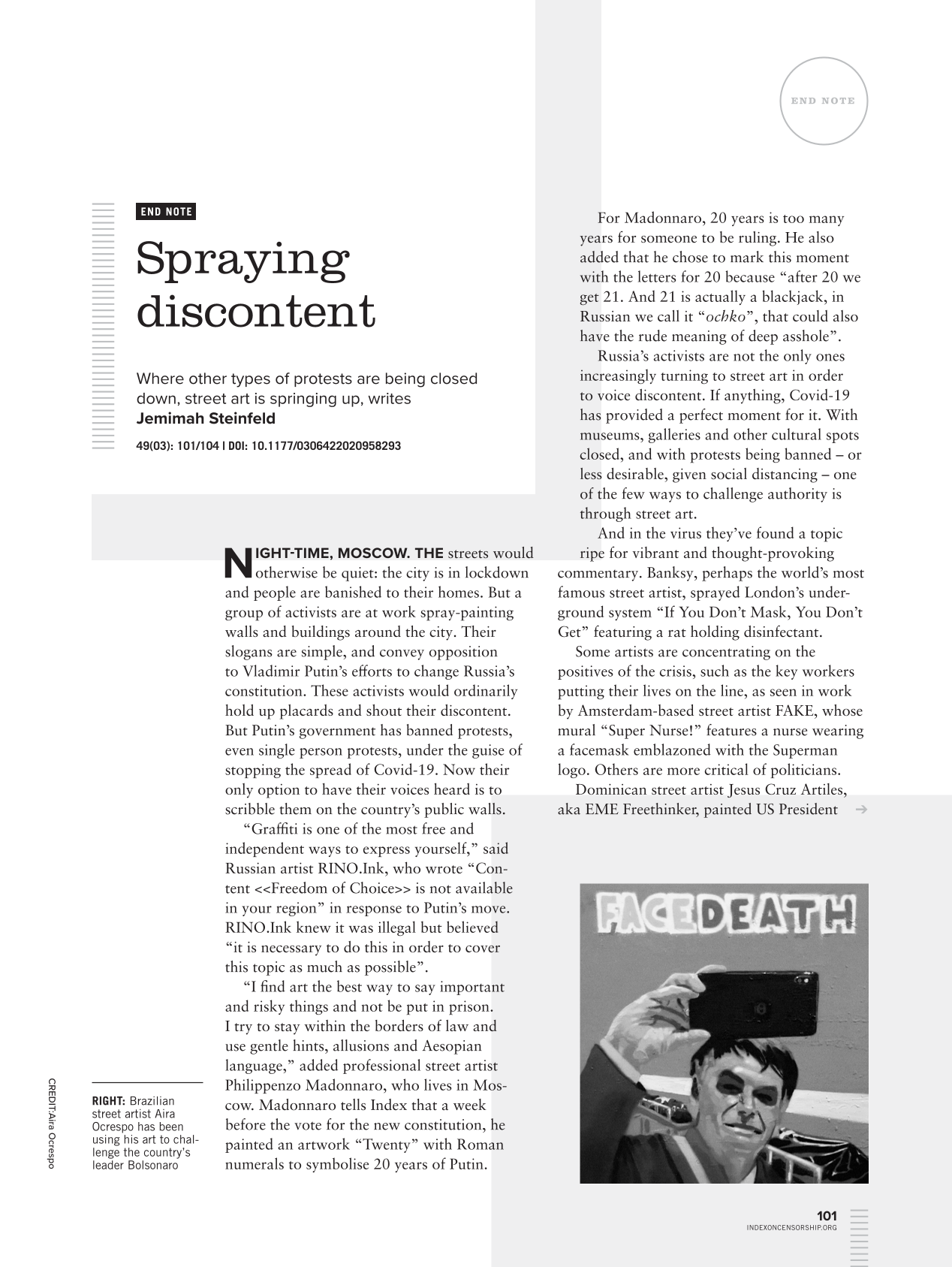
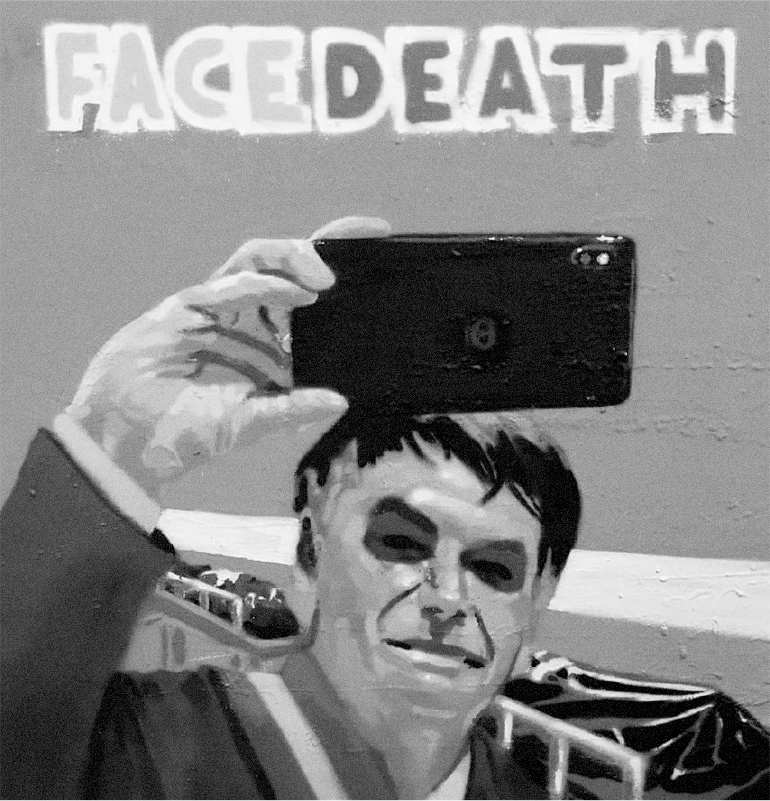
Brazilian street artist Aira Ocrespo has been using his art to challenge the country’s leader Bolsonaro
CREDIT:Aira Ocrespo
Dominican street artist Jesus Cruz Artiles, aka EME Freethinker, painted US President Donald Trump and Chinese leader Xi Jinping kissing through masks, and just days earlier completed a mural of a woman saying, “I don’t trust in Bill Gates [,] China or USA!!”.
In Brazil, the artist Aira Ocrespo has depicted President Jair Bolsonaro on several occasions since the outbreak. Bolsonaro has discouraged social distancing and lockdown, and was quoted as saying: “So what? What do you want me to do?” when asked about Brazil’s fast rise in Covid-19 cases. The text reads “Bolsonaro’s mask against the coronavirus”. In another work, a picture of Bolsonaro taking a selfie has “Face death” written above it. “Brazil heading for the world’s first pandemic,” the artist writes on an Instagram post of the work.
With the art being in a public space, its impact is felt not just by those who are doing the work but by those observing it. Journalist Issa Sikiti da Silva, who is based in Uganda and travels to neighbouring countries, says he has noticed lots of images and slogans recently and is “moved and impressed”.
“In a continent plagued by poverty, dictatorship, corruption, neo-colonialism and all sorts of social ills, some people take to the streets to express their displeasure and frustration about these challenges,” he told Index. “Street artists take on the landscape, highly visible areas and public spaces, including highway walls, to draw different characters and slogans to send their message to whoever it may concern.
“These messages are often provocative, shocking, powerful, educational, among others. In some instances, street artists get in trouble with the local authorities if their graffiti messages are deemed critical to the regime, which instruct security forces to take them down and detain the authors.
“Street art is a form of freedom of expression which is not tolerated in many African countries, where dictatorship reigns and all forms of political and social art are deemed offensive to the ruling party.”
Wachata Crew is a team of urban street artists from Tanzania. One member said: “Street art plays a big role in Tanzania, especially in matters of delivering messages in a unique and colourful way… Much of the population finds it more entertaining and convincing than [TV and newspapers].”
Wachata Crew stick within the legal framework and try to avoid issues that might be contentious and get them in trouble. But that still leaves room to cover important issues, including a large mural promoting mask wearing when Covid-19 was first in Tanzania, which was well-received.
Street art, and graffiti, its more basic bedfellow, are nothing new. From the dawn of humanity there are examples of it: prehistoric cave paintings in Burgundy, France; references to Virgil on the streets in Pompeii; messages written on the walls of Germany’s Reichstag in 1945 by triumphant Soviet troops; red Chinese characters appearing all over the country during the Cultural Revolution. People have long been determined to express their views on public property.
Its forms vary from entire walls taken over by murals, which might often be officially sanctioned and approved, to simple one-word messages painted surreptitiously in the night.
And its practitioners cut across socio-economic borders.
“The creative urge to leave one’s mark in public space crosses the boundaries of class, gender, sexuality, ethnicity and religion,” said street art expert Richard Clay in an interview with the BBC.
Today, social media is also proving very useful in this field. Peter Bengtsen, author of Street Art and the Environment, told Index: “In many cases, street art and graffiti are no longer experienced in person … but rather through images on social media. Arguably, then, while the initial expression in the street certainly has importance (as it perhaps creates a sense of authenticity in whatever message is being conveyed), its distribution on social media is incredibly important, as it has the potential to reach a much larger audience than the original street work.”
Whether separated by class or country, the current crop of artists have one thing in common – they are using their art to hold power to account.
“Street art is important for political and social expression. It is part of our urban environments. It is not going away. It is an additional channel for people and groups to express their opinions and beliefs,” said Jeffrey Ian Ross, an academic at the University of Baltimore and editor of the Routledge Handbook of Graffiti and Street Art, in an interview with Index.
“It is one of several types of communication that, if disseminated widely, can have a subtle impact on shaping how people respond to the pandemic,” he said, adding that he’d “noticed a considerable amount of not just street art but graffiti during the pandemic”.
He said street art could call attention to issues, such as Covid-19 and the death of George Floyd, and it could also “be an additional vehicle of communication when other means are prevented and or frustrated”.
A mural done by Russian artist Philippenzo Madonnaro ahead of Putin’s proposed constitution change
CREDIT:Laila Ajjawi
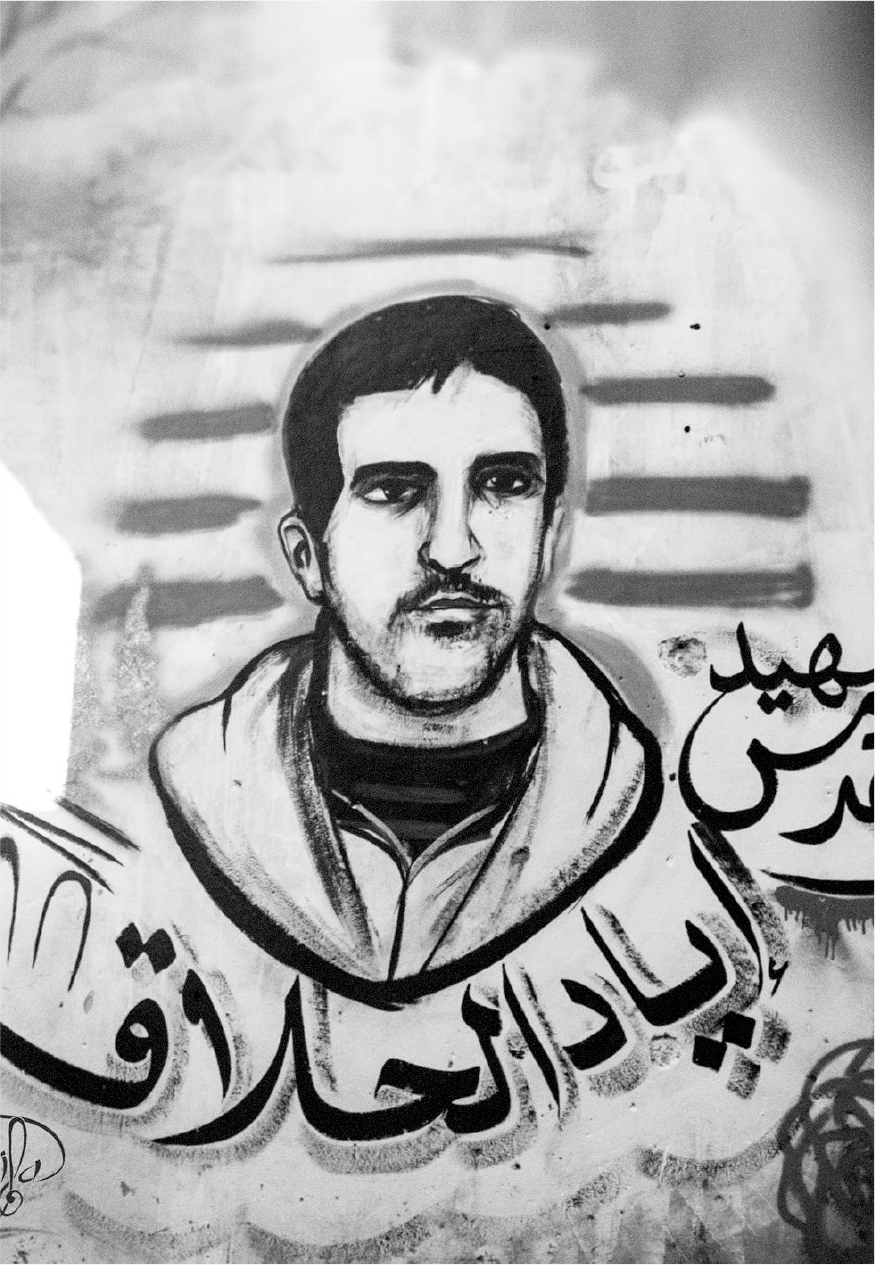
Laila Ajjawi’s mural of a Palestinian whose death was likened to the death of George Floyd
CREDIT:Laila Ajjawi
Bengtsen sees its role as crucial, albeit somewhat complicated, when it comes to free speech.
“Both graffiti and street art are ways to directly put a message out there. Stencils and posters are common ways to spread political messages, perhaps especially in authoritarian states where free speech is often severely limited,” he said.
“On the one hand, street art and graffiti can be cast as tools of rebellion, free debate and democracy. They are potential ways for everyone to raise their voice. On the other hand, however, street art and graffiti can also be seen as decidedly undemocratic – as expressions that individuals force upon others by circumventing public decision-making.”
However, to say that all are succeeding in their endeavours would be a stretch. In Russia, several of the activists-turned-artists have been arrested. And in Jordan, the artist Laila Ajjawi says financial woes related to Covid-19 have curtailed her creativity. In order to make a living, and to simply afford the materials that go into street art, Ajjawi is largely reliant on commissions, but these have dried up. She hasn’t stopped entirely – she recently did a piece on the death of Eyad al-Hallaq, a Palestinian whose killing in Jerusalem in June drew comparisons to the death of George Floyd.
Even in calmer times, Ajjawi said she had to get permission from the Jordanian officials for every piece she did – and that that can be hard. In some instances her work is removed even when she has been given permission. In 2016, for example, she drew an old woman with a city between her hands. The authorities, which can take issue with women on display, thought it was about devil worship, so it was removed.
“It was so sad … That was one of the biggest downs in my graffiti life,” she told Index.
Ajjawi hopes the condition will improve soon so that she can do more artwork.
“Graffiti gives you a lot of power and makes me feel like I am doing my duty for my community,” she said.
And what would she paint now if Jordan were her canvas? “I would do something that motivates people. Because of the pandemic, people are feeling very demotivated. Some people don’t have anything and are very depressed. I would love to do something that boosts them, makes them think about themselves and how strong they are.”