




Abstract
With lawyers and activists under huge pressure not to voice opposition, India’s government is increasingly willing to trample on freedoms.
It is also a time when some of India’s most outspoken activists are disappearing deeper into the prison system, with little sign of being released. The pandemic, which is forcing courts to function in the virtual realm, is giving an unintended fillip to the state to manipulate its institutions with impunity.
Around the middle of July, 80-year-old Telugu writer and activist Varavara Rao, who has been languishing in a prison in Mumbai without trial for nearly two years, was shifted to a hospital in the city after he complained of feeling unwell for several days. He was diagnosed with a slew of health issues and tested positive for Covid-19. Kept in the overcrowded jail, alongside at least 1,000 other prisoners who had contracted the disease, Rao had been susceptible to the virus. And so are the 11 others who, like him, are being held in Indian prisons under an often misused anti-terrorism law, the Unlawful Activities (Prevention) Act (UAPA).
The UAPA, according to Supreme Court advocate Karuna Nundy, not only reverses the burden of proof like many other anti-terror laws but also gives “untrammelled discretion” to law-enforcement agencies. Cases filed under the UAPA, for instance, can be investigated by officers as junior as inspectors.
The current Indian People’s Party (BJP) government keeps pushing back the boundaries around freedom and democracy and how it would like to operate. Laws such as the UAPA are no longer being invoked in conflict zones alone — they are becoming a common tool in BJP-ruled states to intimidate dissenters. As historian and political commentator Ramachandra Guha put it, these laws have become “naked instruments of oppression”. He said: “Previously, when charges were slapped under such laws, there was a possibility of seeking habeas corpus. But currently, the courts seem to have become handmaidens to the repressive state.”
Several commonalities bind the 12 detainees. They are all left-leaning politically —Rona Wilson fought for the liberty of political prisoners, Sudha Bharadwaj lobbied for the rights of tribal communities, and several others have spoken out against the government’s agenda of creating a Hindu-majority state. Four of the arrested are well-known academics: Anand Teltumbde, a Dalit scholar and activist, is a professor at the Goa Institute of Management; Bharadwaj is visiting faculty at the National Law University in Delhi; Shoma Sen is a professor of English at Nagpur University; and Hany Babu – the most recent to be charged under the law – teaches English at Delhi University.
Most crucially, though, the 12 detainees are all linked to a public event called Elgar Parishad, held on 31 December 2017 in Pune, Maharashtra. They had gathered, along with a soaring crowd of thousands, to mark the bicentenary of a historic victory of the Marathas, supported by the lower-caste Mahars, against the British in the Battle of Bhima Koregaon (1818). At this meeting, the speakers condemned the surge of violence against Dalits and lower-caste people by the Hindu right-wing. This was the ember for a major conflagration, and a riot-like situation erupted the next day, fanned by long-standing grudges and existing tensions between the castes.
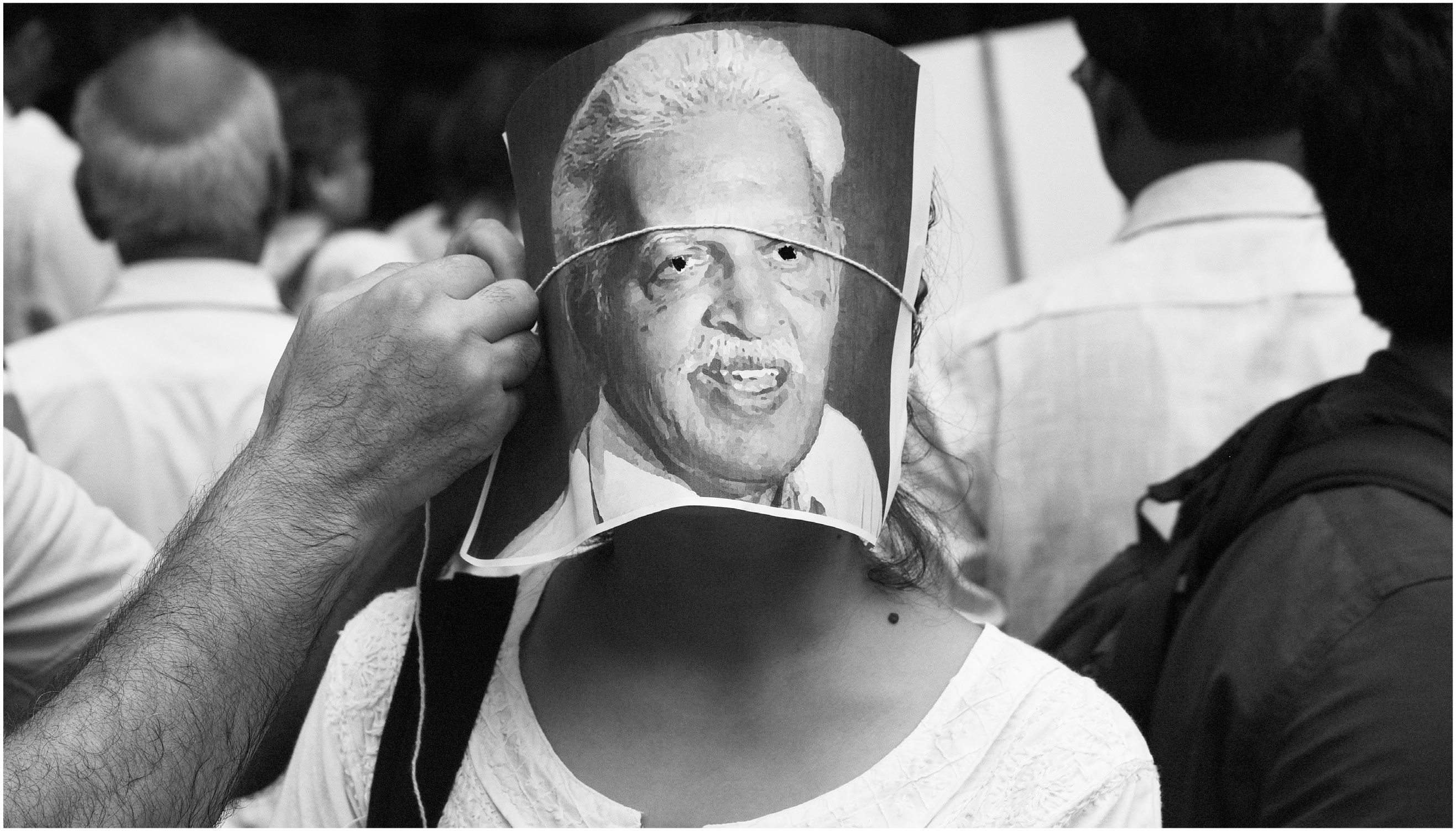
A protester wears a mask of imprisoned activist Varavara Rao at a demonstration against the arrests of pro-democracy activists in India in 2018
CREDIT: Burhaan Kinu/Getty
Later that year, this event became the flash-point to arrest and detain Rao and the others. In subsequent months, more of their allies, who are accused of following a Maoist ideology (also mockingly called “urban naxals” by a section of the political classes), have been rounded up and arrested under the UAPA.
“These individuals have been jailed for their opinions,” said Aakar Patel, a journalist and former head of Amnesty India. “[The] government has criminalised free speech as India has never seen before, including during the Emergency.”
The right to dissent, though guaranteed by the constitution, has never had an easy airing in India. From the Emergency imposed by Prime Minister Indira Gandhi in 1975 to the brazen media censorship carried out under the watch of current Prime Minister Narendra Modi, an unbroken tradition of silencing thinkers, journalists and activists who refuse to toe the government’s line is palpable.
Attempts are made to “disappear” them from the public eye and discourse. In extreme cases, such retributive measures may assume the form of outright violence, as was the case with the murder of journalist and activist Gauri Lankesh in 2017, by non-state agents.
In other instances, a law such as the UAPA, which can land a suspect in jail indefinitely with no hope of securing bail, takes care of the problem. It becomes a weapon in the hands of an authoritarian state.
India is no stranger to such draconian laws. In 1971, Gandhi’s government passed the Maintenance of Internal Security Act, which gave law-enforcement agencies a wide brief to suppress dissidents. People were kept under preventive detention indefinitely, their homes were searched without warrants, and wiretapping was an approved mode of surveillance.
“While the Emergency may have seen the most widespread misuse of such laws, legislations like these have operated in Kashmir, in the north-eastern states, along the Maoist belt, in the states of central India, among other parts of the country for decades,” said historian and political commentator Ramachandra Guha. “Subsequent governments, be they led by the BJP or the Congress, have been guilty of strengthening such misuse.”
Social scientist and activist Nandini Sundar, who was similarly persecuted by the state on cooked-up charges, concurs with this view. In 2016, the Central Bureau of Investigation, acting on the orders of the Supreme Court, had filed a charge sheet against seven Special Police Officers and 26 leaders of a vigilante group called Salwa Judum, groomed by the Chhattisgarh government to combat the Maoist insurgency in the state. The original complaint had been made by Sundar and her co-activists, reacting against the violence unleashed on the poor tribal population by these militia groups.
Within days of their complaint, a report was filed against Sundar and her colleagues by the local police, alleging them of being involved in the murder of a tribal leader. The investigation dragged on for three years before Sundar and her co-activists were cleared of all charges in 2019 for lack of any direct evidence. In August, the National Human Rights Commission awarded them compensation for the “mental harassment and human rights violations” caused by the false report.
“Right now, the Indian republic is in the hands of people who never believed in its project as a secular republic,” Sundar said. “They are the ultimate ‘anti-nationals’ (a pejorative term for left liberals that has been given currency by the right-wing) and separatists since they want a Hindu rashtra [state], not this constitutional republic.”
The tactics used to achieve these ends, Sundar added, include the “conscription of a loyal cheerleading media and subversion of all independent institutions”. Most worrying among the latter, perhaps, is the subversion of the power of the courts.
Consider the conduct of the Supreme Court in the case of Gautam Navlakha, a civil liberties activist accused in the Bhima Koregaon case, currently held in prison under the UAPA. Last year, five judges of the apex court recused themselves from hearing his petition without citing any reason. “Recusal must come with an explanation of why and an acknowledgment, if any, of a conflict of interest,” said Patel. “In these cases, it seems that the judges don’t want to annoy the government.”
Nundy added: “The fact that a law like the UAPA is being used to target lawyers themselves (Bharadwaj has represented the poor in many litigations) strikes a body blow to the rule of law. I’m reminded of one line from Shakespeare’s Henry VI: ‘Let’s kill all the lawyers’.
“Lawyers are the bastions against violations of civil liberties. If you kill all the lawyers then there’s nobody left to speak.”