




Abstract
Archivists worry that this summer’s law to regulate social media will make it harder to research disappearance cases in Turkey.
For Turkey’s Kurds, the Toros was injurious for a different reason. In the forced disappearance cases of thousands of Kurdish activists during the 1990s, the white vehicles played a key role. They became symbols of the disappearances because they were the last things activists saw before rogue state officials kidnapped or killed them.
This July, spectres of the cars and Turkey’s army of the disappeared haunted the country again. The European Court of Human Rights (ECtHR) rejected an application by the family of Fahri İnan who, in 1994, was killed by a group of masked men who approached him in a Toros. Although the police identified the car’s licence plate and its owner, he wasn’t called in for an interview and, over the next 25 years, nobody was held accountable. In 2014, Turkey’s Constitutional Court dismissed the case because it had passed the statute of limitations. With the ECtHR’s rejection, the case appeared closed.
For the dead man’s son, Serhat İnan, there was little closure, however, and he pledged to fight for the recognition of his father’s death. I came across news of his struggle on Perpetrator Not-Unknown, a digital archive monitoring extrajudicial killings and enforced disappearances committed by state agents in the 1990s. Run by the Truth Justice Memory Centre, Perpetrator Not-Unknown comprises legal analysis and other articles on forced disappearance cases.
Emel Ataktürk, director of the Tackling Impunity programme at the Truth Justice Memory Centre, has spent her life working in Turkey’s human rights movement. She views İnan’s case as one piece in a large jigsaw puzzle.
“At the centre we focus on documenting disappearances,” she told Index in the organisation’s offices in central Istanbul. “Compared with a case lawyer, the information we amass is different. Instead of solving individual cases we try to see the big picture about forced disappearances.”
The Truth Justice Memory Centre is a leading organisation operating in memory studies, a nascent field for Turkey’s NGO world. Founded in 2011 and staffed by 20 human rights defenders, most of whom work full-time, the centre focuses “on enforced disappearances with an aim to reveal the elements and patterns of how this crime was committed and to bring the perpetrators to justice”.
CREDIT: Patric Sandri/Ikon
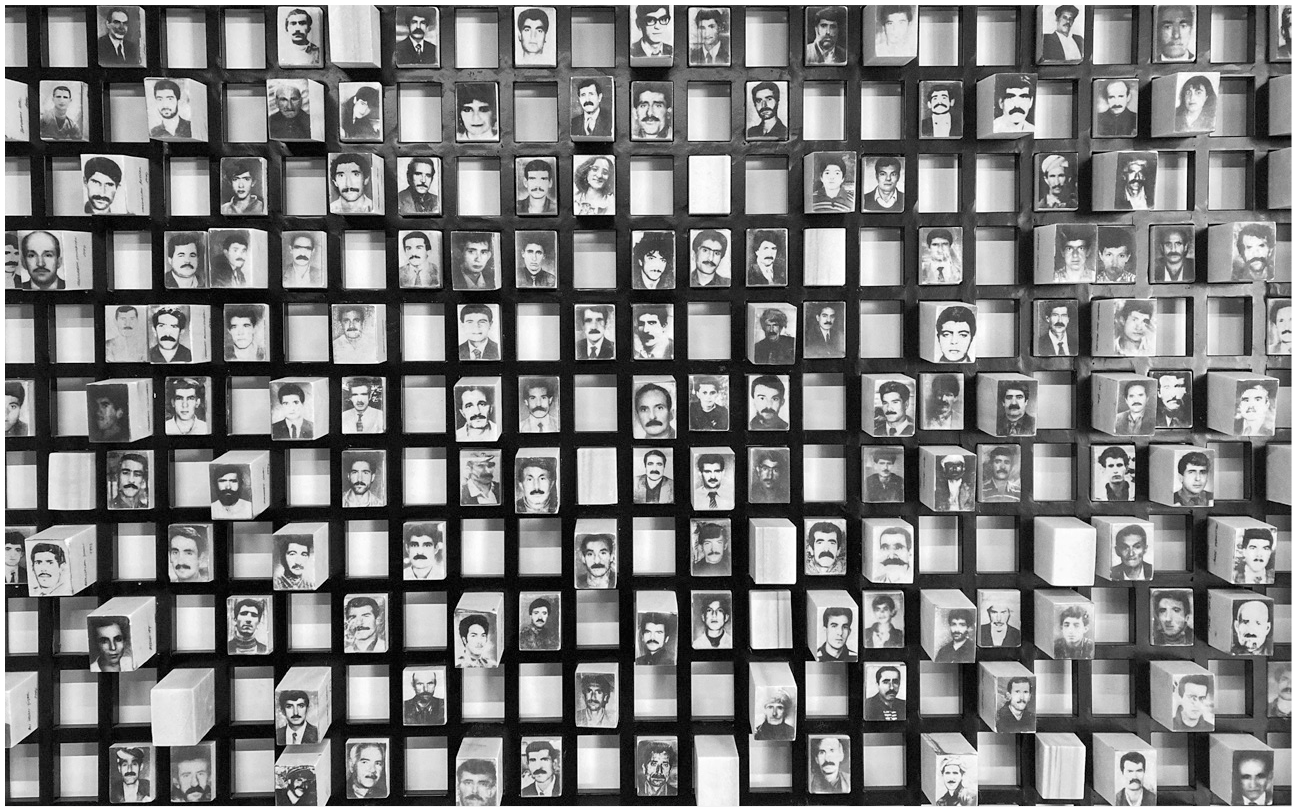
Marble stones adorned with photographs of the disappeared from the offices of the Truth Justice Memory Centre
CREDIT: Truth Justice Memory Centre
When the centre’s founding team converged in 2010, Turkey already had a slew of respected human rights organisations. From the Human Rights Association (IHD) to the Human Rights Foundation of Turkey (TIHV), these organisations proved their worth during coups and under repressive governments.
“So, we asked ourselves, ‘Why would anyone need a centre for truth, memory and justice’?” Ataktürk recalled. Founders agreed that “a wall of denial” had defined the Turkish republic since its foundation in 1923, and that “the refusal to accept systematic human rights violations had grown into a pattern of denial”. The centre would highlight this pattern through extensive documentation.
At the time the centre was founded, the human rights situation was different in Turkey. Between 2008 and 2010, Turkey was implementing the Copenhagen criteria, the rules that define whether a country is eligible to join the European Union. These include improving democracy, the rule of law, human rights and the existence of institutions that guarantee minority rights.
“It was a positive period when viewed from today’s perspective. NGOs became more visible and vocal,” Ataktürk said. “When we established the centre in 2011, the 1990s was recent history.”
The forced disappearances of that period peaked in 1995 and then slowly decreased. It was also the time when Recep Tayyip Erdogan’s political star began rising. As Istanbul’s newly elected mayor, he pledged to fight Turkey’s “deep state” and its rogue operations against the pious and the Kurds. These promises, soon forgotten, helped Erdogan become prime minister in 2003. In 2011, he invited Berfo Ana, the mother of Cemil Kırbayır, a victim of a forceful disappearance, to his office at the Dolmabahçe Palace.
Aged 103, this symbol of the forcefully disappeared told Erdogan that she didn’t lock her door at night in the hope that her son might return. “Don’t lower me to my grave before finding bones of my son,” she said. Berfo Ana died two years later, having not found her son.
For Ataktürk and her colleagues, winning the trust of people such as Berfo Ana to document their cases was key. “We met people who directly suffered from forced disappearances, conducted interviews with families of the disappeared, and looked at judicial processes to see whether those investigations progressed properly or were stuck somewhere inside the system,” she said.
This way they were able to display, in all its concrete detail, systemic human rights violations in Turkey and analyse disappearances using big data. As files about victims, culprits and judicial processes piled on their desks, they felt they had to “bring together separate cases and analyse what they were telling us”.
The centre staff did their best not to re-traumatise relatives of the disappeared. Psychiatrists and experts trained staff, asking them to role-play. “One person would be the relative of a disappeared person; in a short time she’d believe she actually had a lost relative and became muted and start crying.” They learned about the ethics of talking about the disappeared. Still, Ataktürk says many experienced a second-hand trauma after these interviews.
Enis Köstepen leads the centre’s fundraising work. “During its foundation, the centre made a list of 1,353 forcefully disappeared persons,” he told Index. “This was the number of disappeared whose bodies were never found. Later some bodies were located, and the 1,353 number changed.”
When I was a teenager in the 1990s I too remembered reading horrific stories of forced disappearances in newspapers.
“When you live among events you know about them, but when someone asks you to prove they actually happened you notice you need concrete data,” said Ataktürk.
So the centre set out to establish a database of the disappeared. It would comprise information gathered from human rights defenders and families, with the ultimate aim of creating social acceptance that “these disappearances really took place”.
In this endeavour, the centre asked relatives of the disappeared to contribute their own documents. It also got in touch with lawyers who looked at these cases. “We said, ‘If you trust us and allow us to work on documents you share with us, you’ll contribute to a project that will also serve as a memorial for the disappeared’. It wasn’t easy at the outset. But as documents began flooding in, a bigger picture began to emerge.”
The centre made this data publicly accessible. It couldn’t share all the data, so it filtered it and tried to show the phenomenon of forced disappearances in all its harrowing detail.
In this work it co-operated with the EU delegation to Turkey, Heinrich Böll Stiftung and OAK Foundation among others. Since 2011, the centre has published numerous reports including Enforced Disappearances and the Conduct of the Judiciary (2013); The Unspoken Truth: Enforced Disappearances (2013); and Holding Up the Photograph: Experiences of the Women Whose Husbands Were Forcibly Disappeared (2014). In a recent event organised by the centre, a relative of a forcefully disappeared activist asked: “What can we tell to those eyes that don’t see, and to those ears that refuse to hear?”
The centre plans to bring together all the films, albums, books and exhibitions on the theme of memory.
But in 2016, an anonymous complaint about a culprit in one document almost led to the disappearance of the database itself. The police went through the social media posts of the centre’s communication director, in whose name the database’s domain was registered, and detained him. The database was no longer publicly accessible and, at the moment, the centre is making preparations to reopen it.
To Ataktürk, such developments didn’t come as a surprise. A seasoned human rights defender and lawyer, she is not easily shocked by Turkey’s tribulations. The new social media law passed in July upset her with its inclusion of “the right to be forgotten”, which she fears will be used to conceal names of rogue state officials.
“The right to be forgotten will be a great problem in cases involving forced disappearances.” she said. “It will have a negative impact on the struggle to fight impunity.”
Ataktürk also represented Murat Çelikkan, the centre’s director and founder, when he was imprisoned in 2017 for “showing solidarity” with a censored Kurdish newspaper.
Çelikkan was released after spending two months in prison, but bad news soon balanced good news. The ECtHR’s latest decision on Fahri İnan, Ataktürk believes, was against “the spirit” of the European Covention of Human Rights. She fears that if the same refusal to process the cases is applied to others from the 1990s, this may negatively impact the struggle for justice on forced disappearances.
Still, the centre had some support. Engin Yıldırım, the vice-president of Turkey’s Constitutional Court, wrote an opposition to the decision and quoted a report by the Truth Justice Memory Centre. “This cheered us a bit,” Ataktürk said. “You know, this work resembles digging a well with a needle. At the moment all the doors are closed to us. But the political conjecture changes quickly in Turkey. And then anything could happen.”