




Abstract

TeaBrush serves the sort of high-end flavoured ice teas that are as ubiquitous here as lattes and cappuccinos are in the West. One of its selling points is personalised messages on the drinks. Over the past year, many of the protest movement’s slogans, such as “liberate Hong Kong, revolution of our times” and “five demands, not one less”, have figured on the café’s plastic goblets.
Since the passing of the National Security Law on 30 June, Mok has deemed those too risky to display, although there are still visible signs of support for the protests. These include action figures of frontliners in signature yellow hard hats and the familiar cutesy protest mascots, the LIHKG pigs.
The new law has forced many of Hong Kong’s pro-democracy businesses – informally known as the “yellow economy” – to reassess what they can and cannot say.
Political stances by businesses in Hong Kong have historically been the preserve of pro-Beijing elements, according to Vera Yuen, lecturer in economics at the University of Hong Kong.
“Under British rule, businesses under the influence of communist China were doing this. There were department stores funded by Chinese government money, staff recruited from pro-CCP schools,” she said. However, in recent decades, such positions have been rare.
Businesses are loath to nail their colours to the mast in either direction lest they alienate anyone. Some businesses perceived as supporting the government – known in Hong Kong parlance as “blue” – have incurred the wrath of hardcore protesters and had their premises trashed.
Risking a share of the mainland Chinese market is a great concern for many, but that has not stopped some businesses from supporting protesters.
Enterprises sympathetic to the cause have provided bottles of water and refreshments during marches, funded first-aid material, offered protesters meal vouchers and hired those in need of work.
But the National Security Law, with its draconian sentences for supposed secessionism, subversion and terrorism, has introduced a new danger. Antagonising consumers is one thing – risking lengthy prison sentences is another entirely.
Pro-government activists remove a so-called Lennon Wall of posters from a street in Hong Kong, September 2019
CREDIT: Kyle Lam/Getty
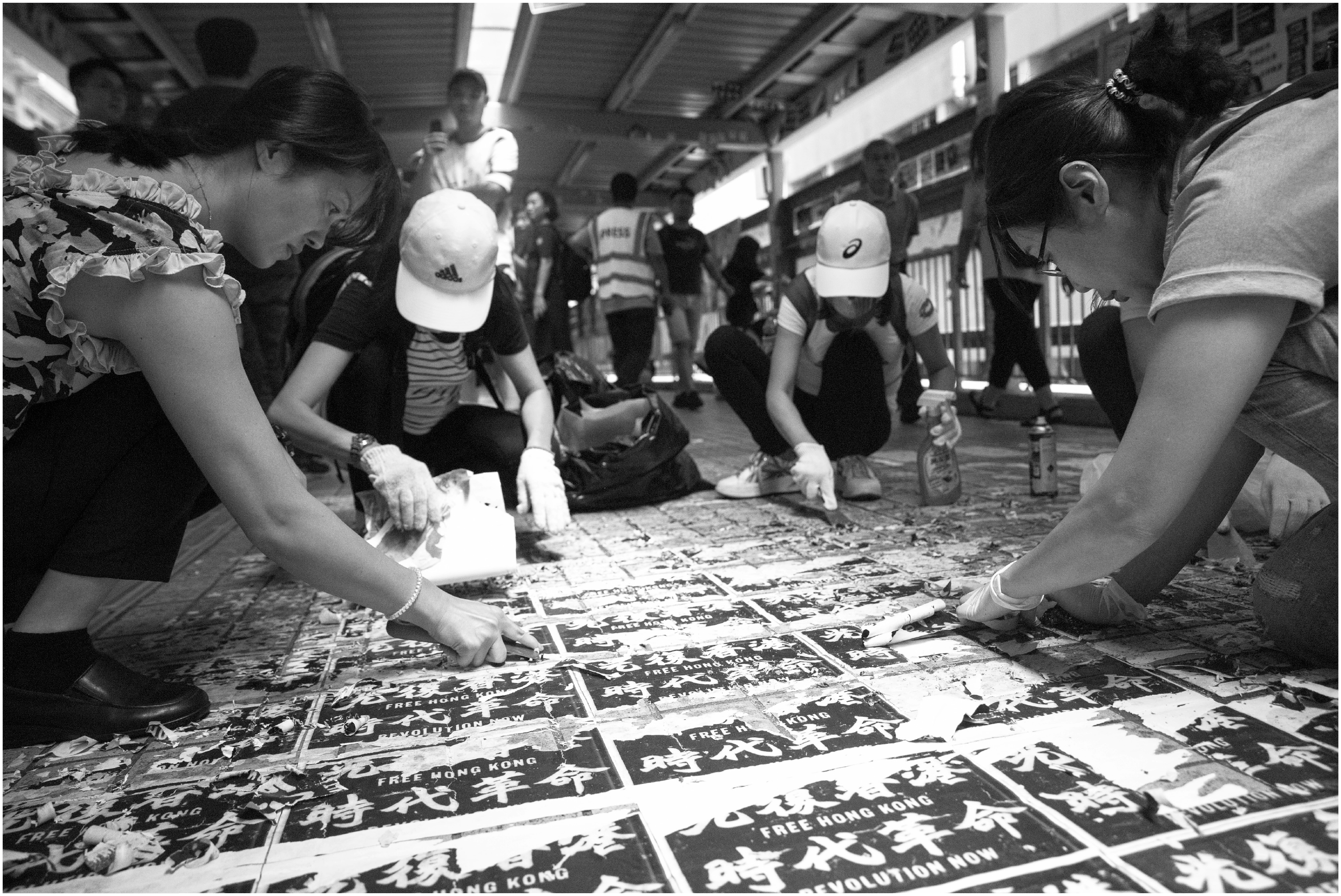
On the night the law came into force, a number of cafes and restaurants scrubbed their Lennon Walls – collages of Post-it notes bearing pro-democracy messages – in case they fell foul of the new ordinance. Certain forms of dissent are now effectively criminalised, particularly if they are seen to advocate independence.
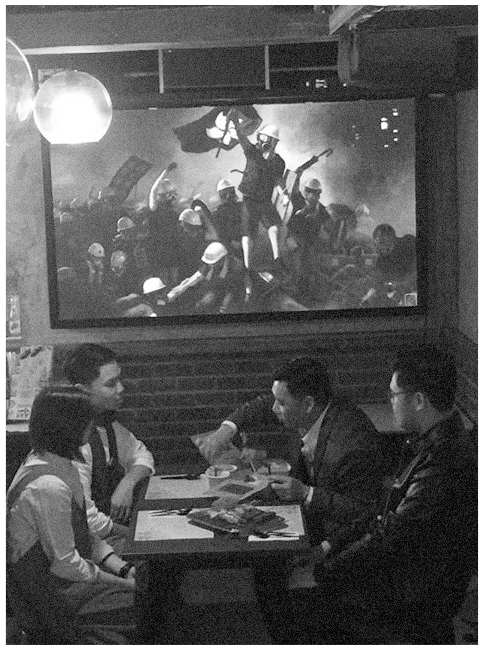
Nam Fy, 32, opened a small restaurant serving Japanese rice bowls in Mong Kok last September, while the protests raged throughout the city. Many in his position would have kept their heads down but Nam was unabashed in his support for the protests, hanging prodemocracy posters in the restaurant and even broadcasting the protest anthem Glory to Hong Kong on a street-facing LED screen. It didn’t do any harm to business, as pro-democracy diners flocked to eat there.
Direct ripostes from the authorities are less likely than an accumulation of lesser persecutions. Herbert Chow, owner of Chickeeduck, a chain of 13 children’s clothing stores, had a lease renewal on one of them refused in June after it featured a statue of the protest icon Lady Liberty.
Diners eating besides a screen about Hong Kong independence, a typical scene from inside a restaurant in Hong Kong until recently
CREDIT: Oliver Farry
Mok admits his own business has been shielded from trouble with the landlord by a sympathetic mall manager. But both he and Nam foresee increased health inspections and other pressures for dissenting restaurateurs.
Even before the National Security Law was brought in, Nam encountered police officiousness after a video of him remonstrating with riot police during a protest last year went viral.
Officers have stopped and searched him and issued fines for petty violations, such as using a kick scooter on the pavement, and Mok says he has been ordered to stop allowing other yellow economy businesses to use his offices.
Nam says he will still try to push the envelope, albeit in a low-key way, likening it to jaywalking. “It’s not a matter of what you can do but what you dare do.”
But, with friends who played an active role on the protest frontlines contemplating moving to Taiwan, he is aware there are limits.
Determining where those limits lie can be difficult, and businesses in various fields which have taken a pro-democracy position are grappling with a fog of doubtfulness.
Publishing is one sector in Hong Kong that has felt an increasing chill in recent years.
For decades, the city was the centre of Sino-phone publishing, free from the censorship of communist China or Chiang Kai-shek’s Taiwan.
But now, troublesome books in Chinese have a far greater chance of appearing in Taipei than in Hong Kong. As with signs in restaurants, titles are disappearing from bookstores.
Jimmy Pang, 64, has run Subculture Publishing for more than 30 years, bringing out books on topics of local interest and Hong Kong history. Though a vocal supporter of the protests, he says his books are far from the contentious material published by a group of Hong Kong booksellers who were abducted by Chinese security agents and taken to the mainland in 2015.
Even so, he worries about the current climate. He says it is getting harder to publish “because publishers are reluctant to publish certain writers, and then distributors won’t carry certain books”.
The fact that many of Hong Kong’s book-shop chains are owned by CCP-affiliated companies compounds this further.
It is the vagueness of the new law that bothers him the most. “Everyone in government is telling us something different about how it affects us,” he said.
He also fears its arbitrary provisions, which allow police commissioners to issue their own search warrants, saying: “It’s no longer rule of law but rule of man.”
Two of Pang’s recent titles – a global history of independence movements which barely mentions Hong Kong, and a book on China’s 1989 democracy movement by veteran journalist Ida Chan – have drawn the attention of pro-Beijing social media and, as a safety precaution, he chose not to feature them at this year’s Hong Kong Book Fair.
Such uncertainty in the face of a nebulous law leaves many in Hong Kong’s yellow economy wondering where the red line lies – a situation that can only play into the hands of Beijing.