




Abstract
Azeri journalists and activists are finding their online accounts are being hacked and altered, reports
Ismayilbayli was released on 15 June. One of the first things he did was change all his passwords, including on his Gmail account. But a couple of weeks later, he received another email from Facebook, informing him that someone was trying to access his account and reset his password – someone who was not him.
Ismayilbayli suspects that it was local law enforcement who broke into his phone and got hold of his social media accounts, and who sent a request to Facebook with his ID information in an attempt to change the password.
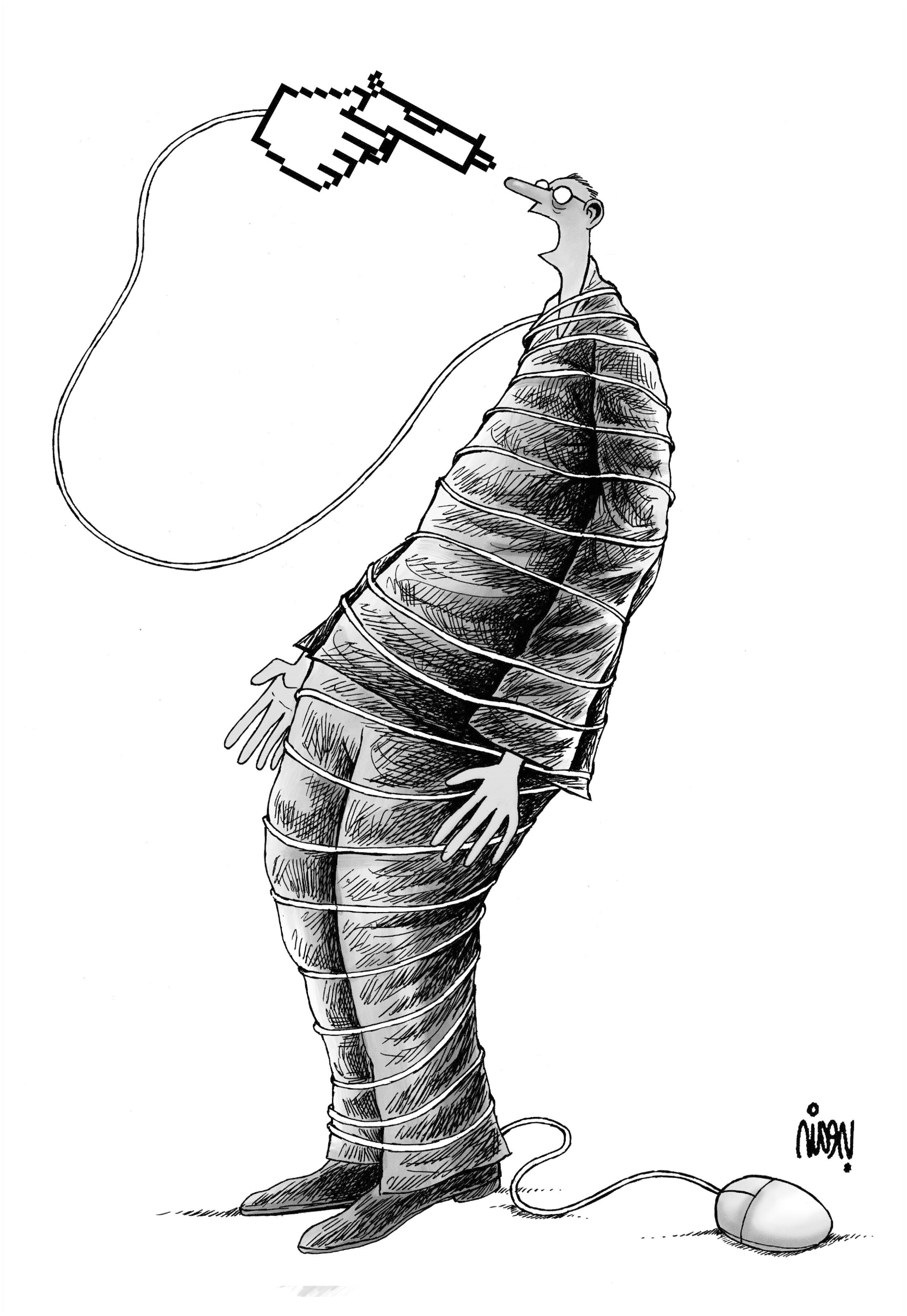
CREDIT: Payam Boromand/Cartoon Movement
Aysel Umudova, a freelance journalist and a reporter with Berlin-based Meydan TV, which covers Azerbaijan, said her account was also intercepted using the same tactic. ID information was sent to Facebook with a request to reset her password. Umudova had never requested that change.
Umudova’s and Ismayilbayli’s examples are not isolated cases of journalists and activists targeted online in Azerbaijan. Theirs are just some of the most recent examples of how people’s social media accounts are being targeted in a new trend that aims to harass and silence.
Azerbaijan’s track record on human rights and freedom of speech has been declining for decades. Documented by international rights watchdogs over the years, these violations, arrests and silencing tactics have become a regular occurrence.
Authorities have jailed scores of activists over the years, reaching a peak in 2014 when some 30 high-profile rights defenders, journalists and political activists were sentenced to lengthy prison terms.
Arrests, followed by the cutting of support to local NGOs, tough legal amendments and, eventually, the blocking of all remaining independent media websites have left one thing – social media – as the last free space. Facebook is the most popular platform, alongside Instagram and YouTube. And on these you can find plenty of posts on campaigns carried out by exiled activists, general grievances and comments on daily economic, social and political problems in the country.
Mission “digital crackdown” was only a matter of time.
Journalist Fatima Movlamli says she has lost count of the number of times her Facebook account has been broken into. Movlamli was targeted for the first time in 2018 when she organised a solo protest in response to a presidential election that many believe was rigged.
“Holding nothing but a sign that read ‘Dictator Aliyev’, I was arrested and taken to the anti-trafficking department of the ministry of the interior. I was 17 years old at the time and, despite being under-age, I was arrested, tortured and later blackmailed,” said Movlamli in an interview with Index. The online blackmailing campaign against Movlamli took place shortly after she was released. Pictures and videos of an intimate nature, including Photoshopped images, were circulated on social media.
The efforts by the authorities to maintain control have been stepped up, explains Movlamli, especially in the past year. Among other measures introduced during the pandemic, an SMS-based permission system was introduced in April. Citizens are allowed out only for basic necessities or if they have permission slips from their employers. The limits on movement were later extended to journalists.
In June, journalists were required to register online in order to get permission to work in the capital. Movlamli was among those who objected to this and relied on Facebook as a platform to make her voice heard. That is when her account was targeted again. In July, she lost all access to her account. Similar to the experiences of Ismayilbayli and Umudova, her ID information was shared with Facebook to request a password reset.
Movlamli is certain the perpetrators are the ruling powers. “They have access to all of our personal data and they have turned these attacks into some kind of trend now,” she said.
Unless social media platforms disclose IP addresses and the names of those who have requested password resets, it is hard to prove who really is behind these attacks. What is certain, however, is that the perpetrators have access to sophisticated technology that allows them to bypass additional security layers.
Meydan TV is all too familiar with digital attacks against its reporters, its website (which is currently blocked inside Azerbaijan) and its Facebook page. The most recent attack was reported on 18 June when a significant amount of Meydan TV’s content was deleted from its Facebook and Instagram accounts. Its Azerbaijani language Facebook page lost all content going back to 2018 and its Instagram page lost two months’ worth of content.
In May, Meydan TV’s Russian language page had lost all its content. The same month, its website experienced DDoS attacks.
The intent behind such attacks is clear: to limit information flow, to keep citizens uninformed and reliant on government media, and to cause as much damage as possible to independent news platforms. The time then invested in recovering accounts, battling with social media platforms over copyright violations and community standards and retrieving deleted content is time that could instead have been invested in exposing corruption, telling stories and informing the audience.
These attacks have not stopped journalists and activists from doing their work. It just makes it very hard – and, in the case of Amina Rustamzade, a journalist who was targeted online in a series of Facebook and Instagram posts, the consequences can be shocking. On 17 June, Rustamzade attempted suicide. Although she has recovered, she has left the platforms to avoid further damage.
Each post was reported to Facebook and Instagram. However, the level of harassment did not apparently violate their community guidelines.
Index has raised the matter with Facebook. A spokesperson from the company said:
“We take our responsibility to protect the privacy and security of people on Facebook extremely seriously. Facebook does not work with any government, including in Azerbaijan, to target accounts for hacking.”
Clearly, there has been harassment, but Facebook says it does not have the context of the posts. Neither does it seem to have anyone who listens to these calls for help.
Unless someone has a contact within the company, the chances of being heard amid the platform’s automated response and detection system are slim.
As Movlamli told Index: “Facebook needs to understand that in countries like ours, Facebook is not just a social media platform where memes and cute pictures of kittens are shared and liked. It is also [the only] place where we can get our voices heard. It’s a place of hope.”