




Abstract

Anıl Özgüç, a professor of medicine at Istanbul’s Aydın University, and a contributor to progressive website T24, found herself in the eye of a Mephistophelian storm recently. As a medical scholar, she had long stayed silent about politics in the workplace.
“Then one morning I woke up to find my name printed in all the national newspapers as a signatory of a petition I’d not signed,” Özgüç told Index.
“The petition demanded the imprisonment of scholars who had signed a ‘Peace Petition’. I was traumatised to see my name attached to it. I can’t describe the sadness I felt that morning: first there was shame, and then anger.”
Özgüç’s silence had begun in January 2016 when 1,128 scholars issued the Peace Petition, asking for a ceasefire in the war between Turkish security forces and armed militant group the PKK. Noam Chomsky, David Harvey and Judith Butler, as well as leading Turkish scholars, were among the signatories. Soon after the Turkish government accused signatories of defending terrorism and opened a court case, the number of signatories snowballed to 2,212.
The petition was forwarded to Özgüç as well. But she didn’t sign it. “I didn’t feel safe with all its content,” she recalled. “I had lots of friends who signed it. They lost their jobs, their health and their future. I still feel like crying when I think of what they’ve been through.”
Thousands of scholars continued working and kept their mouths shut. They refrained from talking about taboo subjects, such as the Kurdish question, because of social pressure, persuaded that this would result in more security. Meanwhile, their colleagues were detained after dawn raids on their homes, or were forced to flee for their safety.
But in 2019, Turkey’s Constitutional Court annulled the convictions and the courts began releasing those who had been imprisoned. For scholars such as Özgüç, who sympathised with their cause, this was happy news. Department heads hoped colleagues would return from exile to their teaching posts. Nobody quite expected what happened next.
On 20 July 2019, pro-government scholars published their own petition, The Constitutional Court Can’t Legitimise Terror. Signed by 1,071 scholars, it described the court’s decision “concerning the rights abuses of some scholars who have propagated terror in their so-called Peace Petition” as “scandalous”.
The decision “has hurt the memory of our martyrs and wounded the public conscience”, the petitioners said. “Finding fault with the state for its struggle against terrorism can’t be categorised as freedom of expression, anywhere in the world.”
A woman is detained by police after protesting the dismissal of academics from university posts, outside Ankara University, Turkey
CREDIT: Umit Bektas/Reuters
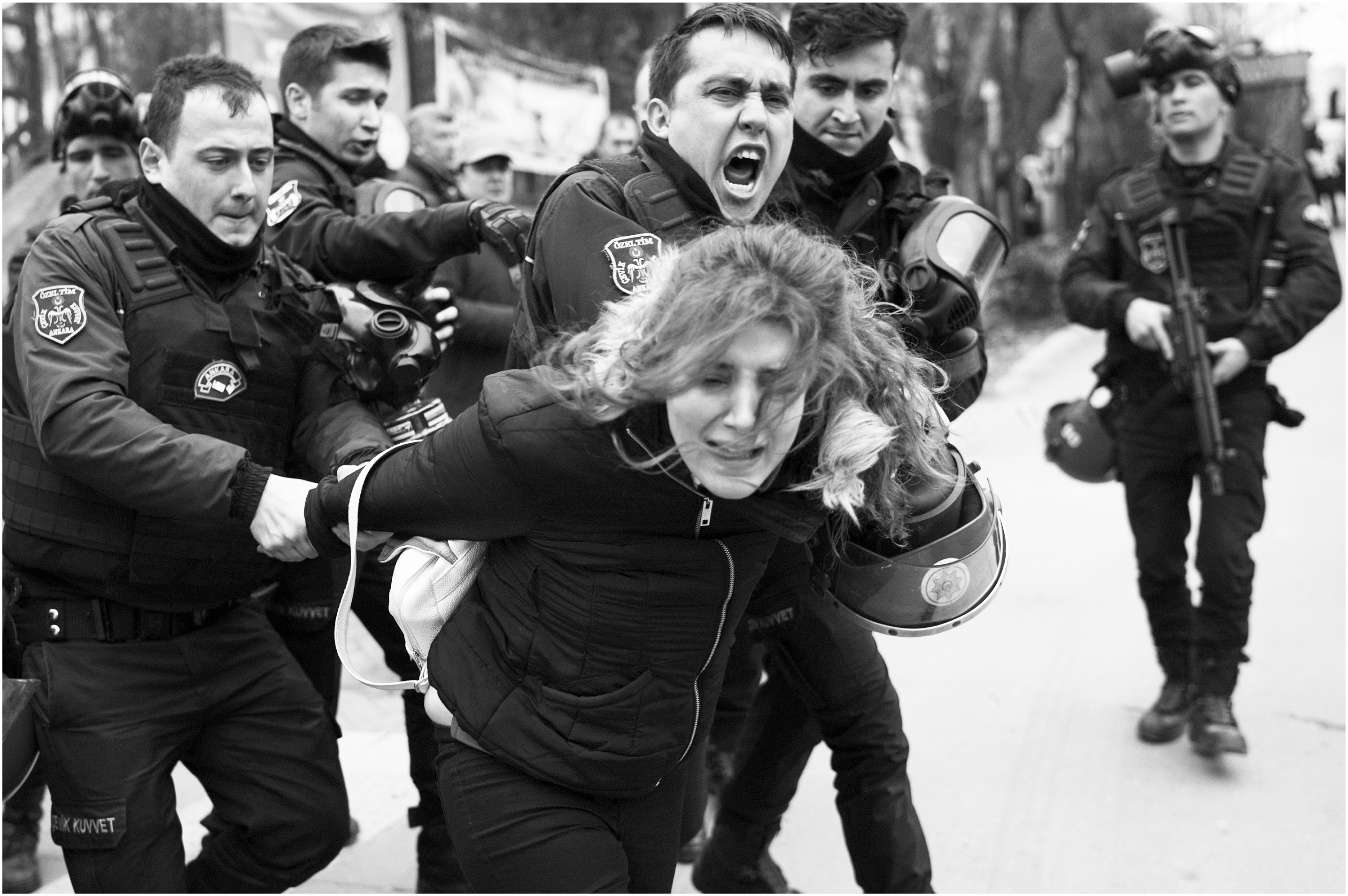
Özgüç’s name was among the signatories despite her not having seen the petition, let alone signing it. The campaign seemed like a test of their willingness to remain silent.
But this attempt at continued coercion has had the opposite effect, and scholars have begun to raise their voices. Mehmet Şerif Eskin, a literature professor from Istanbul University who wasn’t outspoken about politics in the past, started a campaign to clear his name. He said he didn’t hear about the petition before seeing his name on its signatory list.
“This is a shameful thing,” he said. “How could they use my signature without asking me?”
Another professor, Ercan Eyüboğlu, from Aydın University, tweeted: “I deplore those friends who believe that I could’ve signed such a petition!” He summarised his feelings in three words: “rebellion, indignation, fury”. Soon the number of names on the petition dropped to 1,068.
Like other silenced scholars, the petition was the last straw for Özgüç. She resigned from her post the following morning. She says she realised how freedom and security were indistinguishable for her: “Being forced to pick one destroys our souls.” She regrets her past inaction and silent agreement with scholars who, “in order to feel safe, told themselves: ‘I’d better stay silent. If I can manage not to see upsetting things around me, then I won’t be upset by them’.” She says such magical thinking isn’t part of only academic life. “What we experienced mirrors the whole society.”
Her regret was a common utterance. Many also felt anger, guilt and resentment that they had chosen to stay silent but had still, ultimately, fallen foul of the system.
Paradoxically, while Özgüç – who did not sign the original Peace Petition – wants scholars to be more outspoken, Sarphan Uzunoğlu, who did sign it, asks for caution.
“Self-censorship for my betterment is part of my daily routine,” he confessed in an interview with Index, questioning whether the petition which led to his prosecution was useful at all, considering its outcome.
“Many students were deprived of the good influence those scholars might have had on them had they not lost their jobs after signing the petition,” he said.
A lecturer at Kadir Has University and the editor of website NewsLabTurkey, he believes “unthinking deals of silence” are part of the social contract the “post-truth political order” imposes on us. It is “almost impossible” to have a balance between the struggle for freedom and the comfort of security, he argues. “What defines Turkish academia is self-censorship, rather than censorship.”
Uzunoğlu describes a chilling atmosphere of coercion in Turkish colleges where students record their teachers in lessons and during visits to their office, and scholars inform on their colleagues. But he says this atmosphere should make us more, rather than less, tolerant of scholars who have little choice other than submission: “Under these circumstances, nobody should accuse those who prioritise security and safety.”
Fighting coercion, Özgüç says, may increasingly become a privilege available only to those who wield power in academia. When she faced hostility from the pro-government press after speaking out about removing her signature, colleagues assured Özgüç she would be safe once she became an assistant professor. “This sounds childish but is a reality nevertheless,” she said. “There is a pattern of seeking protection for free expression through academic titles.”
Such stories resemble what Turkish media experienced half a decade ago, when many newspaper editors and television presenters sustained a strategic silence in order to keep their jobs. During 2013’s popular protests at Istanbul’s Gezi Park, CNN Turk showed a documentary on penguins; the editor of the news division who made that call, a committed Marxist, has since apologised. Like many of his colleagues, he no longer works in the mainstream media.
“I’ve built little pockets of freedom at school where I can remain optimistic and embrace my students,” Özgüç said. “But I’m not sure if that amounts to real academic freedom.”
Uzunoğlu agrees. Individual responses are insufficient in fighting the overriding coercive atmosphere. “Universities are un-unionised, so scholars lack protection. Even if we have a new government, these problems would remain, since they’re integral to the way our universities work.” (Unions do exist but their power is limited. In fact, some have been attacked, such as the Egitim-Sen union. While Egitim-Sen has thousands of members it has had to fight court cases for, respectively, defending the Kurdish language and secularism. Membership to Egitim-Sen and other unions may therefore actually add to the precarious sitations of Turkish scholars.)
And yet, he argues, Turkish scholars wouldn’t be persuaded so easily to give up part of their freedom in exchange for their security if they had the backing of institutional protections. That’s something they should fight for.