




Abstract

Are we choosing to give away our privacy to get free apps and services and what are the consequences?
I am usually logged in to my Google account when I use Google Maps. Logging in makes the online experience seamless, particularly when you are using more than one device. It remembers websites you have visited and passwords between browsers, for example. On Google Maps you can define places such as your home or office, making it easy to calculate commute times and driving directions for regularly visited places. It also offers recommendations on places to eat and more.
But just take a look at your timeline (it’s in the “hamburger” menu). Mine shows more than 700 places which I have visited in the past six years.
Google’s argument for retaining this would be that it uses your location to provide everyday services and, naturally, locally relevant adverts. It is, after all, in the business of making money.
But what if your government is also interested in where you have been? Perhaps you visited the offices of the opposition several times last year.
For Google to give a government access to your data, that government has to make the request in writing. It must be signed by an authorised official and the request must be made in response to a legal process under an appropriate law.
That sounds like an onerous process, but it did not stop more than 75,000 such requests for user data – not including user account details – in the first half of 2019, according to a Google transparency report. The number of requests has more than doubled in four years. Should individuals be worried? Well, in the last set of figures available Google says it revealed user data in answer to 73% of those requests.
You don’t have to accept this. You can turn off the location services on your device, or for specific applications, and you can delete this location history.
In 2019, the company finally added the incognito mode to Maps, which allows you to search and get directions without that information being saved to your Google account.
However, the vast majority of people choose not to use it, although some actively do so to use these free services.
The reality is that free services are not free, and many of those billions of users are happy to be complicit in order to make their lives easier.
A 2019 survey by the Centre for Data Innovation looked at the trade-off between exchanging data and access to online services. It found that 80% of users in the USA wanted Facebook and Google to collect less of their data. However, when asked what trade-offs they would make in order for this to happen they became more ambivalent. When asked if they would accept less data collection but lose some of the functionality of these services, support fell to 64%. When asked if they would pay a monthly subscription fee in order for Facebook and Google to collect less of their data, support dropped to just 25%.
CREDIT: Wan/Cartoon Movement
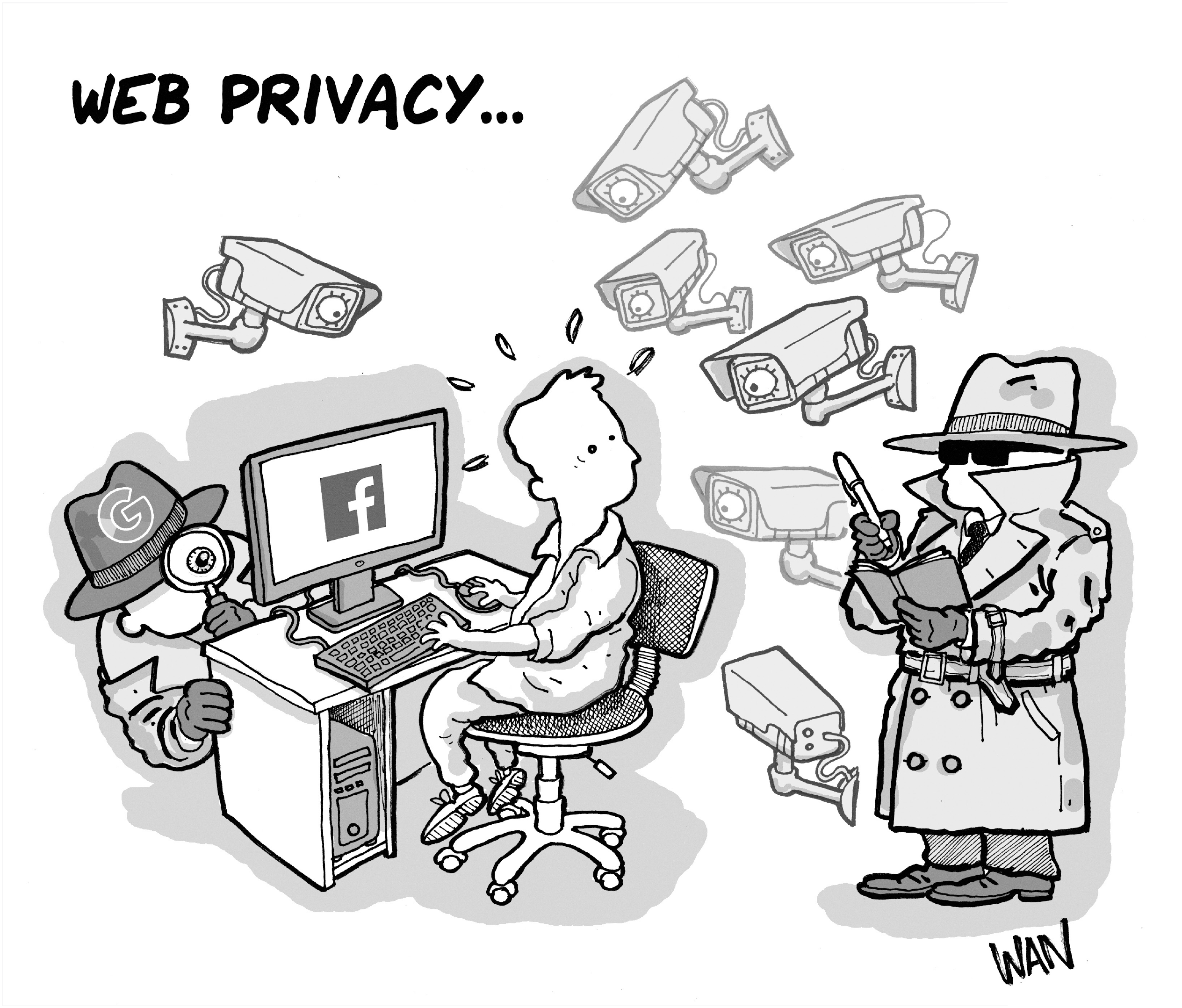
Some of the platforms have considered this idea. Speaking in 2018, Facebook COO Sheryl Sandberg told NBC that while the company already had different forms of opt-out for users wanting to protect their data, there was currently no way to opt out of everything. “We don’t have an opt-out at the highest level,” she said. “That would be a paid product.”
This idea has become known as “pay for privacy” – those who choose not to hand over personal information will be charged more or will receive a second-class experience.
“Privacy should be a right, not a privilege, and not part of a Faustian bargain,” said Bennett Cyphers, staff technologist at the Electronic Frontier Foundation.
He believes that Google and others “coerce or require users to agree to absurd amounts of data sharing in order to sign up”. He said: “Most of the data they collect is not necessary to provide the services they offer and is instead used to profile and monetise users through ads.”
“The default should always be that Google doesn’t collect such sensitive data unless you specifically ask it to, and that it doesn’t use that data for anything you don’t want.”
Phil Barden, who runs the marketing agency Decode, said: “We want to use Tik-Tok or Snapchat because there is a social motivation to do so because all your friends are on it and we want to use it now. This is rewarding. What we don’t want to do is to read through all the pages and pages of terms and conditions in order to obtain the reward.”
In an op-ed in the New York Times on use of data, Google chief executive Sundar Pichai wrote: “First, data makes the products and services you use more helpful to you. It’s what enables the Google Assistant to book a rental car for your trip… Second, products use anonymous data in aggregate to be more helpful to everyone.”
Whistleblower Edward Snowden was horrified at the idea that people were happy to give away their most private of information. In his autobiography, Permanent Record, he recounts the first time he saw a smart fridge.
“I was convinced the only reason that thing was internet-equipped was so that it could report back to its manufacturer about its owner’s usage and about any other household data that was obtainable. The manufacturer, in turn, would monetise that data by selling it. And we were supposed to pay for the privilege,” he wrote.
It is not just in the USA that people are willing to share data. A 2018 survey by the Global Alliance of Data-Drive Marketing Associations of people in 10 countries showed that more than half of people decided whether to share their personal information on a case-by-case basis, dependent on the benefits.
Another problem is data creep. Many people sign up to use services with only a cursory glance at the lengthy terms and conditions, which often cover exactly what a company will do with your data.
Microsoft’s services agreement, for example, says, “.you grant Microsoft a worldwide and royalty-free intellectual property licence to use your content, for example, to make copies of, retain, transmit, reformat, distribute via communication tools and display your content on the services.” That is pretty wide-ranging.
However, terms and conditions are not set in stone. Ashley Winton, a global data protection and privacy expert with law firm MWE, said in English contract law, normally you have to be aware of and agree to a change to the terms and conditions that apply to you. The laws in other countries are not so clear
Let’s be clear: we can do more to make sure we are not giving away our private information, and companies can do more to make sure we know what we are giving away. Already the search engine Bing gives you a cut of the money it makes selling your data, offering Amazon vouchers for using it.
But Cyphers said: “The problem is that governments, and the US government in particular, have let the companies get enormously large without any serious regulation or even serious threats of consequences for bad behaviour. And that’s a problem we can solve, both with strong privacy regulation and vigorous anti-trust enforcement to unwind some of the mergers that helped these firms grow so large.”
Governments are keen to keep the flow of data coming. Oppressive governments who are addicted to the enormously intrusive insights that such data can bring on their opponents all the more so.
Something to think about next time you complacently click OK to sharing your information and location.