



Abstract
He meant that journalists should be exclusively guided by the principle of truth, without fear or favour. When asked about his political line, the globe-trotting reporter responded: “I know only one line, the railway line.”
In journalism, however, the lofty ideal of independence is often just that: an ideal. Complicity with one side of the story is constantly lurking in the background. Journalists instinctively wonder what reactions their reporting will provoke and what impact it will have on society and power but also, more selfishly, consider their status, their career, their sources and their friendships.
When, as a young journalist, I covered the Central American revolutions in the 1970s and 80s, my indignation at the brutality of the military caudillos was such that I was permanently torn. Should I really write that the Sandinista National Liberation Front (FSLN) was dogmatically Marxist and mentored by Cuban agents at the risk of undermining the broad opposition movement; or of condoning the rise to power of an authoritarian regime if I hid it? Sometimes newspapers made the choice on my behalf and spiked articles that did not fit the acceptable line. These dilemmas never abated as I grappled over the next few decades with stories – from the peace movement to the Iraq wars or terrorism – which bluntly raised the question of the consequences of my reporting or commentary on public opinion.
Complicity rhymes with conformity, and sometimes it relates to the prevalent cultural mood. It leads journalists to follow the dominant narrative and leave incovenient facts out of their stories. In the 1950s and 60s, the intellectual hegemony of Marxism was so powerful at Saint-Germain des Pres that, in left wing circles, “it was better to be wrong with Jean-Paul Sartre (the communist fellow traveller) than to be right with Raymond Aron (the lonesome Cold War liberal)”. In the neo-conservative 1980s it was mostly inconceivable for mainstream journalists to refer negatively to Afghan “freedom fighters” or to underline the presence within the Polish Solidarity movement of ultra-conservative figures such as the Kac-zynski twins, as well as celebrated liberals such as Jacek Kuron or Bronislaw Geremek.
Today, as the new political hegemony has shifted rightwards in sync with the rise of national populism, liberal or left-leaning writers are shrinking from highlighting “negative stories” about refugees or Islam because they fear they will feed racism or be reprimanded by their progressive friends. On the “other side” the temptation to amplify those negative stories is too strong.
The eagerness to be anointed by prominent figures from one side or the other, as well as being in tune with the perceived public majority, inevitably feeds complicity and self-censorship. This comes at the cost of undermining the integrity of information that, according to Jurgen Habermas’s theory in Truth in the Public Sphere, is essential to generate considered and reasonable public opinion.
Some in the French establishment media also practise a form of complicity which, if less ideological, reflects a system of mutual benefit between journalism and power. French journalists’ deference in front of their “elected monarch” has regularly been mocked by their Anglo-Saxon colleagues. In France, special access journalism, junkets and private presidential briefings are based on the assumption that the journalists who are the “chosen few” will be “on side” and complicit in the official narrative.
Often, complicity is driven by opportunism rather than by ideology. Without the support of state institutions, non-governmental organisations or corporations, some reporters would simply not be able to travel around the world. Their reluctance to be transparent about who sponsors their reportage testifies to the malaise.
Some invitations inevitably blur the lines between journalism and public relations and compromise the journalists’ independence and integrity. Invited reporters who “spit in the soup” and dare to deviate from their hosts’ narrative are few, and are expeditiously excommunicated.
Dealing with confidential sources can also lead to complicity. The leak that a source gives to a journalist may imply, as a quid pro quo, protection from critical coverage. The dilemmas of “revelation” journalism were bluntly and controversially addressed in a September 2019 essay in the leftist monthly Le Monde diplomatique by the late investigative journalist Pierre Pean. He implied, under the headline “Who benefits from the anti-corruption struggle?”, that a new generation of “investigators” were mainly puppets of the judicial and political authorities who leaked them stories, and accomplices in a drama that they did not control.
“Journalists pay for their access to (judicial) documents by an extreme dependence on their sources,” he wrote. “When minutes of the proceedings come from the lawyers of the plaintiffs, the articles generally reflect the latter’s point of view.”
Journalism inevitably implies transactions and compromises. But complicity, whatever form it takes, is a scourge for journalism. It deprives the public of part of the facts that it needs to forge its “informed consent”. When it is paired with conformity and the dominant narrative, it marginalises dissident voices who may be closer to the “truth”, or may at least bring a minimum of balance in a story.
Jean-François Kahn, one of France’s most famous maverick journalists, was particularly damning in an early January 2020 column in the Brussels daily Le Soir when he described how the French establishment press regularly crucified him when he begged to differ with Michel Foucault, Gilles Deleuze and other untouchables of the French intelligentsia.
Such perception of complicity also undermines journalists’ credibility. According to the 2020 press barometer published by the Paris daily La Croix, only 25% of the French public think that journalists are independent from political parties or corporations.
The “complicity with the elites” is also behind the accusations and the physical agressions against the press by the Gilets jaunes (yellow vests) protesters who have turned media-bashing into a combat sport.
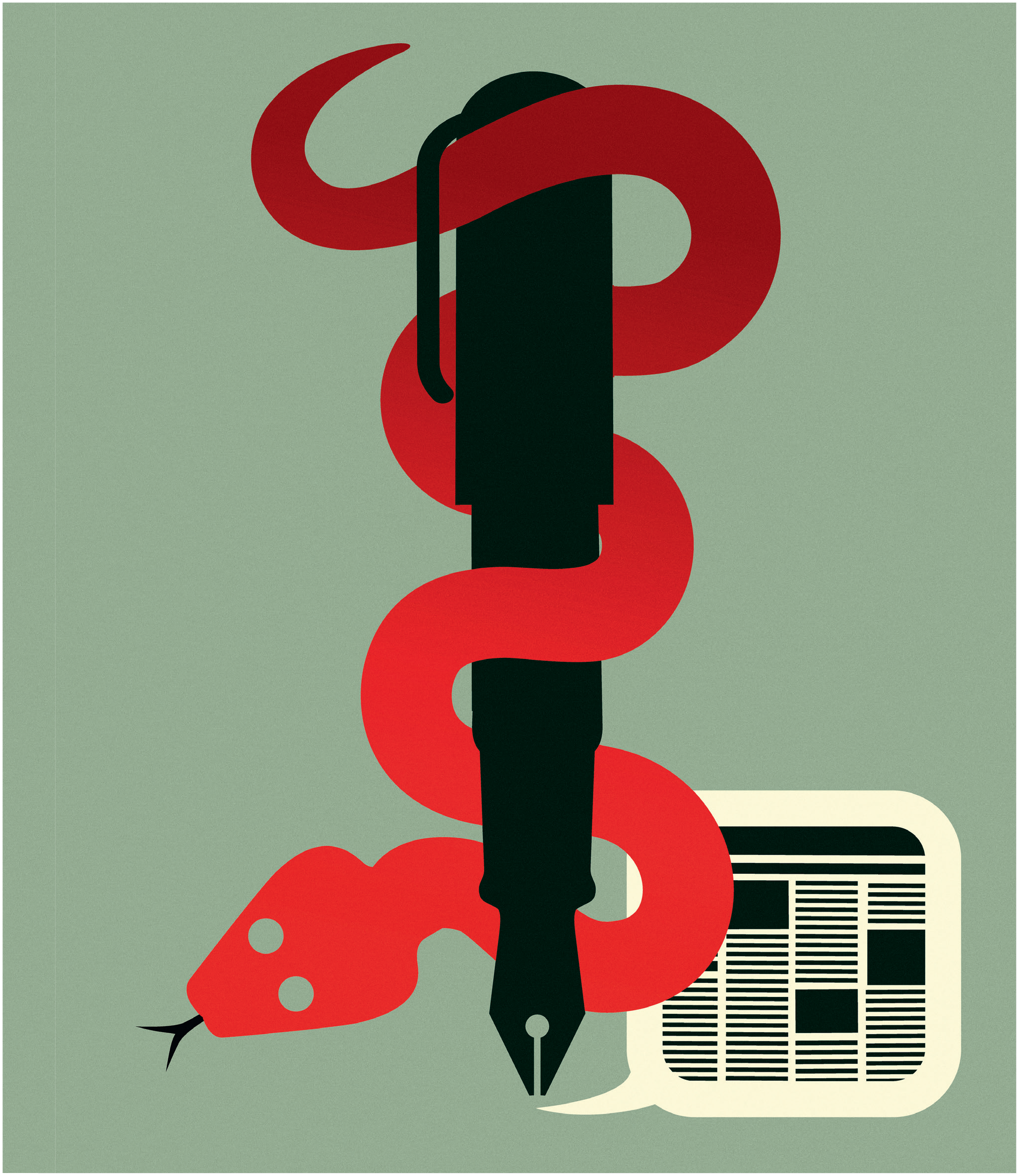
CREDIT: Gillian Blease/Ikon
Finally, censoring “for a good cause” acts like a boomerang and destroys what it pretends to defend. Lately, under the pretext of fighting fascism or racism, well-meaning self-censors have provided the far right with the immense privilege of claiming that it is the only one “speaking the truth” and the opportunity of accusing the liberal or progressive media of belonging to the “lying press”. In February, commenting on a controversy around blasphemy and the malaise it created in progressive circles, Jean Quatremer, the ebullient and influential Brussels correspondent of the liberal-left French daily Liberation, did not mince his words: “Trapped by the Islamists’ discourse on ‘Islamophobia’, part of Macron’s party – and especially part of the left – has allowed the far right to hijack secularism (laicite), freedom of expression, the right to atheism or feminism.”
The risk of complicity underlines the need for diversity and pluralism in the media so that the silence of one on a specific issue will be compensated by the noise of the other.
But, much more fundamentally, it makes it imperative for journalists to assert their autonomy along the line of Walter Lippmann’s adage in his 1920 essay, Liberty and the News:
“There can be no higher law in journalism than to tell the truth and shame the devil.”