




Abstract

People all over China are embracing CCTV cameras in the name of security without considering the implications for their free speech.
“It’s because of the tourists,” he said, referring to the throngs on Ghost Street, a nearby strip of restaurants popular with visitors. “Someone could climb over the roof and get in the courtyard.” He made a convoluted gesture meant to resemble a ninja-like intruder getting through. He then showed me the new security camera he’d placed outside the outer door, its lens pointing down at the doorstep as if to leer at all the mailmen, pizza delivery guys or roommates’ boyfriends who wished to enter.
My landlord – and his fluffy dog, Tiger – once watched over the apartment himself. But that changed in 2017 when Beijing authorities conducted one of the most sweeping construction drives in years, euphemistically dubbed a “beautification campaign”. Shop doors were bricked over, second storeys were torn down and whole alleys of buildings were given a fresh new brick layer of uniform grey. Not coincidentally, the renovations resulted in thousands of people moving out of the hutongs (lanes), my landlord included. Authorities tore down his apartment at the front of our courtyard and he moved out of the home he had lived in for decades into a tall, austere concrete building.
The campaign stripped the once-bustling hutongs down to their bare, brick-walled essentials. But it did add one thing: more CCTV cameras.
CREDIT: lightkitegirl/iStock

In 2015, Beijing authorities announced that every major street corner in the capital was monitored. Now, government-installed cameras are so plentiful that, if you squint, hutongs look like they’re adorned with the gargoyles of Notre Dame. According to Oliver Philippou, a senior analyst at IHS Markit, which specialises in expertise on global technologies, China’s installed surveillance cameras surged by nearly 70% in recent years to 350 million in 2018, up from 210 million in 2015.
“By 2021, China’s installed base is expected to rise to 490 million cameras,” Philippou said. “Driven by the government’s Xue Liang programme [the nationwide drive to unite the country’s various CCTV cameras under a unified surveillance network], the Chinese market receives significantly more government funding than any other region in the world with the aim of providing widespread video surveillance coverage within public areas.”
Despite the implications this has on free expression in a country that is one of the most censored in the world – and mounting evidence of how it is already being deployed against Muslims in the province Xinjiang (internet experts revealed in 2019 that a surveillance company was tracking the movements of at least 2.5 million residents there as part of a far-reaching security clampdown) – people still want more cameras. In China, as with the rest of the world, consumer video devices are a growing market, Philippou notes, though, proportionally speaking, that the consumer market for these devices isn’t as large as it is in the USA. What’s different is that, in China, consumer demand has surged alongside government-led surveillance pushes. Chinese tech companies are marketing sleek, easily installable home cameras; Xiaomi sells a popular security camera for as little as $30, which users can sync with an app and watch live footage while they’re away.
My landlord was just one of many in my neighborhood who complemented our hutong’s new cameras with his own. After all the small shops and noodle joints were cleared out, the only businesses that repopulated our hutong were higher-end boutique hotels, selling the traditional hutong experience to visitors from cities in China where ancient alleyways no longer existed. These upscale businesses came with their own, gleaming cameras.

The hutongs are quieter now, but their chatty noise was once its own kind of security. Before CCTV cameras, nosy neighbours and shopkeepers were a de facto neighbourhood watch. (I know this from experience: An utterly terrifying woman who lived across from me used to make me pick up rubbish in the street, even though it was never mine.) This old-fashioned security network harks back to a time before the block housing developments which dominate Chinese cities today and are staffed 24/7 by omniscient bao’ans (security guards). In hutongs, the people hanging out on their doorsteps playing mahjong or drinking tea were the security. Peter Hessler references this in his 2006 New Yorker essay about living off Ju’er Hutong, just two blocks west of mine, when he calls “hanging around in the street with the neighbours” the “ultimate hutong sport”. He then notes the omniscience of nosy neighbours when he wonders how a local matchmaker knew of his Italian heritage – she’d heard it from the bike repairman on his street. “I had no memory of the conversation, but I picked up a valuable hutong lesson: never underestimate how much the bike repairman knows.”
More recently, China Unicom referenced the power of neighbours in an advert for its 5G services, in which a group of grannies sitting around outside recognise someone unusual in their neighbourhood and stop crime using their phones. Renovations dampened this streetside conviviality, injecting an air of distrust into the once-friendly neighbourhoods. Fortunately, it lives on elsewhere. I am currently based in the south-western city of Kunming, where government reach is less visible and the march of modernisation feels slower than in Beijing. By the entrance to my apartment block is a small shop. The shopkeeper, Mr Li, and I are friendly – he likes to ask about what Americans eat for dinner, and more than once he has let me know that there was chilli sauce on my shirt.
CCTV in the Forbidden City, Beijing
CREDIT: Natalie Cook/Picfair
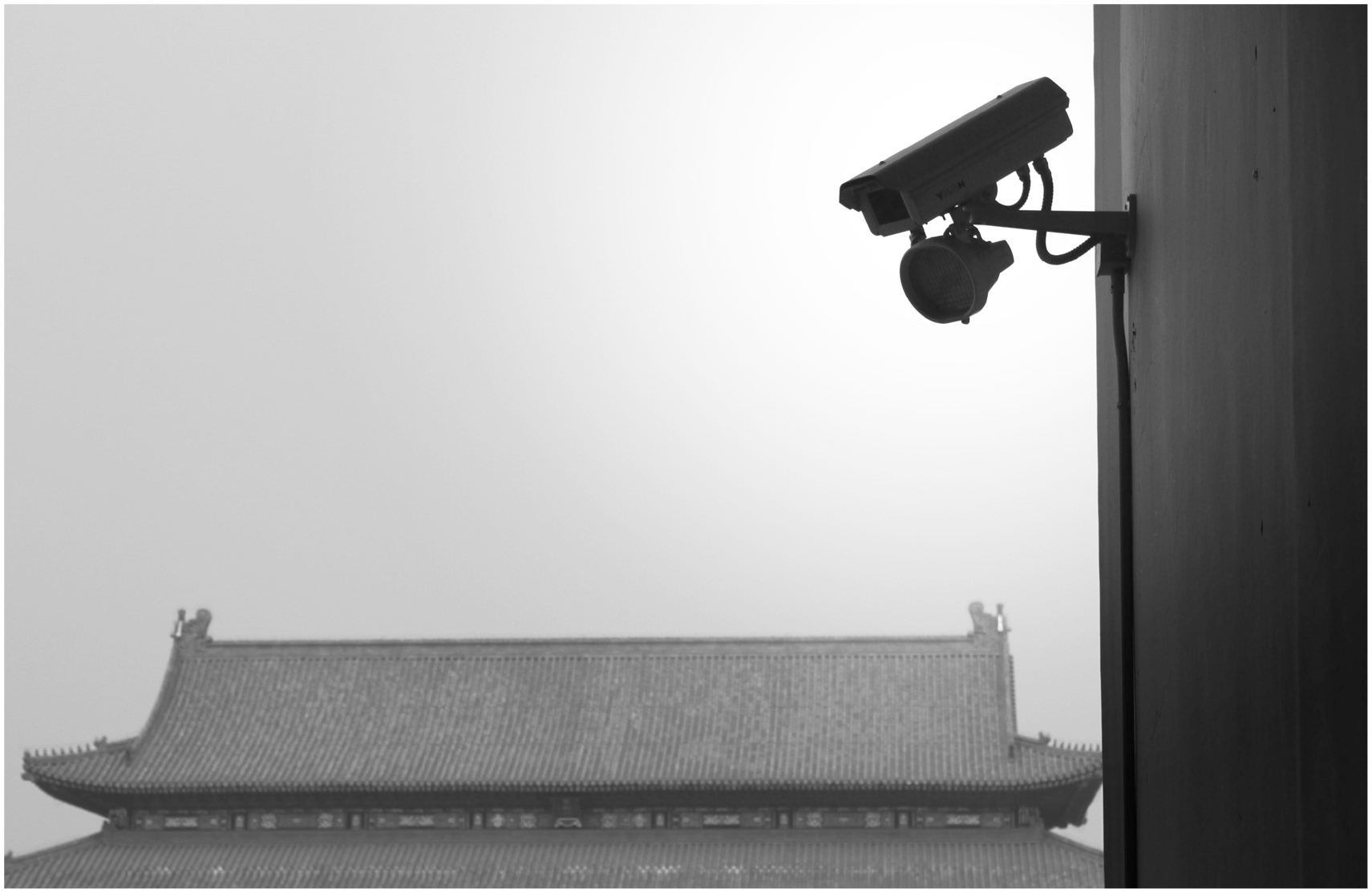
Recently, police arrived at our compound’s front gate, responding to a noise complaint. Whoever had called in had said the foreigner was having a loud party, probably because expats in China have a well-earned reputation for partying. When the police asked about the foreigner in the compound, Li vouched for me, saying I was well-behaved. He was right. When the police knocked on my door I was in my pyjamas, washing dishes, and they apologised for disturbing me. But what would have happened if I wasn’t well behaved? In China, badly behaved can mean anything from criminal activity to simply saying or writing the wrong thing about the government. It’s hard to go under the radar when we’re all being watched.
In Beijing’s hutong renovation campaign, small shops like Li’s were the first to go, the Lis of their respective blocks replaced with cameras. What happens in Beijing is a template for the rest of China. Soon it is likely that we will all be watched and much the worse for it.
Big Brother is Watching
Just how is surveillance used in China?
CORONAVIRUS DRONES
The Chinese authorities have been using surveillance technology to monitor and control the population during the coronavirus outbreak. Audio-equipped drones are hovering over residential streets telling citizens it sees without facemasks to go indoors.
SUBDUING THE UYGHURS IN XINJIANG
The surveillance system in Xinjiang, western China, is being used as part of an extreme crackdown on the Uyghur Muslims. Among other measures, technology is targeting Uyghurs to help assess who should be sent to “re-education camps” and monitoring them upon release.
PHONE DETECTION
In April 2019, The New York Times found that in one apartment complex in Zhengzhou facial recognition cameras, combined with technology that can identify mobile phone numbers, matched 3,000 numbers with faces in just four days.
PYJAMA SHAME
In the city of Suzhou, the authorities published photos of people wearing pyjamas in the street to publicly shame them for “uncivilised behaviour”. Facial recognition technology was used to capture the images and identify them.
SEVEN MINUTES
BBC reporter John Sudworth teamed up with the police in Guiyang, southwest China, to find out how long it would take for them to locate and apprehend him using surveillance technology. The answer? Seven minutes.