



Abstract
Cocaine use is soaring in Colombia, and so is the power of the cartels to stop journalists working.
Manzano received the threats after reporting on criminal gangs stealing electricity for their drug crops in south-west Colombia. After assessing his case, the government offered him a bodyguard, a bulletproof vest and a panic button.
He saw those measures as inappropriate and told Index: “I am constantly challenging the authorities. Those same authorities can’t guard me.”
Each year, the United Nations prepares new campaigns, reports and data to promote the war on drugs ahead of the International Day against Drug Abuse and Illicit Trafficking on 26 June.
But the UN’s statistics show drug use is soaring, fuelling black market criminality that creates a climate of fear in countries such as Colombia, where illicit cultivation is rife.
Empowered Colombian criminals are increasingly targeting journalists and social activists. Mexican drug cartels have also expanded their role in the country and are aggressively silencing those standing in the way of their smuggling networks.
To combat this crisis, Colombia’s government has allocated more than £200m ($253.7m) to protect journalists and activists in 2020. But experts say drug gangs now have the power to overwhelm, and even corrupt, the very institutions charged with protecting freedom of expression.
At least five reporters in the south-western Cauca province received death threats last year. The messages were signed by the Western Joint Command of the Sixth Front, an obscure group of dissidents that once belonged to the now-disarmed Revolutionary Armed Forces of Colombia, or Farc. The threats signalled the start of a campaign of intimidation that has forced three of the five journalists, including Manzano, to flee the country.
South-west Colombia is a key hub for drug cultivation, and few places in the world are more closely tied to the latest trends in global drug markets.
The 2019 UN World Drug Report indicates that more people than ever are smoking marijuana around the world, in line with an estimated rise in global supply.
According to the UN, cocaine use is also increasing, and manufacture of the drug reached an all-time high in 2017, the most recent year for which estimates are available. Colombia drove this upward trend, producing an estimated 70% of the total.
Preliminary data from the next World Drug Report, to be released in June, points to a tiny decline in Colombian coca cultivation in 2018. However, it was still the second highest year for production on record.
Drug crops have boomed in the wake of the historic peace deal Colombia signed with the leftist Farc guerrillas in 2016. The agreement – which ended 52 years of bloody conflict – included a subsidy scheme for coca farmers who switched to growing legal crops.
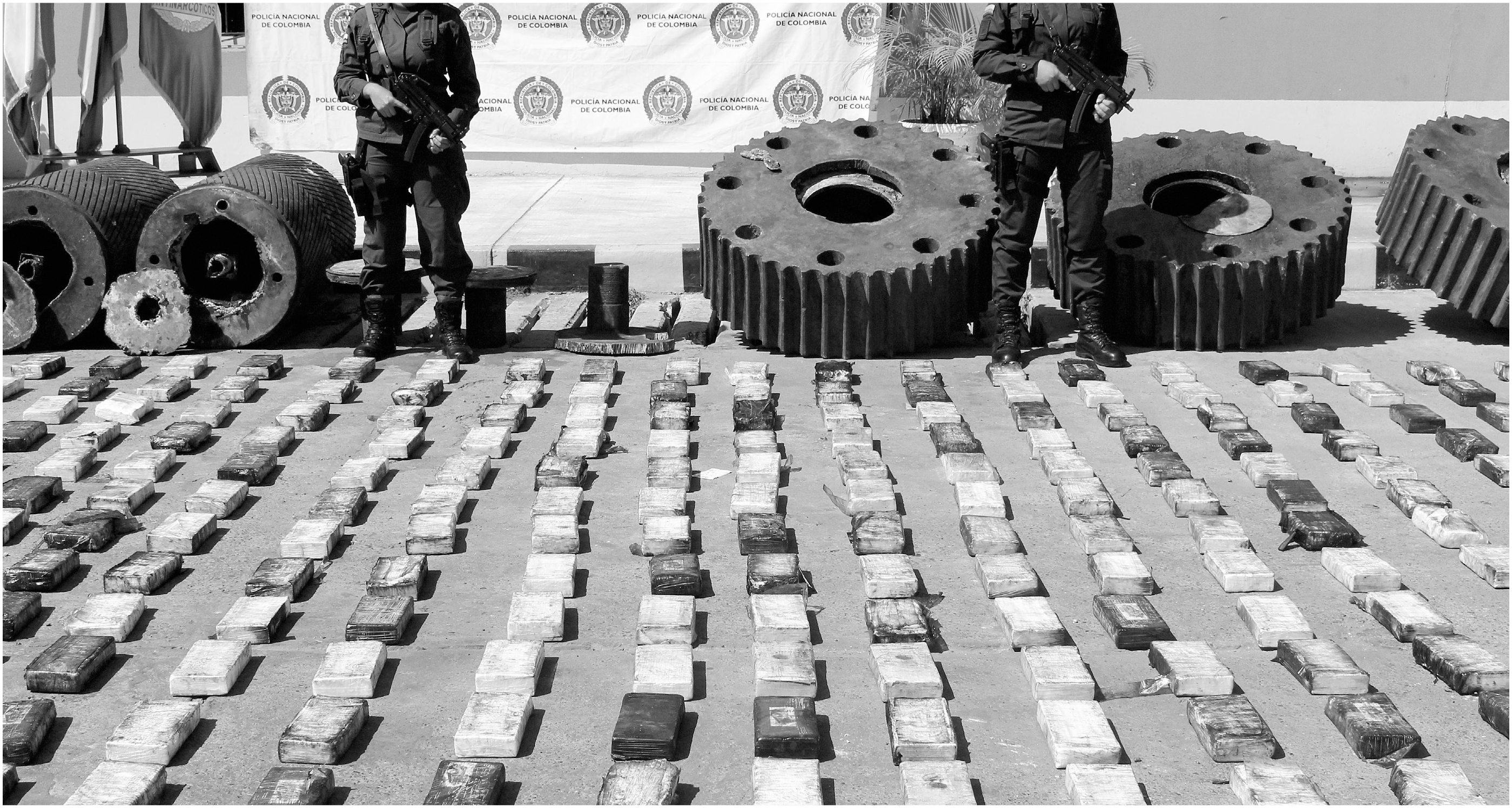
Police stand guard over packages of cocaine that were about to be illegally shipped to the Netherlands
CREDIT: Hugo Penso/Shutterstock
But the government has faltered in its commitments. According to the UN, fewer than half the families enrolled in the programme have received the full promised payment. In the Cauca province, nearly 30% of families have received nothing in return for volunteering to destroy their coca crops.
Meanwhile, armed groups are competing for the country’s lucrative drug fields.
“The restructuring of powers [in Cauca] means it has become a zone of both major journalistic interest and great censorship,” said Luisa Fernanda Isaza, of Colombia’s Foundation for Press Freedom (Flip), a nongovernmental body.
Nearly 40% of Cauca’s population lives in an area without a local media outlet, and security concerns are a key factor behind that trend. Last year, Flip documented 19 acts of aggression against the press in Cauca alone. Those included threats and harassment, physical attacks, property damage, illegal detentions and obstruction of journalistic work.
Community leaders, politicians and activists faced even greater violence. In September last year, assailants opened fire on a car carrying mayoral candidate Karina Garcia before setting the vehicle alight. Garcia, her mother and four others died in the attack.
In October, five members of an indigenous defence force were massacred on a routine patrol of one of Cauca’s native communities. State authorities blamed Farc dissidents for the killings.
These were part of a wave of attacks that swept the country. The Institute of Studies for Development and Peace (Indepaz), a Colombian NGO, counts 756 killings of defenders between the signing of the peace deal in November 2016 and January this year.
Public advocates for a switch from drug crops are at particular risk. Indepaz says at least 85 activists were killed during that period because they supported crop substitution.
Colombia’s president, Ivan Duque, recently told the national newspaper El Tiempo that Mexico’s Sinaloa Cartel had played a role in his country’s criminal landscape for many years.
Historically, Mexican criminals were limited to distribution, trafficking drugs to the North American and European markets. But wealthy Mexican cartels are now taking a direct role in drug production to iron out potential supply chain problems, and Colombia’s government has documented a sharp increase in Mexicans participating in illegal activities within Colombia since 2014.
Many observers living near Colombia’s coca and marijuana fields draw a link between the arrival of Mexican criminals and rising instability. “Colombian armed groups used to bring the drugs to strategic points,” said one journalist, who asked not to be named. “Now the Mexicans have come here and sparked more violence.”
Last year, the Indigenous Regional Council of Cauca raised the alert about a statement published under the insignia of the New Generation Sinaloa Cartel on social media. The message warned indigenous defenders they would “slaughter them like animals” if their operations were disrupted.
In a statement published last November, Flip also tied the recent campaign of intimidation against journalists to their “denouncing the presence of Mexican cartels, allied with Farc dissidents in the region”.
Alexander Cárdenas, a cameraman who worked alongside Manzano at Caracol Television, was one of the five media workers who received death threats last year.
In July, a group of men with Mexican accents approached Cárdenas in northern Cauca. The men ordered him to stop filming and leave. Despite their threats, he published the report, an action he sees as a catalyst for the aggression that began the following month.
“I have been going to northern Cauca for 23 years,” he told Index. “I have seen people die in conflicts. I’ve seen soldiers die. But no one has ever told us we can’t be there… Threatening journalists, burning candidates, we’ve not seen this before.”
Cárdenas changed his address three times to avoid the aggressors. He was staying at his sister’s house when two men rang the doorbell and demanded to know his whereabouts. Cárdenas escaped through the back door and left the country two days later.
Like Manzano, Cárdenas was forced into exile despite receiving attention from Colombia’s National Protection Unit. This federal agency manages the safeguarding of more than 8,000 activists, politicians and journalists, among others.
An official assessment concluded both Man-zano and Cárdenas were at extraordinary risk. However, police failed to provide the routine patrols promised as part of the security schemes.
But those inconsistencies were less alarming than the discovery made just weeks later, when a government raid on the offices of the agency revealed at least one of its officials had collected security data and sold it to criminals.
Cárdenas, who had already left the country when the news broke, asked: “How can those who are supposed to protect you sell your private information to those who want to kill you?”