




Abstract
President Rodrigo Duterte of the Philippines is using extreme threats and expletives against female journalists as a way to shut them up.
The young man in that story is now 74 and the most powerful man not just in his home city but in the country. Rodrigo Duterte is still drunk – this time with power. He still clearly subscribes to the idea that sexual remarks are a weapon to dominate the weak, and that demeaning comments about someone’s body can unsettle an opponent who would otherwise have the upper hand.
By all indications, Duterte perceives journalists who poke at his questionable or controversial policies as enemies, so that weapon is trained on us as well.
Just this September, Duterte railed at my news organisation, Rappler, in a speech before provincial vice-governors. He complained about how we supposedly played up the allegation of a self-proclaimed whistleblower that his (Duterte’s) family was connected to the illegal drugs trade.
“These Rappler people. I said, this is the last straw, ‘You sons of a bitch, your — smell! I just can’t say it, your underarm or your —’. Yes, I’m being rude towards them. ‘You leave me with no recourse. You disrespect my person’,” he said, stopping short of directly mentioning vaginas.
Months earlier, also in relation to media coverage of that discredited witness, Duterte called Ellen Tordesillas, president of the investigative journalism group Vera Files, “every inch a prostitute”.
Between those two incidents Duterte signed the Safe Spaces Act, a law that punishes a wide range of sexual offences, including a number that he himself had publicly committed or confessed to. When journalists pointed out the irony to his spokesman, Salvador Panelo, he replied: “You assume that the president is vulgar. He never was vulgar. When he cracks jokes, it was intended to make people laugh, never to offend. Being vulgar is different. You women should know that. We have to distinguish between someone who is coarse and someone who is just trying to make you laugh.”
Journalists – especially women – aren’t laughing.
Duterte’s first display of sexism as presidentelect was towards a female TV reporter. In a press conference in Davao City in May 2016, he wolf-whistled at GMA7 reporter Mariz Umali while she was asking a question about his prospective appointees to the cabinet. In that same press conference, Rappler reporter Pia Ranada pointed out to Duterte that what he had just done to Umali went against the anti-sexual harassment ordinance the city council had passed, and he had signed, during his term as mayor. Duterte’s response? He wolf-whistled at Ranada, too.
When our reporter persistently asked him about his violation of the local law, the president-elect said: “I don’t like your question. Next question.”
This misogynist president has unravelled since, saying in speeches that he kept an eye on Vice-President Leni Robredo’s legs during cabinet meetings; that he would make Pope Francis watch a supposed sex video of Senator Leila de Lima to make him regret giving her a rosary; that, as commander-in-chief, he would take responsibility for soldiers if they could each rape three women; that soldiers should shoot women communist fighters in the vaginas because women are “useless without them”; that if he were the boyfriend of the pretty town mayor who was seeking his endorsement, he’d hold on to her panties until they snapped; and that he molested their maid when he was a teenager.
Last February, Duterte was angry with former senator Francisco Tatad, who wrote in a newspaper column about the president’s alleged sickness. Duterte told the columnist that his virility would prove he wasn’t ill. “You want to know if I’m still up to it? Do you have a wife? Lend her to me!” he said.
Journalists’ protests can go only so far. Can we sue Duterte for his sexist words or actions towards us? He is immune from lawsuits while in power. Can we boycott him in our coverage? He’s the president. Can we expect media owners to come to their employees’ defence against the highest official of the land? The prevailing mindset in the industry is that intimidating remarks from officials “come with the territory”.
And there lies the bigger danger that Duterte presents. He is the president. When he displays misogyny and gets away with it, men can be emboldened to follow his example and women might become accepting of how their dignity is lowered.
Theresa de Vela, gender studies expert at Miriam College, previously explained to Rappler the concept of “gender socialisation” and how Duterte, with the rape jokes that come to him so easily, had made an “extremely harmful” contribution to how Filipinos develop their expectations of and attitudes towards the sexes.
“Leaders play a role in our socialisation because they represent one of the social institutions that mould our society… When you have a president doing that, you’re adding to, reinforcing that sexual script that says sexual violence is acceptable behaviour and is part of the male behaviour to be in society. It is manly. It’s what makes you an attractive male,” De Vela said.
Duterte’s supporters prove that this point is true, spreading gender-based vitriol on social media against journalists and the president’s critics.
Rappler’s Ranada has been threatened with rape after consistently asking hard questions of the president. So has Inday Espina-Varona, Reporters Without Borders prize for independence winner, for her hard-hitting columns and social media posts, and so has former Reuters photo-journalist Ezra Acayan’s family after he documented Duterte’s bloody war on drugs. Vice Asia-Pacific editor Natashya Gutierrez was called an “attention-seeking whore” when she was a Rappler reporter. A non-political journalist I know who wrote just one column critical of a Duterte policy found a photo of her daughter online, posted liberally by the president’s supporters, wishing the young girl to be raped and dead. Rappler CEO Maria Ressa has been insulted with comments that she isn’t attractive enough to be raped.
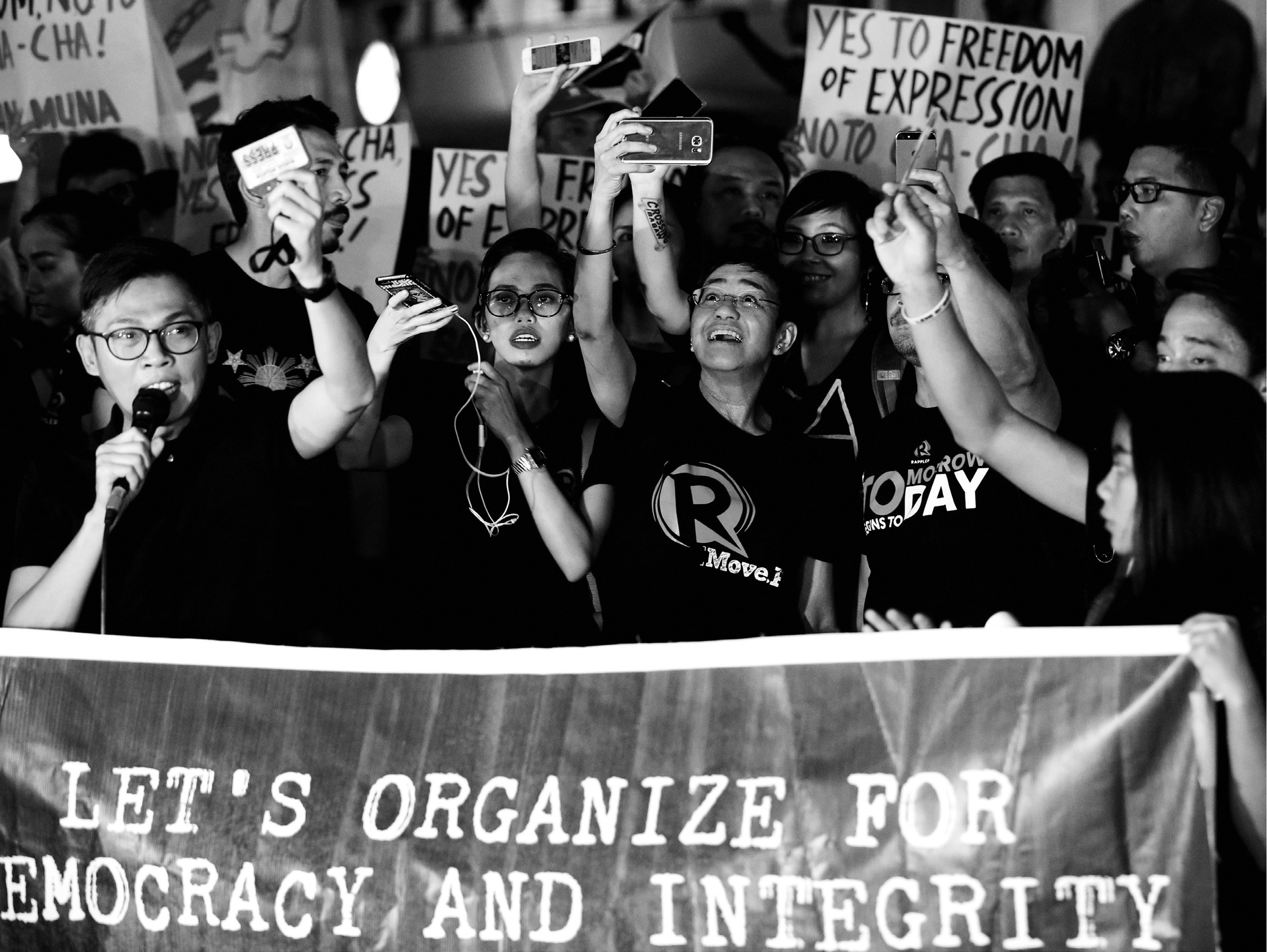
Journalists and supporters of Rappler, including CEO Maria Ressa (middle) protest a move to revoke their registration
CREDIT: Bullit Marquez/Shutterstock
In a talk at Rappler’s headquarters in December 2017, the International Centre for Journalists’ Julie Posetti said female journalists were indeed “more vulnerable to online harassment” than their male counterparts were.
Drawing from her study of journalists’ security in the digital age, she said cyber harassment against women journalists was sexualised and focused on their physical appearance, sexual orientation and family members, among other things. The intention of the attackers was to intimidate these women into abandoning investigations they were doing, or to destroy their credibility when they criticised public figures and institutions.
Duterte thinks the problem is with women and not with him. Last March – ironically (again), at an event honouring women law enforcement officers – he said: “Puta (Bitch), you know, you women, you are depriving me of my freedom of expression…. You criticise every sentence or word I say, but that is my freedom to express myself… I am doing this because I am trying to bring you to the limits of despair.”
He can try, all right. But expect us – women, journalists – not to get tired of pushing back.