




Abstract
The Indian prime minister likes to put on a tough show and this plays well with mobs who follow his war cry, writes
In October this year, Modi invited a delegation of 27 members of the European Parliament to visit Jammu and Kashmir. The idea was to show this hand-picked team of international observers – 22 of them belonged to right-wing parties in their home countries – that all was well in the northern state. When MEP Chris Davies of the UK’s Liberal Democrats agreed to join only on condition that he be allowed to move around freely, “unaccompanied by military, police or security forces”, his invitation was withdrawn. It was a typical example of Modi’s “strongman leadership”: nothing short of unquestioning fealty is good enough for his administration.
Of course, it is worse for those within India. Take Kashmiris, for example. On 5 August, Modi’s government abrogated Article 370 of the Indian constitution, under which Kashmir had enjoyed special privileges including a degree of autonomy since 1954. The decision was announced in parliament by a minister, Amit Shah, who cited a presidential order that sealed the fate of Kashmiris overnight. At the time of writing, Kashmir is reeling under a government-imposed communications ban. Mobile phone services remain patchy while access to the internet is suspended. This is the quid pro quo that Modi’s government offered as its “solution” to the long-standing conflict in Kashmir. The silencing of a population of more than 12 million and the detention of local leaders are the fallout of its smug arrogance.
Concern for internal security is the government’s ostensible reason for prolonging the lockdown. But another motivation is Modi’s distaste for hearing public opinion that challenges him and his government’s actions. An iron-fist stance is one way to achieve this.
Aggressive crackdowns by ruling governments are not unknown in independent India. From 1975 to 1977, Indira Gandhi, the then prime minister, imposed a state of emergency across the nation, leading to severe curbs on press and personal freedoms. Yet even this period of censorship and systematic repression was more an aberration in India’s otherwise robust democratic fabric.
Since Modi, of the Bharatiya Janata Party, was elected with an overwhelming majority in 2014, the scene has changed radically. Free speech is a poisoned chalice in India now, and the crushing of dissident voices is the new norm. But it’s not just Modi and his officials who are policing speech – it’s people from all walks of life, and they’ve become an indispensable tool in maintaining Modi’s image. A typical example is the recent fiasco over an open letter by 49 Indian celebrities addressed to Modi, asking him to take stringent action against the growing number of mob lynchings since he assumed office. The plea – signed by intellectuals such as historian Ramachandra Guha and filmmaker Shyam Benegal – enraged Sudhir Kumar Ojha, a lawyer. Ojha filed a petition in court against the signatories, accusing them of tarnishing “the image of the country”, undermining “the impressive performance of the prime minister” and “supporting secessionist tendencies”. After more than 180 cultural personalities condemned the court order, the case was dropped, but not before a point had been made: “If you are not with Modi, you are with anti-India forces.”
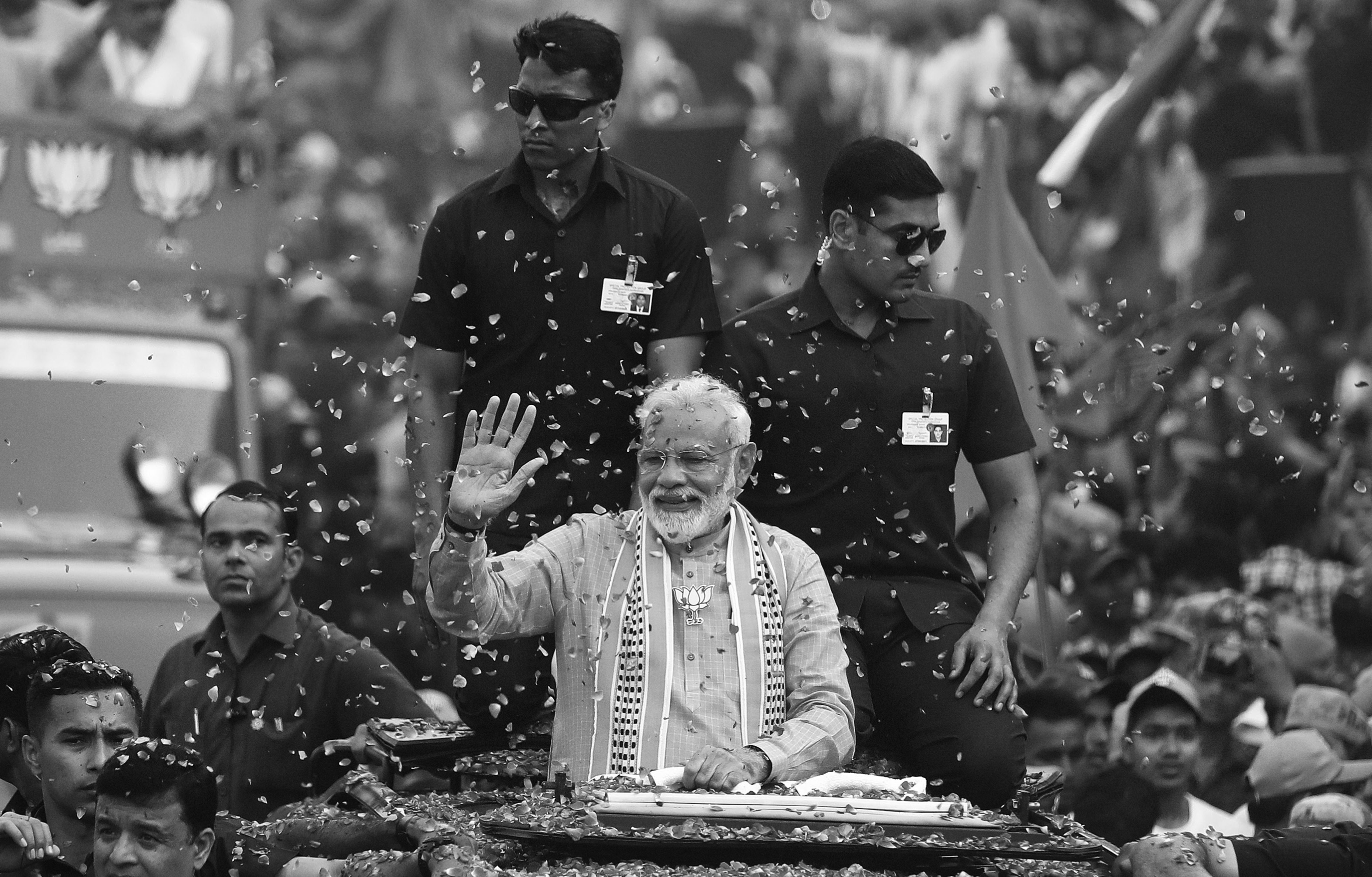
Indian Prime Minister Narendra Modi waves to supporters at a parade in April 2019, flanked by security guards
CREDIT: Adnan Abidi/Reuters
While Modi may be celebrated within India by his burgeoning tribe of followers, for others his tenure has fostered a climate of fear and intimidation. More than 250 people have been lynched since the start of Modi’s rule. Most of the victims are Muslims or belong to marginalised castes, largely targeted for eating beef. The BJP’s Hindu nationalist agenda extols the cow as “holy mother”. Bands of men who go by the name of gau rakshaks (self-styled protectors of cows) terrorise the vulnerable for alleged smuggling of cows or possession of beef. They’re the strongmen following their strongman’s vision.
Many of these hate crimes are fuelled by the spread of fake news on social media, especially WhatsApp, which is another weapon in Modi’s armoury. The escalating volume of disinformation has led to the rise of dedicated fake-news busters but the cycle of violence and vendetta remains unabated.
In many instances Modi projects an image of being aloof to suffering, such as when in 2015 an irate mob barged into the home of a 52-year-old Muslim man in a village near Delhi, accused him of keeping beef in his refrigerator and killed him. Modi maintained a studied silence for days, even as citizens took to the streets in protest. In 2017, a 15-year-old Muslim boy was called a “cow-eater” by a crowd during an altercation over seats on a train, assaulted, then thrown off. Again, Modi waited for days before condemning the incident.
If silence is Modi’s steadfast ally, so is a section of India’s fourth estate. As business interests of corporate media get tied up with political goodwill, ethics are compromised with impunity. Modi’s thundering warnings to Pakistan make for headlines and spin-offs on prime-time television but criticism of his shortcomings are met with intimidation, online trolling and threats. Modi’s supporters are quick to label dissenters “anti-nationals” or seditionists.
It started in 2016 with a group of students at the Jawaharlal Nehru University in New Delhi being charged with sedition – a draconian legal legacy of the colonial era – for allegedly raising “anti-India” slogans at an event. “Anti-national” is now common parlance and has even entered the jargon of governance. The latest data released by the National Crime Records Bureau lists offences perpetrated by “anti-national elements” as a new category of crime, although it doesn’t define the term.
Modi’s government also instituted a controversial rule mandating cinemas to play the national anthem before every screening (see Spring 2017, 46.01, p.66-68). Those who didn’t stand up during the anthem failed in the eyes of any staunchly nationalist audience around them. Even those with disabilities were not spared. Although the decree was reversed last year, the attacks haven’t ceased. In Modi’s India, it’s par for the course to be abused as a “Pakistani terrorist” for not demonstrating patriotic fervour approved by the majority.
Even facetious memes have landed people in trouble. Police travelled 250km to arrest a 19-year-old tailor for sharing an allegedly “offensive and morphed” image of Modi over WhatsApp, mocking his doomed mission of cleaning up “black money”. Fans of Modi, whose love for the camera is well documented, evidently favour only one kind of image makeover: one that projects their strongman leader as an everyday superhero. Modi cleans up strategically placed rubbish from streets, takes selfies with his buddy Donald Trump and roars back at Pakistan’s nuke threats. That’s the image they like.
As India’s economic performance dips, it remains to be seen if the armour of a strongman leader will continue to protect his fortunes in the months to follow. For now, it has only a mere dent. It will take the collective will of Indians and a strong political opposition to unseat him from power.