




Abstract

Here we explore the ways in which leaders such as Russian President Vladimir Putin are using technology for their own purposes.
Following the death of Saudi Arabian journalist Jamal Khashoggi in October 2018, who was murdered at the Saudi consulate in Istanbul, Canada-based Saudi dissident Omar Abdulaziz launched a lawsuit against Israeli company NSO Group, claiming its software played a part. Abdulaziz, a confidant of Khashoggi, asked the Canadian courts to ban the company from selling its products to Saudi Arabia and to seek damages.
NSO Group’s most infamous product is the spyware Pegasus, which works by sending innocuous-looking links. If users click on them, the spyware is installed on their devices. Missed calls via WhatsApp or push SMS messages have also been revealed as ways for it to be installed. A brochure shared by security researcher Claudio Guarnieri reveals that Pegasus can “remotely and covertly collect information about your target’s relationships, location, phone calls, plans and activities – whenever and wherever they are”, as well as enabling real-time call monitoring.
WhatsApp has since filed a lawsuit against NSO Group saying it had used its servers to infect target devices in several countries with malicious code. NSO Group disputes the claims.
Index has previously reported on the use of Pegasus in Mexico, following an investigation by Citizen Lab and the New York Times that revealed messages sent to Mexican journalists were laced with Pegasus spyware. It was dubbed by some papers at the time as the “Mexican Watergate” (Autumn 2017, 46.03, p.82-3).

While messaging tools such as WhatsApp have proven useful to activists because of the end-to-end encryption they provide, they can also be used in ways that the company did not intend, as the example of Pegasus shows.
Another instance of this was revealed in Freedom House’s Freedom On The Net report 2019, which said that the victory of Jair Bolsonaro in Brazil’s October 2018 presidential election was “a watershed moment for digital election interference in the country”. According to the report, supporters of Bolsonaro “spread homophobic rumours, misleading news and doctored images on WhatsApp”.
The Organisation of American States found that the messaging platform was being used to send bulk messages to multiple numbers through scraping software obtained online, and that automated messages were being shared with groups.
Local newspapers also reported that Bolsonaro was benefiting from a network of big businesses using undeclared funds to disseminate pro-Bolsonaro messages via WhatsApp. Bolsonaro denied the accusations, qualifying the bulk messaging as “voluntary support”.
WhatsApp has proved particularly useful in Brazil as the app is not used for just private messaging. As a result of many mobile phone operators allowing unlimited WhatsApp access to subscribers, people who cannot afford an internet plan are able to turn it into a social media site of sorts, with people joining groups and connecting to others they have never met.
In March 2017, Canada’s Citizen Lab uncovered a wide-ranging campaign against Egyptian NGOs, lawyers, journalists and activists following a tip-off from the Egyptian Initiative for Personal Rights. EIPR had begun receiving an increase in suspicious emails related to Case 173, a legal case brought by the Egyptian government against NGOs over issues of foreign funding. Analysing the emails, Citizen Lab realised that they employed a technique known as OAuth phishing.
OAuth is a perfectly legitimate way for internet users to grant websites and applications access to their information without handing over the password and is widely used by Facebook, Google and Twitter.
The attack works like this: you receive an email purporting to be from your email provider inviting you to update your security setting and the email looks legitimate so you click on the link to take you to your security settings. In some attack variants, an OAuth dialogue box labelled Secure Mail opens, and by clicking on your email address you unwittingly give a third party the ability to send, read and delete your emails.
Citizen Lab was not in a position to identify the sponsor of the campaign, but those targeted were largely those parties charged by the Egyptian government in Case 173.
In January 2019, a further investigation by Amnesty International revealed that several hundred prominent Egyptian human-rights defenders, media outlets and staff of civil society organisations had been targeted by OAuth phishing attacks and that these “likely originated from government-backed bodies”.

Where there’s an opinion on the internet, there’s an internet troll not too far behind, ready to attack. Trolls have been around ever since the earliest days of online conversation, but in the past few years trolling has become industrialised.
In “troll factories”, employees are paid to post disinformation or add comments to news stories and social media posts that discredit the writer or offer a contrary view.
The best known of these is the Internet Research Agency in St Petersburg, allegedly funded by oligarch Yevgeny Prigozhin, a restaurateur known as “Putin’s chef” and a close ally of the Russian leader. The activities of the Internet Research Agency were revealed by whistleblower Lyudmila Savchuk, who worked undercover at the company for two months in 2015.
“It was a regular part of the job to write posts in which you praised Putin,” said Savchuk. During her time there, a regular task was to “spread negative publicity on Ukraine”.
The organisation was also called out in Robert Mueller’s report for interfering in the 2016 US presidential election.

For some young people in open democracies, if you can’t search it then it doesn’t exist. Usually this happens if the wi-fi goes down, but sometimes it is because even the mighty Google holds up its hands and says it cannot find anything relevant.
Yet in countries such as China, the reason you get zero results is often far more chilling.
In 2009, digital activist Jason Ng noticed that the internet was blocked during riots in Xinjiang province. It inspired him to build a computer script to see which search terms were routinely censored on microblogging platform Sina Weibo. He found that 500 terms, including “tank”, the names of government officials and “hairy bacon”, a reference to Mao’s preserved body, could not be searched for. Even seemingly innocent terms such as “today” found themselves out of favour with China’s internet censors as they became linked to commemorations of the Tiananmen Square massacre.
But it’s not just China censoring its search functions. Foreign companies operating in the country have been accused of doing it too. Online image resource Shutterstock, for example, runs a keyword blacklist for any user with a mainland China IP address. A spokesman said that the company was “bound to local laws”.
CREDIT: Sergio Ingravelle/Ikon

Stifling Parody
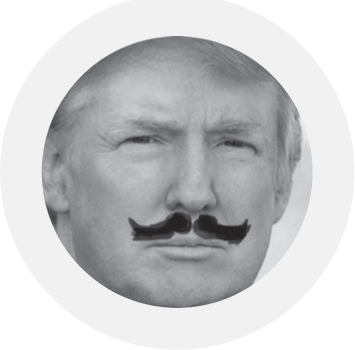
The account @RealDonaldDrumpf, referring to Potus’s historical surname, has some 90,000 followers – far short of Trump’s 66 million, but still impressive. The account is managed by writer Richard Hine.
“I started the account in 2013 when ‘fake news’ still meant the humorous kind, eg The Daily Show and The Onion,” said Hine in an interview with Index.
The idea that you can actually parody Donald Trump’s Twitter is an interesting one.
“There is nothing so outrageous or stupid that I can say in the voice of Donald Trump that someone on the internet will not believe is actually being said by Donald Trump,” he said. “Many of my tweets are actually previews of future Trump tweets.”
But the account has attracted the ire of its subject.
“He got into a feud with me when I exposed his ongoing racism and stupidity regarding the Central Park Five [five men who were wrongly jailed for the assault and rape of a jogger in New York]. This appears to be the first time a celebrity engaged in, and lost, an argument with his own parody account on Twitter. After that, he blocked me and I remain blocked to this day.”