




Abstract

Budapest’s new mayor has signalled that he wants to speak out for those that Viktor Orbán has tried to silence, reports
So said Gergely Karácsony in his October inauguration speech as mayor of Hungary’s capital city. These sentiments might seem unremarkable, but they come against a backdrop of conservative “family” policies promoted by the government.
Just a month earlier, a peculiar photo started circulating on social media: eight middle-aged men in suits sitting in the front row of a conference held in Budapest. What made the photo unusual was not the line of high-ranking politicians and church dignitaries in itself, but the fact that the Budapest Demographic Summit was focused on raising fertility rates in the region.
The event was far from the dystopia of The Handmaid’s Tale as there were plenty of women in attendance, even as speakers. Yet the solutions offered for fighting low birth rates were perfect examples of the populist government’s approach to the “obligations” of its citizens.
“Having children is a public matter, not a private one. It’s not an individual obligation but a social and demographic necessity,” said László Kövér, speaker of the Hungarian parliament, adding that childless people were “not normal” and “stand on the side of death”. Meanwhile, Miklós Kásler (the minister responsible for family policies) has emphasised the need for returning to Christian values. “Women will give birth if they want to, if they feel the urge, if they are raised to do so,” he said.
Right now, government policies are pushing a particular set of values and in doing so leaving those that do not conform feeling like outsiders. For instance, women who bear four children are exempted from personal income tax for life. There is a cash incentive for large families to buy seven-seat vehicles. Families are entitled to loans of more than $30,000 that are written off if they have three children.
But couples must be married to qualify for the loans, and families who fail to produce the required number of children will have to pay the interest and the loans back, a provision that puts pressure on new mothers.
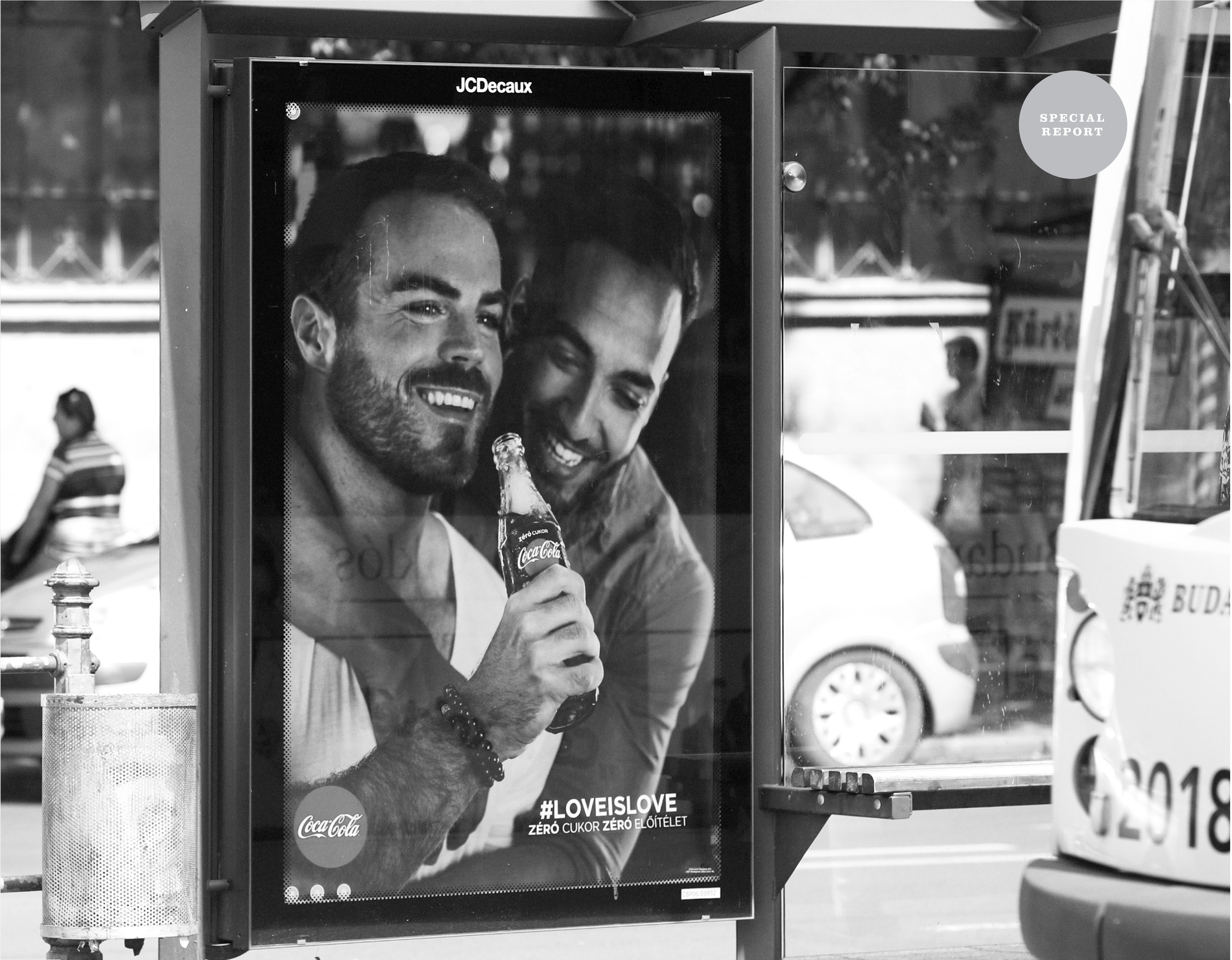
An advert for Coca-Cola promoting LGBT acceptance. An MP in Orbán’s party Fidesz took a homophobic stance against it, calling for a boycott of Coca-Cola products
CREDIT: Bernadett Szabo/Reuters
“My first child was conceived three months after we decided to have a baby. The second one took years because my husband worked abroad and I had health issues. I am already 39 and afraid of what will happen if we are not able to have a third one,” said one mother, Viktória.
Although religion does not play an important role in society and only 9% of Hungarians attend church services each week, Prime Minister Viktor Orbán likes to emphasise the importance of Christian values, such as marriage and family. He sees big families as tools for fighting migration. If Hungarian women can populate the country then there will be “no need to bring in foreign workers and Christian society will be protected from newcomers”. He has even come up with a term for the system he wishes to build – he calls it Christian democracy, which in his view would elevate the nation above the individualism of liberal states.
Critics say the notion is a mixture of macho and populist nationalism which means those who do not conform feel squeezed out. The rhetoric puts particular pressure on women (see p.72), who may feel reduced to being simply child-bearers while men defend the country against threats. Abortion is legal and available in Hungary, but it is far from easy to obtain to ensure a low take-up rate.
Discussions about gender are also considered a threat by Orbán. It has resulted in a ban on gender-study programmes at universities, and the government refuses to ratify the Istanbul Convention on violence against women.
“People are born either male or female, and we do not consider it acceptable for us to talk about socially-constructed genders rather than biological sexes,” the prime minister’s spokesman said.
The country – alongside Greece – came last in the EU’s 2019 Gender Equality Index. Hungarian women are frowned upon if they want to pursue a career and are not satisfied with solely being mothers.
When Orbán was asked in 2015 why there were no women in his cabinet, he replied that “few women could deal with the stress of politics”.
Anna Júlia Donáth, a Member of the European Parliament from opposition party Momentum, said: “The pro-government media portray politics as something that is for men in suits. They believe women should stay home and take care of the children.” She also admitted that criticism sometimes made her doubt whether she was good enough for office.
But there is another angle to gender policies in Hungary.
“Contrary to most countries where grassroots or religious organisations have mobilised against the term ‘gender’, in Hungary it is the government that maintains the perception of danger, so that it can present itself as the protector of the country,” said political scientist Eszter Kováts.
When it comes to LGBT groups, the government is also making its views clear. The country’s constitution states that marriage is possible only between a man and a woman, thereby making it difficult to change the legal recognition of gay and lesbian relationships from registered partnerships to marriages. LGBT people are not allowed to adopt, are not allowed access to artificial reproductive techniques and cannot take each other’s names.
According to an EU survey, more Hungarians would be content with a Roma prime minister than with a homosexual one. (Roma are another group regularly demonised in the country.)
Anti-gay sentiment is also fuelled by state rhetoric. Recently, a Fidesz MP called for a boycott of Coca-Cola after its advertisements featured a gay couple, and the speaker of parliament, Kövér, often makes homophobic comments. “Morally there is no difference between the behaviour of a paedophile and the behaviour of someone who demands such things,” he said, referring to marriage and adoption rights for gay people.
These public comments have also emboldened far-right groups. On the anniversary of the 1956 revolution, a group of protesters tore down the rainbow flag from a community centre and set it on fire. The police were nowhere to be seen.
LGBT people increasingly feel the burden when trying to reach out to wider society. Getting to Know LGBT is a school programme that was launched by the Labrisz Lesbian Association in November 2000. Its sessions are run by trained volunteers who help students understand the concept of LGBT rights and answer any questions. Last year, the programme was attacked by MP Dóra Dúró, who called it “homosexual propaganda”.
“We get fewer invitations to schools, because some principals are afraid of what people and the government would say,” said an activist.
Views of homosexuality differ depending on location: in the countryside, it is not only LGBT people themselves who face obstacles but their families and supporters of gay rights as well. Homosexual people from smaller towns and villages often move to Budapest, not only for jobs but also because they don’t want their families to be stigmatised, and the capital is generally more accepting. A young couple speaking to news website Abcúg recently complained that, in the countryside, being gay was a bigger disadvantage to them than being Roma.
But among the calls for traditional values, the government rhetoric has had another impact: more people are fighting back. Karácsony, the new mayor, has already vowed to stand up for the rights of LGBT people, religious minorities and the homeless. And if he keeps to those promises, next year the rainbow flag will be flying above the city hall during Budapest Pride.
It might be a small gesture but it’s a huge statement.