




Abstract

Once targeted by dictatorships, theatres and galleries are now under political pressure to close shows in democracies, too.
The latest victim of the trend is Germany, where anti-immigration party Alternative for Germany (AfD) is going after shows and exhibitions. Marc Jongen, unofficial party philosopher of the AfD, has said he wants to “de-grime the [left-dominated] cultural scene”, while Hans-Thomas Tillschneider, another senior member, has called for theatres to return to a traditional repertoire.
Index spoke to Marc-Oliver Hendriks, executive director of the opera house Staat-stheater Stuttgart, who said this summer an AfD politician requested the nationalities of the members of those employed in publicly funded theatres in the state, which included theirs (the ministry responded by providing the number of international artists, not their exact nationality). The ministry also made “a statement on how the arts have always been international and that the overruling aspect of employment is artistic excellence”.
With incidents like this becoming more commonplace, the Mobile Council against Right-Wing Extremism, who provide advice for those dealing with right-wing extremist intimidation and threats in Germany, recently published a handbook for cultural institutions and artists on how to navigate the rise of the far right. It advises people to stay calm, to know of and agree on institutional values and to make these known.
“Public statements on one’s own democratic stance are particularly effective if they are made in conjunction with other cultural institutions and associations. The strength lies in the diversity of the rejections of right-wing attacks on artistic freedom and the cultural sector,” Hamid Mohseni from the Council told Index.
“There is pressure on cultural institutions – mainly in eastern Germany but not only in eastern Germany – from the AfD and their allies on the extremist far right. This alliance and the threat that stems from it is very different from the situation 10 years ago,” said Roman Schmidt, who is head of the contemporary history division of the Heinrich Böll Foundation, a think-tank that works on democracy and human rights.
Schmidt says right now the power of the AfD is curtailed as it is not in government, but he’s worried that it could gain control at the Lander (state) or municipal level. “This would be a disaster for Germany because when it comes to cultural and educational institutions, the Lander have the say and the budget.”
Schmidt, who has a doctorate in history, added: “We have a strong polarisation between a liberal, predominantly urban part of the population that has a cosmopolitan, pluralist outlook and a more nationalist, closed, inward-looking part.” He points out that in the Weimar Republic the arts flourished, but what happened next showed how democracies can fail very quickly.
In Brazil, this polarisation is particularly pronounced. The country legalised same-sex marriage in 2013 but it is also one of the most dangerous places to be LGBT in the world. The young, urban and educated are pitted against the religious and conservatives. In President Jair Bolsonaro, the latter group have found an ally.
Since coming to power on 1 January, Bolsonaro has made cleansing the arts a central goal. Of his many threats, he’s called for Ancine, Brazil’s state-backed film agency, to accept “filters” or face closure. He accused the agency of supporting “pornography” – a reference to its co-financing of Bruna Surfistinha, a drama based on the real-life story of a middle-class prostitute.
Performer, choreographer and writer Wagner Schwartz is feeling the sting. Even before Bolsonaro came to power, back in 2017 Schwartz found himself at the centre of a storm following his performance of La Bête – a one-man show in which he lay naked at the Museum of Modern Art in São Paulo and invited people to move parts of his body. When a four-year-old innocently did (and it was recorded), allegations of paedophilia spread like wildfire online.
“As soon as I was called a ‘paedophile’ by the extreme right at the end of 2017, [getting] work in some Brazilian institutions became harder. In 2018, for instance, only local and independent festivals decided to programme my work. I’m still censored today.”
Schwartz says the major institutions want to avoid scandals and political problems, something Index picked up on when contacting Ancine. The agency was keen to state that it would not comment on anything political following our questions about Bolsonaro.
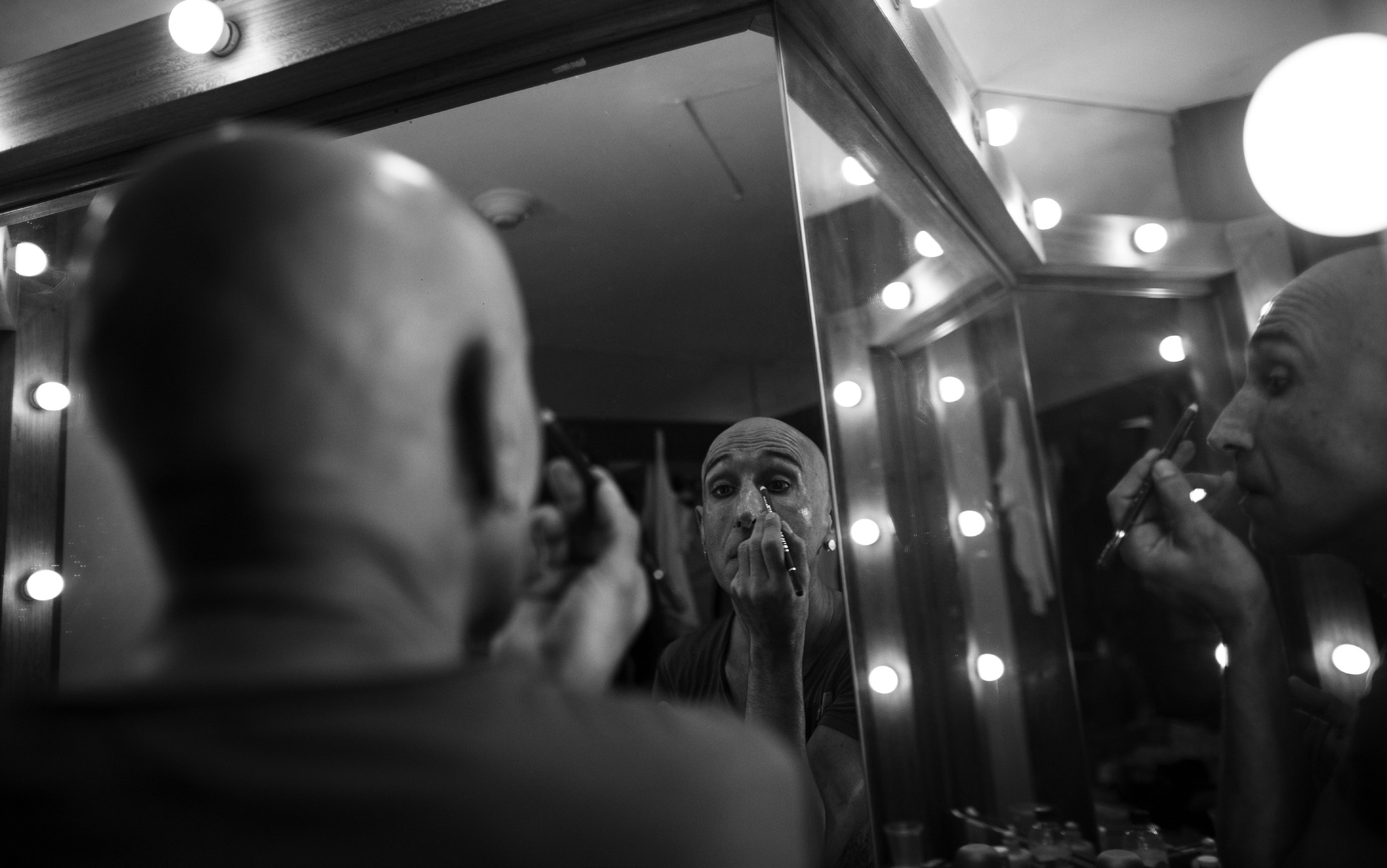
Director Artur Luanda Ribeiro prepares backstage for the premiere of Irmaos de Sangue at a theatre in Rio de Janeiro, Brazil this September. LGBT productions have been in the firing line since Bolosonaro took over
CREDIT: Mauro Pimentel/Getty
Scottish playwright Jo Clifford sounds an even more alarming tone. “Since Bolsonaro has come into power it has become too dangerous to perform in Brazil,” she said of her play The Gospel According to Jesus, Queen of Heaven, which features Jesus as a trans woman. The play was on tour in Brazil until recently.
“The last time they did so, a bomb was thrown into the performance space and armed police invaded the theatre. They performed anyway, but it was clear that to continue [after that] would be at too great a cost.”
When The Gospel According to Jesus, Queen of Heaven was first performed, at Glasgow’s Tron Theatre in 2009, there was a huge number of protests and calls for its ban.
Clifford has just completed a hugely successful 10th-anniversary festival of the play back at the Tron without protests. But last Christmas there was a run at Edinburgh’s Traverse Theatre and an online petition demanding the play be banned attracted 24,674 signatures.
“We are on the front line of a culture war that will only deepen and strengthen as the ecological and financial crisis worsens and the right feel more fearfully they are losing their grip on power,” Clifford said.
Dóra Papp knows what that feels like. In Viktor Orbán’s nationalist Hungary, “liberalism” has long been a dirty word. Since his most recent election win last year, the Fidesz party leader has upped the ante, pledging to “embed the political system in a cultural era”. That has translated into funds being cut from the arts, on top of shows and talks being cancelled and newspaper editorials criticising plays as “promoting communism” or “gay propaganda”.
Papp, who is an activist and former chief executive of an independent theatre company, appears exhausted by it all when we speak. She says that independent companies are suffering more and more, and that self-censorship is becoming rife in what was a once thriving cultural scene.
“Should they have confrontational subjects on their programmes or should they self-censor and try to get government funding?” she asked.
Papp also points out an irony about Orbán. As a result of Hungary’s membership of the EU, artistic talent is draining out of the country. Freedom of movement – something that Orbán despises – is actually helping him when it comes to the arts.
CREDIT: CurvaBezier/iStock
“Even in those times there was a pressure to find a way to create something in Hungary,” said Papp of Soviet-ruled Hungary. “But this is not a need now in Hungary. People facing problems have the opportunity to leave, and that has a bad effect on willingness to change.”
When it’s not about attacking the arts, it’s about supplanting them. Bolsonaro is clear on his vision for the director’s chair. He wants art to be about “Brazilian heroes”. In Croatia, it’s folklore. Miljenka Buljevic, manager of literary centre Booksa in Zagreb, says that when Croatia was applying to become an EU country, the country outwardly committed to liberal values.
“But now that we are in the EU, we have conservatives in power and folklore societies have embraced certain discourse. All of a sudden, people are embracing folklore,” she told Index.
Buljevic is upset about the recent closure of the last independent cinema in Zagreb. In its place stands a shopping mall. “The ecosystem is falling apart. We see more and more commercial things,” she said. Buljevic does point to some positives. The founding of Kultura Nova in 2011 marked a turning point for the arts in the country, with its aim of “improving the system of financing the arts and culture”, and her organisation has recently doubled in size.
And the backlash is being met by a counter-backlash. Back in Germany, the Cinexx cinema in the historic town of Hachenburg offered members of the AfD free tickets to a screening of Schindler’s List in January in response to the AfD’s disdain for Germany’s focus on Holocaust remembrance. Theatres and other cultural institutions have also formed a network to ensure they show a united front. “It’s a good reaction to what is happening,” said Schmidt. “It’s more important right now to work with as many people as possible, not just with your tribe.”
Perhaps the most successful counter-offensive has come from a Brazilian federal judge. In August, Bolsonaro took away nearly $17 million in film grants from about 80 movies, including films with LGBT content. In October, judge Laura Carvalho ruled against this move. “Freedom of expression, equality and non-discrimination deserve the protection of the judiciary,” she said at the time.
Director Emerson Maranhão, whose documentary Transversais, about the lives of transgender people in Brazil, was targeted, told Reuters that while the fight was not over yet (the government can still appeal the decision), justice had been done. “We are living in lonely times, but decisions like this make me feel like we are back to living in a democracy.”
For Schwartz, festival directors who are also affected by the situation in Brazil have supported him and work continues to come in. “I owe it to them,” he said.
As for Buljevic, the best form of resistance is existence. She said: “I’m stubborn. I’ve been saying that ever since we started survival is the ultimate subversive strategy.”
Seven Swipes at Art Censorship, and a Response
• In 2017, an AfD politician in Aachen threatened theatre director Reza Jafari with legal action unless he altered his play to omit parallels between right-wing populism and fanatical Islam.
• In Paderborn, the AfD filed a defamation claim against the city’s theatre over an illustration on a flyer that compared the AfD’s rise to that of the Nazi party.
• In Berlin, the AfD has filed several legal complaints against an exhibition on far-right extremism that referenced the AfD.
• Political events were banned at the central theatre in Freiberg following complaints from an AfD councillor, who labelled a book reading and discussion on right-wing populism as “left-green ideology”.
• In Dresden, which declared a “Nazi emergency” this November, AfD members took part in protests in 2017 against a public art installation by the Syrian-German artist Manaf Halbouni. One AfD politician said the installation was a “monument to the sharia state”.
• A public sculpture in Kassel called Monument for Strangers and Refugees was labelled entstellende Kunst (“disfiguring art”) by the AfD. It was relocated from the main square in 2018.
• This summer, in Stuttgart, an AfD politician requested a list of the original nationalities of all artists in state-run opera, orchestra and ballet companies.
• One fightback: The Cinexx cinema in Hachen-burg offered free admission to screenings of Schindler’s List this January for all AfD members. The ticket offer was provoked by comments from the AfD which included referring to the Holocaust memorial in Berlin as “a monument of shame”.