




Abstract
Terrorism allegations and journalists’ safety were two of the issues tackled by Index during the past quarter, reports
The way information is shared online was also debated in October when Index partnered with human rights organisation Liberty at a fringe event held by the UK’s Conservative party at its annual conference. Hyvarinen, who was a panellist, said the discussion focused on threats and challenges to freedom of expression online. She argued that the government’s Online Harms proposals would cause a new set of problems. The draft legislation, outlined in April, introduced the idea of companies having a duty of care in terms of what appears on their websites, but Hyvarinen said: “It is a really badly thought through idea.” Senior managers could face fines or even jail but Hyvarinen suggested that, in an effort to be seen to be “doing something” about issues such as the spread of terrorist content, the legislation could penalise people who were not to blame. She said: “It’s important to note that duty of care and all these sanctions… don’t apply just to the big social media platform providers, they apply to everyone according to this proposal. Small companies – startups, for example – could be liable for things that they do not have the resources to avoid or control, so that’s hugely worrying.”
Jessica Ní Mhainín, policy research and advocacy officer, who is managing the Index media monitoring project, said: “Independent journalists, who have been writing about the Turkish incursion into Kurdish-held areas of northern Syria, even just on their social media pages, are being targeted for using words such as ‘warfare’, ‘incursion’ and ‘invasion’.”
Press freedom in Turkey has been steadily declining under President Recep Tayyip Er-dogan. Turkey is now the world’s biggest jailer of journalists, according to Reporters Without Borders, with more than 200 arrested or detained under charges relating to their work since the failed coup in July 2016. Ní Mhainín said the incursion into Syria posed the most recent threat to journalists, as they struggle to report military activity objectively.
After the coup attempt, Erdogan declared a state of emergency and took draconian action against the media. The state of emergency officially ended in July 2018 but Ní Mhainín said: “Since many emergency laws were transposed into state law, the ending of the state of emergency has made little difference to civil liberties, including media freedom, in Turkey.” An Index report focusing on media freedom in Turkey in May and June 2019 found a surge in physical attacks on journalists.
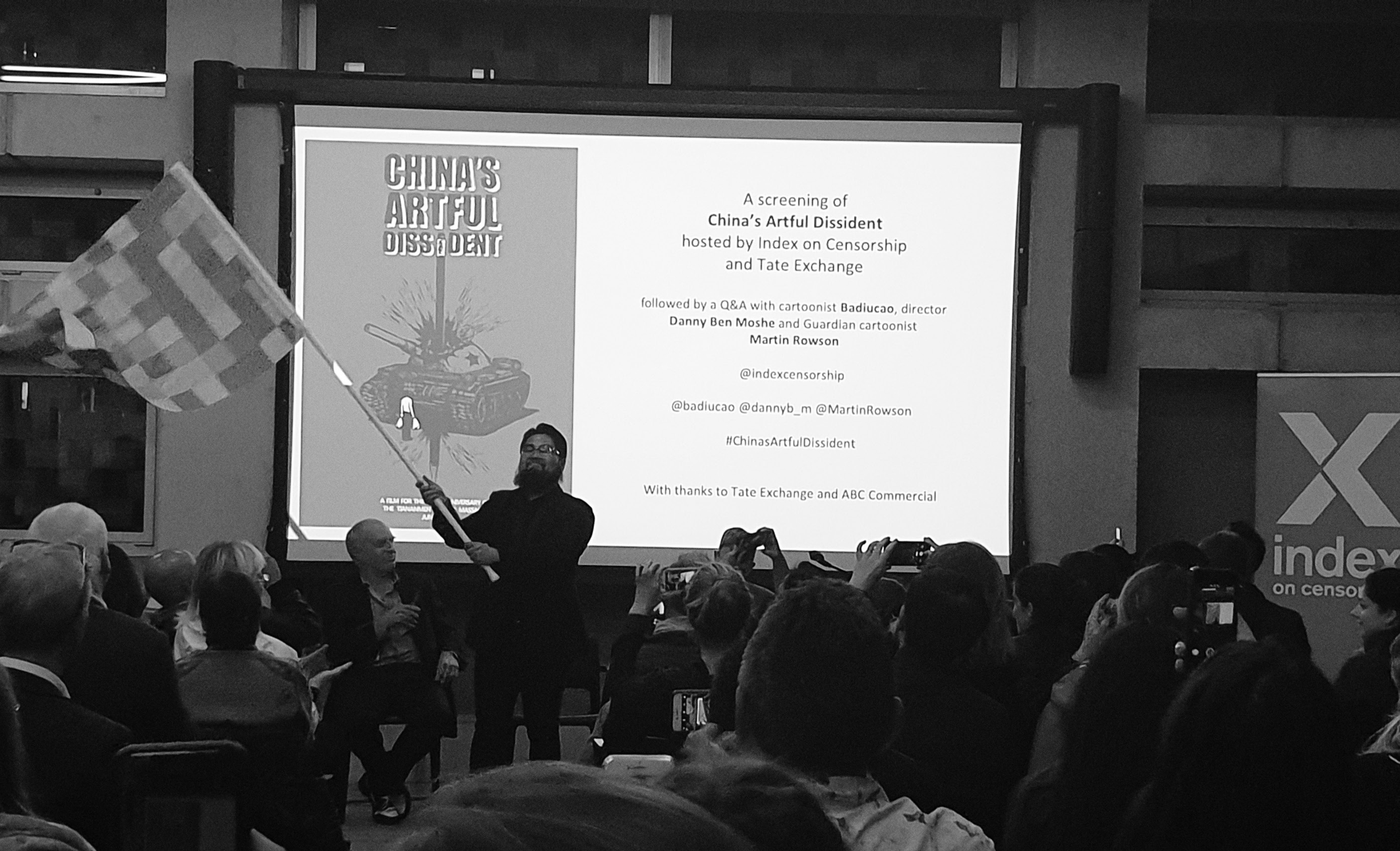
Chinese cartoonist Badiucao waves his Lennon flag at the screening for the film about him, China’s Artful Dissident at the Tate Exchange, London
CREDIT: Orna Herr/Index on Censorship
Ní Mhainín is now working on another report tracking attacks on media freedom in Turkey between April and November 2019. Reporting trends show that journalists are being charged with offences related to terrorism and insulting media officials. The risk increases if journalists show support for, or affiliation with, the Kurds. “If you’re saying anything in favour of the Kurds, they will arrest you and put you in jail, [and assume] you are part of a terrorist organisation,” she said.
Author Kaya Genç, who is the magazine’s contributing editor in Turkey, told Index that journalists often did not speak out against issues surrounding the Kurds or defend those who do. “That kind of solidarity, you don’t see it in Turkey because people don’t want to lose their jobs,” he said. Erdogan has cultivated an atmosphere of fear – the result of an assault on freedom of expression and a culture of disinformation. The Turkish government’s attempts to frame the incursion into Syria as a peaceful mission could be categorised as the latter.
Inaya Folarin Iman, manager of the Free Speech Is For Me project at Index, spoke at the Battle of Ideas Festival held at the Barbican Centre, London, in November. On the panel – Is a New Far-Right on the Rise in Europe? – Folarin Iman argued that the UK government was trying to exploit public concern about the far right “in order to sink their tentacles deeper into tech companies, and essentially increase censorship and online regulation”. At the same time, she argued that those who were expressing anti-immigration views could face pressure not to speak, which could be a free-speech issue, too. She said the term “far-right… is essentially being used as a tool to demonise political opponents, particularly people that might have criticisms of mass immigration”.
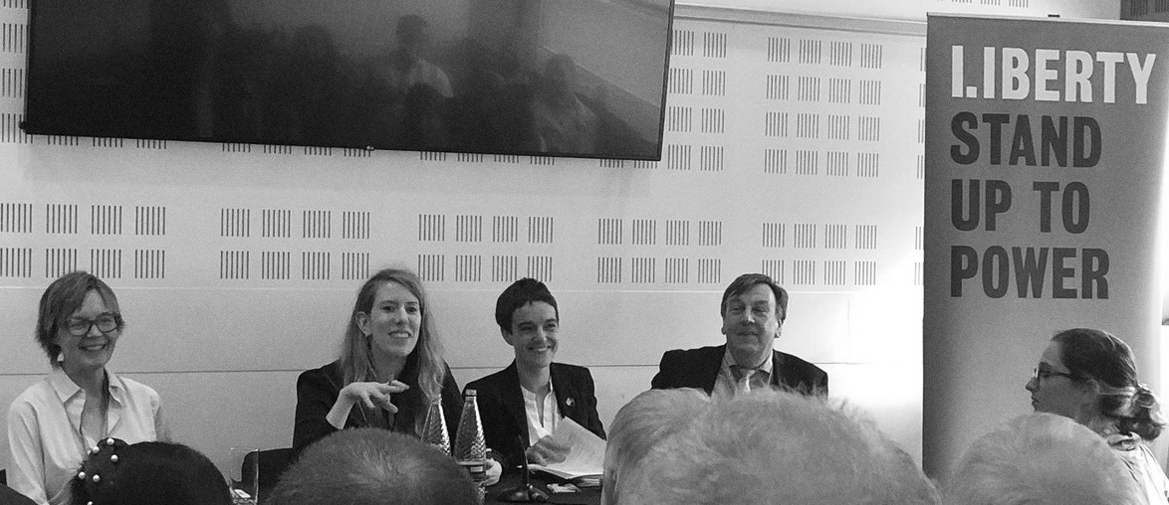
A panel at the fringe event at the Conservative party conference. Left to right, Joy Hyvarinen, journalist Katy Balls, Liberty’s Martha Spurrier and John Whittingdale MP
CREDIT: Liberty
Also at the Battle of Ideas, Index CEO Jodie Ginsberg brought her concerns about the direction of freedom of expression online to a panel about privacy. In response to concerns that there was not sufficient online protection, Ginsberg said: “We have plenty of legislation that deals with explicit threats of violence against women, and against men. What worries me is that people are seeing this kind of unpleasant narrative and saying the solution to that is to prevent those people from speaking at all, to ban and censor that language. If we feel that there are certain subjects that are essentially off-limits because we are being watched for what we say about them, that fundamentally alters the public political discourse.”
The fight for free political discourse in a hostile climate was the dominant theme of the evening when Index, in partnership with the Tate Exchange, hosted a screening in October of China’s Artful Dissident, by filmmaker Danny Ben-Moshe. The documentary follows Badiucao, a Chinese cartoonist who fled to Australia, whose work is critical of President Xi Jinping’s government. Most recently he created work to demonstrate his solidarity with the protesters in Hong Kong. He was at the screening, and spoke of the importance of freedom of expression on social media. He said: “There is a relatively large community on Twitter from mainland China – about one million people. These are the people who will see my work, will download my work, will repost [it] inside China.” News that circulates in mainland China from Hong Kong is closely monitored and filtered, so the sharing of work such as Badiucao’s is of critical importance to combat a one-sided government narrative.
Index editor-in-chief Rachael Jolley attended a roundtable at the Institute for Human Sciences in Vienna in conjunction with the Vienna Humanities Festival. One key discussion was about those in power trying to control narratives about history. Jolley said: “The control of history is a way of disinforming people – it’s a way of deliberately giving people inaccurate information. You’re seeing it in lots of different countries… national leaders like to portray a history that falls in line with their view of the world or the world they’re trying to promote.”
Promotion of a certain version of history can be used for political gains. Jolley cited Canadian historian Margaret MacMillan, a past Index contributor. MacMillan had described how a country’s history can be manipulated by a government to form a particular national identity and then draw support for its agenda. Jolley said the rewriting of history often presented an idealistic version of the past, and “that sort of rose-tinted idealism of a nostalgic past is used to portray a certain type of politics that is quite often anti-immigrant and anti-modernisation”.
Finally, Index’s year-long training and mentorship programme empowering people to defend their right to free speech has just begun. Seven people from the UK and six in the USA will be offered mentoring and media training in order to gain confidence to publicly discuss the importance of freedom of expression.