




Abstract

Governments around the world, including democratic ones, are increasingly using internet shutdowns during elections and at moments of political crisis.
Then in August, the Indian government shut down mobile and broadband services in the parts of Kashmir under its jurisdiction as it announced plans to remove the region’s special status, essentially cutting the autonomy of the area and putting it under direct control of central government.
India is the country that has written the handbook on internet shutdowns. Other countries are reading it. India has restricted access to the internet during periods of unrest since 2010 and the duration and frequency has increased dramatically since the Narendra Modi-led government came to power in 2014.
It is now the country that shuts down the internet more than any other, with 134 shutdowns recorded last year. The government previously shut internet access in Kashmir for 133 days in 2016, according to research group InternetShutdowns, but this latest digital blackout, accompanied by an unprecedented removal of political sovereignty, is a clear example of how internet access is being used to wield political power.
Closing down the internet is increasingly being used as a reaction by countries around the world when protests arise or elections get controversial.
The move in Sudan came in a moment of massive upheaval that began in December 2018 with protests over the tripling of the price of bread and led, in April 2019, to President Omar al-Bashir stepping down after 30 years. The military government that replaced him, the Transitional Military Council, found itself directly at odds with the well-educated, digitally-savvy protestors who wanted to make sure that this council made way for a fully democratic government. They ignored a curfew the council had tried to impose in Khartoum and stayed on the streets, demanding a democratic transition.
CREDIT: Sara Qaed/Cartoon Movement
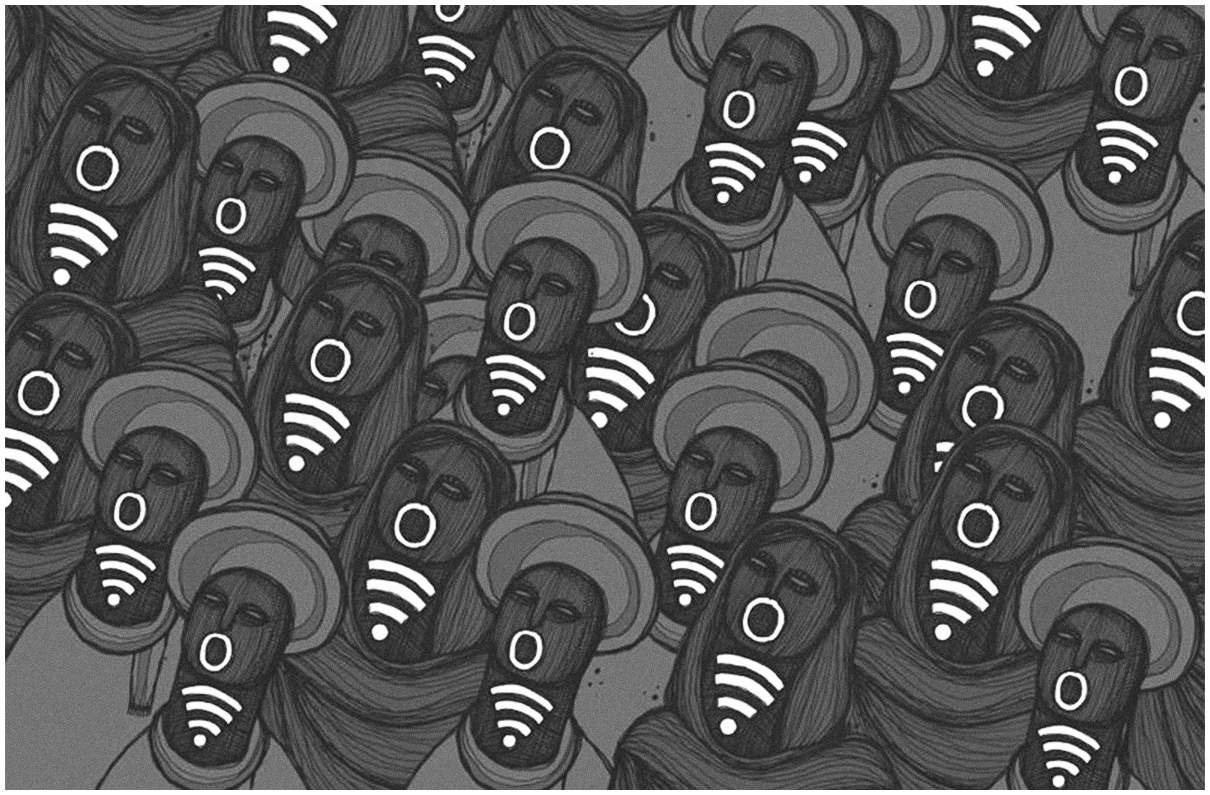
On 3 June, the military council opened fire, killing more than 100 protestors and implementing an internet blackout, citing security concerns. The blockade stopped protestors from mobilising and allowed the military council to carry out extra-judicial killings and detain protestors with impunity.
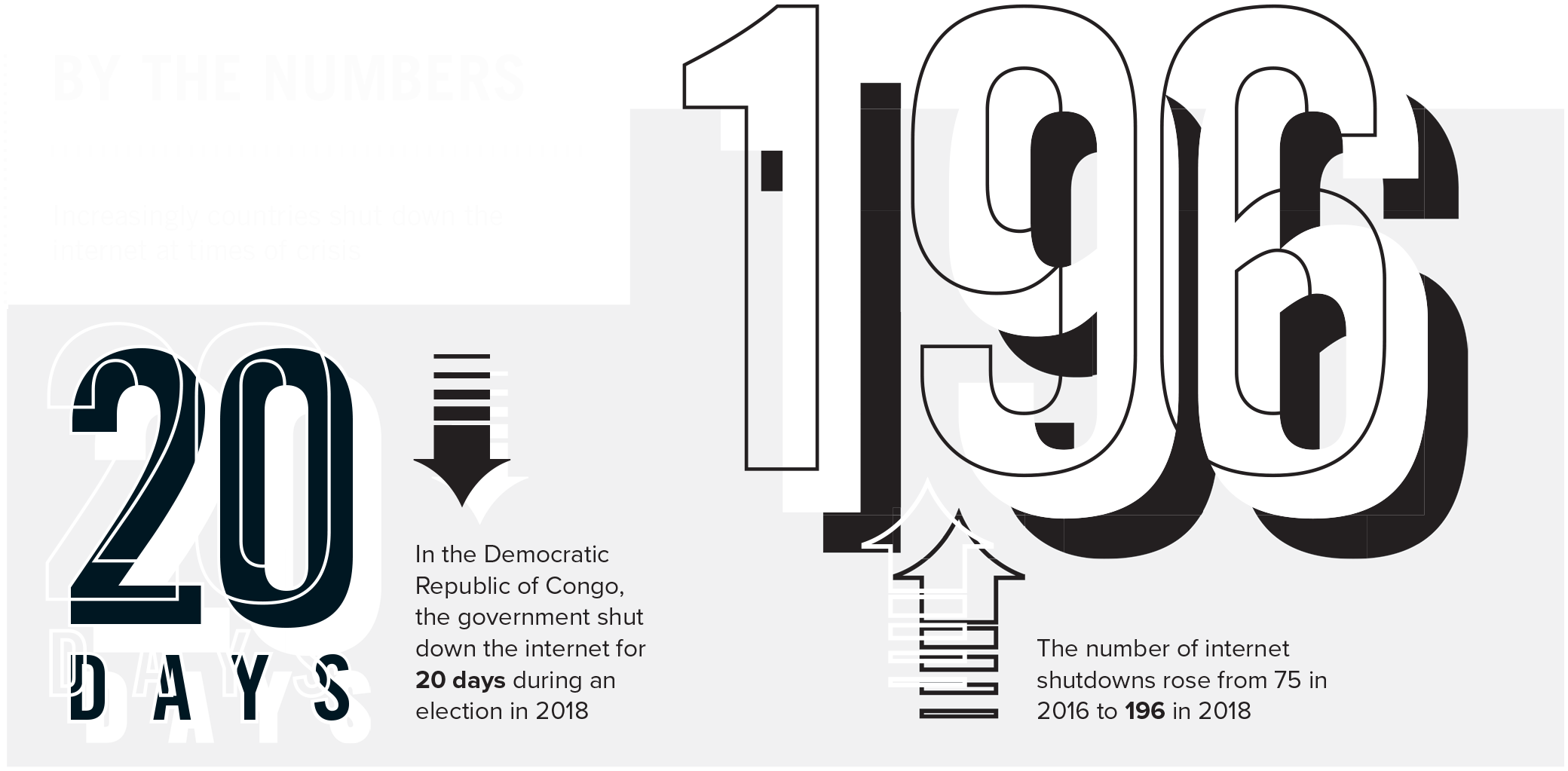
Data from digital advocacy group Access Now shows the number of internet shutdowns worldwide rose from 75 in 2016 to 196 in 2018, and the number is rising again in 2019.
Of the 196 shutdowns in 2018, governments used reasons of public safety to justify 91 of them and national security for another 40. In reality, 98 shutdowns were triggered at times of political instability and protest.
CREDIT: RobinOlimb/ iStock
In 2019 many governments that had not tended to try to get people offline discovered the off switch. These countries included Benin, which turned off the internet during parliamentary elections in 2019 and Malawi, where people found themselves unable to get in online in the jours after a tightly contested presidential election.
Social media blackouts are a quick way to put obstacles in the way of collective behaviour, says Silvia Majo-Vazquez, a researcher at the Reuters Institute for the Study of Journalism. “Groups can, of course, use other channels to organise, but the scale of mobilisation is quicker on social media than on other channels, which is why authorities seek to block it.”
This is especially true in Sudan, where only 28% of the population is online and their demographic coincides closely with the demographic of protestors.
Half the world’s population is now online, so internet control is becoming more powerful as a way to control civil society. Berhan Taye, of Access Now, said: “Part of this is that governments don’t understand how to combat misinformation and think shutdowns help. But in places like Sudan it is also clear we had forgotten people-power, and the impact people gathering can have. And governments think they can use shutdowns to mitigate that.”
One trend in 2019 has been the tendency of more democratic countries, including Benin, to use shutdowns around election time and times of civic unrest.
The UK shut down internet access on London’s underground rail network during climate change protests in April, affecting thousands of people who had travelled across the country to join the march.
By The Numbers
Increasingly countries shut down the internet at times of crisis
Source: Access Now
Mary Meeker, the former Morgan Stanley analyst and venture capitalist who has tracked digital trends since 1995, says that fewer and fewer people worldwide live in countries with zero internet censorship – 20% in 2018 compared with 24% in 2016.
And states are developing better technologies to do it. Even countries such as Ethiopia, with a low internet-access rate, can access deep packet inspection technology to limit internet access in some regions. This technology is a form of data processing that looks at the type of data being sent over the internet and reroutes it accordingly.
The technology was also used this year in Egypt to block websites set up by campaigners who wanted to oppose President Abdel Fattah el-Sisi’s plans to hold a referendum to change the constitution and allow him to stay in power until 2030. The campaigners set up a petition that gained more than 700,000 signatures, only to see it blocked within hours.
Egyptian journalist Dahlia Kholaif has documented the use of internet blackouts in Sinai, where shutdowns are accompanied by a clampdown on civil society, including imprisoning cyber activists for a host of crimes such as threatening national security, contempt of religion and spreading false information.
This year, she says, the government has made it clear it is willing to choke communications across the whole country, not just Sinai.
“This is a government that knows the strength of social media. It came to power through social media and has now spent a lot of time and money making sure it can get it under control,” she said. “This is the worst it has ever been.”
There is also more justification. Fake news, concerns over national security and concerns over the rapid spread of hate speech online have all created spaces and justifications for governments. In Sri Lanka, in the wake of the 2019 Easter attacks, the government suspended social media. This was ostensibly to stop the spread of hate speech that could rebound on the country’s Muslim communities, but in reality the ban also helped stopped discussion of the intelligence failures that led to the attack.
Technology and mobile companies have been slow to develop norms that make it clear when governments have the right to shut down the internet.
This is particularly true in sub-Saharan Africa and much of the global south, where mobile data is how people primarily get online. In February 2019, 54% of all web traffic in Africa and 60% in Asia was via mobiles. In Europe, it was 39%.
In the Democratic Republic of Congo, the government shut down access to the internet for 20 days after a disputed presidential election in December 2018. The country’s two main mobile operators, Vodafone and Orange, said they had to comply under the terms of their operating licences.
Catherine Gicheru, who works in civic technology and data journalism in Code for Africa, which helps citizens use the internet for political engagement, argues that telecoms companies should use their influence more.
“These telcos are multinationals, and yes, they operate within the laws of a country, but why can’t they have the guts to stand up and say ‘no’ sometimes?” she said.
Gicheru calls for an international code of conduct for telecoms companies clearly stating they will not sign licensing deals that give political authorities the right to order them to switch off their signals at will.
This would help mobile operators navigate situations such as that in Zimbabwe, where the government shut down the internet at the start of the year during civilian protests, only for the country’s courts to reverse the move a week later, ruling that the authorities had overreached themselves.
Strive Masiyiwa, the head of Econet, one of the country’s main mobile providers, apologised on his Facebook page for the shutdown and said the company had no choice but to comply.
It should also help avoid odd rulings such as the one in Sudan in June 2019, when lawyer Abdel-Adheem Hassan won a lawsuit against the telecoms operator Zain Sudan over the internet shutdown – but the court ruled that the suit applied only to him. For a while he was the only civilian in the country who could get online via his mobile.
“One advantage of filing lawsuits against shutdowns is that it creates some transparency over who exactly issued the order and how long it will last,” said Taye.
Ultimately, the power to end internet shutdowns may lie with the technology companies themselves. Google’s sister company, Loon, is developing giant internet balloons designed to deliver internet connectivity to remote parts of east Africa and they have already been used to connect people hit by flooding in parts of Latin America, including Peru. Facebook, meanwhile, is developing the use of drones to get remote areas online.
So far, neither of these companies has used its new technology to allow citizens to bypass government-mandated internet shutdowns, but they have raised awareness of digital rights.
And as research groups such as the Brookings Institute assess the exact cost of internet shutdowns to the economy of a country, corporations and citizens may well be persuaded to exert more pressure on governments – and technology companies and mobile operators – to clarify when it is not acceptable to cut off the flow of information. And that may discourage governments from continuing to reach for the off switch when things get rough.