




Abstract
The USA is making it much harder for artists, writers, musicians and academics to gain access to the country.
“It’s alarming,” said Summer Lopez, senior director of free expression programmes for PEN. “Pre-[President Donald] Trump we had to worry about increased surveillance of writers around the world and how we felt about that in the US. This feeds into what we’re seeing now with new visa policies such as social media collection, which has a chilling effect on freedom of expression.”
Almost all US visa applicants are now asked for their social media information for the last five years including user names for sites such as Facebook, Twitter and YouTube. Even applicants for the USA’s visa waiver programme, the Esta, are asked to provide this information, though for them it is not yet obligatory.
Matthew Covey, of Tamizdat, a New York-based non-profit organisation that promotes international cultural mobility and exchange, says it’s a worrying development. Although there is little evidence the government is using social media profiles to deny entry, it does not stop artists and performers from self-censoring.
“I recently had an inquiry from a Norwegian opera singer who was panicked about the delay in her visa in case the delay was due to her social media. She had posted her opinions about [the] Standing Rock [protest], and it was the fact that she panicked and had removed the posts from her Facebook page that is significant for free speech.
“This fear, perhaps way more powerful than the reality itself, is a concern, especially when you think about the interconnectedness of intelligence – for example Homeland Security and Interpol data. There’s the question: if the US government is collecting all this information on me, where else is it going?”
It’s also creating fear in the academic world, says Sarah McLaughlin, of the Foundation for Individual Rights in Education, where academics worry they may be denied entry for something they have put on Facebook or Twitter.
“Academics may choose to self-censor rather than risk engaging in speech they believe could limit their ability to study here,” she said. “Worse, as it’s unclear how this information is used, there is the possibility that the government may use the information it collects to scour academics’ social media posts for objectionable views. Both of these are inappropriate results in a country committed to free expression.”
The Trump travel ban, introduced in 2017 and still in effect, is something else that has had a detrimental impact on creative voices from outside the country. “The travel ban was a tipping point. It said, ‘You’re not welcome here’ and was such a symbolic move that it’s hard to come back from and has long-term effects,” said Lopez. “Other perspectives are very important for Americans. We need to hear creative voices from Yemen, Syria, Iran and Libya – and if we can’t, that’s alarming.”
She says that Kareem Abeed, the Syrian producer of the Oscar-nominated documentary Last Men in Aleppo, about the current Syrian civil war, was refused a visa to attend the 2018 ceremony. He finally got one with the help of PEN after there was an uproar.
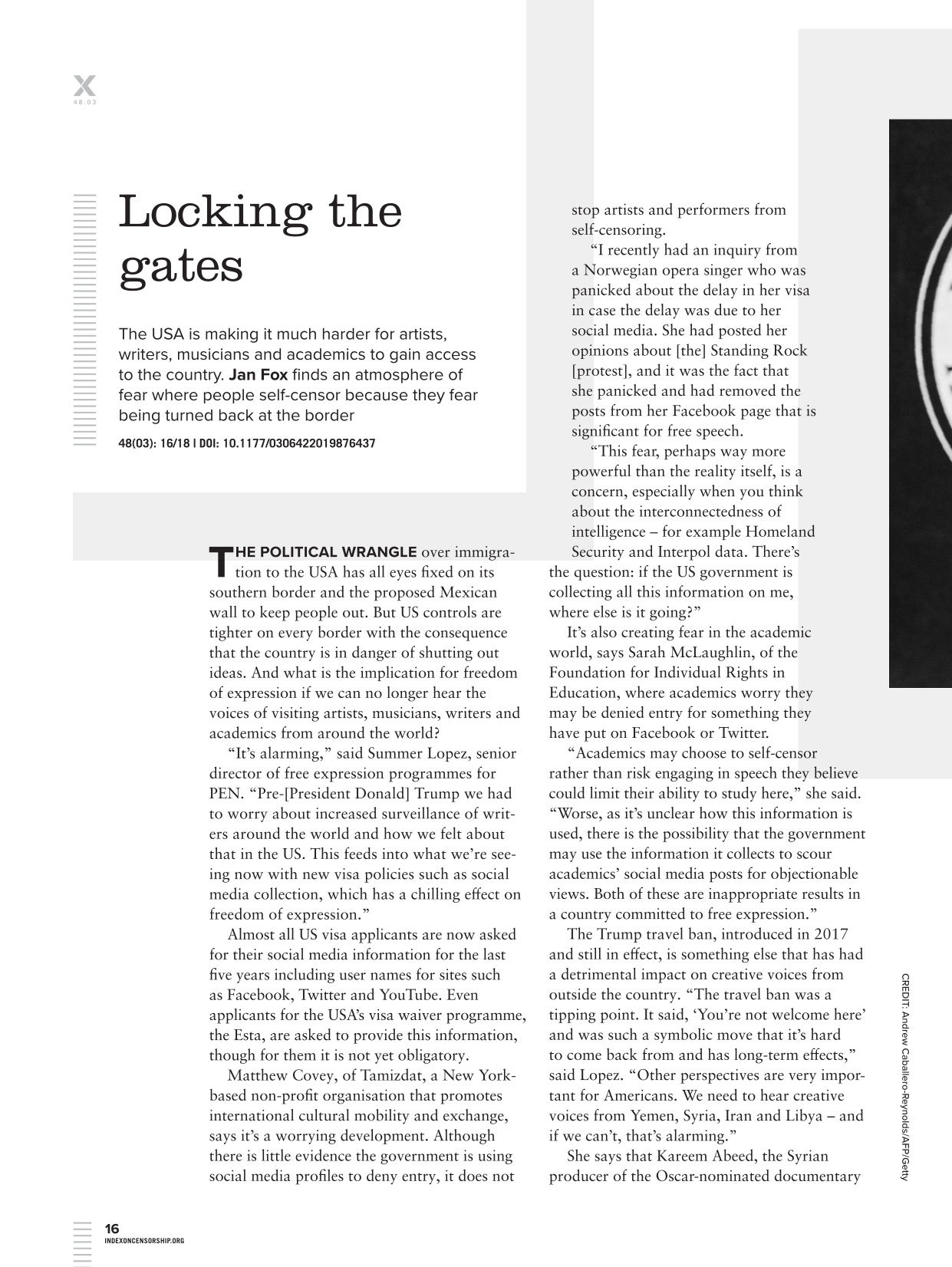
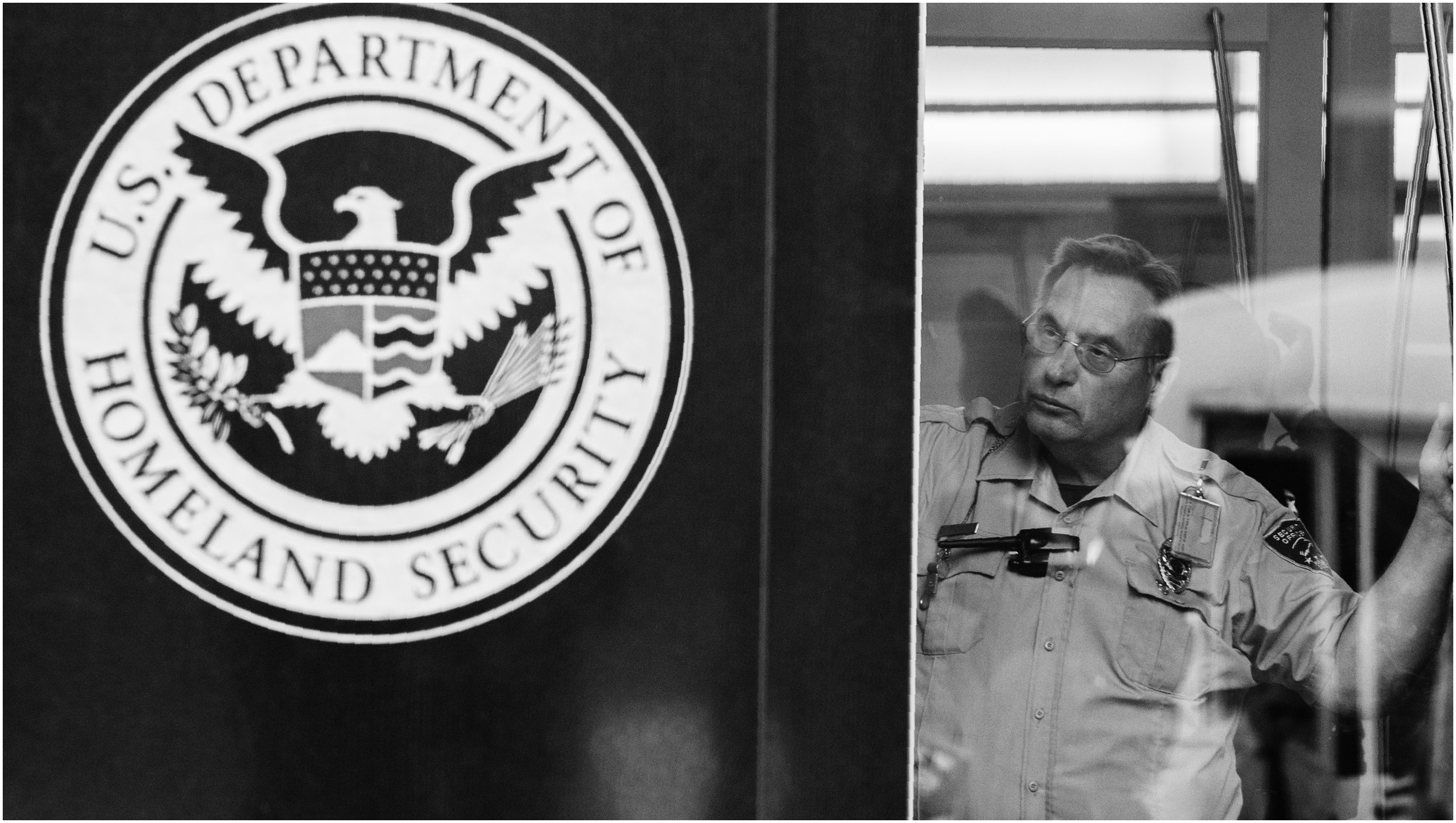
A security officer observes from inside an office at the US Immigration and Customs Enforcement (ICE), which forms part of the Department of Homeland Security in Washington DC, October 2017
CREDIT: Andrew Caballero-Reynolds/AFP/Getty
And there’s a darker implication stemming from the ban. Joy Garnett, arts advocacy officer at the National Coalition Against Censorship, told Index: “The direct adverse effect on international artists and writers may be hard to measure precisely but it should be to everyone’s concern that artists who have previously looked towards the US as a place where they can express themselves freely run a greater risk of being exposed to retaliation under repressive regimes at home when the US closes its doors to them.”
Academics are also being affected by tighter visa restrictions. FIRE highlights two cases this year where visas were denied to Palestinian speakers who were scheduled to speak at US universities. One was politician and negotiator Hanan Ashrawi (who has been a frequent visitor to the USA for decades) and the other was Palestinian activist Omar Barghouti, who had been due to speak at colleges including Harvard and New York University. No concrete reasons for the denials were given.
McLaughlin told Index: “One of the great promises American universities can offer students and academics is the possibility of freedom to study and research without government interference or punishment. That freedom is threatened if immigration restrictions are used to interfere with the free exchange of ideas across borders.”
Similar refusals have affected visiting Chinese professors and scholars, possibly due to heightened fears of espionage and political theft. A New York Times article in April 2019 highlighted the case of Chinese professor of international relations Zhu Feng, whose visa was cancelled by FBI agents at the airport on a recent visit to Los Angeles.
There are many reasons why visas are denied, explains Covey. “Often people just have the wrong visa. They come in on an Esta, but really need an O or P work visa. [Other visa types apply to academics.] The authorities have turned a blind eye to much of this in previous years – for example, the loophole of the ‘audition’ or ‘showcase’ criteria where, for instance, musicians may be able to perform at a one-off festival – but now customs and border control enforcement has really tightened up.
“This administration is buried in xenophobia and hysteria, although there’s been a general tightening of the screws on visas since the 1990s so it’s not all Trump. With the xenophobia aspects it’s hard to keep track of the fact that most of the immigration rules are, in fact, about labour, not security. They were originally designed not to take jobs away from Americans. And if you’re an artist who says you’ll work for free just to be seen, that’s also unhelpful as it’s deemed that you are lowering the value of US labour,” said Covey.
Lack of officer training or having the “wrong” visa, means many artists might be denied entry or experience harassment when they arrive at the border.
One of these was Australian children’s author Mem Fox. Despite 116 previous visits to the USA to promote her books, she was detained and questioned in 2017. Cartoonist Ali Dorani (aka Eaten Fish) who fled Iran, was the winner of a Courage In Cartooning award in 2016 but was denied a visa to visit the USA last year to visit the annual convention of the Association of American Editorial Cartoonists’ Convention.
At the 2019 Oscars, Mexican actor Jorge A Guerrero – who was in the multi-nominated film Roma – was denied a visitor visa three times. He missed several awards ceremonies, including the Golden Globes, before finally being admitted just in time for the Oscars ceremony following pressure from distributor Netflix. It’s not clear why he was previously denied visas.
Rocketing visa costs are another factor in dissuading foreign creatives who want to visit the USA, says Covey.
“Back in the early 1990s it was affordable and viable, and mostly the paperwork could be filled out by interns at arts organisations. But there’s been ‘bureaucratic creep’ since then,” he said. “Two years ago the cost of filing for an O [work] visa went up significantly. In 1992, a five-piece band might have been able to come here for under $500 including all filing fees; today it’s ten times that and you usually need a lawyer – this is a real impediment to foreign artists wanting to come.”
It may have become too hard for creative people to even try to visit the USA at a time when it’s critical to hear other voices, says Lopez.
“After [the New York terror attacks of] 9/11 we worked hard at PEN to ensure international cultural exchange,” she said. “The spread of nationalism and isolationism around the world means this is exponentially more important. We are hearing exclusive nationalist messages and we are not hearing from people with different perspectives, so this is very disruptive. We at PEN are fighting for that space to hear other voices. What’s going on now definitely increases the sense of alarm.”