




Abstract

Travellers to Turkey should be prepared for what they are not allowed to do or read.
Unlike North Korea, Turkey doesn’t yet have its own intranet with sites disconnected from the world. Instead, the Turkish internet is a slightly redacted version of the original.
Over the past decade, as part of a nationalistic drive, Turkey has more keenly defended its borders to control information coming in and out of the country. As a result, censorship is taking subtle new forms. Since the early 2010s, as the country has become politically more isolated and has turned its back on its EU accession goals, Turkish control over the flow of information slowly increased. Once considered a bridge between East and West, Turkey began to resemble a border between continents.
Placing physical borders on the flow of information, in a nation of 82 million people, is a Herculean task demanding immense budgets and dedicated personnel. Turkey has recently focused its energies on two fronts. First, authorities use digital borders to control information coming into the country. Secondly, they use physical borders to control reporters and visitors who travel in and out.
This task was outsourced to the Information and Communication Technologies Authority. Founded in 2000, the ICTA oversees a budget of more than $900 million and employs a staff of about 640.
Seven years earlier, the internet had arrived. It came on 12 April 1993 via routers installed inside the Middle Eastern Technical University in Ankara, posing a challenge to the authorities’ grip on information. The early 1990s, a catastrophic time for human rights, had seen torture becoming rampant in police stations; prosecutors eagerly pursuing prison sentences for dissidents; and Kurdish political activists routinely suffering forced disappearances. By the time the first internet access provider was founded in 1996, dissidents hoped the internet might loosen Turkey’s political borders.
In 2001, about the time Western magazines were hailing Turkey as a bridge between East and West, the Turkish parliament passed a law to regulate the internet. Numerous websites, mostly those related to Kurdish separatist groups and the hard left, became inaccessible. After 2005, the pace of bans accelerated. In 2007, Turkey shut off access to YouTube after it failed to remove a video about Turkey’s founder, Mustafa Kemal Atatürk. The same year, a Muslim evangelist preacher named Adnan Oktar used a Turkish court order to shut down the blogging website WordPress, not just the page about him, but all WordPress-hosted sites, which disappeared overnight.
The legal framework for such border control actions is murky. In 2011, the ruling AKP (Justice and Development Party) passed a law to create the “safe” use of the internet; three years later, it gave the ICTA the right to shut down websites it didn’t like within four hours.
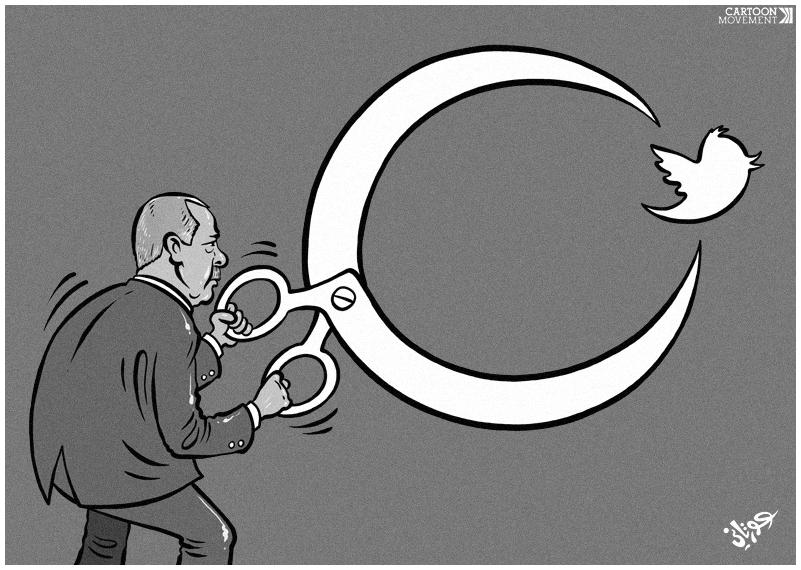
As the government became more inward-looking politically, its border patrols on information grew. In 2014, the ICTA closed Twitter for a time, using a law that made it possible based on “privacy violations”. In 2017, it shut down Wikipedia.
Turkey remains a tourism destination for Westerners, but now the second aspect of border control came to the fore: policing what foreigners can see while they are in the country.
Pat Yale, a Cambridge University graduate, moved to Turkey in 1998 and began living in a cave-house in Cappadocia. “For anyone moving to Turkey from a country such as the UK, the single biggest barrier to accessing knowledge has to be the Turkish language,” she told Index.
“This is especially the case with bureaucratic language, which is notoriously difficult even for native speakers to understand; when translated, it all too often ends up reading like gobbledy-gook. Of course, language issues render libraries fairly useless for newcomers. In this context it hardly helps that Wikipedia has been banned in Turkey for more than two years.”
Despite problems accessing information, Yale managed to write for the Lonely Planet Guide and co-authored four other English books on Turkey. Nowadays, she advises travellers to prepare for information restrictions before reaching the Turkish border. “I’m not much of a techie myself, but the obvious advice in general is to sign up to a VPN to get round the blocks,” Yale added. To get around the Wikipedia ban, she devised a different technique: putting an “e” before Wikipedia in the address bar. “I absolutely hate not having access to the site,” she said.
Turkey’s border with Syria is 822km; its border with Iraq is about 330km. For activists, writers, researchers and journalists such as Yale on their way to Turkey, recent stories from those borders were alarming. Since the Syrian civil war began in 2011, and especially after the rise of Isis and the flourishing of Kurdish-controlled cantons in 2013, Turkey’s borders with Iraq and Syria moved to the centre of Turkish politics. Security forces, which for years failed to detect and detain Isis and Kurdish militants heading to Syria and northern Iraq, are more vigorous nowadays.
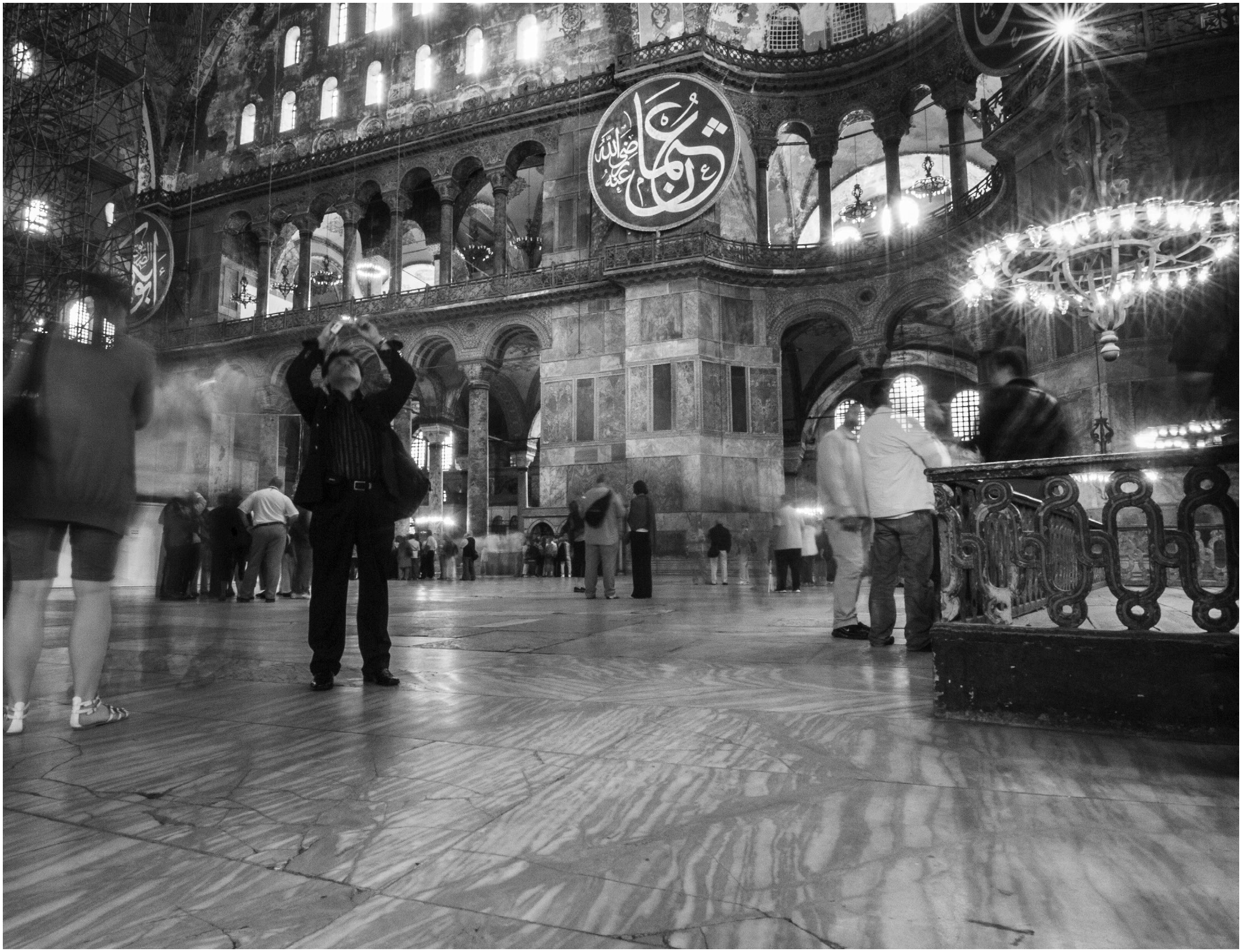
Tourists take photographs inside the Hagia Sophia mosque in Istanbul, Turkey, but they cannot have access to its Wikipedia page in Turkey
CREDIT: Neil Julian/PicFair
Some journalists, such as Steve Sweeney, have found getting into Turkey an issue. The international editor at the London-based socialist newspaper Morning Star, Sweeney arrived at Istanbul’s Sabiha Gökçen Airport in March 2019 and was immediately detained by border police. “A police officer grabbed my phone out of my hand and bundled me into a holding area next to their office,” Sweeney wrote in a piece detailing his detainment. “The tiny smoke-filled room was already packed when I arrived. The 18 men looked puzzled and surprised at my arrival. I was the only person of non-Turkish or Middle Eastern appearance.”
CREDIT: Jehad Awrtani/Cartoon Movement
After a brief interrogation, the border police told Sweeney that he was a national security threat. Sweeney was put on a Pegasus Airlines flight to London. He is now on a blacklist and is banned from entering Turkey. Around the time of Sweeney’s detention, two French Communist Party members experienced a similar ordeal.
Turkish border police are wary of writers and activists such as Sweeney who visit Turkish border cities to communicate with fellow-minded activists for political or journalistic purposes. Some of the fears of border authorities are hardly unfounded: over the past half-decade, hundreds of Isis militants from the USA and the EU have passed through Turkey on their way to Raqqa. But those border risks and past mistakes now allow the Turkish authorities to bar critical voices from entering the country. Over the past three years, about a dozen correspondents have learned they’ve been blacklisted from Turkey while trying to cross the border. Border police handed them notices, put them on planes and sent them back.
Yale, who is now working on a book about Gertrude Bell’s travels in Anatolia, acknowledges that borders have long been problematic in a geography as politically troubled as Turkey. Bell, an ardent traveller who advised Winston Churchill (the British statesman who later became prime minister of the UK), helped draw up the borders of the Middle East after World War I.
“Foreigners newly arrived in a country obviously vary in how much prior knowledge they have of it,” Yale said. “But one risk is that we bring with us a set of assumptions about how things work based on what happens in our own countries.”
Our own intellectual borders can hide vital information about countries we travel to. Yale advises visitors to Turkey to prepare by using social media as a reference point.
“In the face of these problems, the various websites and Facebook sites set up specifically to link foreigners with each other can be invaluable. They enable people to ask questions of those who’ve recently dealt with the same problems or whose longer stays in the country mean that they may have a better understanding of the language and the different systems in operation.”
But therein lies a conundrum. According to Freedom House’s 2018 Freedom on the Net report, Turkey is among five countries that showed the largest decline in internet freedom in the past five years. It argued that it left social media companies with little choice “but to censor non-violent political commentary as a condition of doing business in the country”. Others argue that they have other choices.
Changing the status of Turkey from a bridge to a border between East and West has come at this steep price. When borders alienate more than protect, they no longer serve their proper purpose, as disgruntled locals join expats in looking beyond borders for lives elsewhere.