




Abstract

Isis burnt thousands of books in Mosul’s central library, writes
The original library and its contents were destroyed by Isis after they captured Mosul in 2014. It was a bid to wipe out the city’s history and intellectual heritage.
Now the library is being rebuilt and starting to provide services to the university’s students and researchers. Ahmad al-Najim, a student of economic studies, believes the library is essential – not just to students but to the recovery of his city as a whole.
“The library is the face of Mosul. We need the library to protect and preserve our history to envision our future,” he said.
Another student Yusif Ali adds that the library is “the only place where we can make a better future”. For many students on campus, the library is vital for research and to develop their knowledge.
Last May, I was invited by a Danish anthropologist to an event in Norway – the fifth anniversary of the Future Library, a self-defined “100-year public artwork” tasked with collecting an original literary text by a renowned writer every year from 2014 to 2114, which will remain unread and unpublished until 2114.
The idea that a library would open in a century’s time was fascinating to me, someone who was trying to revive his own library destroyed by a group of terrorists. The Future Library confirmed our mission to rebuild the library of Mosul, as there are still those who imagine and believe in the power of libraries.
At that event, in the Nordmarka Forest, just outside Oslo, I sat listening to South Korean writer Han Kang reading aloud. While the audience was focused on her words, my mind was half a world away in Mosul, consumed by thoughts of whether our once thriving library would ever recover.
Since the first days of its occupation of Mosul, Isis wanted to change the city’s history and replace it with its own narrative. The first victim of that destructive ideology was our library. They stole rare manuscripts, burned irreplaceable books and destroyed a building which once had one of the most extensive collections of documents and archives in the entire Middle East.
In the battle for the city, more than 80% of the urban landscape was heavily damaged or completely destroyed. Although the need to reconstruct the city was pressing, the library was also an urgent priority for many Mosul residents, including Ali al-Baroodi, an English teacher at Mosul University.
“We need libraries, as most of them were either burned, bombed or looted. It breaks my heart to walk by empty bookshelves and blackened walls,” he said. “We also need to revive school library visits so that we’ll have a new generation that loves and values reading.”
These convictions were the force behind the launch of a global campaign in February 2017 to preserve the library’s remaining books, as well as to resupply it.
The idea behind this campaign goes well beyond the books themselves. It is also about engaging the city’s youth who, for three years, lived under the rule of constant terror and experienced indescribable horrors. I called upon young people in Mosul to help us recover the library’s remaining books, and the results were amazing. We preserved more than 30,000 rare books and manuscripts.
The global response was also immense as thousands of people responded to the call, sending us books. In less than a month, Mosul Eye’s appeal reached its first goal – that of reconnecting Mosul with the world.
The campaign re-inspired Mosul’s cosmopolitan character and its intellectual and cultural life, showing the world that a city once occupied by Isis that should be starving was also yearning for books. But there were those who attacked, mocked and humiliated me and others who were calling for books for a destroyed city, and who told us we first needed bread.
We wanted to do much more than restock our library with books, however.
I visited libraries around the world, including the Alliance Israelite Universelle Library in Paris – a library dedicated to preserving Jewish history – in an effort to obtain digital copies of rare manuscripts, documents and microfilms. I also spent countless hours searching open access collections in an effort to collect any document related to Mosul and its history and my work as a historian helped me gain access to many other libraries and institutions.
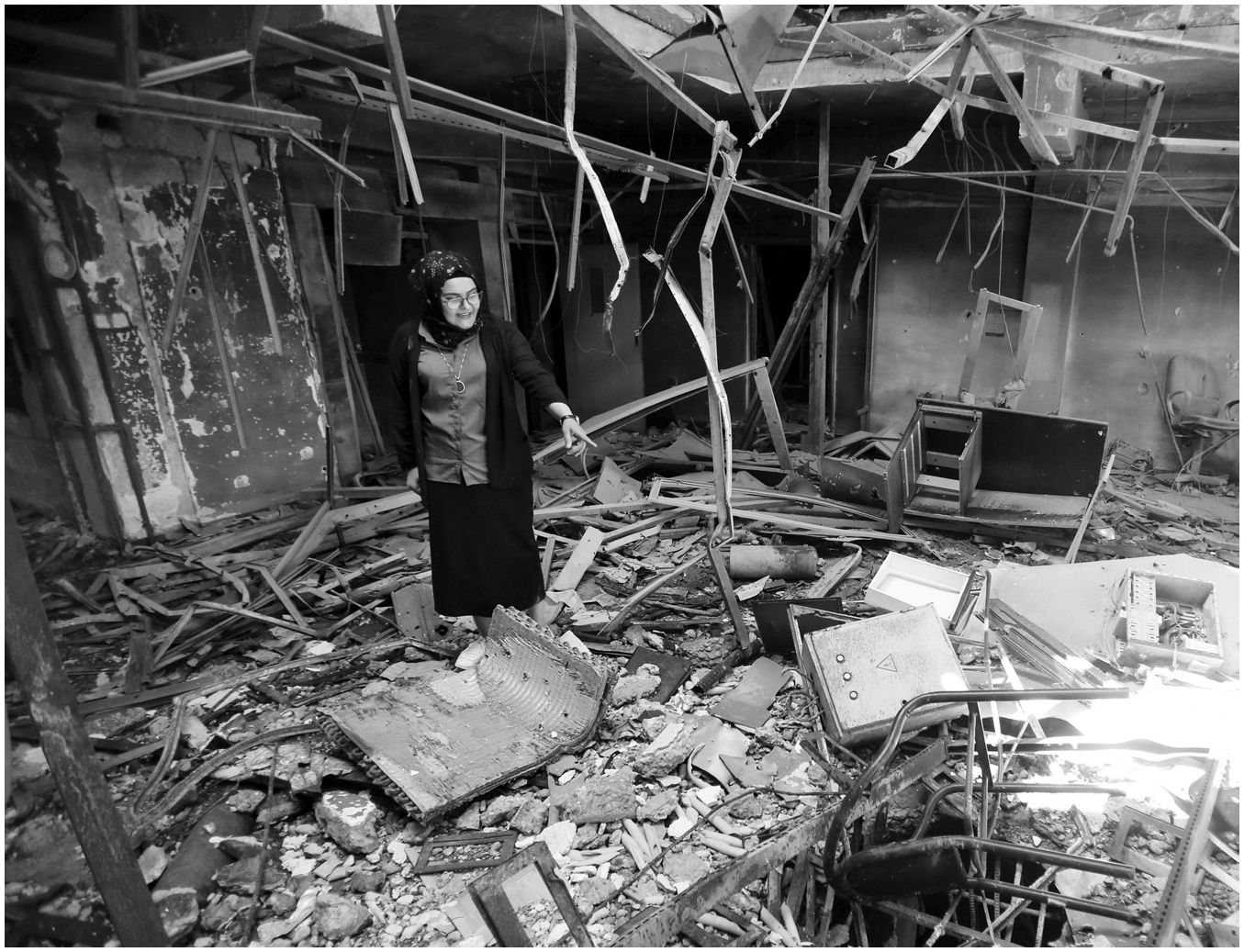
Raghad Hammadi, a member of a group of students who campaigned for the Central Library of Mosul University to be rebuilt, walks in the rubble and destruction in May 2018. Isis fighters looted and systematically destroyed book collections in the library during February 2015
CREDIT: Zaid Al-Obeidi/AFP/Getty
The linking of diverse partners round the world including in the Middle East and north Africa was made easier by new technology and brought us different books from many places. The campaign for libraries is about people and creating a new collective and visual memory in Mosul, especially among the youth, and ending the censorship of reading in the city.
“We cannot have a university or a city without a library,” agriculture professor Anas al-Taie said.
More books arrive at Mosul every day, but our focus is now moving to digitisation, so that what has survived these years of war and destruction will be protected. We are reconnecting the university and its library with the growing field of digital humanities to provide access to the most recent publications and digitised materials.
Our call is now for donations of digital archives, digitised manuscripts and assistance with establishing a digitisation unit.
After so many years of isolation and disconnection from the rest of the world, Mosul is being reconnected globally through books.
These budding relationships and the future projects they will yet build are starting, slowly, to replace the terrible memories of these past years, especially for the young generation.
Footnotes
Additional research by