




Abstract

Author
Her distrust of all forms of authoritarian ideology is a constant throughout her work, influenced – as she was – by the struggles in 20th-century Europe, where countries on the continent succumbed to the violence of fascism and communism.
Her most famous screenplay, for which she received an Oscar nomination, was for the Alain Resnais film, Hiroshima Mon Amour, which she wrote out of “weariness with the cinema of consumption”. She explored the erotic relationship between a Japanese man and a French nurse in Hiroshima in 1957. One of the first new wave films written at the beginning of the cold war, it cuts from the story of the couple to pictures of the after-effects of the nuclear bomb which the Americans had dropped on the city only 12 years before. It also includes flashbacks to the main female character’s memories of having a German soldier as a lover during the war. Not only was the film a lot more overtly sexual than most 1950s movies, but the theme of sleeping with the enemy and the sharp critique of the use of the nuclear bomb to end the war were taboo for many at the time. The film was pulled from the 1959 Cannes Film Festival to assuage American sensitivities.
Duras was born in the first year of World War I in French Indochina, now Vietnam the daughter of two French schoolteachers. Her father died when she was very small and her desperately impoverished mother – who always hoped her daughter would make money – bought a rice farm in a place where the land was constantly being lost to the sea.
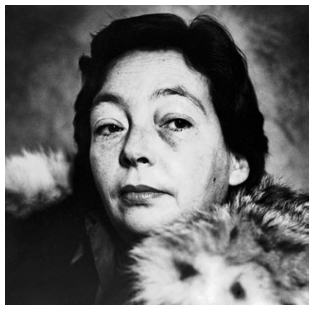
French novelist, screenwriter, scenarist, playwright and film director Marguerite Duras
CREDIT: Sipa/Shutterstock
Duras’s 1984 Prix Goncourt-winning novel, L’Amant, about the 15-year-old’s affair with a wealthy Chinese man, sold five million copies in four weeks and was felt to be an account of that period, even though it was not strictly true.
Duras left to study in Paris aged 18. She joined the French Communist Party and during the German occupation she worked for the Resistance, while also working for the paper supply section of the Vichy government. A year before her husband, Robert Antelme, was deported to the concentration camp at Buchenwald, she published her first novel, Les Impudents. From then on, the horror of the death camps informed everything she ever thought, felt and expressed.
Although she remained a member of the Communist Party for seven years, she suffered from its restrictive and patriarchal structure and claimed that she became truly de gauche only once she left, and learned “to despise no one” – though she spoke out bitterly against the Soviet Union, saying: “The century’s greatest hope has become its greatest failure.”
As she built a career as one of the greatest of French writers she was always of the moment, both universal and timely.
For her, 1968 was jouissif, a joyful explosion of revolutionary feeling. Politics were spiritual: “It’s all as if God did exist.” But she lost faith in politics, as one might lose faith in God. Love, alcohol and writing filled the void left by both. She had no wish to live in the 21st century, in which “all conditions were present for the experience of the utmost ennui, the futile expectation that something might happen…”
The Lorry (Le Camion), an extract of which is published in English for the first time below, is scarcely a story, more a proposition containing all other possible stories.
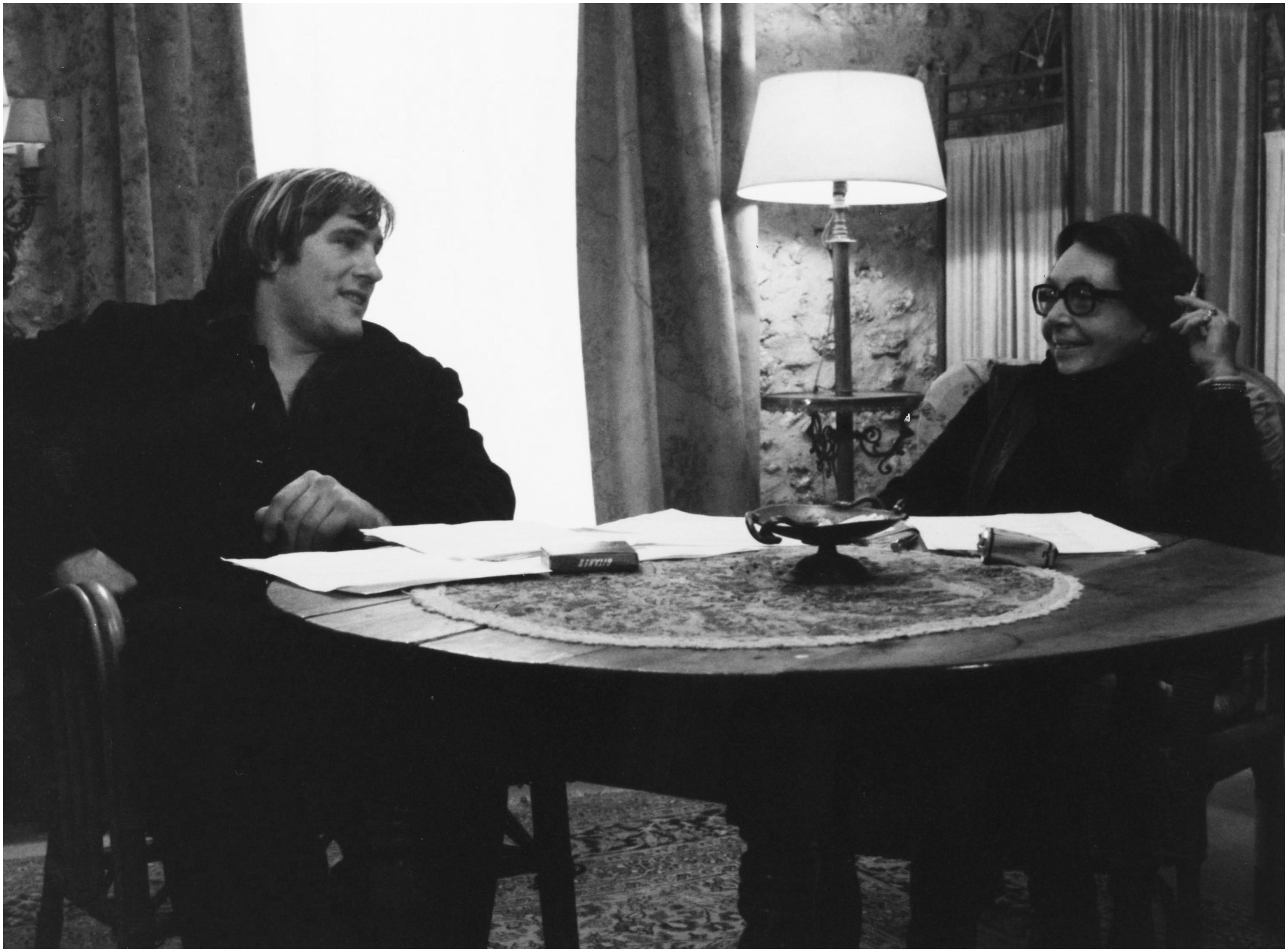
The script is cast in the conditional mood, the tense children use when they propose a make-believe game which is also deadly serious. Duras sits reading the script with French actor Gerard Depardieu in a dark room (a metaphor for a photographic darkroom in which characters not seen on screen are imagined). On a road in northern France, she tells us, not far from the sea, a woman hitches a ride in a lorry and speaks to the driver about love, politics, life, antisemitism, the “massacre of the earth”.
Still from the film Le Camion which was first released in 1977 featuring Gerard Depardieu and Marguerite Duras
CREDIT: Auditel/Kobal/Shutterstock
Perhaps she does the same thing every night, her way of making the world more tolerable. Occasionally the camera cuts to the lorry, travelling, or the road the two travellers see ahead. The music is Beethoven: the Diabelli variations.
All through her life, Duras affirmed the limitless potential of the text. The sea, the mother, the wind, love, loneliness – these are the words she puts on the page, which contain the possibility of, and carry, all other words. “I don't always quite understand what I'm saying, but I know it's true.”
The Lorry
DARKROOM
(Beat.)
(Beat.)
She is travelling around.
Silence.
(Beat.)
The difference between them would have been the very subject of the film. And their confinement inside the lorry’s cab, the first space.
Silence.
What?
What would have happened?
Of the countryside. Of the wind. Of recent scientific discoveries. Of how difficult transportation is in that region.
Of a child called Abraham.
Of love.
She would have said suddenly:
There is no story outside of love.
It would have been a film about everything.
About everything at the same time:
About love.
SIDE ROAD. Wheat fields.
No text.
In the distance, the lorry is seen. It crosses the screen. Music.
DARKROOM
(Beat.)
I feel as though you and I, too, are threatened by the same light that they are frightened of: the fear that all of a sudden the lorry’s cab, this darkroom, may be flooded by a stream of light, you see... The fear of a catastrophe: Political intelligence.
Silence.
Inspired by specific demands that are supposed to better his lot, all of a material nature.
She would have spoken all alone almost all the time.
He is caught between two affiliations.
He only sees things in relation to them.
I forgot to tell you that she would have been subjected to that omnipotence, the rule by a class which decides the fate of all the other classes.
When she was young.
And then also after.
Silence.
She’d believed it.
A sacred God: the proletariat.
She’d believed it.
No one has the right to question the proletariat’s responsibility.
She’d believed it.
The responsibility of the activist should never be called into question again – that would mean risking blasphemy against the working class.
She’d believed it.
No one dared, no one dares anymore to call into question the responsibility of the working class: blasphemy.
She hadn’t dared.
For a long time.
Silence.
The complicity between the owners and the workers.
Their identical fear.
Their identical goal.
Their identical politics: the infinite delay of any free revolution.
Killing the other man in each man, robbing him of his fundamental nature: his own contradiction.
Silence.
And then one day, she saw.
It was summer.
The clowns, on the tanks, entering Prague.
(Beat.)
Maybe you remember?
These paint-faced, smiling, gently brainless men.
These new killers.
This result obtained through the clash between capitalism and socialism.
A result they were proud of.
(Beat.)
For a long time she watched without seeing.
And then, that day, she saw.
Silence.
The anxiety belongs to the working-class.
Only this material anxiety is worth taking into account.
The anxiety of the others?
Class privilege.
Silence.
Listen. She’s singing.
She closes her eyes and sings.
CREDIT: Keystone-France/Getty
— FOREST. Pan shot.
In the foreground, frozen puddles. Behind, a birch tree forest white with frost.
Music.
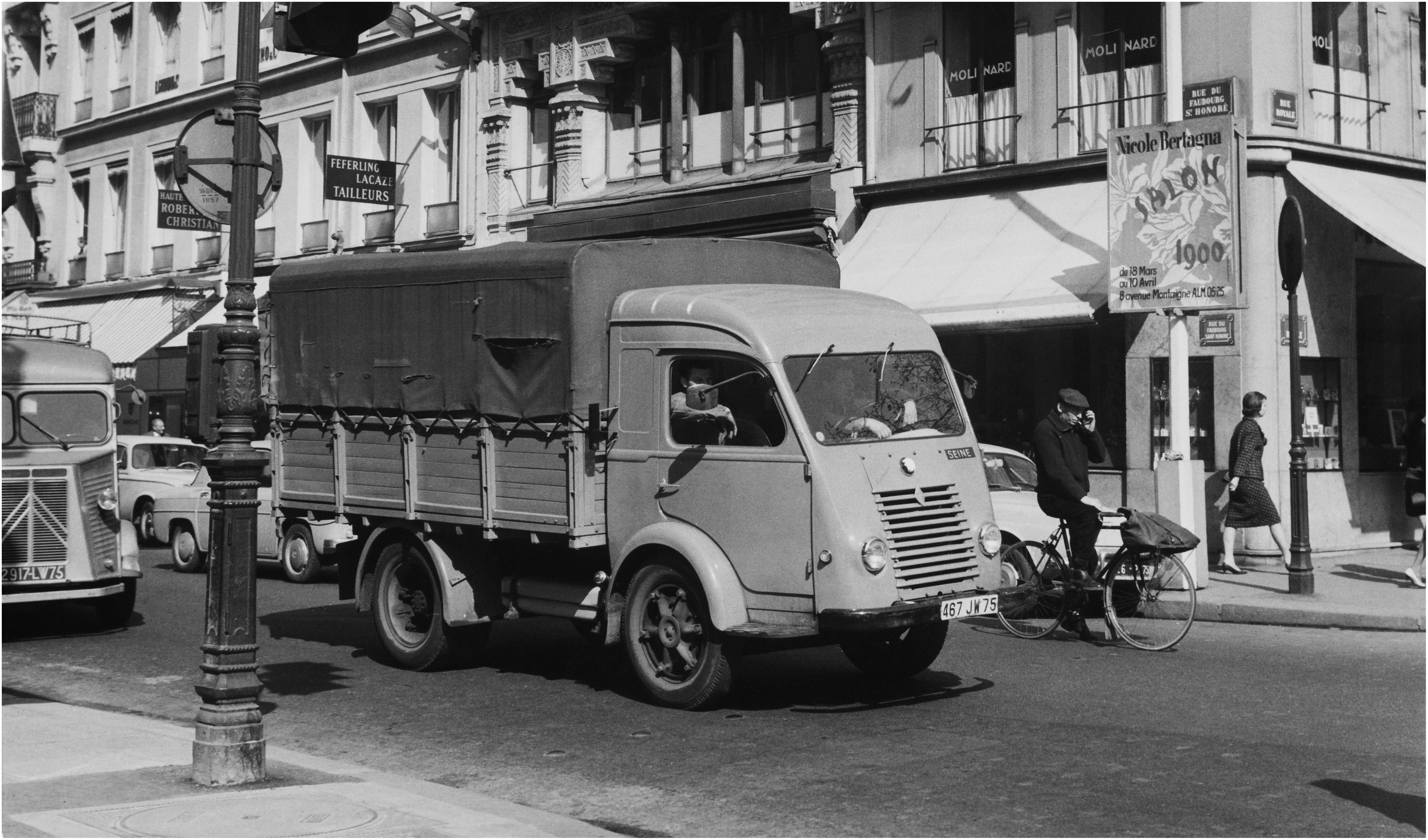
At the end of the pan shot, a road. The lorry. It drives along the forest, crosses the screen, very slowly.
Far away.
Loud.
(Beat.)
And then she would have spoken of other towns.
Of many other towns.
Less far away.
Between the vineyards. caught between vineyards and rivers.
Other rivers.
She would have said she remembered them less precisely.
He doesn’t ask which ones.
(Beat.)
She sings.
She closes her eyes. Sings.
DARKROOM
She tells him: you know, Karl Marx, that’s all over.
She always says the first names: Marcel Proust. Pierre Corneille. Leon Trotsky.
Karl Marx.
.some kind of obsession.
Silence.
(Beat.)
Yes.it’s true.
You are a reactionary.
(Smiles. Silence.)
(She reads.)
That’s it, Gou-chy.
(Beat.)
(Smile.)
Do you know it?...
Did you see, they’ve enlarged the buildings along the river, southside, where it slopes down.
That’s good... On the north side, it all opens onto the forest...
It was necessary to do it. It had become too small lately.
Silence.
Are you involved in politics?
She answers:
No. Not involved.
I’m not involved in anything.
I’ve never been involved in anything.
SIDE ROAD, the region of Chavenay (Yvelines).
Wheat fields. No text. The lorry appears in the distance, disappears, descends. Crosses the screen.
Music (Diabelli’s theme).
DARKROOM
Who has just given birth.
Silence.
She says:
Imagine, my daughter has just given birth and my car broke down the very day I had to leave.
(Beat.)
It’s a boy.
The birth wasn’t too bad.
(Beat.)
Since my nephew, that day, had to meet his brother, who lives where my daughter lives, I told myself that I could leave with him, but we missed each other by an hour, so it didn’t work out. Then what? I took the train to meet my sister right away without telling her in advance and, of course, when I arrived, there was no one, no one: a neighbour told me that my sister had gone to see a friend and wouldn’t be back till the evening.
So I decided to stop the first passing car.
(Beat.)
My sister lives in the middle of nowhere. There is only one train a day and it comes at impossible hours.
(Beat.)
I did try to call her, but the operators told me that the local phone lines were down because of a storm.
That happens often in the coastal areas.
The wind. The wind, you see.
It’s a huge plateau. Nothing stops the wind. Nothing, not a tree. It’s barren.
The trees are uprooted by the wind – or twisted, laid down as if massacred.
(Beat.)
She sings.
A long silence. While “she is singing”, M.D. places the manuscript on the table.
(takes back the manuscript)
She’s stopped singing.
(Beat.)
She says: Excuse me, I sing because I’m happy because of this child, you see, please forgive me. I must also tell you that I’m always somewhat confused. I’ve never been able to put my ideas in order, to follow an idea without noticing another on its way.
Oh, just don’t listen to me, in the end, that’s what they say in my circle: don’t mind her. Listen, it’s not all the time; I sometimes say more sensible things – more serious things, as they say.
(Beat.)
I also sometimes go silent for a long time. yes.
(Beat.)
To tell the truth, it creeps up on me like on everyone else: speaking, going silent. Being sad, or full of joy.
(Beat.)
But this, without any rules, it seems, it’s what they don’t like in my circle, this mental disturbance, but you see. after all, I could reply that the fact that I don’t grasp a given logic doesn’t mean that I don’t have some kind of logic of my own. They call me too self-centred. You must have heard the word. It’s used often. In principle, it’s offensive. It’s something one says of children. Too self-centred, he is too self-centred, she is too self-centred.
Silence.
I think the child is called Abraham. I hope this won’t be difficult for him.
(Beat.)
My daughter wanted to call him that. Her husband didn’t really agree.
(Beat.)
He said he was afraid for the child, for its future, simply because it would bear this name.
(Beat.)
She insisted. Her husband said they had to forget all those names, those Jewish words. He said that naming a child Abraham encouraged the worst collective psychosis, all the discriminations and pogroms.
My daughter didn’t budge; she called her child Abraham.
Her husband is in the French Communist Party, which says it all. He was afraid they would call him a racist if he called his son Abraham. He was afraid. He said that he saw no point in calling a child such a name, a non-Jewish child.
I have to tell you that we are not Jews – no. Or Arabs.
Neither Jews nor Arabs.
(Beat.)
My daughter thinks that poetry is the most shared thing in the world, together with love. And hunger.
(Beat.)
She always talks about a counter-knowledge that supposedly happens in us at each moment; we reject it, but in vain, she says. She says: fortunately, because otherwise we would have to wait for the death of the dead.
(Beat.)
I think she’s talking about her husband.
Silence.
The birth was rather painful, but the child didn’t suffer.
(Beat.)
She sings.
Footnotes
Translated by