




Abstract

The rule of law has completely broken down in Venezuela and it is left to journalists to provide “little sparks of light” in the darkness.
The 2019 World Justice Project’s Rule of Law Index ranks the country lowest of all the 126 countries listed, and it falls down in every single category – from failing to provide judicial constraints on government powers to fairness in the criminal justice system.
In May this year, the total breakdown of judicial independence led to judges from the supreme court siding with President Nicolás Maduro in accusing 14 members of the opposition party of treason. Three of them feared enough for their lives to take refuge in foreign embassies and Edgar Zambrano, national assembly president Juan Guaidó’s deputy,was arrested.
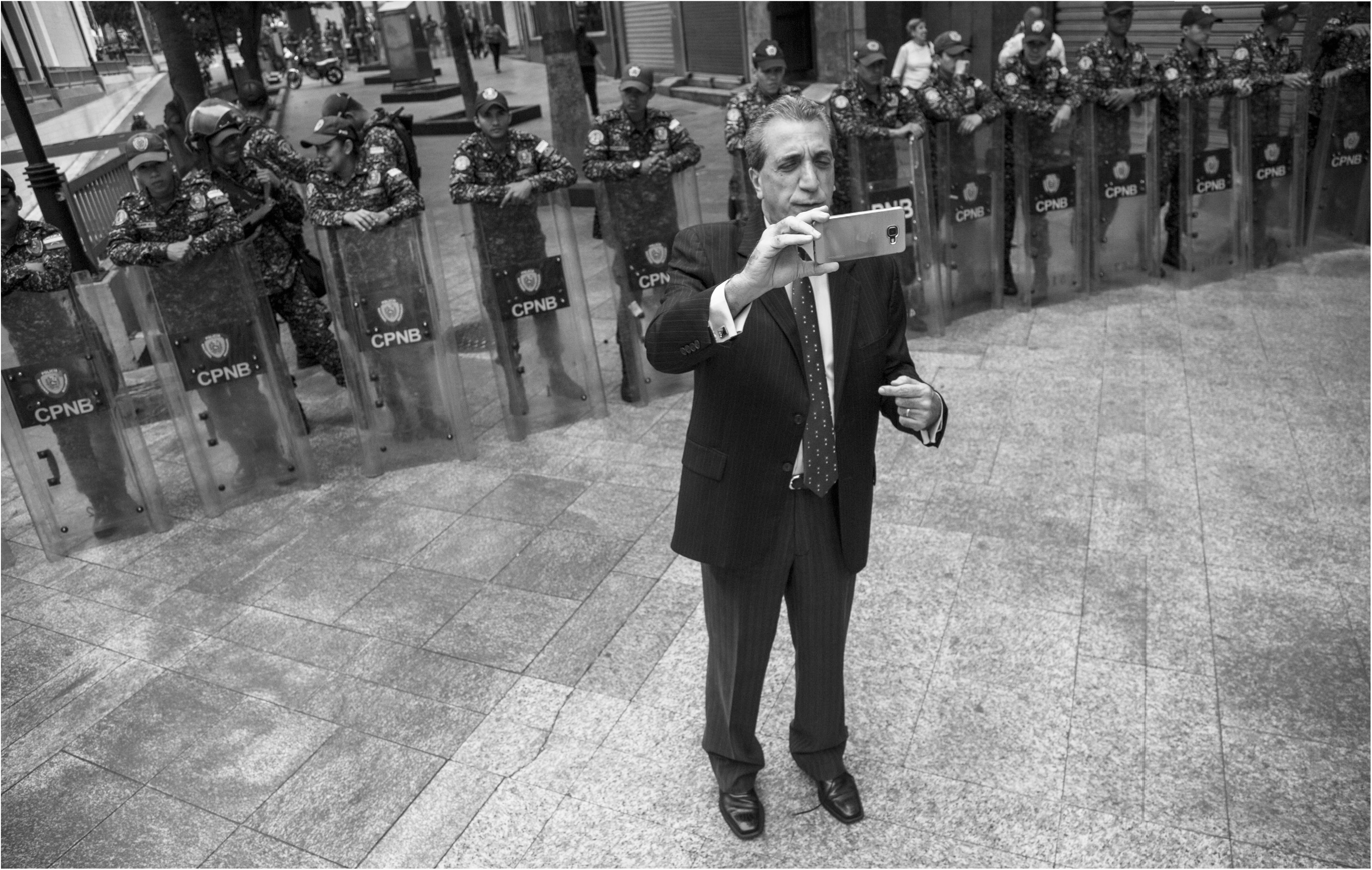
Not only has the supreme court removed parliamentary privilege and immunity from opposition MPs but, with the support of Maduro and the court, security forces have been stationed in front of the national assembly building to intimidate all parliamentarians.
One of the assembly members who has been accused of treason, but has not fled, is Miguel Pizarro. He is an ex-journalist and one of the youngest deputies of the national assembly.
In an interview with Index he said: “The ultimate goal is complete control: political control, social control, control of the economy.”
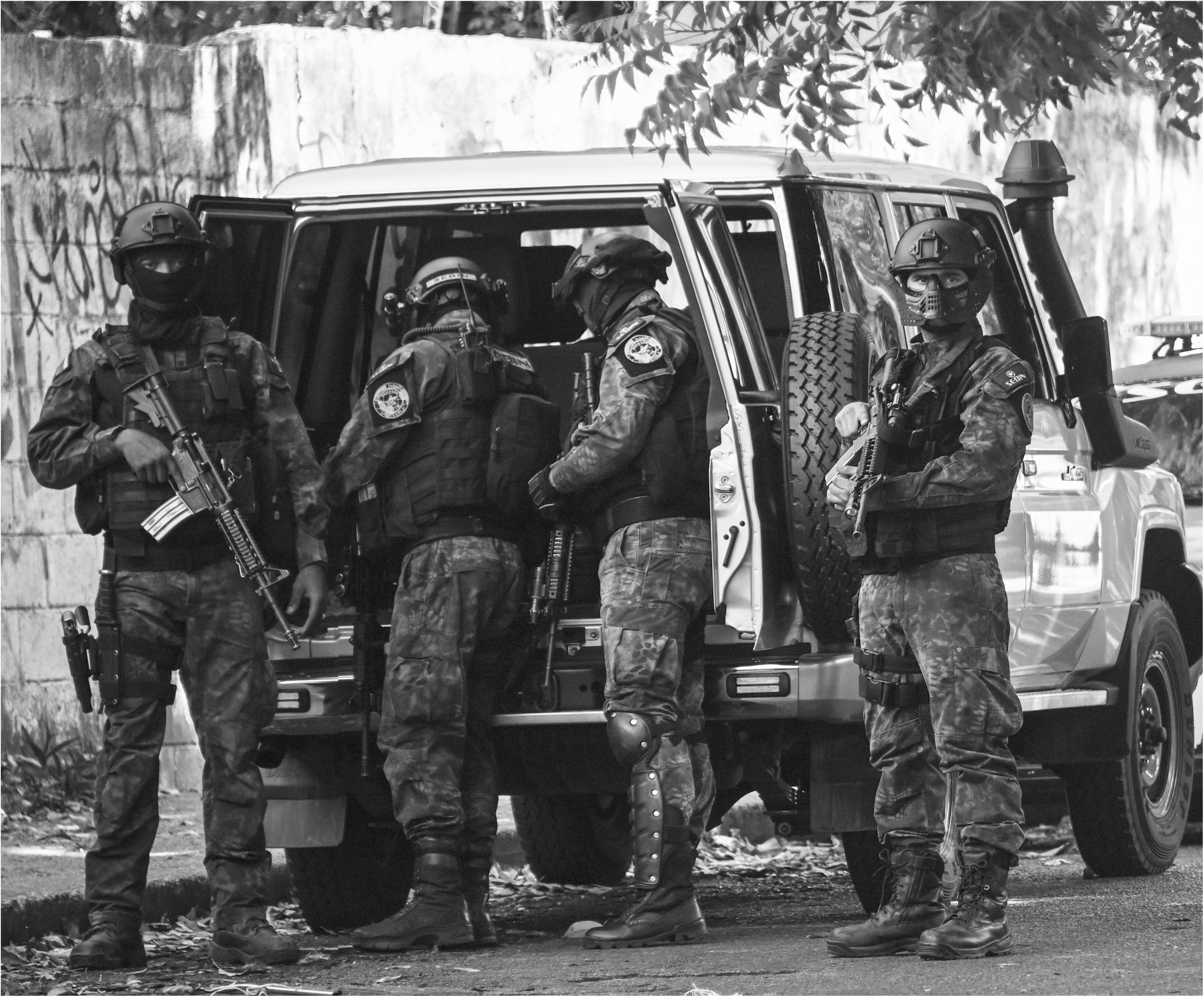
Members of Venezuela’s Intelligence Services (SEBIN) detained journalists outside the home of former police commissioner Iván Simonovis, who had earlier escaped from house arrest in Caracas, Venezuela
CREDIT: STR/AFP/Getty
The judiciary has always been weak in Venezuela, a country which regularly comes low down the WJP’s index. According to Rodolfo Montes de Oca, a lawyer for education action programme Provea, one of the oldest human rights organisations in Venezuela, the breakdown of the rule of law started in 2008 with the decision by Hugo Chavez to amend the constitution. This, he said, had been made worse by Maduro, who suspended the rights to a recall referendum; illegally appointed supreme court judges; and suspended the powers of the national assembly. This led, from 2017, to arbitrary detentions, military trials for civilians, forced disappearances and the suspension of guarantees and rights. It was made easier because Chavez had systematically weakened all the institutions of government including the military, the judiciary and the supreme court.
In 2016 the opposition polled 14 million votes and took control of the assembly.
Assembly member Biagio Pilieri took a picture on his mobile phone to post on social media after the police prevented him from entering the national assembly in Caracas, Venezuela
CREDIT: Rafael Briceño Sierralta/NurPhoto/Getty
Their victory gave them the power to sack supreme court judges who were loyal to Maduro and even rewrite the constitution.
Maduro’s response was to encourage the supreme court to strip the national assembly of its powers and set up a parallel organisation called the Constituent National Assembly, controlled by the judges and Maduro’s supporters.
Elections were then called for May 2018. They were widely thought to be rigged and Maduro won, ending any pretence that there was any separation of powers or that Venezuela had any kind of functioning democracy.
To compound it all, the economy of this oil-rich country is in freefall. Oil exports – which account for almost all the country’s export earnings and half of government revenues -have plummeted, exacerbated by falling oil prices, old infrastructure and, more recently, by US sanctions. US Central Intelligence Agency figures – the only ones available because Venezuela has ceased to collect its own – suggest national deficit stands at 46% of GDP, which is far worse than any other country in the world.
According to a study by the opposition-led national assembly, the annual inflation rate reached 1,300,000% in the 12 months to November 2018. The nation is submerged in total blackout for days at a time because of electricity failures.
When the lights go out, the water also stops because the pumps stop working. People are unable to bathe, to cook, or to flush the toilet properly. This means that ordinary residential buildings begin to stink like the largest sewers in any city. The shops are also closed and it is difficult to get drinking water, medicine and non-perishable food. It feels like being in an apocalyptic scene of some zombie movie.
The only people left to record what is happening are journalists. But journalists are finding it increasingly difficult to operate in the country.
In May, as the crisis deepened, eleven journalists were held for more than four hours in Caracas by the Venezuelan intelligence service SEBIN after filming the home of former police chief Iván Simonovis, who escaped from house arrest in the early hours of the same day. Without any order of detention, SEBIN officials in balaclavas confiscated the journalists’ phones and documents. They prevented them from communicating with their newsrooms and relatives, and, after the usual interrogation, let them go unharmed.
Simonovis was convicted in 2002 of killing demonstrators before a failed coup attempt, and widely considered a political prisoner. Guaidó had been calling for his release, so his escape from house arrest was big news for journalists, who had been surpised by the release of another high profile prisoner from house arrest, former mayor Leopoldo Lopez, at the end of April.
The National Union of Press Workers (SNTP) denounced the aggression and urged the immediate release of the journalists.
Foreign journalists have also had problems, according the Committee to Protect Journalists, and are at risk from the authorities and armed groups known as colectivos. They have documented brief detentions of journalists and their fixers, journalists threatened at gunpoint. The BBC and CNN reported being censored in the country.
Freedom of the press has long been under siege in Venezuela. According to SNTP’s secretary Marco Ruiz, security forces acted against the press on 260 occasions in the first 136 days of 2019, ranging from temporary detention, interrogation without a lawyer, to confiscation of their equipment and deportation.
There is no official freedom of the media. It was controlled long before Maduro stripped the assembly of its power. This control is exercised through The National Telecommunications Commission (Conatel) which is the regime’s censoring organisation. It has effectively shut down independent television channels, radio stations, and newspapers and magazines, as well as blocking thousands of webpages and social networks.
Andrés Azupura is the director of Venezuela Inteligente, an NGO in charge of monitoring free expression online. He says the situation for freedom of expression has got much worse as the political and economic situation in Venezuela has deteriorated.
“The past five months have really been the worst for the freedom of the internet,” he told Index. “We’ve seen how, out of 21 important information and news sites in Venezuela, 13 were blocked with the start of the political crisis between Guaidó and Nicolás Maduro. It is incredible how the ability of the citizenry to access information and news has deteriorated – it’s become a kind of battle... a game of cat and mouse.”
The economic crisis has also meant that there is not enough money to print newspapers. Panorama, in the western state of Zulia, is the latest daily to announce the end of its print edition after rising costs and regulations on the distribution of paper made it impossible to continue. Many independent journalists are still determined to chronicle this so they can tell the story of how a dictatorial regime decided to hold onto power at any cost in order to perpetuate itself.
Despite the tightening of censorship and the arrests, enterprising journalists have used online resources to continue communicating. By doing so they have exposed themselves to attacks by members of the state and persecution by the political police who punish dissident voices. Azupura said: “On the one hand there are the censors, trying to control everything so that the people don’t see certain news items, so they don’t hear certain voices; and on the other side are the journalists searching for solutions, innovative ways to reach their audiences. There are also the activists trying to defend the right of people to connect with one another.”
An example of one way citizens can be informed and journalists can inform is the independent news website Efecto Cocuyo (The Cocuyo Effect) – an initiative which its own founder, Luz Mely Reyes, categorises as: “small sparks of light”.
A cocuyo is a small insect which emits light and Reyes says the small snippets of news and social media add up to a bigger light, just like the small sparks do. “All together we can illuminate an entire nation” she said. It is because of this that Pizarro comments that “the citizenry has been left with only two tools in order to communicate: on the one hand the social networks, and on the other protest – but with a deep fear of reprisals and consequences”.
It is evident that this total control has affected the ability of Venezuelans to enjoy any freedom of expression. The imposition of the official rhetoric is one of the regime’s primary missions now. If they can’t control events, at least they can determine how their history is told, without caring that this is achieved by sacrificing the people who once voted for them and placing millions who disagree at risk
How do We Find Out What’s Really Happening?
Journalist STEFANO POZZEBON on what it feels like to work as a journalist today in Venezuela
We are trained to question everything and double-check our sources, but with with few reliable media institutions in which to put their trust, average Venezuelans are also doing that now. “Schools will be closed tomorrow,” the rumour spreads. “Who said it? How do we know?”
Both the slums in the outskirts of Caracas and the high-class residential neighbourhoods have become realms of tittle-tattle, where a neighbour’s hearsay acquires the same value as a radio bulletin.
“The government will soon announce a new foreign exchange system...”; “There are ongoing talks between the opposition and the government and soon a solution will be found.”
The endless stream of information, true or false, seems only destined to keep flowing.
Venezuela’s most famous radio broadcaster, Cesar Miguel Rondon, resigned from his post in February after being told by the government of embattled president Nicolás Maduro how he was to refer to opposition leader Juan Guaidó, and to Maduro himself.
Similar orders are regularly passed on to local TV channels, which operate under the constant threat of being pushed off air if reporters, or guests, do not comply with the government’s narrative.
For local reporters, to keep working feels like navigating a minefield – but it’s the effect on society as a whole that is more worrisome. Information spreads unconstrained and unchecked to an audience which no longer has the feeling of being informed or even a sense of knowing what is going on.
As the media is pushed out of the public sphere, there are no other institutions capable of playing the same social role, thus leading to a vast gap of misinformation, ignorance and chaos.
Filling the gap – and, by doing so, having informed citizens who are capable of making informed decisions – will be pivotal for the reconstruction of Venezuela and many other countries around the world where the media are under siege. Working in Venezuela as a journalist requires a good amount of patience and understanding of your personal limits.
Since blackouts started spreading over the country, communications have become unreliable and travelling is more difficult. As a result, it’s often impossible to confirm a fact, check a source or cover an event outside Caracas.
Government officials rarely answer the phones, and even more rarely confirm a piece of information that needs to be sourced.
The supreme court publishes its sentences on a public Facebook page, perhaps because it no longer has IT personnel to maintain a proper institutional website.
In the three years I have been reporting in Venezuela, the growing distance between the story and the storytellers has been one of the biggest obstacles for my profession. It’s hard, or often impossible, to get information from one place to another; hard to speak to a first-hand witness; hard to find a reliable colleague to trust.
The little caveat “was unable to independently verify...”, which would sound like a surrender to many reporters worldwide, has become the norm here.
The country has effectively had two parliaments since July 2018, and two presidents since January this year, and both camps equally try to spin the narrative in their favour to belittle the opponent.
This almost-total anarchy means that there are no set rules: some police could arrest you just for taking a picture, some won’t bother with it. One day a protest gathers tens of thousands of people on the street, and the following day mere hundreds show up. Working as a journalist can be dangerous one time, and absolutely fine the next.
The great Colombian author Gabriel Garcia Marquez and his magical realism created a world where nothing was what it seemed, where X meant Y, and Y meant Z, and where no truth would hold the test of time untouched.
For me, my experience as a foreign correspondent in Venezuela seems very close to that.