




Abstract

The USA has long prided itself on its democracy.
Many worry that the country of some 329 million people, which has prided itself on modelling the greatest democracy in the world, is not immune to unpicking some of its checks and balances – and that this could also have profound symbolic effects around the world.
Academics are debating whether US democracy is robust enough to withstand a populist such as Trump, who likes to ride roughshod over agreed democratic norms.
A recent example was an unprecedented move in May when Trump revoked the White House press passes of a substantial number of journalists, including most of the Washington Post’s reporters, claiming they had not met new standards. Journalists were told they had to seek new passes which give them less access.
Reporters from CNN, The New York Times, Buzzfeed and other media outlets were excluded from a press briefing in 2017 – a trend seen by many as a bid by the president to control the free press.
As Steve Levitsky, co-author with Daniel Ziblatt of the book How Democracies Die told Index: “The checks and balances in our government are mostly being eroded by the breaking down of ‘informal norms’ – the basic norms that underlie any constitutional democracy such as mutual toleration and forbearance or self-restraint in the exercise of your power.”
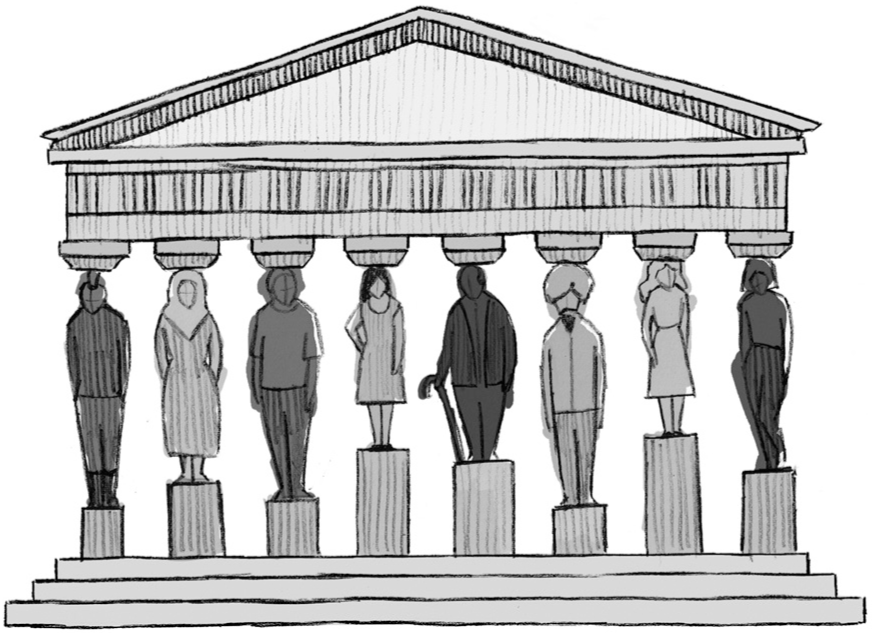
The USA prides itself on its constitution and its system of separation of powers. The founding fathers set up a robust three branch system of the legislative (Congress), the judicial (the courts) and the executive (the president). All the branches checked each other’s power to make sure no one branch dominated the other. The press is often seen as a fourth check on that balance of power.
“A constitutional democracy absolutely requires restraint of the legal powers available to Congress, the executive and the courts, which are immense in theory,” said Levitsky. “The president has the power to pardon pretty much whoever he wants [and] Congress can remove the president.” He argues that this fine balance has been in the process of breaking down for decades and Trump is only the most extreme example, with “the two main parties seeing each other as enemies rather than rivals”.
CREDIT: Danae Diaz/Ikon
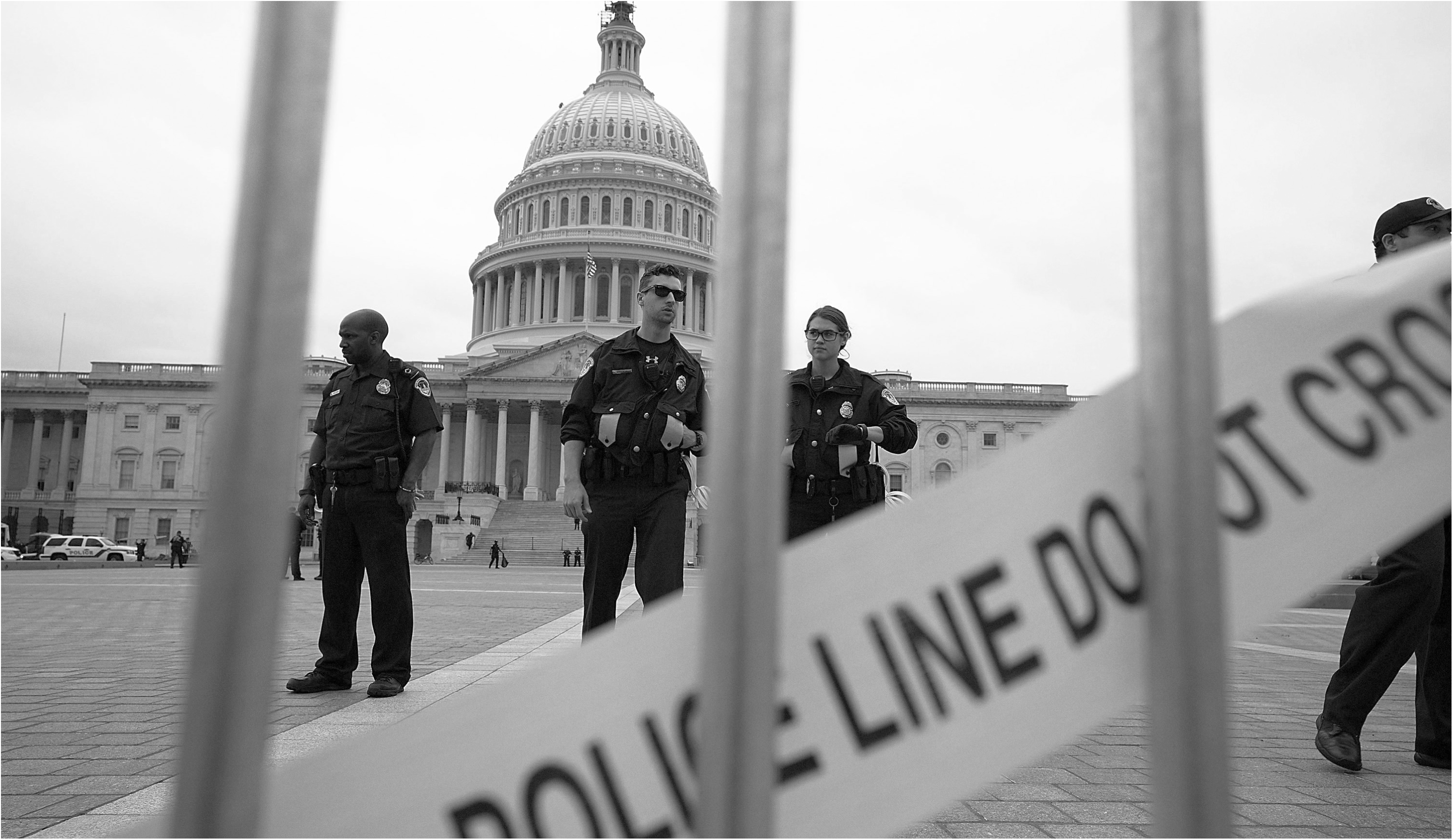
US Capitol police stand guard behind a barricade in Washington DC
CREDIT: Alex Wong/Getty
But it is the polarisation of politics rather than the breakdown of these systems that is dangerous, he adds. He says it started in the era of President Bill Clinton and continued with accusations against President Barack Obama.
“Trump is a symptom of polarisation not a cause. This constitutional hard-balling goes back to the 1990s and Clinton’s impeachment, which had no bi-partisan consensus and violated the spirit of the law,” he said. “Then there was a major increase in partisan influence with the rise of Obama, fuelled by the likes of Sarah Palin and Mike Huckabee, calling him anti-American or even [saying] that he wasn’t American at all. When you describe a president as anti-American, you’re saying he is potentially treasonous. And there have been many obstructive tactics employed, too – the most egregious of which was the refusal to allow Obama to fill the Supreme Court vacancy left by the death of Justice [Antonin] Scalia in 2016.”
He added that equating an opponent with anti-patriotism or treason was an easy tool to use. “This has been done before – back in the 1790s, during the Civil War and in the McCarthyism period – but for the most part it wasn’t a problem in mainstream politics in most of the last century and politicians have not gone there,” he said. “For example, after 9/11 [President] George W Bush had the opportunity to use patriotism against Democrats but, to his
great credit, he didn’t do that. Were we to have a similar attack on the US today, Trump would never show the same restraint.”
The US government announcement of 17 charges under the Espionage Act, introduced during World War I, against Wikileaks founder Julian Assange, set off more alarm bells. First Amendment lawyer Floyd Abrams said: “His indictment under the US Espionage Act threatens every journalist who writes about intelligence, national security and the like and who is dependent upon confidential sources in doing so.” While UCLA journalism professor Jim Newton worried about the implication for First Amendment rights.
Levitsky argues that the courts and judges show plenty of signs of independence. “The judiciary is working better than the other branches of government, adhering more to the norms of professionals and is a pretty effective check,” he said. “However, the politicisation of the judiciary under Trump may mean that fewer people will trust the courts.”
David Snyder, executive director of the First Amendment Coalition, agrees. “One area where we’ve seen the guardrails hold is the courts’ check on executive power,” he told Index. “Federal courts put the brakes on efforts by the president that were unconstitutional and the Trump administration complied and adjusted the Muslim travel ban.
“The path it took to the Supreme Court was what the founders of our country envisioned. Maybe we’ll see a similar showdown with all the subpoenas that various House committees are issuing now. We’ll see what happens if the president ignores a court order.”
Snyder worries about what is happening outside Washington where this polarisation is having a tangible effect, such as in the way individual states dealt with environmental protests over the Dakota pipeline construction.
“After the Dakota pipeline protest there was a raft of bills in various state legislatures that we should allow criminal punishment for protest such as blocking traffic as part of a protest. The sentiment that underlies these efforts is very strong. When we lose the ability to listen to other communities it’s dangerous.”
Snyder also sees checks and balances threatened at a local level, where there are problems with issues such as public access to records.
“The press, especially the national press, has done terrific work in exposing what’s going on at federal level, but at local level there are fewer reporters doing fewer stories and asking for information from public records. The problem that happens when those requests decline is that these federal agencies start to get into the mindset of thinking the records are theirs and not the public’s.”
Snyder also says polarisation is affecting debate, saying people are willing to talk only to people they agree with, which shuts down debate and can skew issues.
“No one would deny that we have to look at some of the issues we have around immigration, but it has devolved into a cartoon argument about a wall. National debate on the subject has been hijacked,” he said.
Lack of open debate is affecting academic freedom, says Henry Reichman, chair of the American Association of University Professors committee on academic freedom and tenure and author of the new book The Future of Academic Freedom.
“The biggest threat to academic freedom is the narrowing of checks and balances to have freewheeling discussions,” he said. “This is a reflection of the notion that universities are no longer centres of inquiry and learning, but they are businesses and students are customers. Big business – funders, donors and corporations – is dictating a lot of what universities do in terms of research and there is also politically motivated pressure in that regard.”
Lack of open discussion is also an issue for the student population, agrees Snyder, saying there is a “worrying trend from both left and right to silence and punish political views you don’t agree with”.
But does this lack of open debate open the door for authoritarian leaders and autocrats to take over? Levitsky has concerns. “We’re in a crisis, but we’re not that close to an authoritarian regime because we have a strong, robust opposition,” he said.
But he believes that the dysfunction and abusive politics may lead people to lose faith. “If that happens they are more likely to vote for demagogic alternatives who offer simple solutions. The next demagogue may be more intelligent and politically astute than Trump.”
And while Snyder agrees that such a takeover is some way off, he does sound a warning.
“When conversation becomes so accusatory, people turn off their brains and we run the risk of bringing someone into power who makes it difficult for a democracy to function properly. People need to have access to good information and be able to address issues – both elected officials and voters need those skills.
“The ultimate goal is to have a government that addresses real social problems. To study these problems we have to see them from various angles, with both parties working together to solve them, but we no longer do that at the federal level,” he added. “We have political parties who have walled themselves off and homogenous communities electing people who aren’t going to bring us together.”