




Abstract

Author
We are discussing his novels, the problems for democracy and free speech around the world.
“It seems to me,” he told Index, “that democracy is a form of channelling of power – almost like a system of dykes and sluices, you know, so that it doesn’t flood: it’s controlled. At the moment you move to something like referendums, or you allow unbridled use of technology, all those old methods of control have gone.”
Harris is a political author, which is rare in Britain today. His novels are often based in other centuries, but the problems of power are similar. He started writing about Nazi Germany, but his Cicero Trilogy – Imperium, Lustrum and Dictator – concentrates on ancient Rome and his most recent novel, Conclave, centres on the election of a new pope.
He sees similarities between what was happening in Rome during the time of Cicero and the rise of strongman leaders today. “The thing that destroyed the Roman republic was the oligarchs whipping up the masses against an elite who had previously sat in control. You may say that’s a good thing, but the lesson from the Roman republic is [that] you can destroy democracy and then it vanishes from the earth for 1000 years or so,” he said.
“If we go back to the Romans, my image of power is something like plutonium, something radioactive, you know. It’s a great dynamic force, but if you touch it for too long, or hold it [for] too long, it will destroy you.”
He believes power needs to be broken up, so that it is not abused. “It has to be diffused through a judiciary, it has to be diffused through a free press, it has to be diffused through elected institutions,” he said. “There are lots of things which are all very slow and often can become corrupt, with all sorts of problems to them, but in the end they provide safeguards so that no one has the power of the dictator to say that we will do this.”
We are eating fish and chips in a pub near his home in Berkshire. This is rural England, as the English like to imagine it – green rolling fields, warm beer and ancient Anglican churches, where change seems to happen slowly, if at all. Harris lives in the old rectory nearby. It could be a million miles away from London, but this area is part of what is called the “home counties”, and the capital is only an hour away by train. It is a perfect place for a writer, particularly one who is interested in the intricacies of power. It is near enough the centre to entertain people from the heart of government – he mentions a recent conversation with a cabinet minister – but just far enough away to be able to write undisturbed.
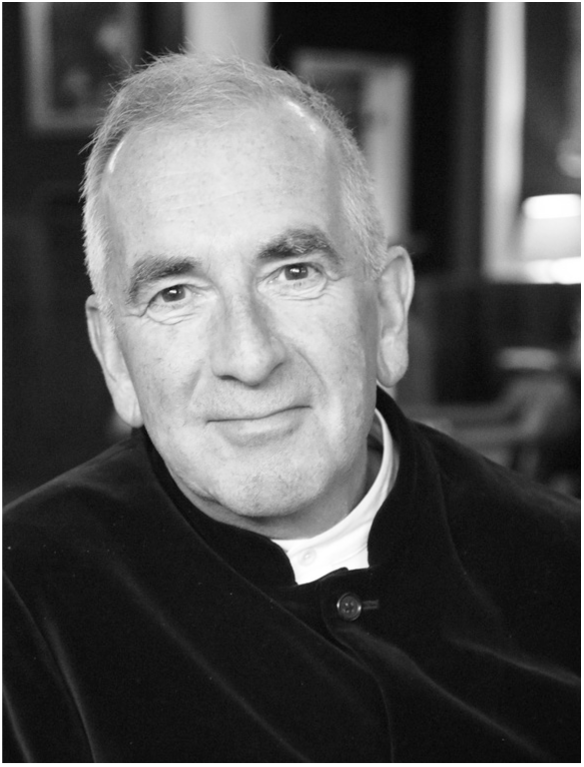
Author Robert Harris
CREDIT: Ktbruce.co.uk
Recent history is also on his mind. “There was a complete high-water mark after the Berlin wall came down,” said Harris. “There was this belief that democracy could simply be transplanted from the West all over the world – the whole of eastern Europe, Russia, the Middle East, Africa – and all the fruits would flow and everyone would be like us: freedom of speech, property rights and so on. But, of course, one realises that it is immensely more complicated than that and, actually, ‘one person, one vote’ is potentially an instrument of tyranny.”
As he explains, the power of the simple majority is a terrifying thing for the minority on the other end of it.
“And what we have got, or were supposed to have, is a system that protected minorities, so unless there was a great consensus for some change voted on in elections along with a range of other concerns, you couldn’t make a sweeping change. Things moved slowly. It was a kind of Burkean view.”
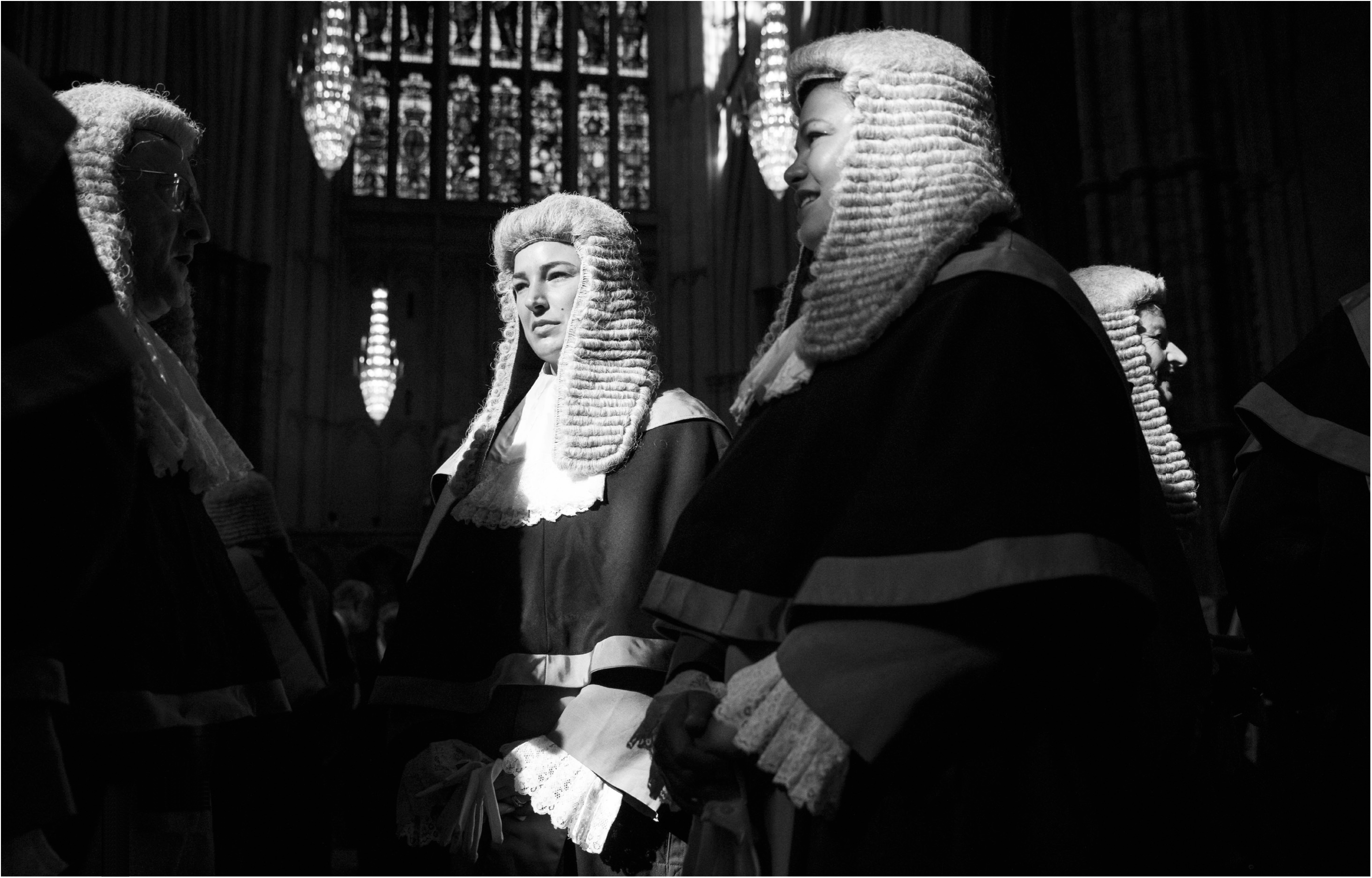
English circuit court judges gather at Westminster Abbey in London in October 2018 ahead of the annual church service to mark the start of the legal year. The service dates back to the Middle Ages and is attended by more than 700 judges and senior judicial figures
CREDIT: Dan Kitwood/Getty
For someone who has thought of himself as a “man of the left”, this is rather extraordinary and Harris goes on to talk about Edmund Burke, a Whig politician of the late 18th century whose thinking was shaped by his revulsion at the chaos caused by the French Revolution, and whose ideas are at the core of traditionalist Conservatism today.
Harris says he now believes, as did Burke, that there is a wisdom and collective strength in institutions that predate us, and will last after we have gone.
“I believe in liberal institutions, I suppose. I see them as a guarantee of our freedom. Wherever you do away with those institutions, or challenge them, [loss of] freedom of expression quickly follows.”
He is convinced, he says, from writing his book Conclave, that the Catholic church’s slow and exhaustive way of choosing the next pope is why that institution has survived so long.
“To my surprise, having long been what I would have thought radical in my views, I have now come to entertain serious doubts about this, because you could have a plebiscite which says: ‘We want political control of the judiciary. Why shouldn’t the judges, a classic elite, out of touch, be elected? They should come under political control. It’s an outrage.’ And then off we
go with the usual things about immigration, or deporting Islamic militants or anything.” And, he says, we change our minds, when people who we like are deported, and it is too late.
He says that democracy should be slow and deliberative, and that democracy and freedom look like people “arguing endlessly in a way a lot of people find frustrating” while dictatorship is often hailed as being dynamic. Therein, he believes, lies the danger.
“One of the most useful books I have ever bought was a 1936 Baedeker guide to Germany produced for the Olympic Games. It has a section on modern history at the beginning describing the Third Reich in neutral terms and one of the things it says is that: ‘National Socialism came to power to put an end to fruitless parliamentarianism’ like it’s a good thing.” he said.
An acute observer of politics, Harris has often been bruised by it. His admiration for British Prime Minister Tony Blair was shattered by the way Blair behaved over the Iraq war. Now he is witnessing Britain divided by a referendum. He says that the debate on Europe is fundamentally about what Britain is: “Not just about whether we are Europeans, but what sort of democracy we live in.”
He says that debate is being shut down and people are becoming intolerant of any other point of view. “The thing is, today, you have to be careful what you say,” he said, adding that when he was growing up, such caveats did not apply.
“In many ways it is good you have to be careful what you say. The vast change in my lifetime towards sexual minorities and ethnic minorities, is wholly good, but few things in the world are ever entirely good.
“So, if you were to say anything in defence of [US President Donald] Trump or Brexit in certain circles you would have to be careful in a way that I don’t think you would have had to have been 20 years ago – and equally on the other side. I know one of the things that has powered Trump, and has powered Brexit and the right, is the idea people can’t tell the truth and [say that] ‘This area has totally changed’. That this is verboten by the authorities. That’s badthink. That’s a thought crime.”
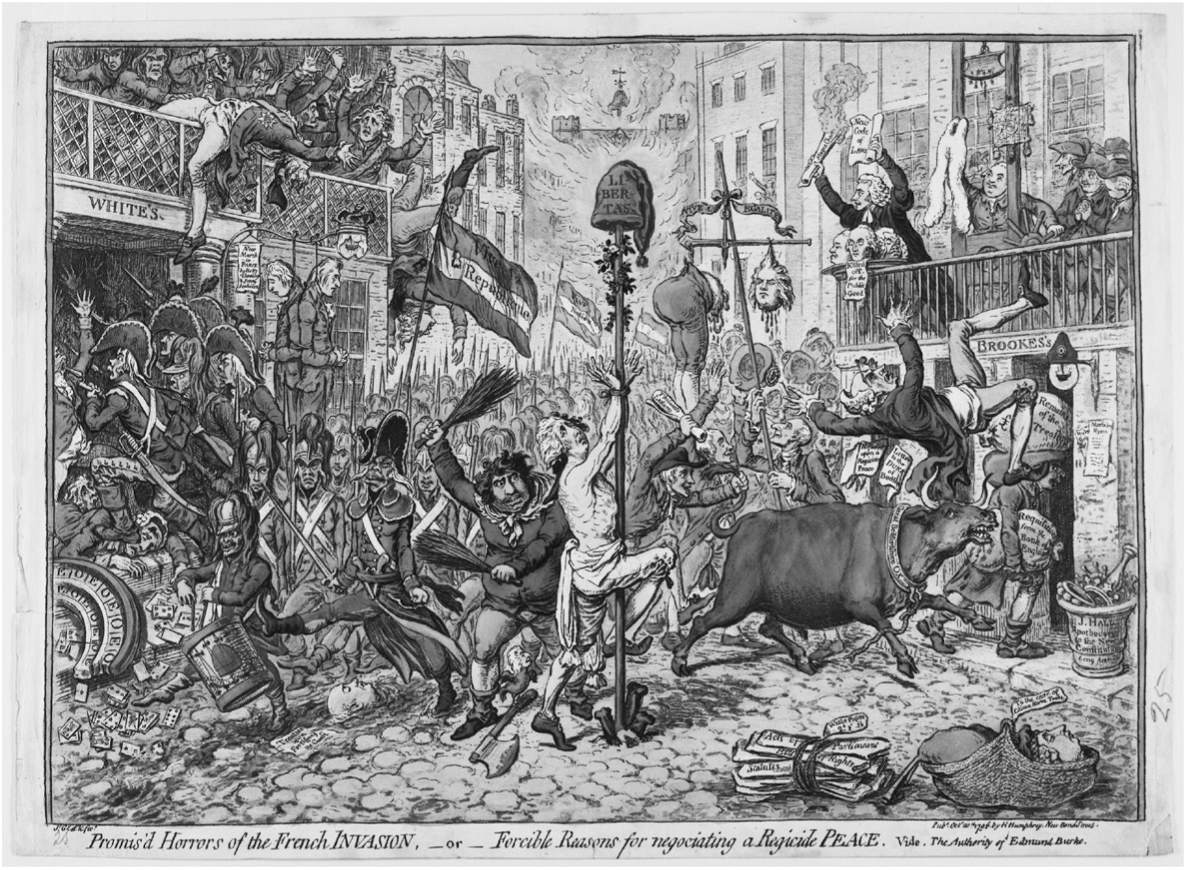
Promis’d Horrors of the French Invasion by the English artist James Gillray. This cartoon from 1796 shows the bloody consequences invoked by politician and philosopher Edmund Burke if the French revolution was played out on the streets of London. Magna Carta is being burnt and acts of parliament have been designated “waste paper”
CREDIT: The Art Institute of Chicago/Akg-images
He is frightened, too, that in some universities people can no longer say things for fear of offence. “The totalitarian thing of saying: ‘tear down this statue, it offends me’,” he said. “The world then becomes, as in the Orwellian nightmare, just the present and whatever the dictates of the present are – the past is removed.
“So, I’m no lover of Cecil Rhodes, but it seems crazy that you should pull his statue down, or take down the statue of Nelson or any other commander, that you have a kind of ‘year zero’ approach to culture and history.”
He continued: “I think that freedom and challenging institutions is a sine qua non of democracy, but when you say that to even hold such thoughts on either side is forbidden then we are in dangerous waters. So, each side has to recognise the validity of the other’s arguments.”
Harris’s latest novel, The Second Sleep, due out in September 2019, is, in part, about words being forbidden. He has been correcting proofs the day we meet. The dystopian novel, he says, looks at what happens when a society such as ours, reliant totally on technology, collapses and people have nothing to fall back on. They repudiate technology and head to the church, which becomes a focus of life.
“In my dystopia, the church exercises control through the 12,000 words of the Bible and that is the language. And although a few other words can be used, by and large the science is gone and the world is controlled through language.”
But, says Harris, he feels that he is lucky. He will not be locked up for what he writes.
“When I wrote my novel about the election of the Pope, which I really enjoyed doing, there was a moment when I sat here in the comfort of west Berkshire and thought: ‘Here I am, I am writing the most subversive novel imaginable about a religion with more than a billion followers around the world. I’m going into its most sacred ritual and I am writing about it and no one is going to criticise me.
“‘There won’t be any denunciations in The Guardian, there certainly won’t be any physical threats.’ I thought if I did this about another world religion first of all my publisher might turn it down, secondly I would be denounced, and thirdly I might well require a policeman on the gate. It brought home to me that even just what I do, as a novelist of entertainment, there are forces out there... and when it comes to physical violence against you, or against your family, then everything looks very different.
“That’s where we have been fantastically fortunate here. All my life, and I’m 62, I’ve been able to say whatever I like.”