




Abstract
German author
Buchenwald (“beechwood forest”) sadly represents the dark counterside of the German classical spirit. The camp was first going to be named Ettersberg concentration camp, referring to the small wooded Ettersberg hillock upon which it was established, previously known for a Baroque castle frequented by Goethe, and where European royals would go hunting. But the Nazis did not want to spoil the Goethe connections for Goethe enthusiasts by choosing the wrong name. Ironically, you will find the remains of a Goethe oak on the site of the Buchenwald memorial symbolising the Weimar-Buchenwald dichotomy in a way no writer could ever invent.
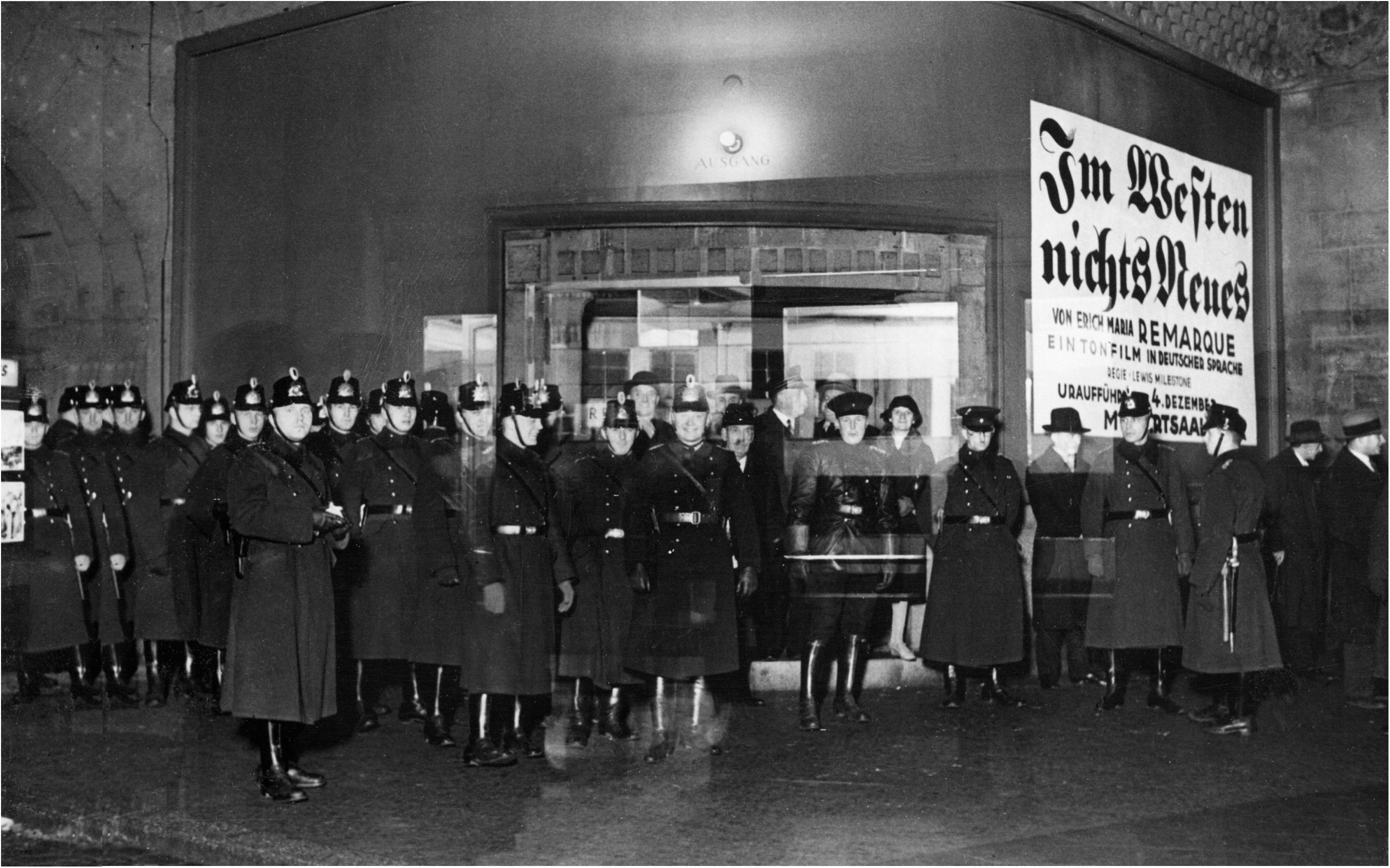
Police outside a cinema in Berlin’s Nollendorfplatz patrolling riots by Nazi goon squads against the showing of the film All Quiet on the Western Front in December 1930. The film was banned a week after it opened
CREDIT:Akg-images/TT News Agency/SVT
But not only does the Weimar Republic receive more attention now, there also seems to be a shift of paradigm in the perspective of how Germans view it.
It used to be that Germans, both East and West, grew up with the notion that the Weimar Republic was doomed from the beginning, and that the Weimar constitution with its presidential democracy made it easy for Adolf Hitler to rise, leading to dictatorship straight away. It may well be that people in other countries, namely the USA, would associate Weimar with the thriving arts and culture, as well as sciences, of the 1920s, recollecting names of the cultural elite that would soon be forced to emigrate and who would contribute to American culture thereafter. In Germany, we would refer to the “Golden Twenties” by using the English words rather than the German equivalent. But we tended not to think of the 1920s as a golden period in Germany. So what has changed? What suddenly makes us want to speak not only of failure and lost opportunities but of the chances and merits of the Weimar Republic instead?
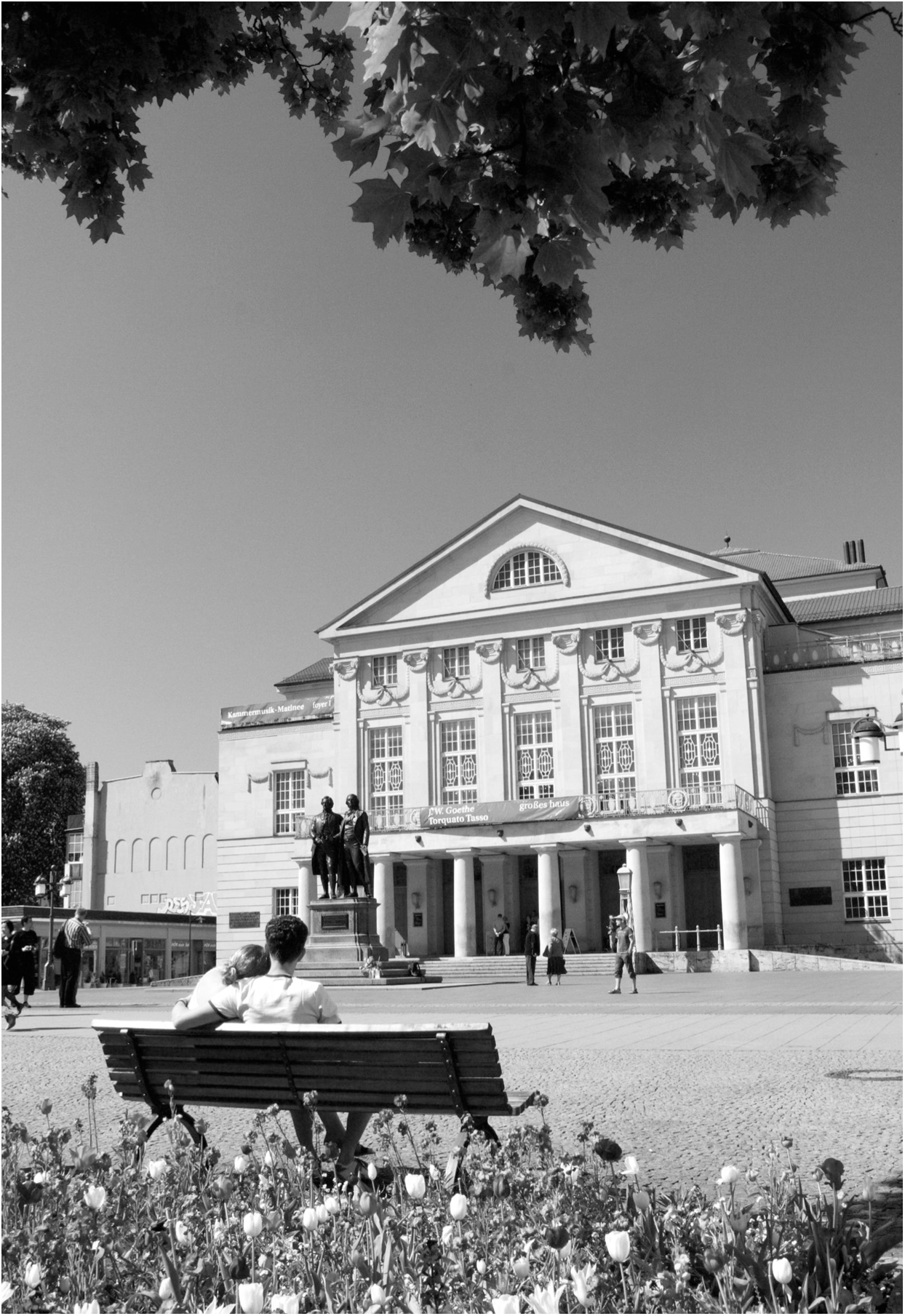
Johann Wolfgang Goethe and Friedrich Schiller, the greats of German classical literature, both lived in Weimar and their statues still stand outside the German National Theatre
CREDIT: Tony Roddam/Picfair
But I wonder. Could it also be that this shift in focus might be fuelled, at least partially, by some new kind of German nationalism? Could it be that – after having reconstructed the Berlin Palace, viewed by many as a seat of imperial power from a time of militarism and national expansionism, and filling it with ethnological artefacts of often unclear provenance from a colonial past – a new kind of nationalism is now ready to reinterpret and digest even the Weimar Republic? Could it be nationalism that makes us boast of the First German Constitution as “one of the most modern constitutions that existed at the time”, having influenced several Latin American states, Japan, and even France? Weren’t we great in granting women’s suffrage as early as November 1918, and doing away with censorship, as had been demanded by brave democrats since 1849?
Thus, films in the Weimar Republic were the only media which had to be passed by the censors prior to presentation. Of course, this meant heated debates all through the decade. Among the most spectacular incidents were the riots by National Socialist goon squads at the opening of All Quiet on the Western Front, based on the novel by Erich Maria Remarque, in December 1930. Due to their constant interruptions and threats to the audience, the performance had to be stopped. A week later the Berlin-based film review board prohibited any further showings of the film in Germany. The reasons given were both that the film was a security risk and that it caused damage to the reputation of the country.
In this, they followed the National Socialist arguments, insinuating that the pacifist message would defame German soldiers and damage the reputation of Germany. It was Goebbels himself who admitted in an article that it had been their strategy to turn the issue into a matter of prestige between the movement and the Prussian administration.
Another controversy arose around the film Kuhle Wampe oder Wem gehört die Welt? (Kuhle Wampe, or Who Owns The World?) based on a script by Bertolt Brecht, in 1932. Even the members of the censorship board were highly divided in their opinions of it. Some claiming the film would incite the working masses to mistrust the state, while others cherished its high quality as a work of art. When Kuhle Wampe was prohibited, Brecht commented drily that the censors – from a police point of view – had better understood the message of his film than even his most sympathetic critics had. Public protests were partially successful, as the film was released in the end, although with specific cuts.
Protests also accompanied the passing of the law to protect the youth from three-penny trash and rubbish. But let us not overestimate the public. In his essays on Schmutz und Schund, published in various newspapers in 1926, Hein-rich Mann’s voice sounds not only sceptical but somewhat gloomy. He points out that the morals of young people have never been deteriorated by reading, but by life itself – by irresponsible elders exposing children to a life brutalised by war and post-war unemployment, inflation and poverty, and the struggle for existence. But whereas the public in Wilhelmine times, including liberal-spirited conservatives, widely protested the moralistic Lex Heinze law of 1892, Mann misses a similar cry of outrage in 1926, saying: “Nobody seems to care much anymore whether literature will be under control.”
His brother, Thomas, founding member of the literature section of the Prussian Academy of Arts, actively joined in the protest against the law on Schmutz und Schund, thus turning away from his formerly conservative, apolitical, attitude. And so did the German PEN centre, based in Berlin. Founded in 1924 by rather conservative writers, many of whom had been ardent nationalists in World War I, German PEN became quite politicised in the second half of the decade, with writers realising that it was impossible to abstain from politics and that John Galsworthy’s dictum of “No politics under any circumstances in the PEN” took a political standpoint itself. German PEN published remarkable letters of protest against censorship, be it against the prohibition of All Quiet on the Western Front, or against Carl von Ossietzky’s conviction on the basis of an allegation of espionage and his 18-month prison sentence after publishing an article on the rearmament of the German air force (prohibited by the peace treaty) in his magazine, Weltbühne.
Other famous cases could be cited, such as the debates around Arthur Schnitzler’s drama, Reigen; charges of blasphemy against a number of renowned writers, including Carl Einstein, Klabund and Carl Zuckmayer; and the voluntary withdrawal of an advertisement for Kurt Tucholsky and John Heartfield’s anti-military publication, Deutschland, Deutschland über Alles by the German Publishers and Booksellers Association in 1929.
As the latter example shows, even if the numbers of books indicted in the end turned out to be relatively small, the laws nevertheless had a devastating effect, leading to self-censorship and a public atmosphere of hate and harassment. Ultimately, it was the Nazis who profited.
At a PEN Congress in 1958, Kästner, by then president of German PEN, commemorated the 25th anniversary of the book burnings and warned: “The events of 1933-1945 should have been fought in 1928. Later, it was too late. One must not wait until the fight for freedom is called treason. One must not wait until the snowball has turned into an avalanche. You have to crush the rolling snowball. Nobody will stop the avalanche... You can only fight rising dictatorships before they are in power.”
Unfortunately, he did not leave a recipe as to how this could be achieved. It would be useful, even now.
Weimar’s Hall of Fame
Footnotes
Hamburg-based