



Abstract
Index staff have been out and about talking to people from all over the world about how they overcome obstacles to free expression.
He was speaking at the Ifex conference in Berlin, which was also attended by Index CEO Jodie Ginsberg, who asked: “What is the response of the international community when your own country rejects you? It’s not something we think about.”
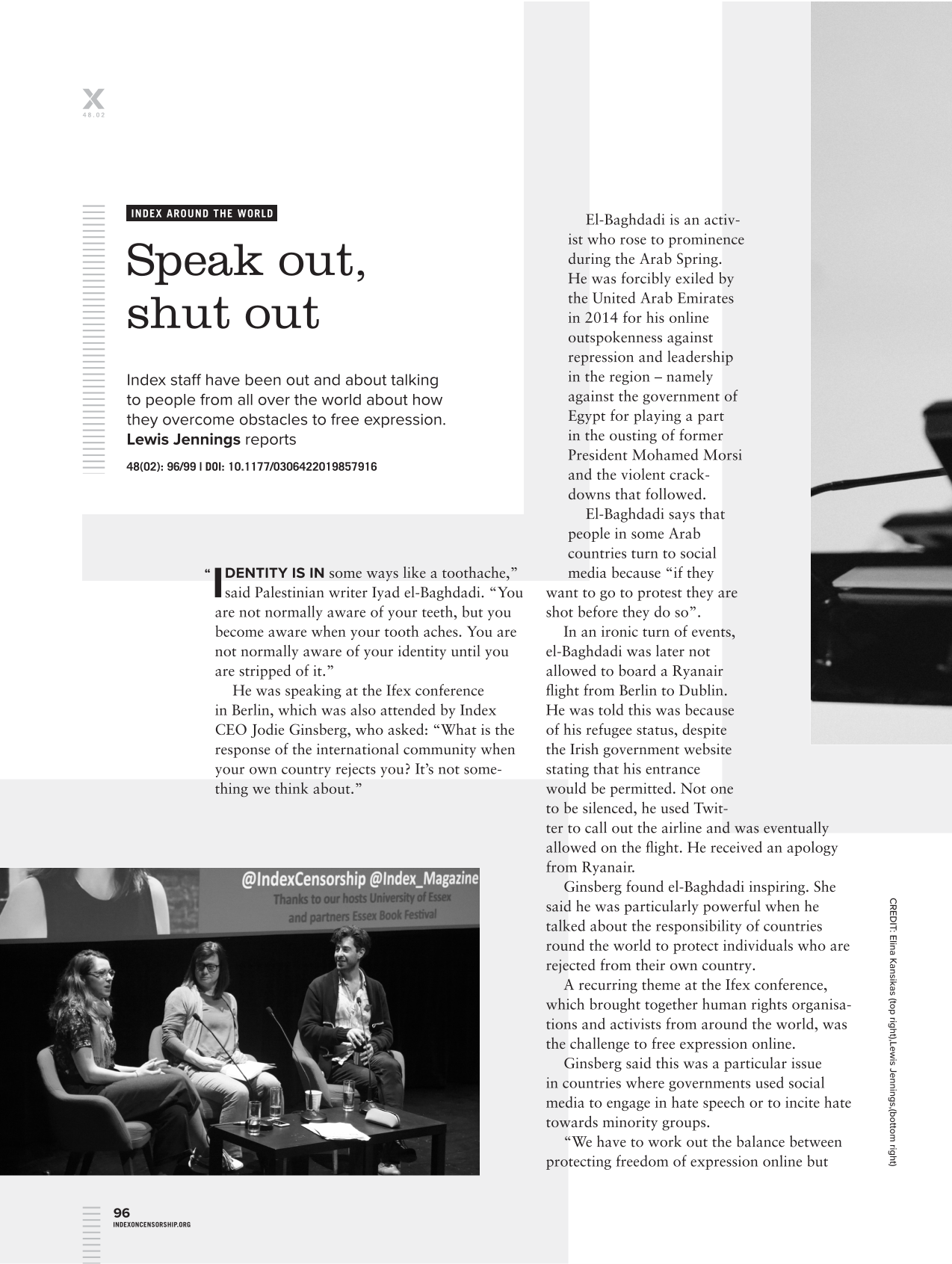
Editor Rachael Jolley chairs a discussion at Essex Book Festival alongside actors from the Globe to Globe tour Phoebe Fildes and Matthew Romain
CREDIT: Lewis Jennings

El-Baghdadi is an activist who rose to prominence during the Arab Spring. He was forcibly exiled by the United Arab Emirates in 2014 for his online outspokenness against repression and leadership in the region – namely against the government of Egypt for playing a part in the ousting of former President Mohamed Morsi and the violent crackdowns that followed.
El-Baghdadi says that people in some Arab countries turn to social media because “if they want to go to protest they are shot before they do so”.
In an ironic turn of events, el-Baghdadi was later not allowed to board a Ryanair flight from Berlin to Dublin. He was told this was because of his refugee status, despite the Irish government website stating that his entrance would be permitted. Not one to be silenced, he used Twitter to call out the airline and was eventually allowed on the flight. He received an apology from Ryanair.
Ginsberg found el-Baghdadi inspiring. She said he was particularly powerful when he talked about the responsibility of countries round the world to protect individuals who are rejected from their own country.
A recurring theme at the Ifex conference, which brought together human rights organisations and activists from around the world, was the challenge to free expression online.
Ginsberg said this was a particular issue in countries where governments used social media to engage in hate speech or to incite hate towards minority groups.
“We have to work out the balance between protecting freedom of expression online but ensuring the government is not abusing its power to shut down the speech and rights of minority groups,” she said. “If these people are bullied off social media, we have lost.”
Zehra Doğan gives a heartfelt speech at the Freedom of Expression Awards 2019, alongside fellowship and advocacy officer Perla Hinojosa
CREDIT: Elina Kansikas

Also this quarter, Index magazine editor Rachael Jolley was at the International Journalism Festival in Perugia, Italy. Attended by some of the magazine’s contributors from around the world, one of the discussions was about how online spaces could offer platforms for the media when others were closed off.
“Wana Udobang talked about how it’s hard to publish in the traditional media for Nigerian journalists who want to write stories that are sometimes controversial. They will find internet spaces that are less controlled,” she said.
“Kaya Genç talked about how social media is one of the ways Turkish journalists get their stories out. It’s important to have the opportunity to hear people’s personal experiences first-hand and get up-to-date with some of the obstacles they are finding. When you go to a conference, it’s quite often just people from one continent, so to get that kind of overlapping of what’s going on in different parts of the world at the same time is unusual.
Jodie Ginsberg introduces the Freedom of Expression Awards 2019
CREDIT: Elina Kansikas

“You really hear from journalists operating from all over the world, and I think that’s really rare. There were some incredibly brave people who are doing journalism in incredibly difficult circumstances.” Head of advocacy Joy Hyvarinen took part in a conference entitled “Journalists Under Attack: a threat to media freedom”, at the Organisation for Security and Co-operation in Europe in Vienna. Alessandro Azzoni, the Italian ambassador to the OSCE, joined prominent journalists and freedom of expression advocates on the panel, which was moderated by Hyvarinen.
They discussed the threats to journalists in the 57 OSCE countries, including those in the European Union. “Many journalists who were there spoke from personal experiences, which was very compelling. At one point, some panellists had difficulty speaking because they were so moved by the terrible experiences that colleagues, and they themselves, have had,” said Hyvarinen. “It paints a scary picture for journalists. Generating good will and pressuring governments is key moving forward. There’s a need for countries to clean up their own house and we have to act.”
Mimi Mefo, a winner of the Freedom of Expression Awards 2019, chats to guests at the ceremony held in The May Fair Hotel, London

Perla Hinojosa, Index’s fellowships and advocacy officer, has been highlighting the introduction of a new rule – Decree 349 – in Cuba that would mean all artists having their work pre-approved by the Ministry of Culture. She was part of a protest at London’s Tate Modern against its introduction.
A previous fellow of Index’s Freedom of Expression Awards, Luis Manuel Otero Alcántara, who runs Havana’s Museum of Dissidence, has been part of the fight against Decree 349. As this magazine went to press, he had been arrested three times for taking part in protests.
Index made a statement, along with Pen International and Artists at Risk Connection, to voice support for Alcantara and other independent Cuban artists.
“It’s important for cultural expression to survive because that’s the heart of any country’s identity,” said Hinojosa.
She added that Cuba’s constant attempts to censor artists whose opinions did not line up with those of the government were hindering such expression.
“Artists are being harassed, their families are being targeted, and so the consequences of Decree 349 are bad,” she said. “In order to help, we need to bring light to the decree and how it hinders artistic free expression.”
She also asked people to share the statement and to tweet about it using #NoAlDecreto349.
“It’s important for Index to show solidarity because I think there’s this romanticism of socialist governments, or Cuba in itself, and I think a lot of people don’t actually know what goes on in these countries,” she said. “These artists are seen as dissidents, but in reality they are just expressing their needs.”

Kaya Genç, Rachael Jolley, Caroline Muscat and Wana Udobang together on a panel during the International Journalism Festival in Perugia, Italy
In March, Helen Galliano, head of strategic events and partnerships, attended the Essex Book Festival, where Index hosted Unspeakable, a series of debates and workshops.
One discussion, chaired by Index editor Rachael Jolley and featuring actors from the Globe Theatre, who completed a two-year world tour performing Shakespeare, shed light on theatre censorship.
“Theatre uses analogies and metaphors a lot, so you don’t always have to be talking directly about the subject or the issue,” Galliano said. “You can use it to find ways around potential censors or regimes.
“It’s really exciting to hear the actors’ stories, as quite often we don’t have the opportunity to hear about the inner workings of a play and everything that goes with that.”