



Abstract

Viktor Orbán’s Hungarian government and friends now oversee all significant local media and, as
Over the past nine years, the right-wing government of Viktor Orbán has taken over the country’s media with the impunity that only a super-majority allows.
The most widely reported closure has been the country’s de facto newspaper of record, Népszabadság, in Budapest. But it is the takeover of local papers in provincial towns, where lots of people get their news, that is the most pernicious.
A visit to a newsagent’s shop outside the capital soon illustrates how strictly regional newspapers now toe the government line – most notably Orbán’s highly successful anti-immigration rhetoric. The papers run headlines such as “Migration pressure growing in the region”, years after the migration wave through Hungary ended, and emigration became the main challenge for the economy.
Meanwhile, the government is consistently portrayed as successfully managing the ongoing funding crises in Hungary’s health and education sectors, with headlines that emphasise promised spending hikes and pay rises.
Regional newspapers also avoid stories embarrassing to Orbán, such as the European Anti-Fraud Office last year uncovering serious irregularities in an EU tender won by a company partially owned by his son-in-law.
Since 2017, 13 of Hungary’s 18 provincial newspapers have been bought by Orbán’s proxy, Lőrinc Mészáros; three by the controversial Austrian businessman Heinrich Pecina; and the remaining three by the late media mogul Andy Vajna.
In December 2018, the government took a further step in its dominance of the media. Claiming the protection of conservative media to be of “national strategic importance”, the Orbán regime made all local papers the property of the Central European Press and Media Foundation (Kesma).
Montage of the webpages of Hungary’s regional press showing they all carry the same story
CREDIT: Bernadett Szabo/Reuters
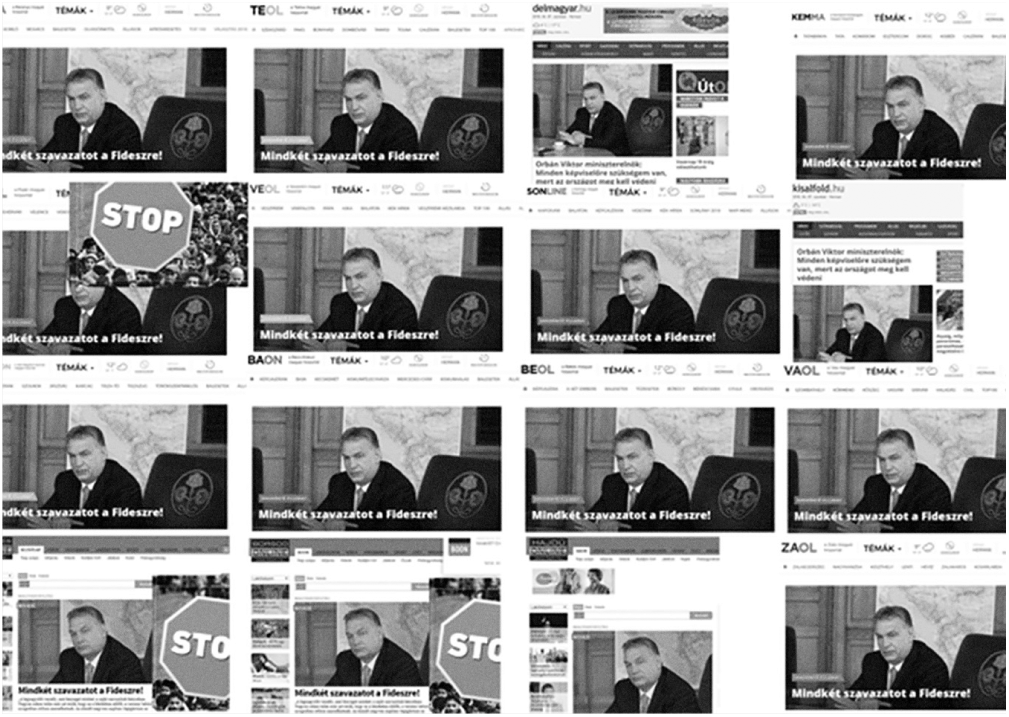
The government decree allowed Kesma to swallow up 476 outlets. It was issued at short notice and sidestepped the usual legal requirements of media and competition law. In one go, the decree created one of Europe’s largest media holdings, in a country with fewer than ten million people.
“All regional dailies belong to the Fidesz media conglomerate now,” said Gábor Polyák, head of Hungary’s leading independent media monitor, Mérték. “It is not about business, it is pure politics.”
Although the number of subscribers to local newspapers has declined significantly in recent years, 400,000 copies are sold every day, which means about 1.5 million readers, according to Mérték.
“It is clear that the national news [articles] are edited centrally [and] articles are taken from government outlets,” said Polyák. “The bias is very clear: in the local news there are no real politics, they spread the political content of Magyar Idők and other Fidesz outlets. Experts in articles are from [state outlets] Echo TV and M1. The bias is very clear.”
The new system “clearly evokes communist times”, Zselyke Csaky, Freedom House research director for Europe and Eurasia, told Index. “The centralisation sends a message that the private media sector property supporting government goals was never really private property. It’s also a reminder to loyal oligarchs and businessmen close to the ruling party that they are tools, useful only insofar as their interests overlap with the government interest of the day.”
Index spoke to a journalist and former long-term employee at Délmagyarország, Hungary’s biggest regional paper, which covers the Csongrád area from Szeged, the country’s third largest town. It serves as an example of how the government has operated to discredit and shut down regional papers.
“Around a decade ago, another news website named Szegedma (Szeged Today) appeared in the city. Szegedma worked as a mouthpiece for Fidesz party delegates,” said the journalist, who spoke on condition of anonymity.
It published a letter which it claimed had been sent by a socialist party MP to Szeged mayor László Botka, telling him to wait until after the April 2018 elections before settling migrants in Szeged. The letter, which the website claimed to have received from a reader, turned out to be fake.
Pressure was also brought to bear on the Délmagyarország editorial desk, claimed the journalist. János Lázár, a Fidesz minister and the erstwhile mayor of Csongrad’s other city, Hódmezővásárhely, was in regular contact.
“There were several occasions when Lázár called editors to spike articles – he would tell the editor that they would cancel all subscriptions if we wrote a story,” said the journalist.
Once the takeover of Délmagyarország was complete, former Fidesz councillor Gábor Bonifert, who edited the rival news website, was installed as editor-in-chief and all but two of the staff quit or were fired.
Opponents to Orbán’s media takeover include NGOs and independent journalists.
Dalma Dojcsák, a lawyer who leads the political freedoms project at the Hungarian Civil Liberties Union (TASZ), is suing the government on grounds of fair competition.
“We knew that we wanted to do something with this problem that has a significant effect on the media market in Hungary and people’s right to access free and non-biased media outlets in Hungary,” she said. But, she needed a partner who could help.
TASZ contacted Szabad Pécs (Free Pécs), an online outlet established in 2017 by two journalists. Szabad Pécs co-founder Attila Babos told Index: “The lawsuit was TASZ’s idea, as it needed a partner in the litigation who was involved in the media market. I immediately said yes.”
In 15 years as a local journalist, Babos has witnessed the collapse of independent local media. “From 2004 to 2016 I worked at the local daily newspaper Dunántúli Napló, the local daily of Baranya county,” he said. “It used to be very professional, highly appreciated and financially very successful, even after the financial crisis of 2008.
A protester holds a copy of Népszabadság newspaper aloft during an anti-government demonstration in 2016. The paper had been closed down just weeks before
CREDIT: Bernadett Szabo/Reuters

“However, the relentless media domination strategy of Fidesz saw the net close in on independent journalism in Pécs. Due to pressure from authorities, Axel Springer had to sell Dunántúli Napló (and many other newspapers) to a Fidesz-linked company,” he said.
After the deal, Babos and several colleagues left the company, knowing that they would be pressured to follow orders that “overwrite the ethics and best practices of professional journalism in favour of the political agenda”.
Anticipating his dismissal, Babos started planning to launch a new independent local news site, choosing the name Szabad Pécs to echo the Radio Free Europe service that served Hungary during the communist era.
“It was founded in March 2017 as a Facebook page, but within three weeks launched its own domain,” Babos said. “The goal is to become the voice of the region and to report about local news that is nobody else reporting. This work is not easy, but not many advertisers appear because they are afraid, so the situation has deteriorated. The local and rural press is very important in Hungary because propaganda is successful if there is no alternative.”
Media Restrictions by Numbers
36 reports of intimidation of journalists
41 reports of legislation or court orders restricting media freedom
55 reports of preventing reporting through various obstacles
32 reports of public ridicule of a media professional
Source: Mapping Media Freedom