



Abstract

Ahead of India’s elections,
An appetite for information, combined with a digital media boom piggybacking on cheap data connectivity, has enabled the mushrooming of regional news outfits catering to a new audience hooked on their smartphones.
Some 620 million people are forecast to be online in India in 2019. And while newspapers struggle to stay afloat elsewhere in the world, India registered a growth in the number of print publications during 2016-17.
Soaring literacy rates have also helped this growth – and if it is compelling, local news in India has a huge audience. “The interesting micro-stories of small groups of people written with a larger, national perspective always do well,” said Sunetra Choudhury, political editor at New Delhi-based news broadcaster NDTV.
She cites a story about the reminiscences of the bodyguard of Mayawati, head of the Bahujan Samaj Party and a prominent politician from India’s lower-caste communities. The report, which had immense regional appeal, was recently the most popular for the broadcaster.
In the south of India there is also a constant demand for, and supply of, local news. And Sneha Koshy, who heads NDTV in Kerala, says this is vital for holding politicians to account.
She describes how news outlets have influenced politics in the state’s Kollam district. A story about illegal mining was highlighted initially by protestors but was picked up by local news and a few national channels. It became a very important regional story, enabled by digital storytelling which forced local authorities, including politicians, to respond.
“When people who know what their rights are raise an issue through local news, MPs know they will have to answer for it during elections,” Koshy said.
One issue is that news from broadcasters such as NDTV jostles for attention with “fake news” on social media sites.
Facebook in India, under pressure from the government, has recently expanded its fact-checking network to help stop the spread of misinformation.
Dheerendra Gupta, a crime reporter with the Patrika daily in Satna, in the central Indian state of Madhya Pradesh, has a nickname for administrators of social media groups that spread “fake news”.
“These ‘Whatsapp Journalists’ are a menace. They undermine the hard work we put into fact checking,” he said.
Whatsapp groups can highlight real problems, such as the illegal mining in Kollam, but they are also vulnerable to being flooded with “fake news” and political propaganda. This has become a worrying trend in a country where vulnerable communities live in close quarters and rumours can spark violence.
“There’s huge demand for local news ahead of the polls. But misinformation on Whatsapp groups run by people who are not journalists has the potential to cause a lot of harm,” Gupta said.
Another problem for accurate local news reporting can be journalists themselves.
India’s rural journalists tell a story of deprivation and of living in the shadow of threats. Amit Singh, a special correspondent for a local daily in Satna, in the central Indian state of Madhya Pradesh, now regrets taking up journalism as a career choice. But this wasn’t always the case. Singh, who is also a stringer for Hindustan Times, takes great pride in telling the stories he has covered in Satna which has a population of about 300,000. His voice perks up with relish in narrating his encounters with dacoits – bandits – operating in remote terrains of the state.
“I’ve written about the nexus of dacoits and politicians. I’ve written about a woman dacoit whose whereabouts even the police did not know. I’m the first to reach a spot, often even before the police,” he told Index.
“But for the past few years, I have been ruing my decision. There’s no money. Not enough to survive. It’s a daily battle.” Singh says his newspaper, the daily Star Samachar, pays him such a small salary that he relies on other means to supplement his income.
“But I am better off than most small-town reporters. I have land in the village nearby where my family lives and I only pay for electricity and rent in Satna. My food comes from the fields,” says Singh, who comes from a family of farmers. Singh says politicians and police are keen to censor news and put pressure on local reporters. He once turned down a bribe of the equivalent of $7,000 because his conscience wouldn’t allow him.
“Stringers are powerful sources of local news. If they are paid a decent salary, this racket of blackmailing will clean up,” he said.
Mahtab Alam, executive editor of website The Wire Urdu, says news in sensitive areas can get diluted if stringers either do not want to jeopardise their personal safety by reporting it, or become morally compromised. Journalists in India have been killed after investigating controversial stories or challenging local politicians.
One of the reasons for the reliance on stringers is that news organisations have struggled financially. Hundreds of small news operations in India’s small towns and cities were badly hit by a move by the federal government in 2016 to ban high-value banknotes, ostensibly to crack down on corruption.
Small businesses that typically fund local news outlets are dependent on cash, and so stopped advertising. News outlets responded by firing reporters and outsourcing news gathering to a network of poorly-paid freelancers.
Singh says most small newspapers have learnt to back a few selected local politicians rather than a political party. Smaller newspapers sometimes lift unverified content from the internet because it saves money.
Shams Ur Rehman Alavi, a journalist from Bhopal, the capital city of Madhya Pradesh, says there’s a dire need for micro-local news. Multi-edition Hindi newspapers with huge circulations, such as Dainik Bhaskar and Dainik Jagran, bring in their own selective news culture, which often ignores local issues. “Take, for example, tribal areas of MP,” he said. “Even if a district has a population of four million, there’s no news coverage from there. Media houses focus on state and national news. Local news gets suppressed. And there’s a complete ‘othering’ of tribals and indigenous people.”
There’s also pressure to follow news from Twitter and Whatsapp, a world alien to many small-town journalists in their late 40s and 50s who struggle to make sense of the newsy internet culture, says Pankaj Shukla, the resident editor of Subah Savere, a newspaper based in Bhopal and Indore.
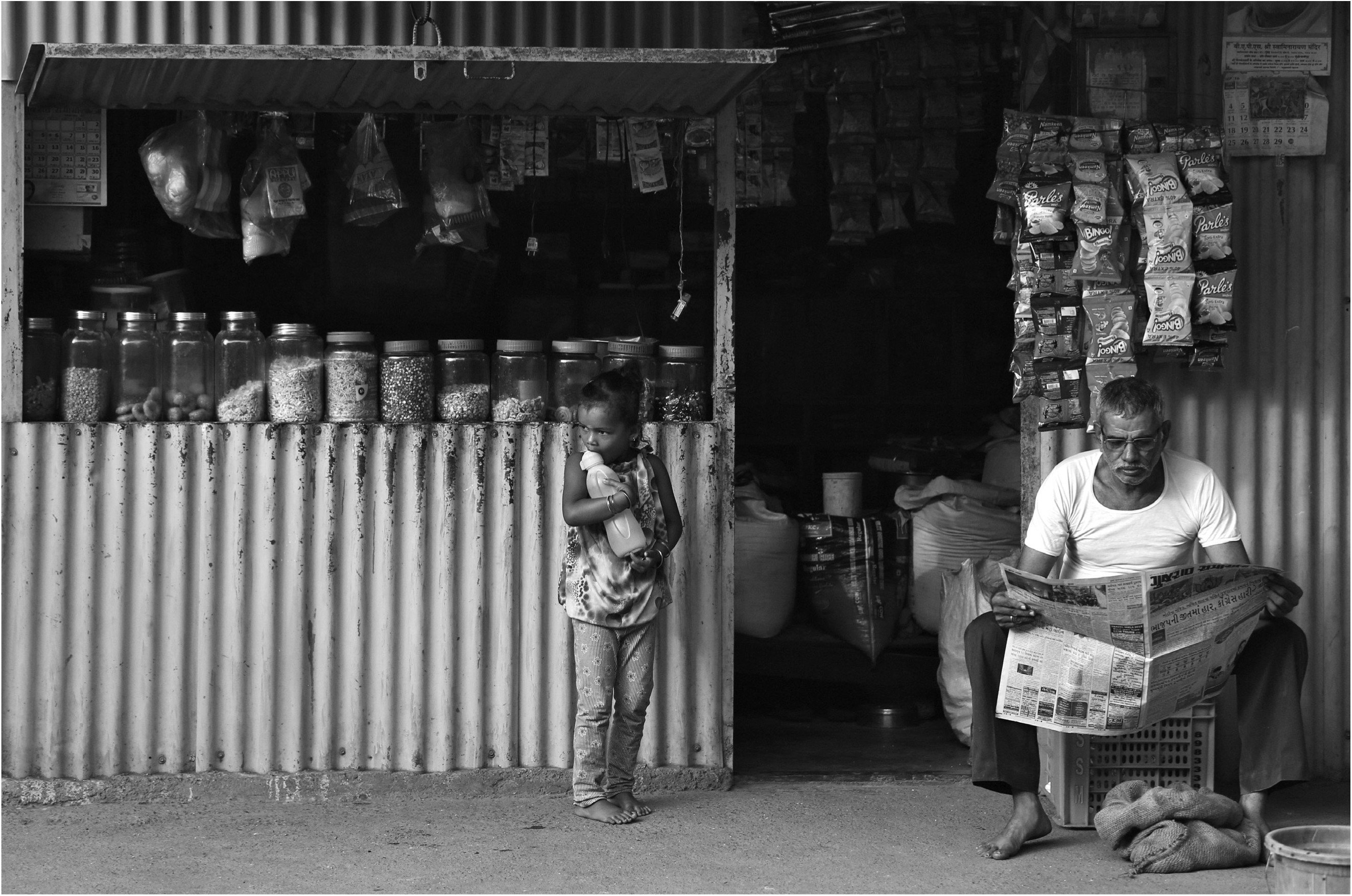
A shopkeeper reads a newspaper in an area of Mumbai, India
CREDIT: Shailesh Andrade/Reuters
“We are not changemakers at this point, we are in crisis…. The space for serious journalism is shrinking,” he said.
He identifies two problems plaguing local news operations: social media such as Whatsapp as a news source and in-house infrastructure problems or, as he wryly states in Hindi, “paisa nahi hai (there’s no money)”.
Patricia Mukhim, editor of Shillong Times, the oldest English language newspaper in the north-east Indian state of Meghalaya, echoes Shukla’s words. “If we think we are influencers in some way, it’s a mirage. In the end, all that matters is money,” she said.
But all is not bleak. Journalist Neelesh Mishra founder of one of India’s biggest rural media platforms, Gaon Connection, says that in today’s news environment, his organisation is a global case study of how an independent local media can thrive without paid news, corporate or political influence, and with no ad revenue.
Gaon Connection was among 10 media outlets in India selected for funding from YouTube as part of the Google News Initiative. Where some local news outlets have failed, Mishra says he has found new revenue streams from the content his platform produces.
“Even the office driver and the office boy have been trained to be content creators. Writing a story is a craft few have, but creating relevant video content is possible by anyone who has a smartphone,” Mishra said. He aims to create a large enough network so that it becomes a powerful voice for people in rural India.
As India goes to the polls starting in April this year, it is not the big media but a trusty network of local reporters, with their ears to the ground, that most Indians will rely on.