




Abstract

Former local reporters
“They Didn’t Stay Secret for Long”

Over a cup of tea, the desk sergeant would let us browse through the overnight crime ledger – burglaries, road accidents, who’d been nicked for being drunk and disorderly…
From there, it was on to the fire station and the ambulance headquarters for a daily update on everything from a chip pan fire to a sudden death.
We could wander into the town hall and talk to anyone.
The part-time council leader was an engine driver who didn’t own a car. He lived near me and I used to give him a lift to committee meetings in the office van. He’d fill me in on the latest gossip and let me flick through the minutes.
All committees were open to the press and the public. If there were any secrets, or dodgy back-door planning deals, they didn’t stay secret for long.
Like Marlon Brando, we covered the waterfront. The city’s population was just 80,000, but it supported one weekly paper, one twice-weekly paper (Tuesdays and Fridays) and a six-day-a-week evening paper. Reporters were assigned full-time to local magistrates, assizes and civil courts – we’d even cover small parish councils.
When I graduated to Birmingham, and latterly Fleet Street, the drill was much the same, if even more intense. Newspapers could afford specialist correspondents, with encyclopaedic knowledge of their own patches.
Pubs and afternoon drinking clubs served as information exchanges. There was one, in particular, near the Houses of Parliament, where journalists, coppers, spooks, politicians, trades unionists, known gangsters and men of the cloth would all congregate.
Everyone knew the boundaries, but all appreciated the value of somewhere they could chat, off the record. When I was an industrial correspondent, most of my business was done over a pint of beer.
It is often claimed that today, thanks to social media, we are better informed. Not true.
What we get from the internet is a bombardment of rumour, speculation, vile abuse and what we have come to know as “fake news”. Citizen journalism is no such thing. It’s activist-driven and devoid of the rigour required of proper journalists.
Old-school newspaper hacks had to get their facts right or they’d quickly get found out.
But they broke important stories, backed by hard evidence. It’s often said, to cite one example, that if there’d been a proper neighbourhood reporter in west London, the problems at Grenfell Tower would have been exposed long before the tragic fire which claimed so many innocent lives.
Sadly, local papers have been put out of business as classified advertising has migrated to the internet. The rot also set in when councils merged and moved their headquarters miles away from the people they are paid to serve. These new supersized local authorities started holding their meetings in camera. Some of them launched their own newspapers to peddle partisan political propaganda and withdrew advertising from independent papers in an attempt to stifle hostile, or at least inconvenient, reporting.
Despite freedom of information laws, we now live in a much more secretive era. Civil servants have been fined, and jailed, for selling stories to newspapers, even though they were undeniably in the public interest.
Reporters have been dragged before the courts for allegedly bribing contacts in the police and government, although pretty much all these cases have been thrown out by sensible juries.
When I started in this game, giving a bottle of Scotch to the desk sergeant at the local nick every Christmas was considered good manners. These days, it would be a criminal offence.
Over the past 12 years, the number of frontline journalists in Britain has fallen from 23,000 to 17,000. Local papers have gone to the wall. The city where I began my career, Peterborough, boasts a population now of 196,000. But it has only one, weekly, newspaper.
Crimes, courts, dodgy deals at the town hall – these all go unreported. This isn’t just a tragedy for journalists, it’s a disaster for our democracy.
Daily Mail columnist
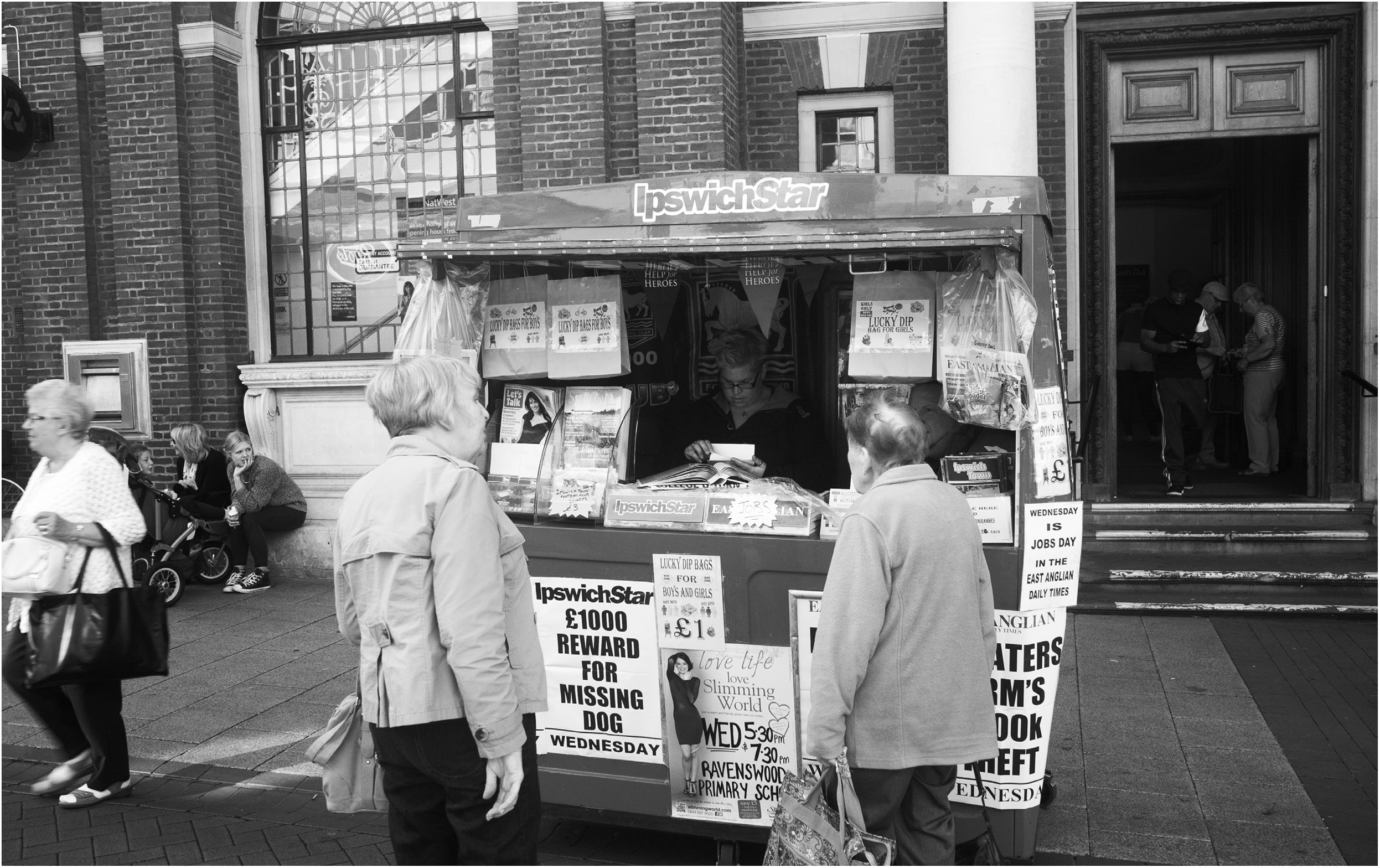
A street stall selling the Ipswich Star. The newspaper based in Suffolk, UK, saw its circulation drop by 37% year on year in 2018
CREDIT: Geography Photos/UIG via Getty Images
Why Should We Care About Local Journalism?
Most daily papers in Germany suffer from a shrinking circulation. That’s mainly due to an ageing readership: the old die, the young look at their mobiles. As if that wasn’t enough, advertising revenues are shrinking dramatically as well. Who wants to search the paper for a new house, car or holiday when all of that is just one mouse-click away?
Despite all that, Germany still has one of the highest densities worldwide of local papers, with very loyal readers. The reason is not news about Donald Trump or Justin Trudeau, Venezuela or Vietnam. National and international news is covered by TV and radio as well as being ubiquitous on the web. What keeps papers afloat is their local and regional news.
Local competence counts. Events on people’s doorsteps are often not found via Google. Why is the local nursery closed? Why have the church bells stopped ringing? Are the roadworks on the main road ever going to stop? Those questions are answered by only the local paper.
No doubt printed newspapers will become a rarity in five or 10 years’ time. But slowing down, or even stopping, the decline will work only with local news.
RALF GUNKEL is editor at Stuttgarter Zeitung and in charge of 10 district editions specialising in local news
“It was the Beginning of a Long Period of Decline”
CREDIT: (Posetti) Tim Anger
I was a trainee journalist in what was then a scrappy commercial radio newsroom. There were five reporters at Radio 2 Double O, as it was known when I joined in 1989, pushing out five-minute local news bulletins every 30 to 60 minutes from 5am to 7pm. We worked in what was effectively a bi-media newsroom (long before the days of multimedia journalism), collaborating with colleagues from the co-owned WIN TV News, who sat adjacent to us. And we competed in a diverse pre-internet media landscape.
This was a city of about 150,000 people served by a campaigning Fairfax Media title called the Illawarra Mercury, which then had capacity for high-impact local investigative reporting; two wellstaffed commercial radio newsrooms; a regional Australian Broadcasting Corporation station with a solid, if somewhat antiquated, newsroom; and three fully staffed commercial TV news services covering a suite of beats. Every Monday night, for example, Wollongong City Council meetings were covered by a full deck of local media representatives.
This was a historic highpoint in media diversity for the region and the competition was mostly healthy. But it was also possibly unsustainable. And it was the beginning of a long period of decline.
But this is not just another story about the slow death of local journalism. It’s a story about local journalism’s diminished capacity to carry out accountability reporting at a time when democracy is more fragile than it’s been in almost a century.
As a teenage trainee journalist at 2 Double O, now known as i98fm, I was warned to beware of the sexually predatory Wollongong mayor and state parliamentarian Frank Arkell. I quickly learned that this man was not just a vulgar harasser but was also reputedly part of a paedophile ring that had operated in the city for decades, and had deep links to local government, the Catholic church and the regional business community. It sounds like a conspiracy theory, right?
Wrong. Arkell was eventually exposed by the Illawarra Mercury as a prominent member of a paedophile ring. Not long afterwards, he was brutally murdered by a man who claimed to have been one of his victims.
Fast-forward a decade and Wollongong City Council was sacked by the state government in the midst of a scandal – again exposed by the Illawarra Mercury – involving sexual favours exchanged for development approvals
Today, the population of Wollongong is burgeoning, but the media landscape has contracted dramatically – despite the arrival of digital media. Two commercial radio stations produce a limited number of news bulletins that rarely break news and sound more like audio press releases. There is now only one, poorly-staffed, local TV news service that does its best with an oily rag. And the utterly depleted Illawarra Mercury is up for sale following the ignominious end of the 185-year-old Fairfax Media brand. The ABC, at least, has expanded its regional presence and airtime but its local content has limited mainstream audience impact.
Local news is often regarded as a training ground for journalists and looked down on by big city or national news organisations. But without robust, well-resourced local news services, my home town would likely never have learned of the depraved, destructive abuse of power that underpinned a decades-old paedophile ring intertwined with a corrupt city council. Nor would it have learned of the illegal disposal of potentially cancer-causing chemicals down mineshafts by industrial polluters. Nor would it have known about allegations of waterfront corruption.
When I returned to Wollongong as a journalism academic in 2013, two decades after I left the local ABC bureau to work on a national ABC TV programme, I found little evidence of the feisty, robust local journalism tradition that birthed me as a reporter. Now, despite the power of social media and the ability of online communities to mobilise, I fear that the paedophile mayor would find it much easier to keep his cover in 2019.
As we continue to search for sustainable business models to support independent journalism that truly holds power to account and counters propaganda, we cannot afford to sacrifice the “local”.
Now at Oxford University’s Reuters Institute for the Study of Journalism,
Being the Eyes and Ears of the Community
CREDIT: (Morton) Ken Lennox

From memory, Mondays would be visits to the local police station and magistrates’ court, which invariably yielded a yarn; Tuesday would be a trip to the council planning department; Wednesday was the weekly council meeting; and Thursday meant a call on the local butcher – who was also the mayor of the Devon market town of Tavistock – to drum up a story. As a budding reporter, I quickly realised that the word “row” always helped propel a thin story on to the front page. Saturdays meant standing outside the register office interviewing several happy couples and dreaming up headlines other than “Dance led to Romance” or “Met in a Pub”.
The extended stints on local newspapers was part of our training on the Mirror Group graduate scheme, which was based in Plymouth. Former luminaries include military historian Patrick Bishop, investigative journalist Nick Davies, crime writer Val McDermid and former Prime Minister Tony Blair’s right-hand man, Alastair Campbell.
Early on, we were taught to distinguish between human interest stories – essentially births, marriages and deaths – and public importance stories which were, in the main, the ruminations of the local council and other official bodies. The boring but important stuff.
Parachuted into local communities, we were encouraged to look around for “off diary” stories, to be the eyes and ears of the community. So I would regularly drive round the area just looking around. It was a routine that yielded dividends.
I remember spotting a man in his driveway who was building a concrete yacht. He told me that once it was finished he planned to sail to Australia. I wonder what happened to him.
On a Plymouth council estate, a couple of houses next door to one another caught my eye. It was clear that the occupants had spent thousands of pounds on improvements that made their homes stand out from the humdrum surroundings.
A knock on the door revealed that they were the first in their road to take advantage of Prime Minister Margaret Thatcher’s controversial sale of local authority housing.
Other features of the weekly journalistic routine in the 1970s would not pass modern muster. When I worked on the Sunday Independent at its branch office in Truro, one of my jobs was to find a pretty local girl who would agree to be pictured for the newspaper. This wasn’t some topless Page Three Girl made famous by Rupert Murdoch’s Sun but a winsome portrait of a young woman carrying, say, a basket of daffodils.
I duly spotted a young woman working in a local antiques shop. She seemed to have all the qualities needed to brighten up an inside page.
I strolled back to the office and informed my senior reporter, a chap called Paul Mann, who is now a successful novelist.
He wanted to double-check my choice so he gave her the once over. He took one look at the young lady in question and shook his head. “Nahh, mate, she’s too old.”
We later discovered that the “ancient” shop assistant, then in her early 30s, was none other than model Jean Shrimpton, the face of the Swinging Sixties and regularly described as the most beautiful woman in the world. For a time she quietly ran a hotel in the nearby town of Penzance. That was one “human interest” scoop that got away.
Of course so much has changed since those days – but much has remained the same.
Looking at the Tavistock Times – now the amalgamated Tavistock Times Gazette – the content has barely changed; tragic road traffic accidents, shoddy builders and planning rows. That word again.
Ownership has changed hands: the Tavvy, as it was known, is now run by the local newspaper group founded by Sir Ray Tindle, who earned his knighthood by saving dozens of local newspapers from extinction.
While the online revolution has cut a daunting swathe through the ranks of local newspapers – the NUJ has called for an inquiry into local newspaper provision – new technology has made mini-Murdochs of us all.
Six years ago, my former Mirror Group colleague Keith Wheatley set up his own online journal, Around Wellington, to keep everyone in his Somerset town up to date on local events. January this year was his most popular month to date.
His enterprise is no money spinner, but Keith keeps his head above water – and still manages to get the word “row” into his planning reports.
Celebrity author and royal biographer