




Abstract
After three decades in local journalism, Tracey Bagshaw investigates the state of UK regional news today. What she finds is disturbing. Newspapers are closing and reporters are no longer covering local courts and councils
The National Union of Journalists warned in 2016 that the regional newspaper industry was in “freefall”, saying that the number of regional journalists had halved to about 6,500, with centralised newsrooms, leaving press benches in many council chambers and courtrooms empty.
Meanwhile, a study by Press Gazette, a trade publication, in 2018 found that 228 local titles had closed since 2005, 40 of those in 2017.
Even where newspapers still exist, journalists increasingly have their work cut out to keep “worthy” content on the agenda, and find coverage of local councils and courts competing with click-friendly online snippets which create big digital audiences. The most read story on the Gloucester Live site in 2018 was a lump of wood floating on the River Severn which “could” have been a monster.
A story count over five days in the Norfolk local paper, the Eastern Daily Press, in January 2019, found 37 council-related stories, 23 court stories and four inquests in papers. The same period in 2009 had 51 local government stories, 27 court cases and eight inquests.
Many local newspapers no longer have lobby correspondents in Westminster. The EDP once had three but now the role is held by a Norwich-based reporter in addition to her other responsibilities. Fewer newspapers have reporters in crown courts every day, and local government meetings are more of a stretch to cover than they used to be.
Current EDP editor David Powles recognises there are problems but said: “There’s no denying our newsrooms are smaller than they once were but… coverage of councils, court and local organisations remains at the heart of what we do.”
His 15-strong Norwich newsroom (backed up by feature writers, digital and sport reporters, and about 20 reporters in seven district offices) maintains specialists in business, local government health, crime, education and court.
But when all local newspapers are under enormous pressure to make cutbacks, something has to give.
In January 2018, journalism students at the University of the West of England observed Bristol Magistrates’ Court for a week. They said it took three days before they spotted a reporter and said the majority of the 240 cases they sat in on went unreported. Most reports that did appear came from Crown Prosecution Service handouts.
They concluded that with about 300 magistrates’ courts in England and Wales, it was possible that 15,000 newsworthy stories were potentially being missed every week.
Journalist Paul Cheston retired in 2016 after three decades covering court cases for the London Evening Standard.
He told Index: “The collapse of local paper circulation has led to reduced costs, reduced pagination, reduced staff levels and training reduced to practically nothing. The result is a handful of reporters rushing to produce the maximum number of stories in the least possible time. Hence court and local council reporting is deemed not time efficient.
“Trying to cobble together a story from court lists, police press releases and, even worse, social media just because there was no reporter in court to take down what happened as it happened is not only plain wrong but dangerous. Apart from the potential inaccuracies, the subsequent report loses all privilege because it runs the risk of being neither fair, accurate nor contemporaneous.”
In Lancashire, David Graham, who worked for the Lancashire Evening Telegraph in the 1960s and 1970s has also noticed the changes.
“The area magistrates’ court, a goldmine for news, sat on Monday and Thursday, with a juvenile court every couple of weeks on a Tuesday, and these were often staffed by two of us, so we could take it in turns to nip back to the office and file copy,” he said. “The local weekly papers also sent reporters and there were often three or four of us on the press bench at any one time, sharing notes and covering for each other.”
They shared a retiring room with police, lawyers and court officials, gathering plenty of background and local gossip. “That sort of contact can never be replicated with a phone call to a court office to get a list of cases and verdicts,” he said. “Magistrates and solicitors were often local councillors as well, so again there was regular crossover contact, with bits of information you could never hope to pick up remotely.”
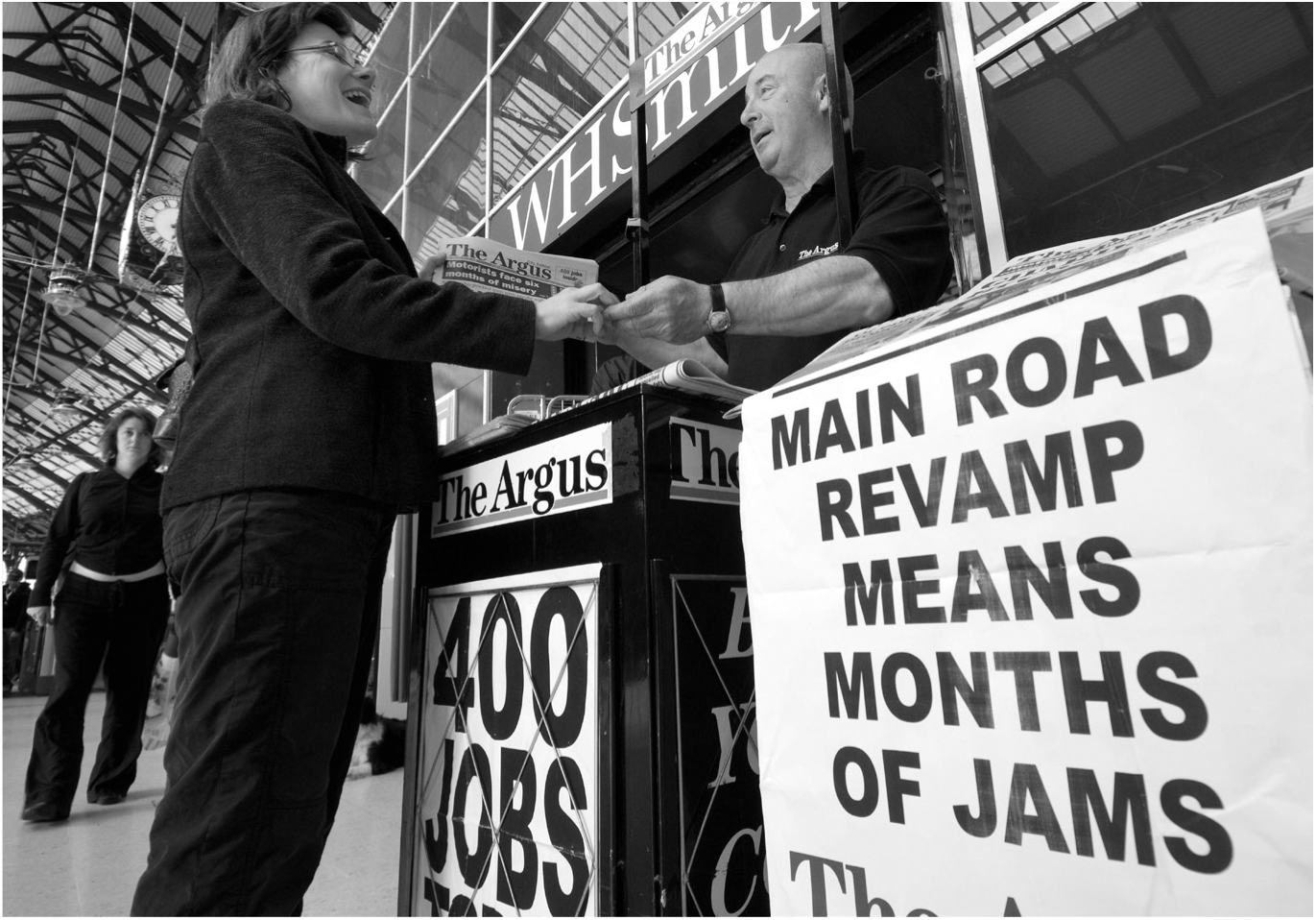
A newspaper stall selling Brighton’s local newspaper The Argus in the city’s railway station, UK
CREDIT: Roger Bamber/Alamy
With a wide patch and several titles to cover, a news editor at one regional media group told Index that his reporters covered as many council meetings and court sittings as possible, but that there were new obstacles.
“The role of grassroots local journalism is more important than ever as we face the combination of public bodies with highly paid marketing teams trying to manipulate the news, and people on community social media sites sharing information, which is often false,” he said. “We increasingly find that councils, health trusts, education trusts and emergency services are more combative in protecting their image and attempting to steer us away from certain issues and stories.”
In 2016 a report by the Centre for the Study of Media, Communication and Power at King’s College, London found UK towns where daily local newspapers had shut suffered from a “democracy deficit”, with reduced community engagement and increased distrust of public bodies.
Martin Moore, director of the centre, and one of the authors, told the BBC: “We can all have our own social media account, but when [local papers] are depleted or in some cases simply don’t exist, people lose a communal voice. They feel angry, not listened to and more likely to believe malicious rumours. Because it’s not necessarily the sexy stuff, like big investigations, for quite some time people didn’t notice it was disappearing.”
Councils say they want transparency, and to this end some are becoming more pro-active. Norfolk County Council is planning to feature its meetings live on YouTube, and local politicians across the UK live tweet from meetings and send copies of their speeches to reporters.
But nothing replaces having reporters in the room, which is why about 150 local democracy reporters (LDRs) are employed through a new collaboration between the BBC and local newsrooms solely to cover local authorities.
One of these LDRs is Neil McGrory, a journalist with 18 years’ experience, who covers East Dunbartonshire and North Lanarkshire councils in Scotland. Since June 2018, McGrory has filed more than 230 local council stories for print and online.
Google and Facebook are now the largest distributors of news. Neither company employs trained journalists, but Facebook is launching a £4.5 million training scheme that will pay for 80 community journalists to improve coverage. The scheme will be run in tandem with the major UK media groups and is designed to fill the gaps.
But some local titles are proudly fighting to maintain the depth of their local reporting.
Sinead Corr co-founded the weekly Stortford Independent in Essex with backing from an independent publisher, and has made a conscious decision to concentrate on local news.
“I go to every single town council meeting,” Corr said. “My colleague attends every parish council meeting in the other part of our patch… We keep a similar watching brief for county council matters. Because I attend every town council meeting, the members make a point of telling me what’s going on and most of them [also] serve at district and/or county level.”
As EDP editor Powles said: “How could people make their informed choices about who is best to run their local services if they are not able to get a neutral account as to what it is exactly they do?”