




Abstract

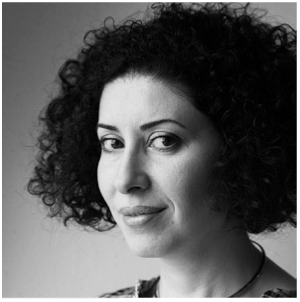
Syrian playwright
“If I decide to stop writing then the enemy – or the dictatorship, shall we say – succeeds in making me shut up, whether I am inside or outside the country,” she said. “So it’s kind of dealing with your own censorship and fears.”
Yazji studied English literature at Damascus University and started her writing career in Syria before moving to Berlin. Her play, Goats, was performed at London’s Royal Court Theatre in 2017.
Her new play addresses the bleak consequences of avoiding self-censorship and is based on what is happening to people she knows in Syria.
“I will not exaggerate and say I am scared to be killed because of my work, but I am scared because I still have family there and I could be detained or imprisoned there. Sometimes I like to close my eyes and think this is not going to happen, but I must also calculate the danger,” said Yazji.
Syrian playwright Liwaa Yazji. Her play Goats was performed at The Royal Court Theatre in London in 2017
CREDIT: Florian Riemann
“It is always a question of how to speak my mind, my opinion, and how to be true to what I believe and still not put myself in the situation where my family are affected over there. It’s about selflessness and selfishness.”
Her new play, Waiting for the Guests, written exclusively for Index and published for the first time below, looks at what happens when a mother’s writing makes her an enemy of the state and she is forced to make the crushing decision either to wait and be killed by soldiers, or to kill herself and her family before the soldiers get to them.
Yazji said: “The horror of waiting at home for someone to come and kill you, but then deciding ‘no, I don’t want to be killed by them, I will do it first’. That whole situation, the fear and horror, the moment when you decide, it stays with me. I put myself in that situation and how I would fictionalise and dramatise that.”
What is happening in Syria has a great impact on her work, and she has previously told Index about the “big responsibility” she has when writing about what goes on in the country. Nonetheless, the playwright warns, the chaotic scenes in Syria could happen anywhere. “You’re always in danger.”
Waiting for the Guests
By
The events take place in a one-storey house with simple, modern decor in a city in Syria in 2014.
Kitchen. A window looks out on a balcony that is enclosed on all but one side. The door to the balcony is closed, as are the shutters on the door. The room is dimly lit. Mother opens the refrigerator, takes out all the items inside and places them on the kitchen counter. She opens the cupboards and takes out the few provisions that remain. She puts pasta on to boil. She opens the last bags of rice and bulgur and impassively pours them onto the floor.
She inspects the flame under the pot of pasta. The flame is burning low – clearly the gas has almost run out.
She turns back to the cupboard, takes out the appliances, including a stand mixer and fancy espresso machine, as well as a set of dishes. She piles the appliances next to the gas tank. She selects four plates and bowls and sets them aside. Then she begins throwing the rest of the dishes onto the floor, one by one, tranquilly observing how the broken shards scatter. She does the same thing with a set of cups that appear brand new: she sets aside four cups and then calmly throws the rest on the floor. She places the dishes and cups she reserved on the kitchen counter.
The telephone rings offstage. It seems as though someone answers.
Mother turns to the rest of the dishes and cups and throws them on the floor, all but the set of four she reserved. She does this slowly, watching each one break.
Daughter enters the kitchen. Mother gestures at her not to come any closer. Daughter looks around in shock and incomprehension. She is about to ask something.
We agreed, no questions today.
Daughter remains silent. She leaves.
Mother finishes breaking everything. She turns to the balcony shutters and opens one side to look out. The sharp light of day enters the room all at once, preventing her from being able to see well. She closes the shutters.
She turns to the counter. She picks up a piece of potato; it is clearly old, and she tries to clean it. She switches on the tap, but no water comes out. She checks the pasta on the stove. She sits at the table and puts a potato and onion in front of her. She begins to chop the onion and starts to cry.
Father appears in the kitchen doorway and looks at her. He looks around the kitchen.
Who was it?
Ammar.
How long?
Two hours… maybe.
Mother nods.
They’re definitely coming?
Father nods in response.
How long do you need?
Mother looks at the clock.
CREDIT: Umit Bektas/Reuters
CREDIT: bwb-studio/iStock
Mother and Father’s bedroom. The window is closed, but the shutters are slightly open, with broken light coming in between the slats. From offstage, the sound of cabinets being opened and closed. Daughter sits on the edge of the bed. In front of her are a set of coloured markers. Father enters. He is carrying a utility knife. Daughter watches him closely.
What should I draw?
Father sits down next to her and starts slicing open the pillows, one by one. Feathers fly around. Daughter rushes to open the pillows and scatter the feathers. She seems happy, if anxious.
What do you like best about our house?
The house.
She walks over to a blank wall. With a marker, she begins to make a small drawing of a house.
(While shredding the mattress) Across all of it.
Daughter watches him for a moment. Then she makes a bigger drawing of the house, and draws the interior of the house as well.
Who’s coming over today? Mum won’t say. Do we like them? Do they like us?
Sound of a shell landing somewhere not far away. Son enters, afraid. He sees the feathers flying around and Daughter drawing on the wall. He seems stunned.
Did you hear?
It’s been closer.
Have you finished what your mother asked?
I put my clothes next to yours on the floor. I’m scared.
Father turns to the mirror and smashes it with his fist. Daughter stops drawing. Offstage, the telephone rings.
Living room. Books line the shelves, and there is a flat screen TV. The room is filled with clothing piled on the floor, next to Son and Daughter’s toys. The window shutters are closed; the room is lit with LED lights and a few battery-powered lamps. Son and Daughter are alone on the sofa. Daughter seems nervous. Son is busy looking around.
Silence.
You feel it?
Son doesn’t respond.
I love you anyway.
Son remains silent.
Tell me that you love me too!
Love you.
Say it for real.
What do you mean?
Daughter hugs him.
Come on, let’s say it together, at the same time. One. Two. Three.
I love you.
Daughter lets go of Son. He stares at the piles of his toys. He is about to go towards them.
Don’t touch anything.
Son goes back to the sofa, giving in to boredom.
Tell me something, was it you who scribbled on the picture above my bed? And did you scribble under my doll’s eye?
No.
It was me who threw your Playmobil out of the window. Were you the one who scribbled on her?
Son shakes his head in response, annoyed with her.
I don’t wanna talk to you any more.
It was me who left the birdcage open.
I know. But I didn’t say anything.
Sounds of bombing.
It’s louder today. A lot louder.
Did you hide anything?
My dinosaur. Enough.
I hid a notebook.
Daughter whispers in Son’s ear. Then he whispers in her ear. They both smile. Silence. Daughter hugs Son again, tightly. Father enters.
Why did you shut the door? What were you and Mum doing?
What were you two doing?
Mother enters carrying the four dishes and crosses to put them down on the centre table. Father exits. Mother exits. Father returns with bread, cups and water. He exits. Mother returns with pasta. She exits. Father returns carrying a dish of tuna, and another dish with all the tinned food they have left. Mother returns with a coffee pot, a sugar jar and biscuits. Father observes the table, as does Mother, trying to determine what is missing. A moment of confusion.
Do we have to wait?
Mother sits down, then Father.
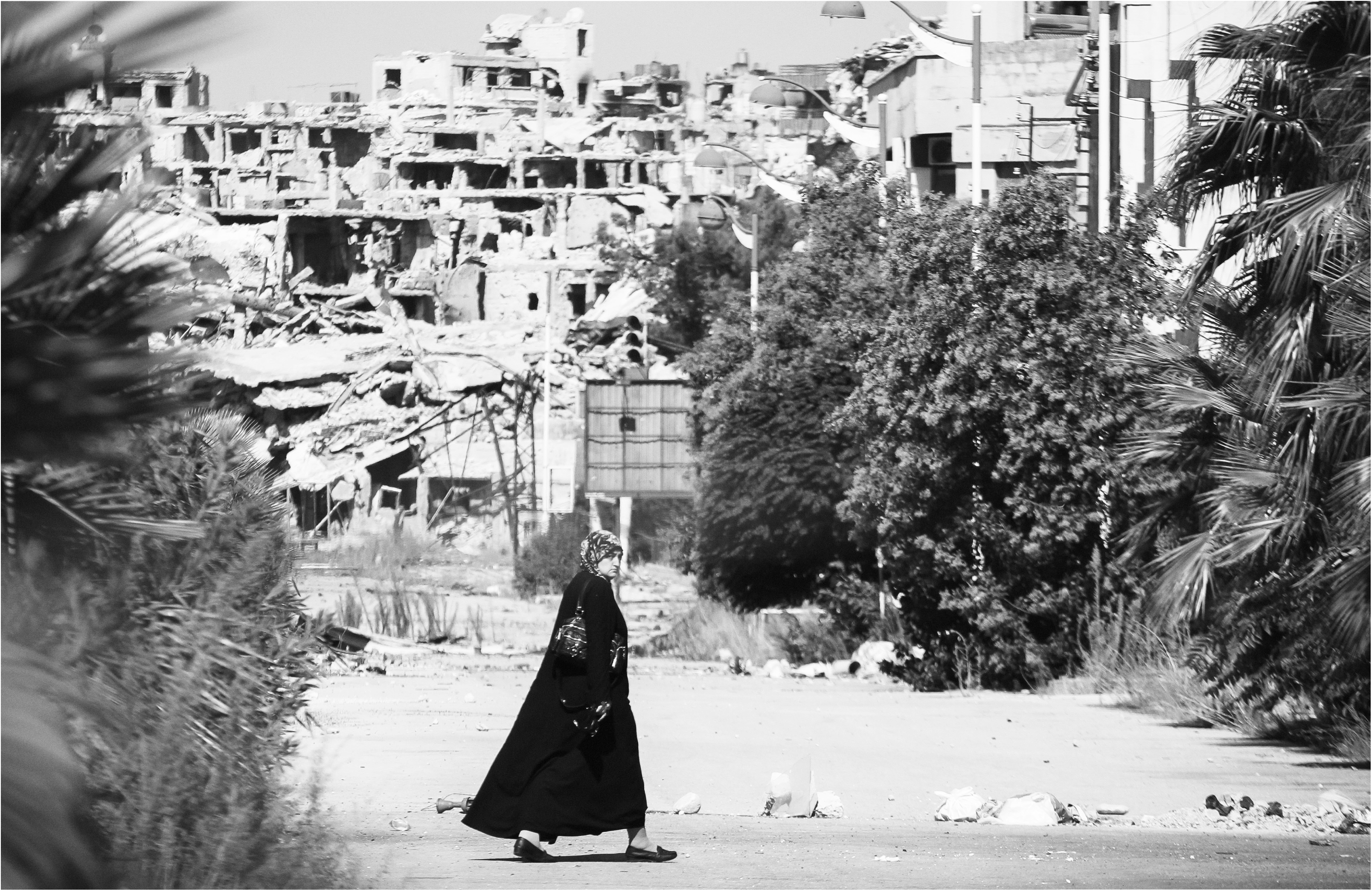
A woman walks through the rubble of Homs, Syria in 2013 before rebels and civilians finally withdraw from the city
CREDIT: bwb-studio/iStock
Is anything of yours left in there?
Son and Daughter shake their heads “no”, looking at each other. Mother remembers something and rushes off. The telephone rings. Father gets up to answer it. Mother returns, stands nearby.
Yeah… and where were they? The co-operative building.
Mother gestures as if trying to figure out whether a nearby building is the one he is referring to. Father gestures in response. She quickly exits while he continues the conversation on the phone. She returns carrying a box filled with cassette tapes of old music and several notebooks that look like journals and diaries. She exits again. She returns with a cloth bag.
(Engaged in conversation on the phone.) Amal’s house? Okay… and Salam? Too?! Azza? Abdullah? Who’s left? Us? We’re about to start dinner. and you lot? (Father jerks his ear away from the phone as if he were shaken by a loud noise on the other end.)… Hello… hello…
Father tries to listen a bit longer then hangs up, now clearly concerned. Daughter looks at him expectantly. Mother sits down next to Daughter and opens the cloth bag.
Come here.
Father walks over to them and sits down. Mother gives Daughter several pieces of gold jewellery. Daughter takes them, not understanding.
Put it on!
They’re ugly! You want them to see me wearing this when they—
All of it.
Daughter puts the jewellery on, while mother puts the rest on herself. Mother puts a necklace around son’s neck. Father watches. Mother takes two wedding rings from among the jewellery, and offers her ring to father. She is overcome with tears, as is he. She extends her hand, and he places the ring on her finger. She looks at him expectantly, and he extends his hand too. She puts his ring on his finger.
Kiss me.
Father kisses Mother quickly.
Kiss me for real.
Father is flustered, then kisses Mother. Sounds of shelling and an exchange of gunfire outside.
Let’s eat.
— They begin to eat.
Why aren’t the fridge and washing machine and microwave where they usually are?
Everything’s next to the gas tank.
We ate before our guests got here. Is that ok?
(to Father) They’re coming for sure?
For sure.
What if they don’t arrive?
We agreed they will.
Maybe…
They’re going to come.
Mother and Father turn to Daughter fearfully.
I know who’s coming. I know why you’re doing all this. So they won’t be able to take anything.
Mother holds back her tears.
Are they coming for us because you wrote against them?
That’s got nothing to do with this…
It does too.
They’re coming for everyone.
Who’s “they”?
If you hadn’t written anything, would they still be coming?
No. Don’t think like that.
Are you lying to me?
No.
We would never do anything that might hurt you.
But you’re against them.
They’re coming for everyone… they’re not going to ask first.
(to Father) Call Ammar!
Father hesitates. Then he stands and dials Ammar’s number. No one answers.
Uncle Ammar in the building across the street?
Mother hugs Daughter.
(to Father) Call Um Salma.
He dials the next number. No one answers.
They must be in the building.
Daughter cries. Mother hugs her, struggling to keep Daughter and Son from seeing that she is overcome with tears. Father walks over to the sofa where they are sitting, reaches underneath and pulls out a grenade. Daughter is frightened. Mother hugs the children. Father, holding the grenade, joins them on the sofa. Mother looks at him anxiously.
(Fearfully) Well?
Father thinks, then hands the grenade to Son.
No.
(to Son) Hold it like this, son… and pull here. (Indicating the firing pin.)
Son is scared of Mother’s and Daughter’s reactions.
No…
I don’t wanna.
There’s no time. For my sake… for all our sakes… if you love us, if you don’t want anyone to hurt us.
Son pulls the firing pin.
Explosion.
Footnotes
Translated by