




Abstract
Nobel Prize-winning author
“As a writer living in a post-Soviet space, I have got used to the fact that writers are always under threat. It’s part of everyday life,” the author from Belarus told Index ahead of being presented with the Anna Politkovskaya award in March.
The global award honours the memory of the journalist, writer and human rights activist who was shot dead because of her reporting about the war in Chechnya. Since Politkovskaya’s death in 2006, life has got more dangerous for journalists and writers in the post-Soviet world.
It is normal, believes Alexievich, to be in conflict with the powers that be. “What is much more complicated and tragic is to be in conflict with your own people,” she said.
Index caught up with her in Bratislava, where she was talking to the Central European Forum about her work.
Alexievich, who was born in 1948 – the daughter of a village schoolteacher who was buried with his communist party card – is celebrated through the world for her moving and remarkable books about the experiences and memories of ordinary people caught up in some of the most significant events of modern history.
In The Unwomanly Face of War she talks to women who were sent to the front in World War II. In her other books she explores the aftermath of the nuclear disaster in Chernobyl, the war in Afghanistan and, in Second-hand Time, the collapse of the Soviet Union.
But recently Alexievich, who lived for several years of her life in self imposed exile, but is now living in Minsk, has found that she is out of sync with the very people whose experiences she has written about. And that is worrying for her.
“So in Belarus, 80% supposedly are for [President Alexander] Lukashenko. In Russia, 70% are for [President Vladimir] Putin, and that’s very, very difficult. There’s no way out. You just have to do your job. It’s unpleasant, but I am not scared.
“When I am in Russia, I am accused of being a Russophobe and a Banderite [a Ukrainian nationalist]. I come to Ukraine and I am accused of all sorts of things by this website.” The Ukrainian nationalist website Myrotvorets has said she is anti-Ukrainian, and she was forced to cancel an appearance in Odessa because of threats against her.
How does she feel about all this? “We are all fatalists,” she said. “Writers used to live in these conditions and, besides, I am 70 years old and at that age you can take these things with a pinch of salt and calmly.”
Alexievich goes on to talk about her friend, the Belarusian-born journalist Pavel Grigoriev-ich Sheremet, who was assassinated in a car bombing in 2016 in Kiev.
“I saw him a few months earlier, and he talked about love and how he loves Ukraine and he said he would talk to me more about love the next time I saw him,” she said. He never did.
Alexievich has spent her life writing about ordinary people’s experiences. “My own president, Lukashenko, says I am slandering both the Russian and the Belarus nations. He claims my books are slanderous because they cast aspersions on the country’s great past, although I find it hard to understand how you fit gulag into that great past.”
Her books are a challenge because “there is an official truth and the governments are trying to appropriate the collective memory”.
She says Putin wants people to remember the great victory of World War II and the glories of the Soviet empire which followed. And that official version of the truth is gaining ground.
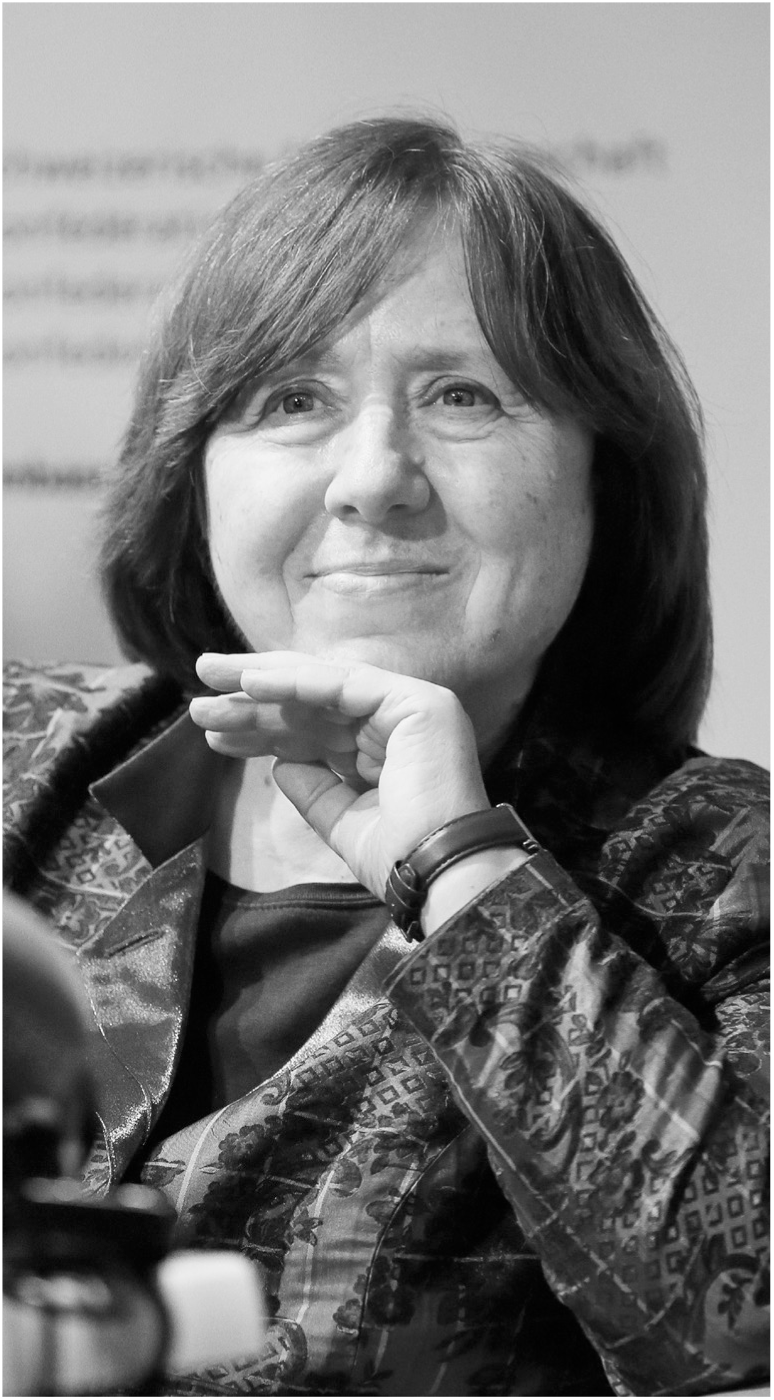
Author and Nobel prize winner Svetlana Alexievich in 2016 at the launch of her book Chernobyl Prayer in Ukraine
CREDIT: Roman Pilipey/EPA/Rex/Shutterstock
Alexievich has fallen out with many friends who support the annexation of Crimea by the Russians, and this is a source of great sadness. “It is very difficult when I go to Russia and I don’t know whether they approve of the annexation of Crimea or not. In this respect, many people took Putin’s side.”
She found it hurtful when some of the mothers of the soldiers who died in Afghanistan sued her for libel over her book Boys in Zinc - the zinc referring to the coffins they were brought home in. She says they had been encouraged by the generals, but there was something deeper.
“What was really shocking was the story of this woman who really wanted to tell the story of her son,” she said. “She had this only son. He was drafted to Afghanistan and he shouldn’t have been. They shouldn’t have taken only sons, but clearly someone else had bribed someone so their son didn’t have to go.
“When he was killed, when the coffin came back, she looked at it with these crazed eyes, and she threw herself on the coffin. And she started knocking on the coffin [saying]: ‘Is it you my son? It is such a small coffin and you were two metres tall.’ And then I saw her in the courtroom. She had wanted me to write her story, and she was testifying against me. I said: ‘I wrote it exactly how you told me… and now you are here’. And she said: ‘I need my son to be a hero’.”
Alexievich added: “It’s very, very difficult. Even such powerful suffering doesn’t liberate you. This is the question I grappled with the whole time I was writing the books. Why doesn’t suffering make you free?”
Her motivation for doing difficult, truthful writing comes from her childhood, where she lived in a house surrounded by books, but “none of them told the truth”. “Suddenly the stories I heard from real life were very different,” she said. “Life was very mysterious, terrible and fascinating and books were flat, patriotic and boring.”