



Abstract

Photographer
“Everyone is out to get you in one way or another,” Conroy, who worked for many years alongside Sunday Times reporter Marie Colvin, told Index, following a screening of Under the Wire, a new documentary about the pair’s work in Syria.
When Colvin was killed, and Conroy was injured in a rocket attack by the Bashar al-Assad regime on 22 February 2012, the war was still in its opening months, but the face of war reporting had already changed.
“There was a massive reaction to Marie’s killing,” said Conroy. “I was at a lot of meetings with editors and all of a sudden it went from journalists doing pretty much what we wanted to everybody becoming a lot more security-aware. It stopped the flow of news for quite a long time.”
But it isn’t just the regime that has editors shaken up. For one, journalists can fetch a hefty ransom for kidnappers.
“It used to be the case that you’d run around with a big ‘PRESS’ sticker on your car, but I don’t think that’s going to help you any more,” he said. “Now you may as well run around with an ATM sign on your head.
“Then we got into the beheadings of mates of mine, Jim Foley and Steven Sotloff,”he added, referring to two journalists murdered by Isis. Video footage of their executions shocked the world. “The whole tone of everything changed.”
Conroy says the press preoccupation with Isis coupled with a dearth of Western reporters on the ground seemed like good news for the Syrian government. “While they were doing that, Assad carried on with the same process of bombing the place to rubble.”
The dictator, however, has not been entirely successful at controlling the war’s narrative. “Silencing the press only made a certain amount of people more determined,” said Conroy. “When Marie was killed, the world’s press instantly focused on Syria It brought more attention than he would like. “The cabal that runs Syria lives in a bubble. Assad’s dad got away with murder in Hama in ’82. They crushed the place, and barely a photograph exists of what happened. So this is a family trait. Assad is thinking ‘He got away with it and so can I’. But it has backfired for him because he immediately came under scrutiny.”
Still, the difficulties in reporting can’t be ignored. Even if a Western editor were willing to send a journalist into Syria, the same journey that Conroy and Colvin made – crawling half-bent through a 3km storm drain having been passed around various unknown figures in the dark – is no longer an option.
“We relied so much on goodwill,” said Conroy. “The Arab Spring had happened and the people who had taken us in and out all had a sense of optimism that things were about to change for the better. We reaped the benefits and we knew they’d look after us.”
One such person was their Syrian translator and fixer Wa’el, who now lives in Finland. “He was the linchpin,” said Conroy. “Before him, we were travelling blind. Once we met him it was like the lights had come on. His English was impeccable and he didn’t want any money, he just wanted to be part of the revolution.”
People like Wa’el are hard to come by and don’t get the praise they deserve, Conroy says. “Without him, we’d all be dead.”
Reporter Marie Colvin (centre) in Baba Amr, Homs, Syria, shortly before she was killed
CREDIT: Paul Conroy

Such benevolence no longer exists. “Journalists have been going in for seven years, and the Syrians are now asking ‘what are you doing here? You keep coming but the world has done nothing. We’ve been shafted’.”
Conroy says he would “very seriously think twice” about entering Syria today. He was able to tell from his time in the Royal Artillery that the Baba Amr Media Centre, an apartment in a partly bombed building in the south-west of Homs, where Colvin was killed, wasn’t collateral damage and that the regime intended to kill the journalists. The bombers were using a military technique called “bracketing”. This is when soldiers adjust their shelling until they hit their intended target. A claim brought by Colvin’s sister, Cathleen, to a Washington court in April 2018 also presented evidence that the Syrian government had “assassinated” the journalist.
Even before they entered Syria, Lebanese intelligence had informed the pair that if “any Western journalist was found in Homs they would be executed and thrown on the battlefield”.
“It’s astonishing to see the levels the regime was prepared to go to silence the press,” Conroy said. “You’re now more in danger with a camera than a rifle.”
The Syrian government was very aware of the power of the media when it decided to attack Homs, he added. “The last thing they wanted was civilian or foreign journalists in the place. There was a lot of time, effort and money spent on tracking equipment and units to track down journalists.”
Around 400,000 people have died so far in the Syrian conflict, including at least 241 media workers, according to Reporters Without Borders. The last two Western reporters to be killed were Foley and Sotloff in 2014. While the overall number of media workers to lose their lives has steadily declined between 2013 (67) and 2017 (13), this does not mean there has been a matched decline in brutality. Rather, it is a sign of how few foreign reporters are now willing to travel to the country.
“I know for a fact that Syrian activists and journalists are still being killed. That has never stopped,” said Conroy.
Photographer Paul Conroy on assignment in Libya with correspondent Marie Colvin
CREDIT: Paul Conroy
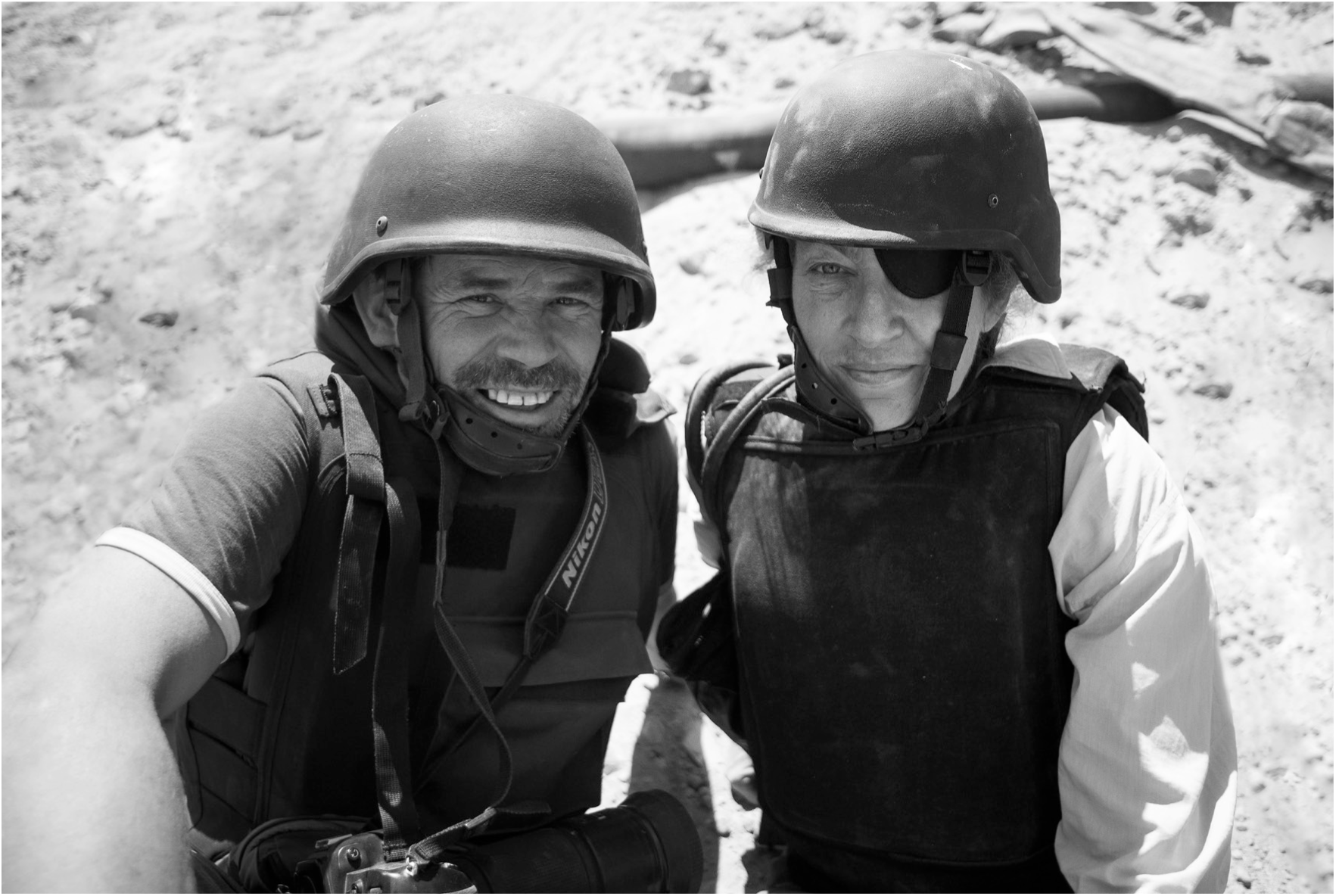
The photographer had worked with Colvin on many assignments since they met in 2003. “Marie was notoriously bad at working with photographers, so The Sunday Times couldn’t believe it when we were still together after a week,” Conroy said. “We discovered that we both wanted to tell the same story, which was that these smart bombs and bullets flying about aren’t all that smart.”
Colvin didn’t enjoy the frontline, Conroy explained, adding: “She wouldn’t have known a Lancaster Bomber from a Mig. She wasn’t interested in the big military picture or what weapons or tanks were being used. Her focus was on people.” And that made her dangerous.
“These regimes, like [Muammar] Qaddafi and Assad, going back many years, like to work in the dark. They really don’t like people like us snooping about, but that’s what she was driven by.”
The story that got Colvin noticed by the regime was her coverage of the widows’ basement in Homs, a place where women and children took refuge but a place the Syrian government claimed was a hideout for terrorists. “Marie was able to take their stories and really deliver something that made the world look. She wanted to be the world’s eyes in these dark places.”
Conroy says that he and Colvin “were almost the last of that generation, where we would be given a big pile of money and go there for as long as they wanted and pretty much do what we wanted”. And the effects have been widespread.
In 2013, a friend of Conroy’s working for The Sunday Times was travelling to cover a story in the Central African Republic. “He got on a flight in Nairobi, and by the time he’d landed he had a message telling him to come back because it was too dangerous.” News editors and security issues will restrict reporting in the future, he said
“I hope I’m wrong, but I don’t see how things like this go back. It has become accepted, somewhere in the ether, to attack journalists. We are now their prey. We are fair game.”