




Abstract

Social media’s like buttons are being designed to make us addicted and emotional, but if we understand we are being manipulated do they lose power, asks
Facebook is the primary social media platform in the country, used by 68% of the population, who “like” it a lot. They are hitting those Facebook reaction buttons – which allow them to express like, love, laughter, sadness, anger and amazement – millions of times a day. And now Facebook, which also owns Instagram and WhatsApp, is reported to be testing out a range of emotion buttons and stickers on those platforms, meaning we’ll soon be able to emote in even more places.
Rolled out by Facebook in February 2016, reaction buttons were used worldwide more than 300 billion times in their first year (that’s 800 million times a day) and, according to a Quintly study, reactions used between June 2016 and June 2018 were up by 433%.
In a recent BBC Panorama programme claiming social media sites were designed to be addictive, Silicon Valley insider Aza Raskin compared social media companies’ use of features such as the like buttons to “behavioural cocaine”.
Ramsay Brown is a self-acknowledged “brain hacker” who knows how to manipulate us into wanting more of the social media experience. He is trained in neuroscience, and the company he co-founded in California, Boundless Mind, writes computer code for apps to enhance engagement.
“Just like architectural and industrial design has certain patterns, so does behavioural design,” said Brown. “The human mind is quite flexible. All social media platforms have ways to keep you coming back – optimal cueing [alerts] is an extension of the old ‘you’ve got mail’ message, but now it’s more personal.
“Another way to keep us hooked is the stopping-rule violation. Our brain naturally sorts things we have to do into giving the events of our day a beginning, middle and end. If you remove the ‘end’ signal – by using the infinite scroll feature on social media – the brain doesn’t know when it should stop, and so it just keeps going.
“A third way of hooking us is similar to using a slot machine, which people stay on for a long time in the uncertainty of payout: it could be good, so we keep pulling that handle. Our brain craves that pleasure response, and when you do get a hit on social media you feel outstanding and there’s a release of feel-good dopamine.”
Larry Rosen, a professor of psychology at California State University Dominguez Hills, says the way social media fuels the pleasure factor is addictive in general terms, but he’s more worried about another issue.
“Our constant need to check in with all of our virtual people produces the stress hormone cortisol, generating discomfort and anxiety if we can’t check in or miss something,” he said. “In studies we’ve done, we see that young people have an active presence on an average of six social media sites so feel an increased social responsibility to check in more often, but for short amounts of time. A controlled study of 25-year-olds in 2018 showed they were checking in 71 times a day compared to 50 times a day in 2017.
CREDIT: James Boast/Ikon
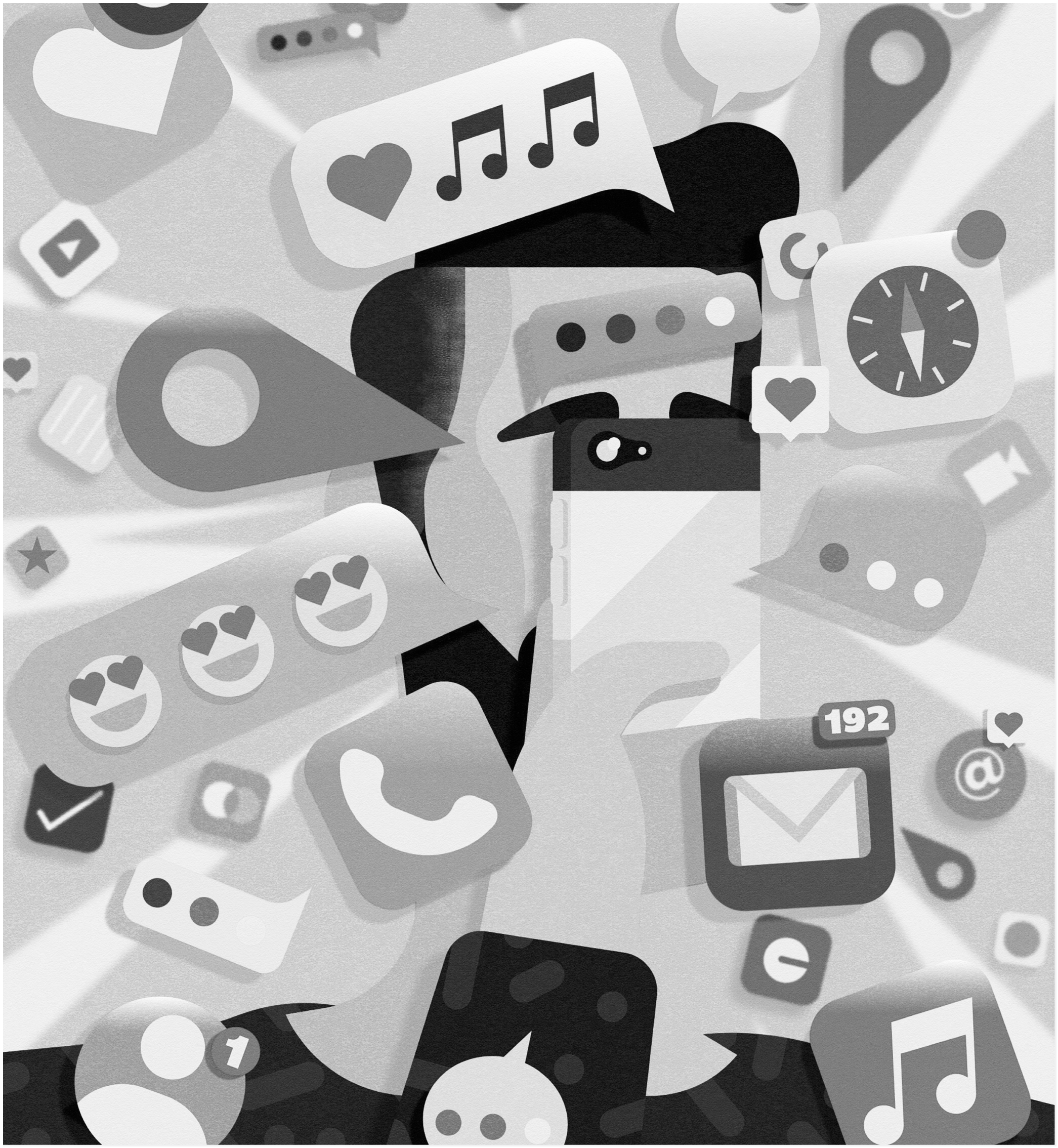
“The like and other reaction buttons ease the anxiety of checking in as you don’t need to leave a comment when a heart symbol will do the job.”
And Rosen thinks there is a real danger to the health of younger generations.
“When you’re stressed, cortisol levels go up, and when it reaches a certain level you go into a fight or flight reaction. The only way for your body to get rid of these stress chemicals is to do the activity that’s making you anxious – check in on your phone.”
Karen North, professor of digital social media at USC’s Annenberg School, weighs in on the impact of reactions.
“People are looking for social engagement and validation online, and an emotional twist like using reaction buttons will give more power to that element because, as human beings, we are drawn to emotion and a desire to connect, and we all know that can be very positive,” she said.
So, what’s wrong with this?
“There’s been a lot of research into attitude change, and it shows that if you get someone to engage in a behaviour, such as clicking regularly on social media posts, their attitudes will follow. We learn from social norms and role models and we have a strong tendency to fall in with those social norms,” said North.
“People’s desire to post or comment or click outweighs their desire to check facts. Cambridge Analytica demonstrated the effect of false news coming from false news-like sources. Most of the time we are just so bombarded by information that we don’t have time to verify it or we just accept it.
“Right now, we’re in a situation where politically, and on a national stage, there’s a lot of less-than-truthful information and news is embellished, which has led to public mistrust in fact. We’re also being pushed more and more into polarised opinions, whether it’s online vitriol against President Trump or postings saying: ‘Click if Barack Obama was your favourite president’.”
Emotion also gets the better of us in times of high drama, says North.
“We are drawn to eyewitness stories – an emergence of online urban folklore – because we want to be one degree of separation from huge emotional events like 9/11,” she said.
“We look for things that touch us emotionally, and when we find someone on social media who says they were there and has direct experience of the event, we make the assumption that it’s true, when it may not be.”
Educator and conflict specialist Jenise Calas-anti, who has worked with Nato and the Fund For Peace, agreed: “We simply can’t process as much information as comes at us in one day – it’s not like the past where we got information from a daily or even a weekly newspaper. Social media interacts with people who do not want to take their time. I think it’s human nature not to want to do the work and verify that things are true before [we] react, and the use of these reaction buttons accentuates and accelerates that.
“I think these knee-jerk reactions are dangerous in very real ways long-term because that’s how we create ‘us’ and ‘them’ social groups, and these can be exploited by people who want political power.”
But Morteza Dehghani, assistant professor of psychology and computer science at USC, doesn’t think that emotion will trump reason.
“I don’t agree with the premise that platforms like Facebook are changing our reasoning,” he said. “It’s the nature of humanity that emotional processes are faster, and gut reactions happen before reason kicks in. Advertisers have known this since the early 20th century and have tapped into it. These reaction buttons are just a new form of communication, and this is an evolutionary process.”
And perhaps there is hope for the future, too, argues North. “Increased polarisation of opinions through emotional responses leaves less room for reason, but one form of inoculation against that is for people to understand that they are being manipulated through the content they receive via social media; that they are responding to opinion, not fact. I believe we will swing back towards fact and fact-based news and that people’s concern will lead us back to reliable and trusted sources.
“We’re a think-tank here at Annenberg and data from our recent studies has shown, encouragingly, that more young people are looking for verifiable sources like The New York Times over Facebook and Twitter.”