




Abstract
Do travellers care about poor freedom of expression or other rights when they choose where to spend their holidays? Scientist and travel writer
CREDIT: Dr Makkoy/iStock

FIGURE ONE
TOURISM AND PRESS FREEDOM IN TURKEY
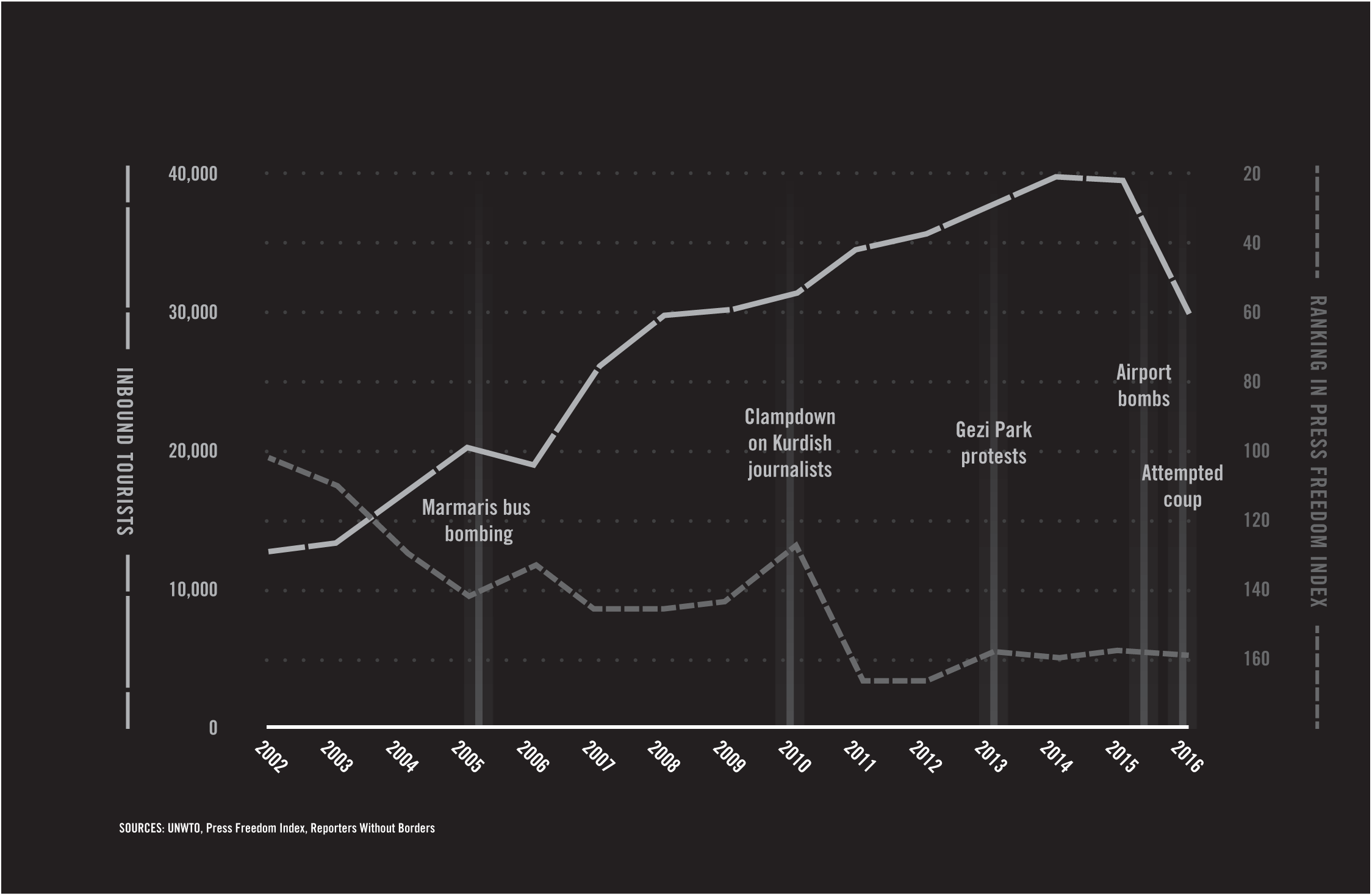
According to data examined for Index, a country might slide down the scale for poor media freedom or freedom of expression, but the number of holidaymakers who visit there appears not to be affected. In fact, some countries see a continuing rise in people heading for their beaches, despite rising violence or increased repression of rights.
But travel expert Justin Francis says this is starting to change as he sees a new generation of travellers who want to find out more about their destination.
While most holidaymakers do not take
issues such as human rights and freedom of expression into account when choosing a destination, there are a growing number who do care, says Francis, founder of tour operating group Responsible Travel. “They think about how their holiday choices might look to others and the wider message they are sending out.”
In Mexico, where killings of journalists have risen dramatically in the past six years, tourist numbers continue to rise, hitting 3.5 million visitors in 2016, according to figures from the UN World Tourism Organisation, compared with 2.2 million in 2007.
According to our article on Baja California Sur by Stephen Woodman (see p8), five acts of aggression against journalists were logged by press freedom group Article 19 in the state between 2009 and 2016. This rose to 16 acts of aggression last year, including the murder of Maximino Rodríguez, a crime reporter, who was shot dead in April 2017.
Many media freedom organisations including Index and Reporters Without Borders see Mexico as one of the most dangerous countries in the world for journalists today.
When mapping tourism against freedom of expression and press freedom data, our data analysis regularly shows a dip in traveller numbers when there is a terrorism incident, but no dip when a country’s ranking for freedom of expression slides, or when there is a rise in media attacks.
FIGURE TWO
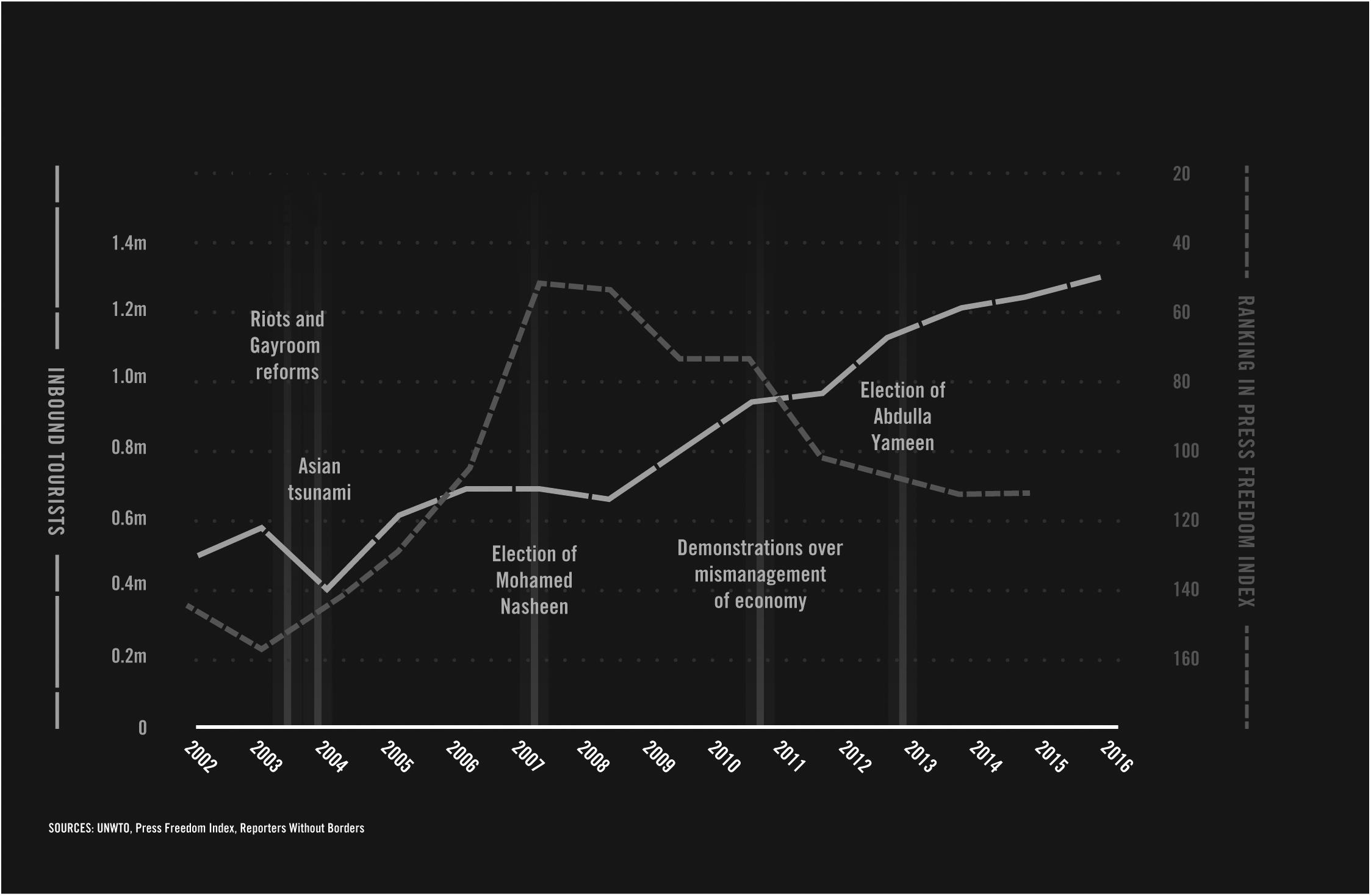
TOURISM AND PRESS FREEDOM IN THE MALDIVES
Mexico is ranked 147th out of 180 in the Reporters Without Borders World Press Freedom Index in 2018, down from 75th in 2002. During this period, tourist numbers have continued to go up.
Meanwhile, in the Maldives – where the government has reduced media freedom, leading to the killing of a journalist and the exile of others – tourist numbers have seen a steady rise since 2009.
With this in mind, it is interesting to consider whether we can see any evidence that political events and the loosening, or toughening, of laws governing freedom of expression can affect tourism to leading holiday destinations.
Figures 1 to 3 compare the ranking of countries in the Reporters Without Borders index with inbound tourism statistics from the UN’s World Tourism Organisation.
The identification of tourism as a key tool for regimes to generate hard currency to promote their own ideologies means that we can also look more closely at the relationship between tourism and freedom of expression. We have highlighted a number of key events in the timelines of those countries which reveal that tourists are generally immune to freedom of expression concerns, yet are highly sensitive to natural disasters and terrorist incidents.
We have taken this further by looking at data collected as part of the annual Human Freedom Index compiled by the Washingtonbased think-tank, the Cato Institute. The HFI uses 79 distinct indicators of personal and economic freedom, including freedom of expression, identity and relationships and economic freedoms.
This shows that countries that score best on freedom and feature at the top of the index, led by Switzerland, are all tourism destinations. Ian Vasquez, the co-author of the 2018 HFI report, says this is no surprise. So does this mean tourists do favour destinations where there is greater freedom?
“Where does most of the world investment traditionally go? It goes to the countries at the top of the list,” said Vasquez. “It doesn’t go to where labour is cheapest, it goes to the higher-cost places because they have the most freedom and the best rule of law. People value that, and that shows up in tourism.”
While the HFI is aimed at policymakers, academics and journalists, Vasquez believes individuals can also use it to make their decisions.
“Reports like this can make people think twice about where to go. If they do decide to go, even if they are concerned, they will possibly be more thoughtful about their trip.”
He cites Cuba as an example. “If more Americans went to Cuba, they would come into contact with ordinary Cubans and it would expand the informal economy, making thousands of Cubans less dependent on the state, and that would be a good thing.”
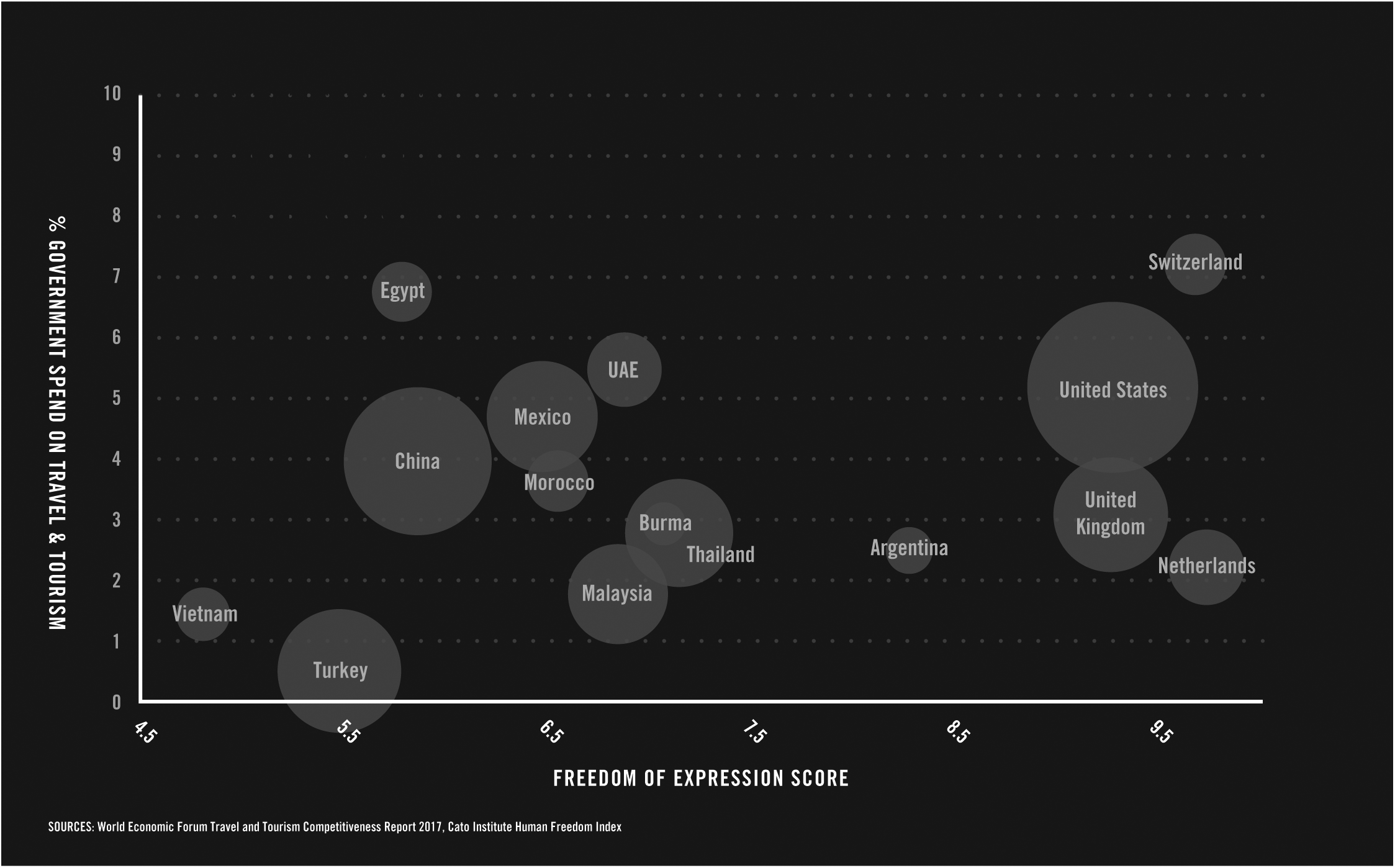
Figure 4, to the right, uses the freedom of expression data collected for the HFI along with World Economic Forum data on how much governments spend on travel and tourism – largely on marketing to overseas tourists through advertising campaigns or by being present at trade shows. The size of the bubbles is relative to the number of inbound tourists.
Egypt, Mexico, Morocco and Thailand all generate a significant proportion of their GDP from tourism and spend heavily to market themselves, even though they score poorly on the HFI.
There are some exceptions to general trends. In 1995, the Burmese government announced that the following year would be Visit Myanmar (Burma) year, with a target of attracting half a million tourists to the country. It is a beautiful country with many natural and man-made attractions.
A travel boycott was called for by Aung San Suu Kyi, leader of Burma’s democracy movement at the time, which was supported by organisations globally and was one of the main reasons the government’s tourism campaign failed to meet its objectives: just 180,000 tourists visited in 1996.
FIGURE THREE
TOURISM AND PRESS FREEDOM IN EGYPT
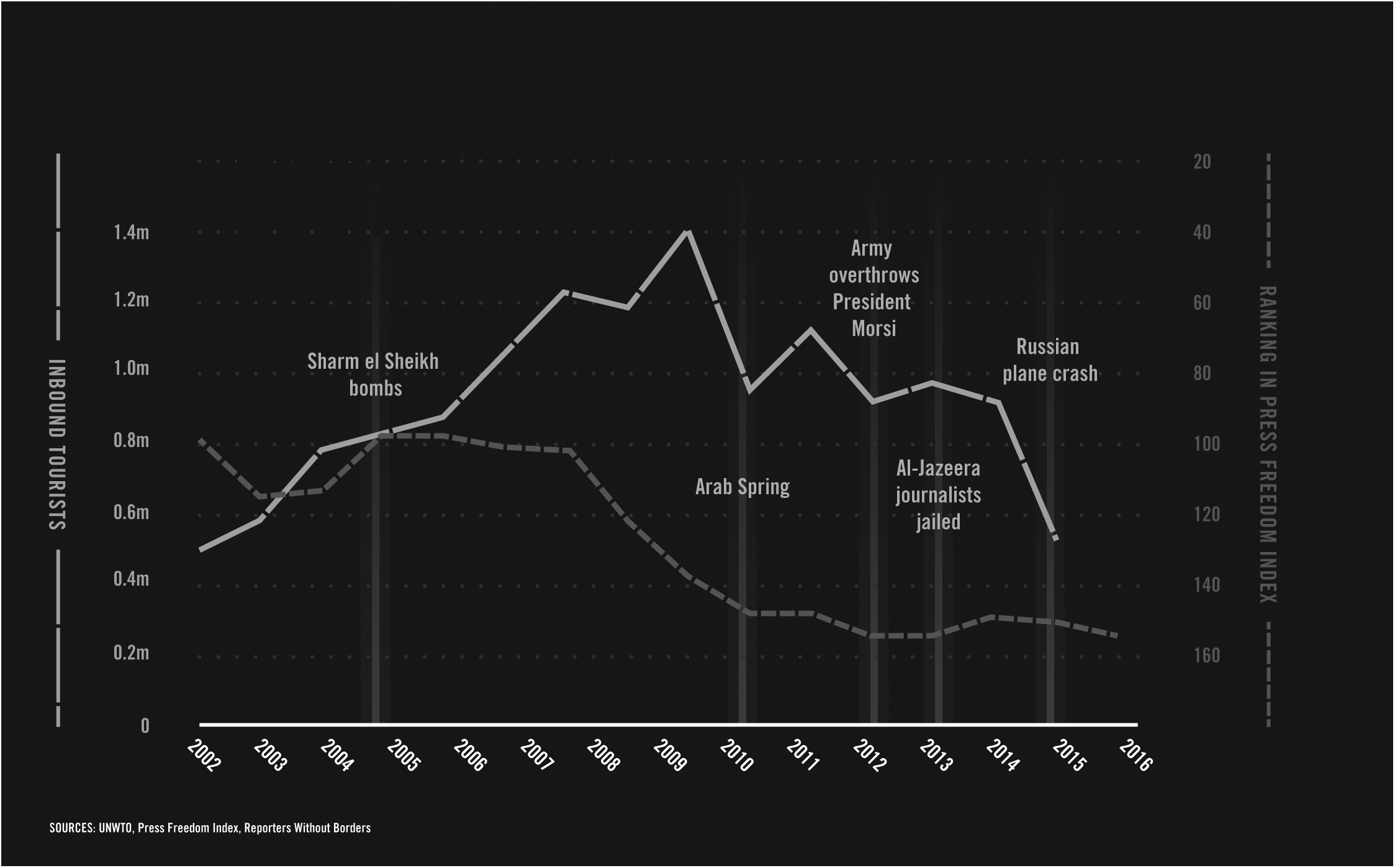
FIGURE FOUR
TOURISM AND FREEDOM OF EXPRESSION
Burma is the only country to have been boycotted by Responsible Travel. Francis says Suu Kyi’s call was the main reason for the boycott. “In most destinations with questionable human rights records, it is still possible to travel and benefit local people by avoiding government-run businesses as much as possible,” he said.
But the issue with Burma was that all its hotels were government-owned, meaning that tourism revenue went straight to the regime.
“We upheld this boycott for over 10 years until May 2011, when The National League for Democracy [Suu Kyi’s party] released a statement to say that they welcomed respectful, small-scale, responsibly operated tourism to Burma,” said Francis.
“It would be hard to find a single destination which has a clean record when it comes to the environment, animal welfare and human rights.
“With human trafficking, anti-homosexuality acts, sweatshop labour, illegal wars, capital punishment, government corruption and political imprisonment rife across the planet, where can we promote as a truly ethical holiday destination?”
Professor Harold Goodwin, co-founder of the International Centre for Responsible Tourism, says this calls for a more pragmatic approach.
“By travelling and meeting with local people, the traveller can understand the social and political situation, and return better informed,” he said.
“They may share that knowledge with others and join a campaign group. It is often important to people living under repressive regimes to have contacts with people in the outside world.”
There can also be positive effects on a nation’s attitudes by welcoming international travellers. For example, some destinations are recognising the economic value of LGBTIQ travellers, says Dirk Baumgartl, head of travel content and strategy at blu media network, which compiles the annual Spartacus Gay Travel Index.
“Countries are shifting more to LGBTfriendly politics,” he said. “Argentina reaped huge benefits from being the first country in South America to recognise gay marriage, for example.”
However, as an overall trend, poor human rights and media freedom records do not appear to currently have an impact on holidaymakers’ willingness to choose their destination. But there are some indications that, over time, this may change.
Putting Bolívar on the Map
Support local people, not governments.
Buy from local craftspeople to bring benefits to the people who need it most.
Stay in locally owned hotels and guesthouses, eat at local restaurants and use local guides.
Be careful not to place people you talk to at risk - they have to stay when you leave.
Choose tourism ventures that have responsible tourism policies and guidelines in place.