




Abstract

Just ahead of the Hawaiian public holiday honouring the historic kingdom,
Tales of an ancient culture that dates back hundreds of years will doubtless be part of the Kamehameha Day celebrations on 11 June, a public holiday honouring the native monarch who established the unified kingdom of Hawaii.
But beneath this beautiful exterior there are tensions. Hawaii is the only US state to have two official languages, yet they are far from equal – and the one that was there first gets the worst deal.
Forty years ago this year, Olelo Hawai’i (the native Hawaiian language) was officially incorporated into the state constitution as the state language, alongside English. It was seen as a great step forward considering that native Hawaiian had been banned by law as a medium of instruction since 1896. It was illegal to speak it in schools and pupils and teachers could be punished if caught doing so. It was also illegal for parents to speak native Hawaiian to their children in a public place, and it was even discouraged at home.
And while some progress has been made since 1978, there are still many restrictions on its use, notably in business, government and the courts, where English still rules.
Lawyer Camille Kalama, of the Native Hawaiian Legal Corporation, said: “Olelo Hawai’i is basically a second-class language.”
In a court case on the island of Maui earlier this year, defendant Samuel Kaeo, wishing to testify in Hawaiian, was ignored by the judge despite the fact that Kaeo, a Hawaiian language advocate, was standing right in front of him, and the judge issued a warrant for Kaeo’s arrest for not showing up in court.
Kalama said: “I was in shock. This was a blatant example of a judge not even acknowledging someone’s physical presence, just because they chose to speak in Hawaiian. The judge treated Mr Kaeo as if he were invisible.”
“It’s our right. Why shouldn’t we be able to speak Hawaiian when it’s a state language? What does that mean if we can’t defend ourselves? It means if we speak in English we exist, but if we speak in Hawaiian we don’t. It’s a punishment for speaking our own language.”
In this particular case, said Kalama, the defendant was known to the judge. Kaeo, a frequent public protester for native rights, had come before him on another occasion.
Traditional Hawaiian ceremony to mark the opening of the 2015 Target Maui Pro at Honolua Bay, Maui, Hawaii
CREDIT: Damien Poullenot/Rex
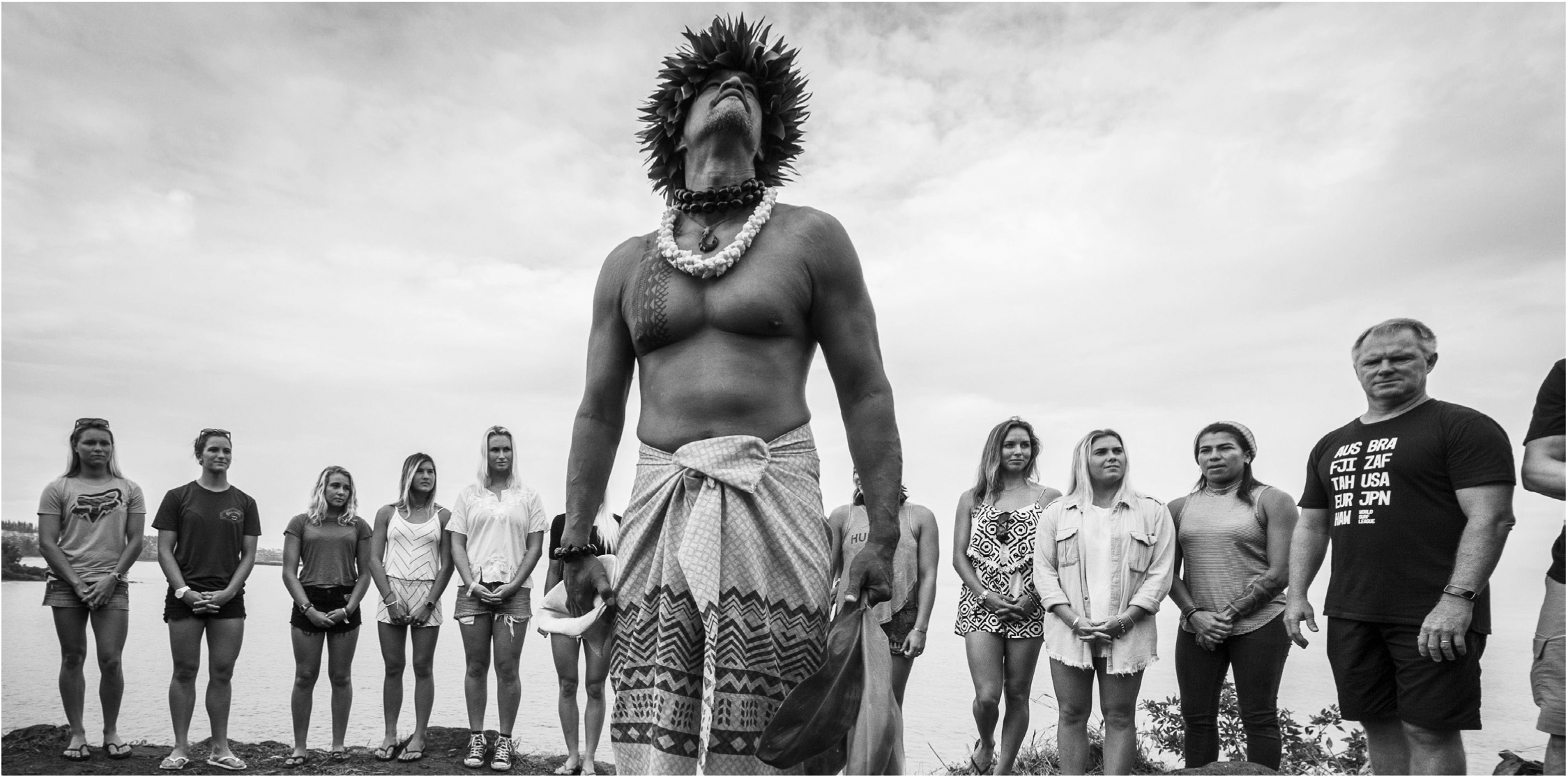
“Mr Kaeo had already shown up three times for this case (travelling from another island) and was told no translator was available. So his choice ends up being, do I speak English, or do I maintain my right to speak Hawaiian?” said Kalama.
“There are things that can be expressed differently in our language and that a defendant needs access to when trying to explain why they did something. Legal terms are also often difficult to translate.”
The inability to speak Hawaiian in court is symptomatic of a wider problem, says Kalama.
“We are constantly forced to speak English and that’s a hindrance to full fluency in Hawaiian and keeping the language truly alive. Mr Kaeo’s court case showed the attitude we see all too often that if you can speak English then you should. It just showed how far we have to go.”
Another issue Kalama’s office is dealing with is the right of prisoners to receive letters in Hawaiian. She explains that Hawaii has run out of prison space and contracts out to prisons in Arizona.
“We had a case where an inmate received a letter in Hawaiian, but the prison refused to accept it because they had no one to translate it into English, yet they have translators for many other languages, including Polynesian and Micronesian ones, so it’s just another excuse,” said Kalama. At the time of going to print, this case was in the circuit court of the US justice system and was as yet unresolved.
“Within the prison system, Hawaiian cultural and religious practice is also looked on as a privilege and not a right,” said Kalama. “People ask why we have to push for the right to express ourselves here on our own islands and I think for many colonised peoples there’s a hesitancy to push, but my children’s generation are more likely to say: ‘Why am I learning Hawaiian if I can’t use it?’ and that’s hopeful.
“We are currently suing the state on the island of Lanai for failure to provide a Hawaiian language school because there are waiting lists and kids can’t get in. If we want to preserve Hawaiian as a living language, it needs to be used more in daily life, and government needs to do more to make this happen.”
Puakea Nogelmeier, professor of Hawaiian language at the University of Hawaii, said: “In courts, people have started to demand the right to speak it, but the state’s attitude is very much one of, why should we pay interpreters? It’s a luxury and if people can speak English then they should. But that’s what equality is supposed to be about – the right to choose from two official languages.”
After the Kaeo case, the state judiciary promised to look at supplying more interpreters “to the extent reasonably possible” but it’s unclear what that will mean.
“I’m hopeful this has called attention to the problem but I think the state has its own agenda,” said Nogelmeier. “We already have a certification programme for interpreters for other languages on the island, such as Japanese, Korean, Polynesian languages, but Hawaiian has no certification at all. This means translators are selected by level and we just hope these people have enough expertise to do the job. These translators are also paid below the level of certified translators.”
He added: “Originally, the kingdom of Hawaii was multi-racial but Hawaiian was the official language. It’s the natural language but now it’s just a hobby in the eyes of some people and that’s patronising, too.”
Repression has a long history here. The kingdom of Hawaii was overthrown in 1893 and formally annexed by the USA in 1898, although Nogelmeier points out that, as there was never any formal treaty, the Hawaiian sovereignty movement claim the islands are illegally occupied. It became the 50th state in 1959.
After being banned, Hawaiian was driven underground, gradually native speakers died off and by the early 1970s, said Nogelmeier, there were fewer than 1,000 people who could speak it. A grassroots movement from parents led to the state introducing immersion schools, where pupils study only in Hawaiian until they reach fifth grade. Testing has still been in English, however, which caused controversy because it disadvantaged pupils.
“Around 25,000 people can now speak Hawaiian at varying levels so they have the ability, but when they leave college there is little to no opportunity to use it outside the home. It’s a huge restraint on expression. I do believe in part that there’s an inherent American suspicion of bilingualism that’s held by a certain proportion of the population – it’s become an aspect of American culture,” said Nogelmeier.
Due to retire this month, Nogelmeier will continue to work with the non-profit To Bind Together In Unity, mentoring translators and helping them explore massive written archives left by their ancestors which few people are now able to read.
But he hopes that, through the passion of young people, this will change. “I hope Hawaiian will be spoken more widely by the community in the 22nd century, but I can’t see it happening before then,” he said.
Also hopeful of change is 34-year-old Kendall Kanoa Kukahiko, descendant of an honoured kumu hula (hula master) who teaches hula in Los Angeles.
She says hula is much more than a dance performed for tourists.
“It’s woven into every part of Hawaiian life and culture, and when the language was driven underground it was a way to still tell our stories through dance and chants. Unfortunately, it’s a form of expression that’s been appropriated by many people who teach it at a superficial level and it’s not taken very seriously by some, but it helps keep our language alive. We see ourselves as the keepers of the language.”