




Abstract

Ahead of July’s elections,
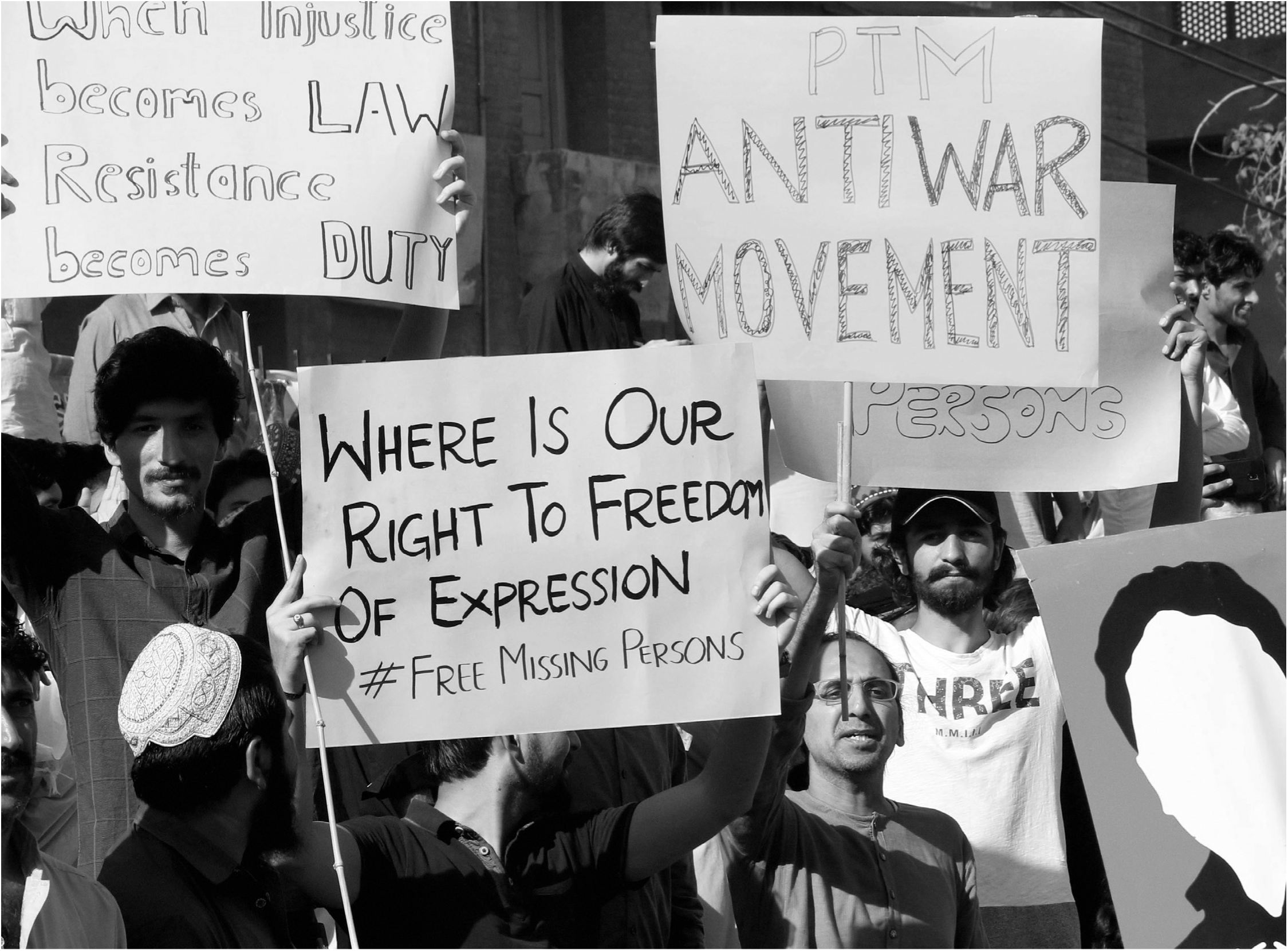
Protesters in Lahore in April 2018 call out the government on forced disappearances by intelligence agencies
CREDIT: Rahat Dar/Rex
Siddiqui, a journalist critical of Pakistan’s military establishment, had no doubt about who was after him. For at least five years, he had been receiving calls from military personnel warning him about his stories and online posts. In 2017, a legal case had been registered against him for maligning the military on social media.
As soon as he reached safety, Siddiqui tweeted photos of himself, dishevelled and bloodstained, and called a press conference to denounce the crackdown on freedom of speech.
“I wanted to go public, to tell not just fellow Pakistanis but the world what they do with journalists in Pakistan,” he told Index.
The stakes were high: an abduction by the intelligence apparatus often ends with a body dumped at the side of the road.
“I felt that it could provide me some security, given that they had not finished the job,” said Siddiqui. “I wanted to ensure that they knew the whole world was watching.”
The brazen assault on Siddiqui was part of a serious clampdown on free expression in Pakistan, especially targeted at the media, which analysts have tied to July’s general election. The military establishment has long been Pakistan’s centre of power, and it is keen to shore up its authority.
“Pakistan is known to have a poor record on democracy,” said Siddiqui. “In the coming months, the military wants to come back into the driving seat – and for that it needs to tame the media, the politicians, the activists.”
Over the past year, numerous journalists and social media activists – mostly liberal, secular and critical of the military – have been abducted by agents of the state, tortured and held for several weeks. If they are released, they tend to give up blogging and stop criticising the military or the hardline religious groups that the military uses as proxies in its various geopolitical struggles.
In January 2017, security forces abducted five men – Salman Haider, Waqas Goraya, Aasim Saeed, Ahmed Raza Naseer and Samar Abbas – who were critics of militant religious groups and Pakistan’s security establishment. Four were released after three weeks of public protests. Samar Abbas remains forcibly disappeared.
As the election approaches, certain topics are completely off-limits. The elected prime minister, Nawaz Sharif – a vocal critic of the military – was ousted in July 2017 over a corruption scandal. In a remarkable example of direct censorship, Pakistan’s TV channels intermittently turned off the sound during coverage of a speech he gave on 16 April 2018. In the same month, the country’s most popular TV news channel, Geo, was taken off air, reportedly over its favourable coverage of Sharif. It was returned only after a deal in which Geo agreed to tone down its reporting.
“What was implicit before is now explicit,” said one Geo journalist who asked to remain anonymous. “It’s quite clear. If we want to remain on air and protect our personal safety, we have to toe the line.”
Meanwhile, a growing protest movement by the country’s ethnic Pashtun population, which explicitly criticises the army over its “war-on-terror” tactics targeted at Pashtuns, has been subject to a mainstream-media blackout. Columnists at major newspapers – including The News, Pakistan’s biggest English-language daily and part of the same media group as Geo – have complained of having their columns censored or held back.
“This kind of environment means that mainstream media credibility is truly at stake,” said Raza Rumi, a Pakistani journalist who lives in the USA following an at tempted assassination in 2014.
“They don’t have express written formal orders by anyone, but they’re indulging in self-censorship, which goes against the tenets of public journalism.”
Rumi, who remotely edits the Pakistanbased Daily Times, acknowledges that he has self-censored, too.
“I am safe, I’m out of the country, but I worry about my colleagues on the ground. So you hold things, or you prune and soften the language.”
Pakistan has a long history of a controlled media, but this crackdown comes after several decades of rapid liberalisation. Pakistan’s modern media industry was born in 2002, after President General Pervez Musharraf allowed the licensing of private broadcasters.
Until then, there was only one news channel, the state-run PTV. Now, there are scores.
Imran Aslam, president of Geo News, told me in 2015 that when he was a newspaper editor in the 1980s, state censorship entailed army men literally standing behind journalists as they readied pages for print. He protested by printing blank pages or by burying censored stories in the classified ads. In the intervening decades, the media became more free and critical than ever before, although certain topics, such as religion, sexuality and the intelligence services always remained off-limits.
Nonetheless, this increased freedom caused a major shift in the nature of public life that coincided with Pakistan’s return to democracy in 2008. The country’s leaders had to answer for policies, mistakes and crimes in a way they never had to before.
“Pakistan entered a new democratic moment, but it was always one step forward, two steps back,” said Rumi. “And now we are seeing a return to full-throttle censorship.”
Pakistan is ranked 139 out of 180 countries on the World Press Freedom Index 2018. There are numerous restrictions on freedom of expression: the threat of reprisal from terrorist organisations or the militant wings of political parties, and the “deep state”. Understanding the power and reach of this “deep state” requires some knowledge of Pakistan’s history – this is a country that has spent more than 30 of its 70 years under military dictatorship. Even when civilian politicians are ostensibly in control, as they are now, the military is running things behind the scenes.
“The Pakistani media fears the military so much that it has started self-censoring more than it should,” said Siddiqui. “So now, even issues that would be covered before and would not irritate the army are being ignored.”
There have been some attempts at pushback. The protests by the Pashtun Tahafuz Movement came about through a grassroots campaign by young people, mostly in their 20s. The leaders of the movement have circumvented media blackouts by using Twitter and Facebook Live videos to broadcast their rallies and other activities.
Meanwhile, more than 100 journalists have signed a petition protesting against media houses’ capitulation to the authorities through censoring and removing content.
“People within the media and these protest movements are challenging this increasing authoritarianism. But without the civilian government or judiciary taking action, it is hard to see things seriously improving,” said Rumi.
Like Rumi, Siddiqui is now in exile, living in France where he is launching a media watchdog to track self-censorship in south Asian newsrooms. He cannot visualise a return to Pakistan.
“I want to be alive, and they might shoot me at the airport if I go back, given that now I have become even more vocal about military abuses,” he said. “I want to continue talking about my country, and my region, and I believe the only way I can continue doing so is from the safety of exile.”