




Abstract

As Colombians head to the polls this spring,
Students at a school in Toribio, an area in Colombia where Farc long fought for control, take part in an evacuation drill, 2012
CREDIT: Jaime Saldarriaga/Reuters
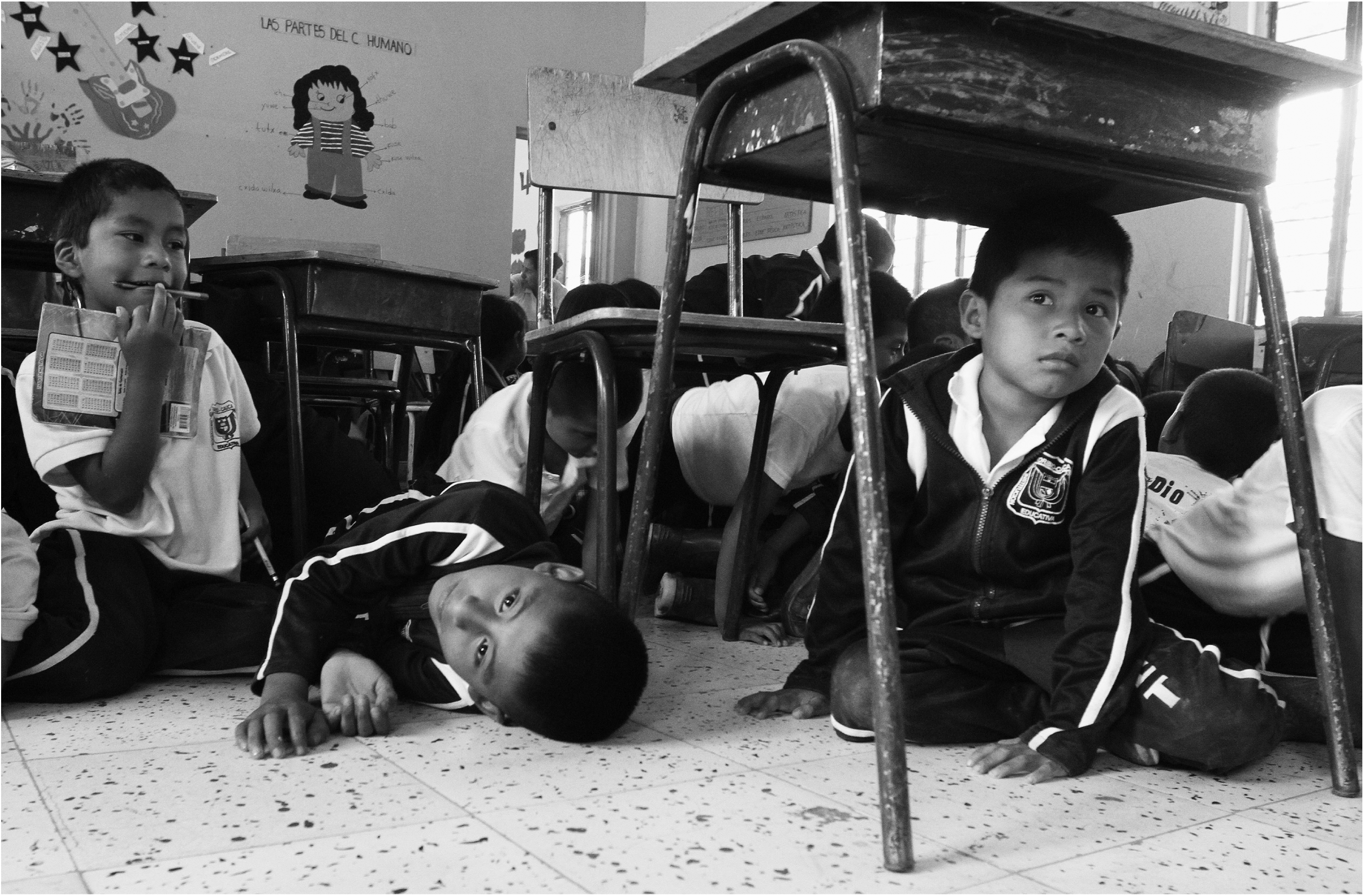
At the same time, a commission within Colombia’s Ministry of Education will be grappling with a complex endeavour: how to teach the history of Latin America’s longest-running conflict, one that has, over five decades, seen the Colombian state and paramilitary organisations pitted against anti-government rebel groups.
The debate over how the conflict and the peace agreements will be taught to young people has been making headlines over the past months, following a bill that re-established the compulsory teaching of Colombian history in primary and secondary schools.
The new bill, which came into effect in December 2017, reversed a 1994 law which had taken history classes off school curriculums, making them part of a wider social sciences module together with geography, anthropology and politics.
“The absence of this subject in the curricula of Colombian schools has led to a sort of amnesia or historic and cultural illiteracy,” said Viviane Morales, a former senator – now running for president – who proposed the new law.
“The government promoted a whole generation of young people who do not know their origin and are not clear about the root causes of the conflicts we are experiencing today.”
The approval of the law was initially welcomed by academics and educators.
“It is absurd not to have a history class in a country that needs to reflect constantly on conflict,” said Ana María Otero-Cleves, assistant professor of history at the Universidad de los Andes in Bogota. “The citizens’ possibility to exercise their rights depends on a minimum knowledge of the country’s history.”
But how to implement the new law has been controversial.
While Morales was adamant that a new history class would be introduced in schools, the Ministry of Education said this was not the case.
“History has always been taught in schools. If you establish an independent class, you take history out of context,” Mónica Ramirez, director of quality at the Ministry of Education, told Index on Censorship.
She stressed that the law’s objective was to strengthen the teaching of history in connection with other subjects and to update teaching methods, but not to have history taught as its own subject.
“What makes the difference in this law is that the focus is on the history of Colombia,” she said.
The ministry’s effort will be led by a commission composed of educators and historians, who will have until June 2020 to launch a new curriculum.
“It is true that Colombian history is taught superficially. But having a new document is not going to guarantee that this is going to change,” said Nancy Palacios, a specialist in curriculum and social studies education at Universidad de los Andes. “The most important thing is to follow up with teachers, give them training.”
Teaching history in Colombia is a daunting task. It is estimated that some eight million Colombians have been victims of the armed conflict over five decades, including forced displacement, homicide, disappearance, torture and kidnapping. As a result, society has become deeply divided between victims and perpetrators, creating different readings of the same incidents, and a highly polarised political scenario.
Moreover, several regions are still experiencing armed violence, and many elements are volatile. For example, the peace deal with the Revolutionary Armed Forces of Colombia (Farc) rebel group that won President Manuel Santos a Nobel Peace Prize may be at risk until the signing of a peace deal with the National Liberation Army (ELN). The talks between the government and the ELN were on hold for six weeks because of violence, but are due to resume shortly.
“I think it is fundamental to teach about what happened in the country, to teach about the victims and re-establish emotional ties. To me it is a moral duty,” said María Andrea Rocha, educational co-ordinator at the National Centre of Historical Memory (CNMH), a government-led centre to promote dialogue and memory surrounding the armed conflict.
The CNMH has led workshops with teachers and students across the country, which resulted in the development of a set of books to help teachers approach the subject of memory. In one case – in the war-torn region of Chocó, on the Pacific coast – teachers said they could not teach about the conflict because their students were involved with armed groups and it could put everybody’s life at risk. So they came up with a different kind of exercise. Students had to make an album of their lives, recreating the moment of their birth, collecting the items that could bring them back to their childhood and interviewing relatives. “The objective was to highlight the value of life in a place where life can be thrown away easily,” said Rocha.
In another project dealing with memory in a creative manner, the teacher Arturo Charria asked students to tell a story of the armed conflict that was close to them through an object. Charria remembers that the father of a student thanked him because the project had given his family the chance to talk about a painful kidnapping that had happened years before. “When a topic handled in class makes it to the dinner table, something is happening inside the student,” Charria told Index.
But these are isolated attempts.
“At school, the focus was on how to pass an exam, on the grades, not on understanding the political and social context in which we live,” said Daniela Diaz, a 21-year-old history student. “I would say that school did not prepare me for a political life.”
But can this new law give young Colombians a chance to dig deeper, and to be better prepared to face their new political choices? Most remain sceptical.
“This history law can be an opportunity, but not necessarily a solution,” said Rocha. “If we go back to traditional history, to memorising dates, heroes, to an elitist view of history, that does not solve anything.”
“With the current polarisation, it is important to understand,” said Otero-Cleves. “History gives you a chance to see the shades of grey. This is why it is so urgent that young people see this from a young age.”
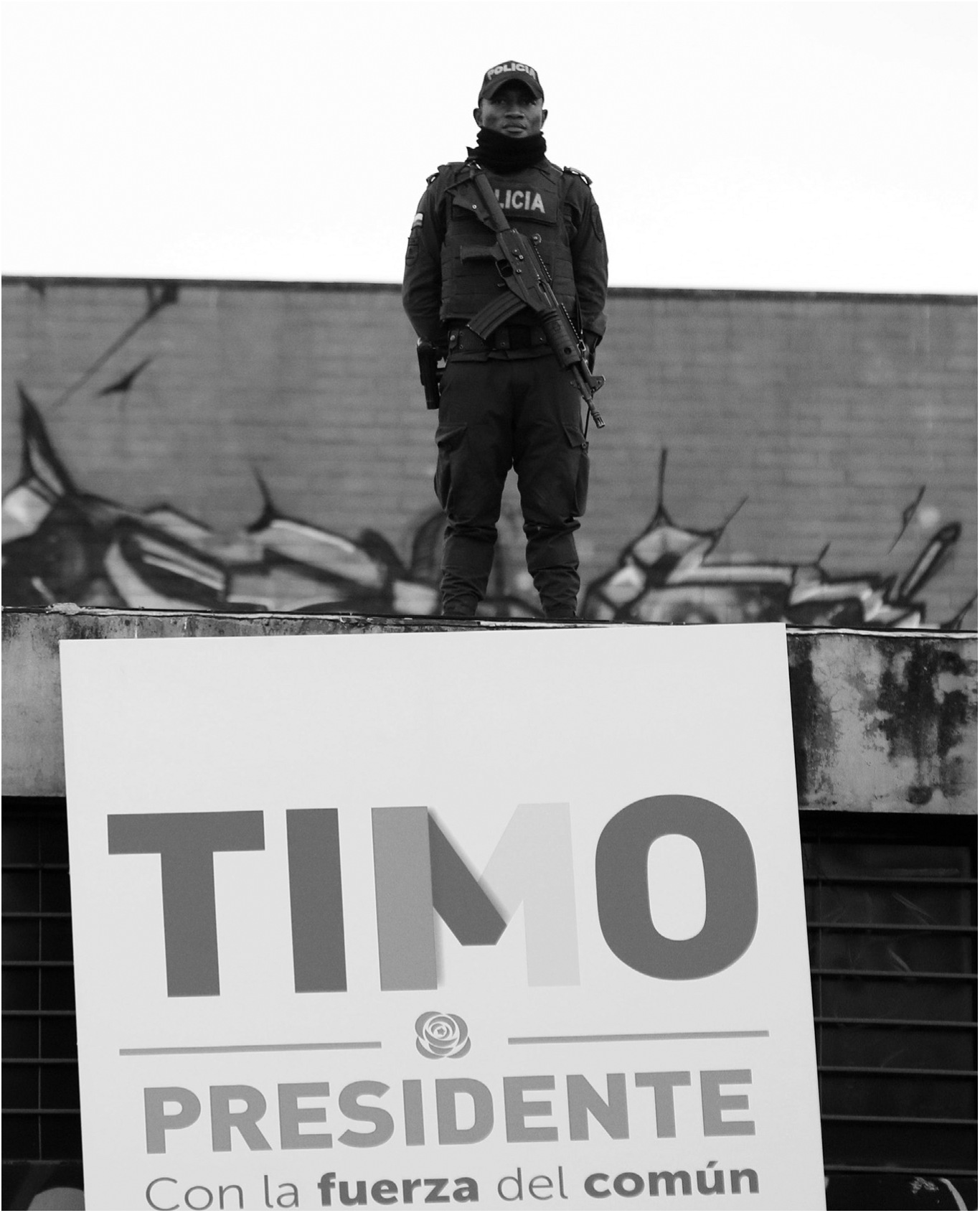
Farc election poster in Bogota, Colombia, January 2018
CREDIT: Mauricio Duenas Castaneda/Epa-Efe/Rex
Putting Bolívar on the Map
Hugo Chávez, who ruled over Venezuela for 14 years until his death in 2013, became known for imposing his own view of history on the country. He adopted Simón Bolívar as his spiritual father and called his left-wing movement after the South American 19th century independence hero. Chávez saw parallels between El Libertador’s efforts to free South America from the Spanish conquistadores, and his own crusade to challenge US influence in the region.
Chávez was so fascinated by Bolívar that he exhumed his bones in 2010. He wanted to prove that the Venezuelan enlightened aristocrat had not died of tuberculosis in 1830, but had instead been murdered. While the DNA tests proved inconclusive, Chávez unveiled a 3D image of Bolívar based on the exhumed bones.
In the name of his hero, Chávez tweaked many national symbols. The country was renamed the Bolivarian Republic of Venezuela, and Congress changed the Venezuelan flag and coat of arms. The new design added an eighth star to Venezuela’s yellow, blue and red flag, in line with the will of Bolívar, who had counted eight Venezuelan provinces that had rebelled from Spain.
Schools were not spared. Chávez, who increased public spending on education, launched a Bolivarian school curriculum, to leave behind what he called a colonial and euro-centric education model that promoted consumerism.
A textbook introduced in 2011, which was free but not compulsory, was dedicated exclusively to Bolívar.
It compared his ideas and scripts to the new constitution approved in 1999. It wrote: “Many of Bolívar’s proposals go beyond the time in which he lived. Your task, and that of our entire youth, is to get to know his ideas, value them, and put them into practice in your social, ethical, political and cultural behaviour.”
The tradition did not change after Chávez’s death. His successor, Nicolás Maduro, has been widely criticised for promoting a cult of the late president (and in so doing of Bolívar). In 2015, the dates of Chávez’s birth and death were added as historical dates into textbooks, and they were declared school holidays.