



Abstract

The turning point for me – and for Mosul – was 13 June 2014, just days after Isis occupied the city, when a document of 16 articles entitled the Constitution of Medina [or Madina Document] was issued to rule the city. This made it evident that the extremists were weaponising history to legitimise their actions. I knew we faced a crisis of knowledge among the public, where history would be abused to encourage the hatred of other groups.
Isis carried out a systematic destruction of Mosul’s identity. First, they forced the city’s non-Muslim inhabitants to flee, destroying their heritage in an effort to remove them from the city’s history. Then came the destruction of ancient Assyrian and cultural sites. After this brutality against Mosul’s non-Islamic history, they shifted to the Muslim community, where they began to systematically destroy Islamic archaeological sites, as well as museums, libraries and manuscripts.
They also took aim at Mosul’s linguistic heritage. Where the city once had a rich, peaceful vocabulary of everyday words and phrases, the group implemented a vocabulary of violence and social division. They brought their own medieval dictionary. We began to hear diwan instead of waizara (ministry), hisba instead of shurta (police), bayt al-mal (house of money) instead of al-bank al-markazi (central bank). New labels were applied to the social classes: ansar were the Isis “local” members and fighters; muhajirun the Isis foreign fighters; munasirun were those who supported and welcomed Isis but were not members. Opponents who were jihadists but were against Isis were mukhalifun. Finally, āmma were the lower classes and were against Isis. My family and I were āmma.
In the early days of the occupation, I wrote posts on Mosul Eye’s social media accounts. At that time, the internet was disconnected by the Iraqi government and the only way to get connected was through Isis-controlled channels. You had to apply for internet access through them, giving away personal details about yourself in the process – something I could not do. Fortunately, a friend filled out a fake application on my behalf.
The ancient city of Nimrud, which contained the tombs of Assyrian kings, lies in ruins, November 2016. Just one of many historical sites destroyed under Isis rule
CREDIT: Idris Okuducu/Anadolu Agency/Getty
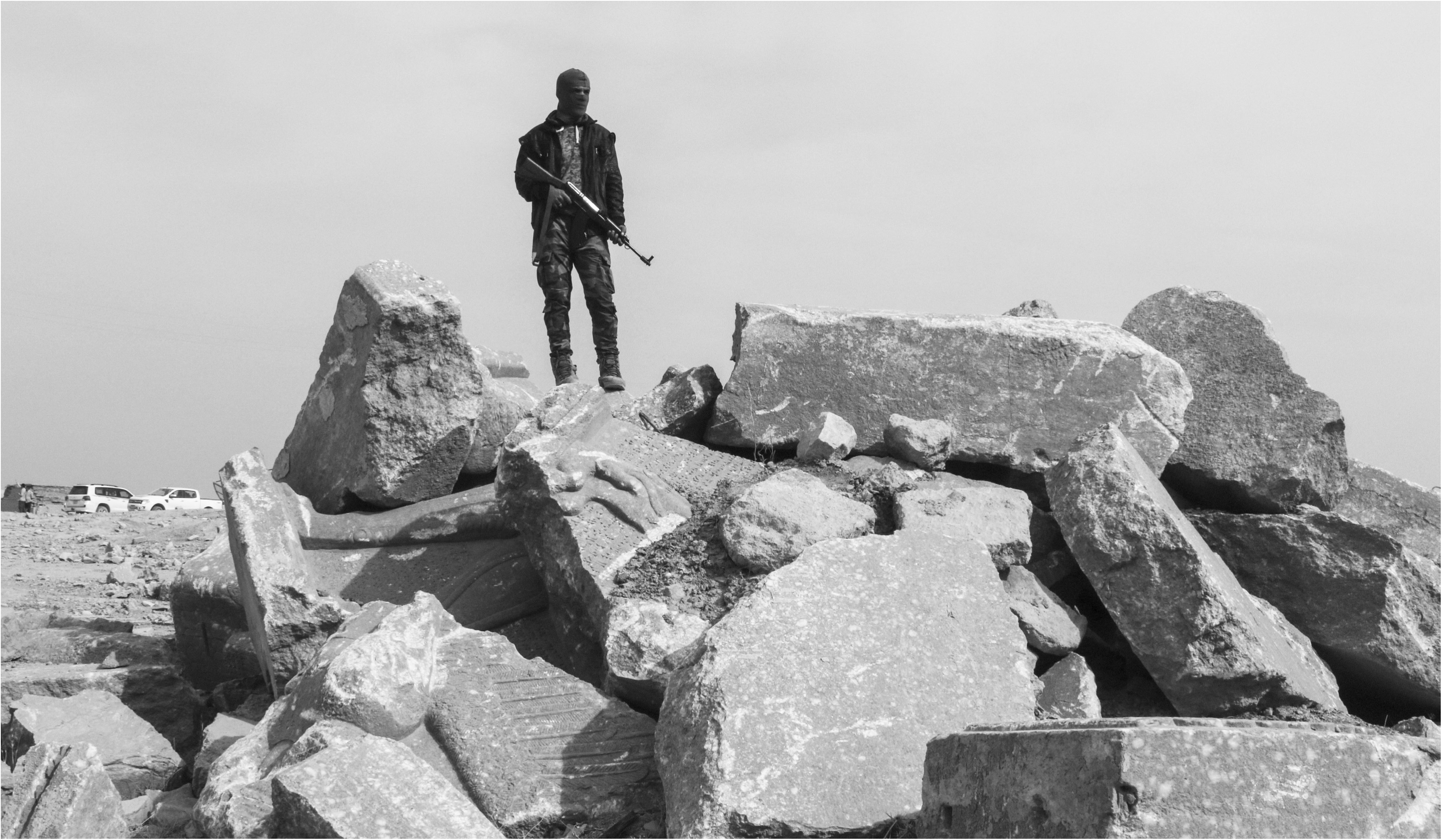
I then wrote anonymously (it has been only in the last few months that I have revealed my real identity, living away from Mosul in relative safety) and I wrote often.
In tasking myself with recording this history, I had to confront not only my own fear of death – for anyone who deviated from documenting the official version of events could be killed – but also the version of history Isis appropriated about my city. In times when oppressors hold all the power and are carrying out extraordinary acts of violence, what can a single person do?
I documented everything I saw firsthand, wandering through the city’s streets and markets and speaking to people for hours. Having lost my job teaching history at Mosul university, I worked small part-time jobs – as a baker, at a grocery store and sometimes as a taxi driver.
Through these roles I witnessed many events and would return home to transcribe them as a historian. I forced myself to go to live executions so that I could hear the names called out of those who were being killed and what reason was given. I went to hospitals where doctors told me about the rape (and sometimes subsequent death from injuries) of Yazidi girls.
To know how decisions were being made, however, I needed access to Isis members. How can one get information from them without being accused of spying and then summarily executed? I chose to play a high-stakes game. Having read, studied and taught Islamic history, I used my knowledge of Islam to debate them, opening a channel of communication. I went to Mosul’s mosques dressed like them and listened to Isis members, waiting for the opportunity to engage in discussions with them and control the debate. I recorded all the information I had gathered, scanned the handwritten documents and also typed up my notes so as to have three records of what was happening to my city. Death was so near. If I were to be killed, it had to be for something. Protecting these records therefore became key. Because I was writing about daily events, I needed regular access to my journals. The threat that Isis could search my home at any moment and find these records was all too real. They routinely searched homes for any reason. My journals became a time bomb that might explode at any moment, leading to the death of me and my entire family.
So I devised a way to protect them, hiding them well in my home. But I was plagued by the fear that no one would know where they were if I were killed, and sharing a copy with anyone would expose my work as an undercover historian. Since 2013, I had been corresponding with a friend who was also a scholar. I decided to share my journals with him electronically without telling him I was Mosul Eye. He emailed me to say they were printed and safe. He probably understood the reason I was sending them.
My battle since June 2014 has been to reverse what Isis has tried to implant in the consciousness of Mosul’s residents with the only weapon I have as a historian – writing history. The social, cultural and historical destruction wrought by the group will impact the city for centuries to come. Documenting history in such a context is a battle for knowledge: to develop the critical thinking capacity of the individual as a resistance to tyranny and to protect knowledge for the future. Now that Isis have left, I hope a more comprehensive history of the city can follow.