




Abstract
Fifty years ago, the UK government abolished the role of the Lord Chamberlain in censoring plays, but vigilance is still needed, writes actor and director
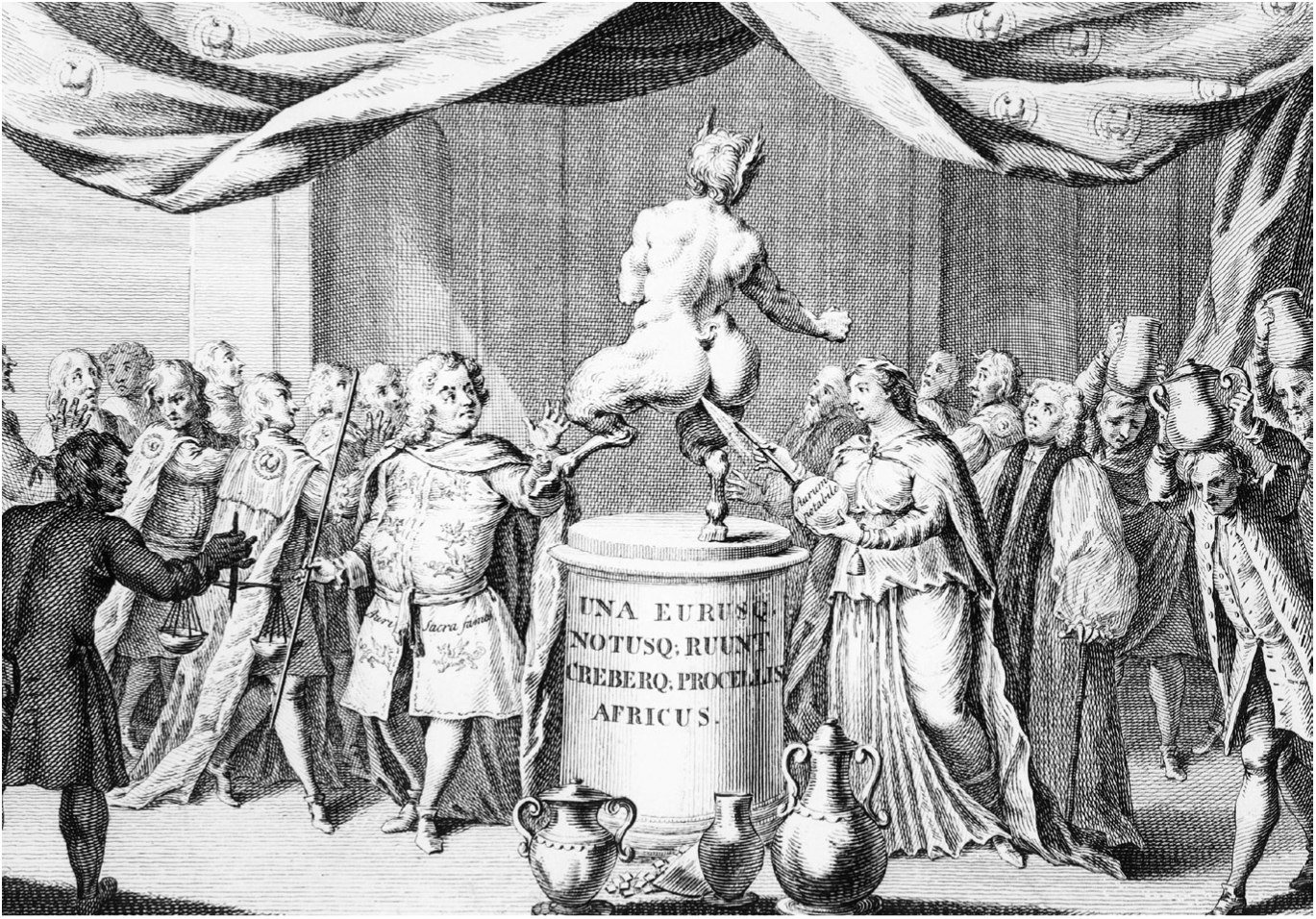
No such play had been announced for presentation, and no author was acknowledged as having written it, so it was widely assumed that Walpole’s cronies had cooked it up; nevertheless, quoting ever more salaciously from the soi-disant play, Walpole roused his fellow MPs to heights of horror and indignation and a draconian bill, the Licensing Act, was passed in the Commons.
From the outset Walpole’s various administrations had been accused of corruption and venality, for which they were duly lambasted in print and on stage by the satirists of the day, among them the fledgling dramatist Henry Fielding, who from 1734 had turned his ferocious talents with increasing savagery onto Walpole personally. Walpole finally snapped, rushing the bill into parliament. It required that henceforth all plays must be submitted to an Examiner of the Stage, an officer of the Lord Chamberlain who would be given powers to forbid “as often as he shall see fit” any dramatic piece “for hire, gain, or reward”.
In the House of Lords, it ran up against the formidable Lord Chesterfield. “A Power lodged in the hands of one single Man, to judge and determine, without any Limitation, without any Control or Appeal,” said Chesterfield, “is a sort of power unknown to our Laws, inconsistent with our Constitution. It is a higher, a more absolute power than we trust even to the King himself; therefore I think we ought not to vest any such Power in His Majesty’s Chamberlain.” More was at stake, he insisted, than the well-being of writers and actors: “The Stage, my lords, and the Press, are two of our out-sentries; if we remove them – if we hood-wink them – if we throw them in Fetters – the enemy may surprise us.” He was certain, he said, that his fellow Lords would reject such a bill; but he was wrong, and we lived with the consequences for nearly 250 years.
Fielding immediately stopped writing for the stage and turned to the novel; incessantly harried by the censor, those writers who stuck by the theatre relapsed into a sentimental and tepid vein which could cause no offence. The censor’s work was done for him: the cop was no longer in the street; he was in the writers’ heads. By the end of the century, the authorities’ hysterical anxiety about the contagiousness of the French revolution made them unusually pro-active: any play which alluded to oppression or patriotism was cut or suppressed; the anodyne Charles the First by Mary Russell Mitford, and Alasco by Martin Archer Shee were banned outright; many others were brutally censored without explanation. Europe was at first the source of all anxiety: then Scandinavia and Russia. The “advanced theatre” of Ibsen and Strindberg, dealing frankly with social issues, was a particular menace. Banning left, right and centre, the censor suppressed Ibsen’s Ghosts, Tolstoy’s The Power of Darkness, Brieux’s Damaged Goods – which dealt directly with syphilis – plus home-grown plays like Shaw’s Mrs Warren’s Profession and Edward Garnett’s The Breaking Point, about a single mother. This authoritarian philistinism caused the poet Swinburne to remark that the Lord Chamberlain had exposed the English stage “to the contempt of civilised Europe”.
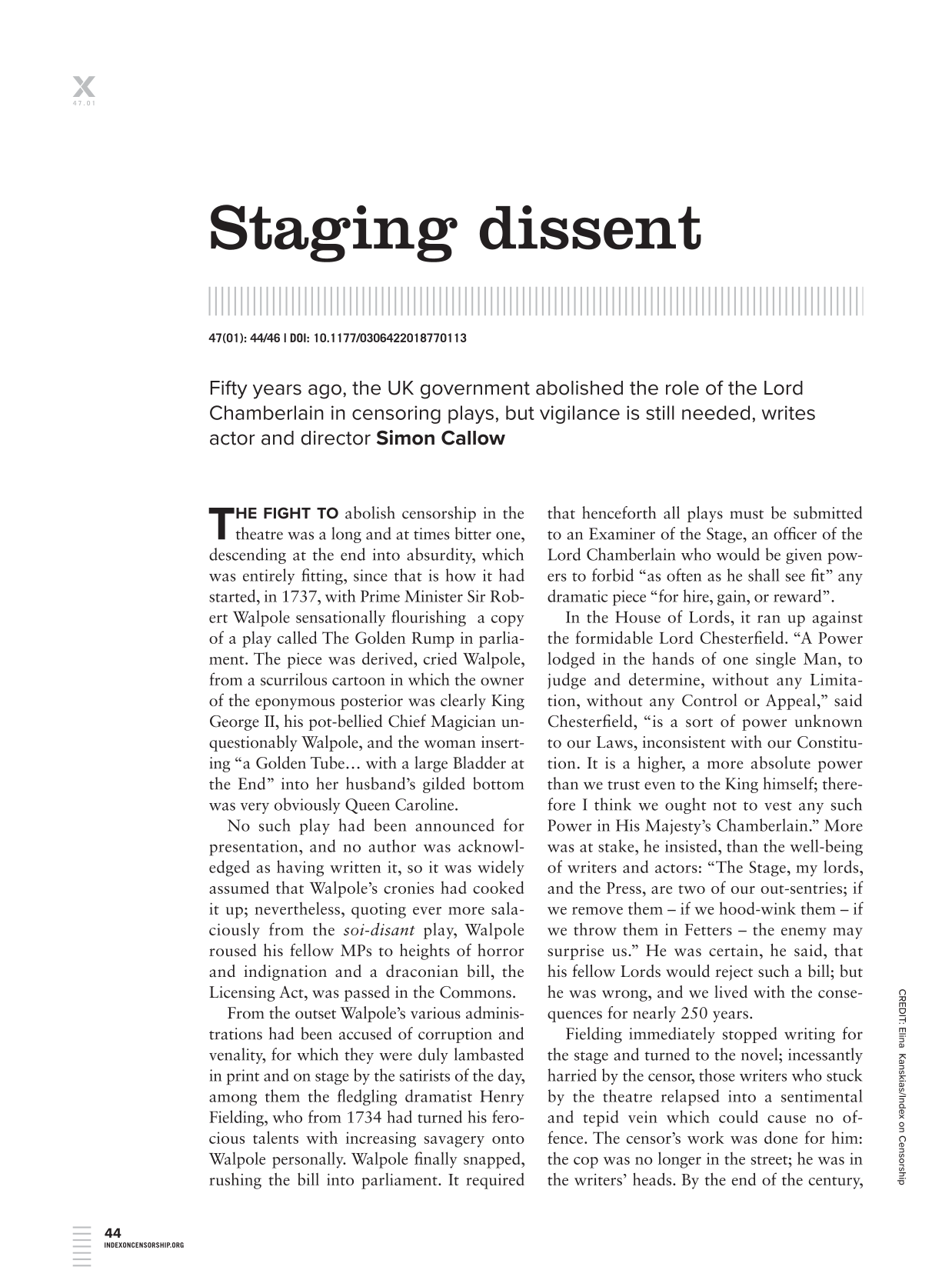
Actor Simon Callow at Index’s Stand Up for Satire show, 2017
CREDIT: Elina Kanskias/Index on Censorship
As the 19th century advanced, dramatists started fighting back, becoming cockier and more cunning. W S Gilbert cheekily put the Lord Chamberlain on stage as The Lord High Disinfectant. Then writers stumbled on the notion of members’-only theatres, which made the first performances of Ghosts possible, as well as of Shaw’s Widowers’ Houses, which dealt head-on with property racketeering. As late as the 1930s, creating a club was the only way in which the very mild biographical play Oscar Wilde, which starred the eminently respectable Robert Morley, could be performed. Homosexuality – “the forbidden subject” as the Chamberlain’s office coyly referred to it – was one of the many key facts of life which they attempted to keep from the British public, but once the Wolfenden Report appeared in 1957, in a blaze of publicity, the game was up.
From then on, the censors were fighting a losing battle. Entrenched in St James’s Palace, they grew further and further out of touch with modern life and developments in the theatre, spending their days trying to bowdlerise the plays they received, proposing baffling alternatives to phrases that offended them: “For ‘wind from a duck’s behind,’” said one report, “substitute ‘wind from Mount Zion’.” “The Detergent song. Omit: ‘You get all the dirt off the tail of your shirt.’ Substitute ‘You get all the dirt off the front of your shirt’.” Managers increasingly resorted to converting their premises into club theatres; London’s Royal Court, leading the attack on behalf of new writing, became stubbornly defiant. John Osborne eventually exploded. “I cannot agree,” he furiously wrote to them concerning his 1960 play Luther, “to any of the cuts demanded, under any circumstances. Nor will I agree to any possible substitutions. I don’t write plays to have them rewritten by someone else.” He won; only a couple of cuts were demanded. The Lord Chamberlain was palpably weakening; finally, the Royal Court’s determination not to be deflected at any cost from presenting the plays of Edward Bond, with their viscerally disturbing imagery, confounded them. Threats of prosecution only further demonstrated their weakness; in due course an all-party parliamentary committee unanimously concluded that the censor must go. Only the Society of West End Theatre Managers, who liked the legal protection the Chamberlain’s office provided, pleaded for its retention. Lord Cobbold, the incumbent Chamberlain, frantically lobbied for special clauses to protect the royal family, the Archbishop of Canterbury and the Pope, but to no avail: he was abruptly consigned to theatrical oblivion.
Cartoon of the Golden Rump, the infamous, possibly fake, play that Sir Robert Walpole used to pass the Licensing Act of 1737, creating theatre censorship
CREDIT: The Art Archive/Rex
The abolition of the office of censor has not, of course, eliminated all censorship. The theatre, as Osborne famously remarked, is a minority art with a majority influence, and someone is always trying to hi-jack it. Private prosecutions are possible, though the failure of the most notorious, Mary Whitehouse’s determination to suspend the run of Howard Brenton’s The Romans in Britain, has had a discouraging effect on subsequent attempts. But from both left and right of the political spectrum, and from religious groups, there have been protests, some violent, against theatre companies held to be offensive in some way. Protest, of course, is an entirely legitimate democratic activity, though it has from time to time overshot its mark, most famously in Birmingham when the play Behzti, set partly in a Sikh temple, was shut down by the violence of the protests, driving writer Gupreet Kaur Bahtti into hiding.
Similarly, any Israeli theatre company, no matter what its position, comes to the United Kingdom at its peril. The Israeli National Theatre, the Habima, was disrupted when it brought its production of The Merchant of Venice to Shakespeare’s Globe in 2012; two years later in Edinburgh The City, performed by the group Incubator, whose remit is to promote Israeli-Palestinian interaction, was closed down because police claimed that they could not guarantee the company’s safety. They returned last year, again to vociferous protests, but the show went on attended by a tiny number of harassed theatregoers.
And the most ominous form of censorship – self-censorship – is always with us; in an age of trolling tweeters and acid in the face, it can be frightening to defy the common wisdom. Courage is required if the theatre wants to continue to be one of the out-sentries, as Chesterfield put it. And it requires sharp and even-handed vigilance from everyone else.
Play by the Rules
Plays were not permitted licences under the Lord Chamberlain’s censorship rules for odd reasons. A licence was once refused because the leading lady entered a tent “nude under her clothes”.
If a licence were granted, it was after numerous cuts and revisions, such as The Bedsitting Room by Spike Milligan and John Antrobus, in 1963, which included the change: “the mock priest must not wear a crucifix on his snorkel”.
Thanks to the Lord Chamberlain’s rules on what could be depicted in a play, topics such as religion were heavily censored. No plays about Queen Victoria were permitted before the late 1930s.
The phrase “up periscope” was banned as the Lord Chamberlain felt it was too suggestive and could lead people to “commit buggery”.