




Abstract
Bestselling Palestinian author
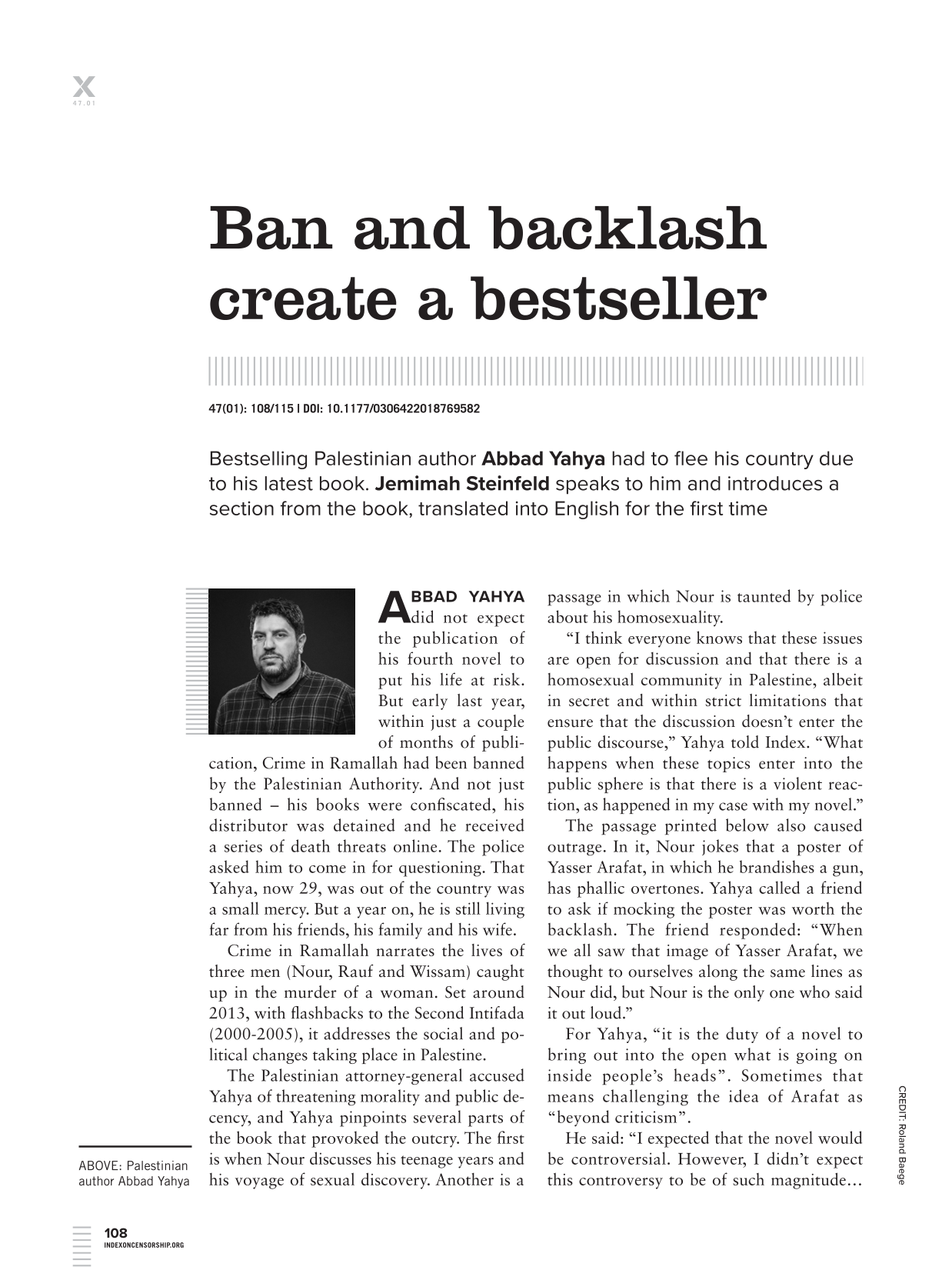
Palestinian author Abbad Yahya
CREDIT: Roland Baege
Crime in Ramallah narrates the lives of three men (Nour, Rauf and Wissam) caught up in the murder of a woman. Set around 2013, with flashbacks to the Second Intifada (2000-2005), it addresses the social and political changes taking place in Palestine.
The Palestinian attorney-general accused Yahya of threatening morality and public decency, and Yahya pinpoints several parts of the book that provoked the outcry. The first is when Nour discusses his teenage years and his voyage of sexual discovery. Another is a passage in which Nour is taunted by police about his homosexuality.
“I think everyone knows that these issues are open for discussion and that there is a homosexual community in Palestine, albeit in secret and within strict limitations that ensure that the discussion doesn’t enter the public discourse,” Yahya told Index. “What happens when these topics enter into the public sphere is that there is a violent reaction, as happened in my case with my novel.”
The passage printed below also caused outrage. In it, Nour jokes that a poster of Yasser Arafat, in which he brandishes a gun, has phallic overtones. Yahya called a friend to ask if mocking the poster was worth the backlash. The friend responded: “When we all saw that image of Yasser Arafat, we thought to ourselves along the same lines as Nour did, but Nour is the only one who said it out loud.”
For Yahya, “it is the duty of a novel to bring out into the open what is going on inside people’s heads”. Sometimes that means challenging the idea of Arafat as “beyond criticism”.
He said: “I expected that the novel would be controversial. However, I didn’t expect this controversy to be of such magnitude… This was shocking, as were the subsequent incitement and threats, which included threats to kill and physical harm.”
According to Yahya, this reaction “was the first of its kind since the establishment of the [Palestinian Authority] in 1994”. Certainly it was far greater than the reactions to his past books, which had themselves ruffled feathers.
“The most significant paradox,” Yahya added, was that “it became apparent that subjugating freedom of expression in my case was just as violent as it was in the novel facing the characters”.
Yahya, who has moved between several countries since last year, hopes to return to Palestine soon. “Ramallah is the place where I live, write in and write about,” he said. If he does return, though, he will do so with trepidation, concerned that he won’t be able to write in the way he used to, scared for his safety and pessimistic about the country’s future.
“Things seem bleak in Palestine, whether at the political level or people’s daily lives. There is a challenge which I think about constantly – namely, the reality regarding freedom of expression and creativity. I think this issue is becoming more complicated and I am concerned that many persons find themselves faced with tough alternatives,” he said. As for Crime in Ramallah, it remains banned. And yet with heightened publicity, far more people have read it than would otherwise. That his work has ricocheted beyond the traditional reading milieu is a sort of “moral compensation for the author”, Yahya said, and that might be another small mercy.
Crime in Ramallah by Abbad Yahya
I walked away, turning my back on the throngs of students demonstrating against the “storming of al-Aqsa mosque by settlers”, an event that was repeated every few weeks and was followed by the same reactions and lectures being cancelled due to pressure from angry students. I walked, my back to the students, the cries and the chanting. At the steps up to the main cafeteria, I bumped into Aya.
“Good morning,” she greeted me, smiling. “How are you?”
“Good morning. I’m well, thank God,” I replied coolly, kicking myself for using the word “God”, a word that had somehow started infiltrating everything I said.
“There’s no lecture. Everything’s suspended,” she declared, as if announcing the liberation of al-Aqsa.
“Yes, I went but there was no one there.”
“All the lectures will probably be cancelled.”
“We’ll see…”
I shifted my body round to try to show that this conversation was over and that I wanted to carry on towards the cafeteria, but Aya stopped me, tucking her long hair behind one ear.
“Do you want to get something to take away, or do you want to sit in the cafeteria?”
Her question caught me off guard and what surprised me even more was how different she seemed today. Or maybe it was her question that made me feel there was something different about her.
“I don’t know,” I replied hesitantly. “I want to see if Rauf is here or not.”
“OK, have a look. And I’ll wait for you here.”
I nodded and walked up the stairs, thinking about how stupid my reply was, what an idiot I was, and about Rauf. Then I started thinking about how there were some words people use all the time that don’t make any impact, but if the exact same words are used in a different context and particular tone, they could become the most important words of our life. I’ll wait for you, Aya had said. Me, who no one ever waited for.
I started scanning the cafeteria for Rauf, as if I really had come here to look for him. Maybe I now wanted to find him so that I could get rid of this new Aya.
But I didn’t find Rauf, so I bought a coffee and left, ready to face Aya, hoping that she might have gone and that she didn’t really mean it when she’d said she’d wait for me. Before I reached the spot where we’d bumped into each other a few minutes ago, I thought about her. Nothing special came to mind besides the fact that she was the only one at university who had resisted the fashion of the “outer bra”, as Rauf called it: that strange garment with short sleeves worn like a jacket, with ends that hung down and tied in a knot below the breasts. It was a trend that swept through the entire female student population, so much so that any girl who didn’t wear something similar would stand out. And that’s what we immediately noticed about Aya. This new fashion was probably a way to draw attention to their breasts and make them seem bigger and Aya didn’t need that. Even now, there’s nothing else that stands out about Aya in my mind other than the memory of that first summer at university.
There she was at the bottom of the staircase, looking up at the entrance to the cafeteria. Her face beamed when she saw me coming down. She tucked in some runaway strands of hair again. I stepped down and walked alongside her, convincing myself that maybe this could be a way to stop myself from thinking about Rauf.
As we walked away from the loudspeakers and the crowds of the Youth Movement and student activists and the al-Aqsa rants, I looked down at my feet and at Aya’s. Aya was rabbiting on about the most important institutions and sectors that might have jobs for us once we finished at the end of term. Her chatter made me feel as if life would carry on in the same way after we graduated, and that we wouldn’t need to do much to start off this next chapter of our lives on the right foot.
Aya said that what worried her most was the prospect of staying at home unemployed after graduating. I wondered if she was telling the truth or whether what she was really most worried about was graduating without being in a relationship that would lead to a comfortable marriage where she wouldn’t need to worry about finding work or not. And then she’d be happy to stay at home waiting for her husband to come home from his job.
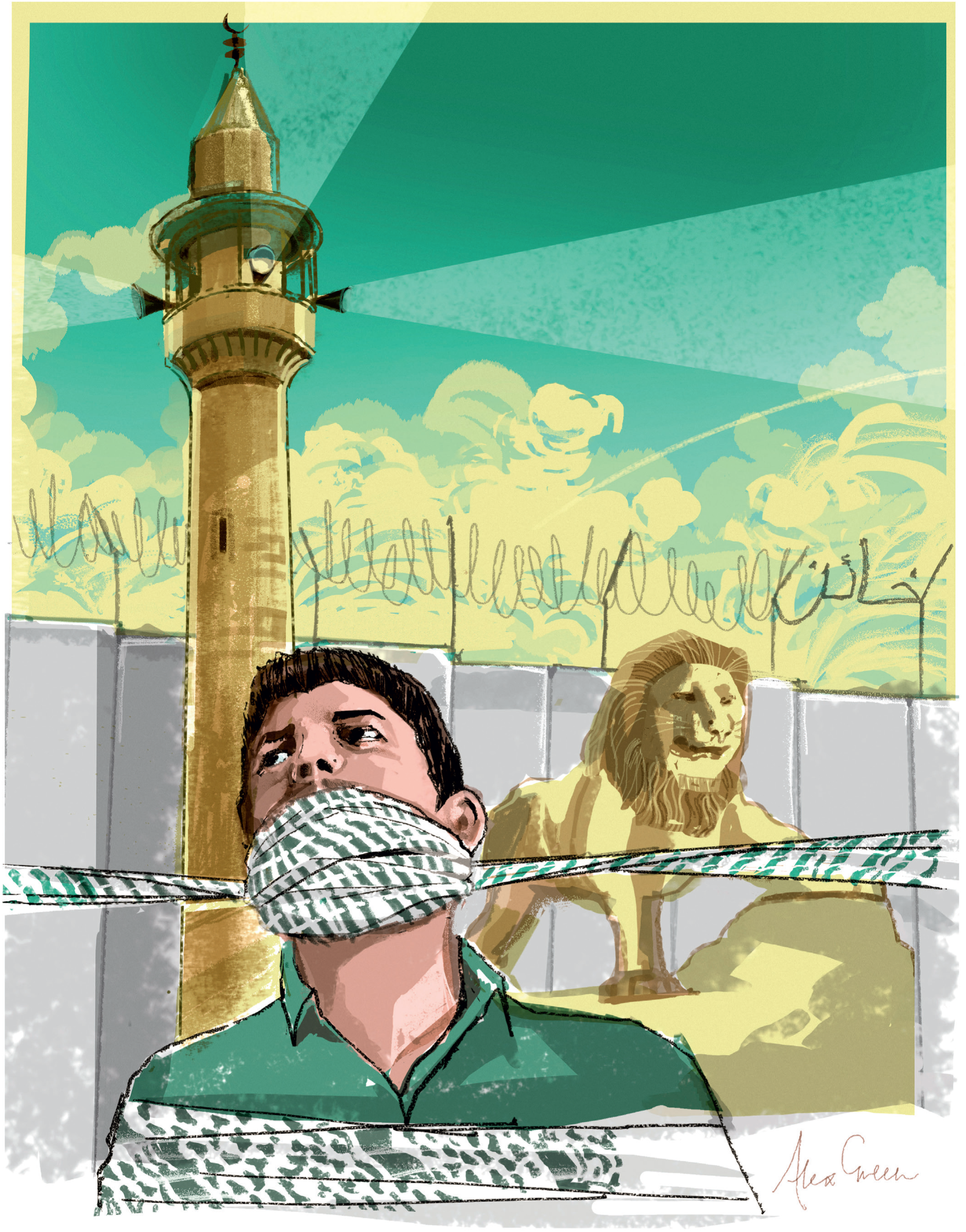
CREDIT: Alex Green
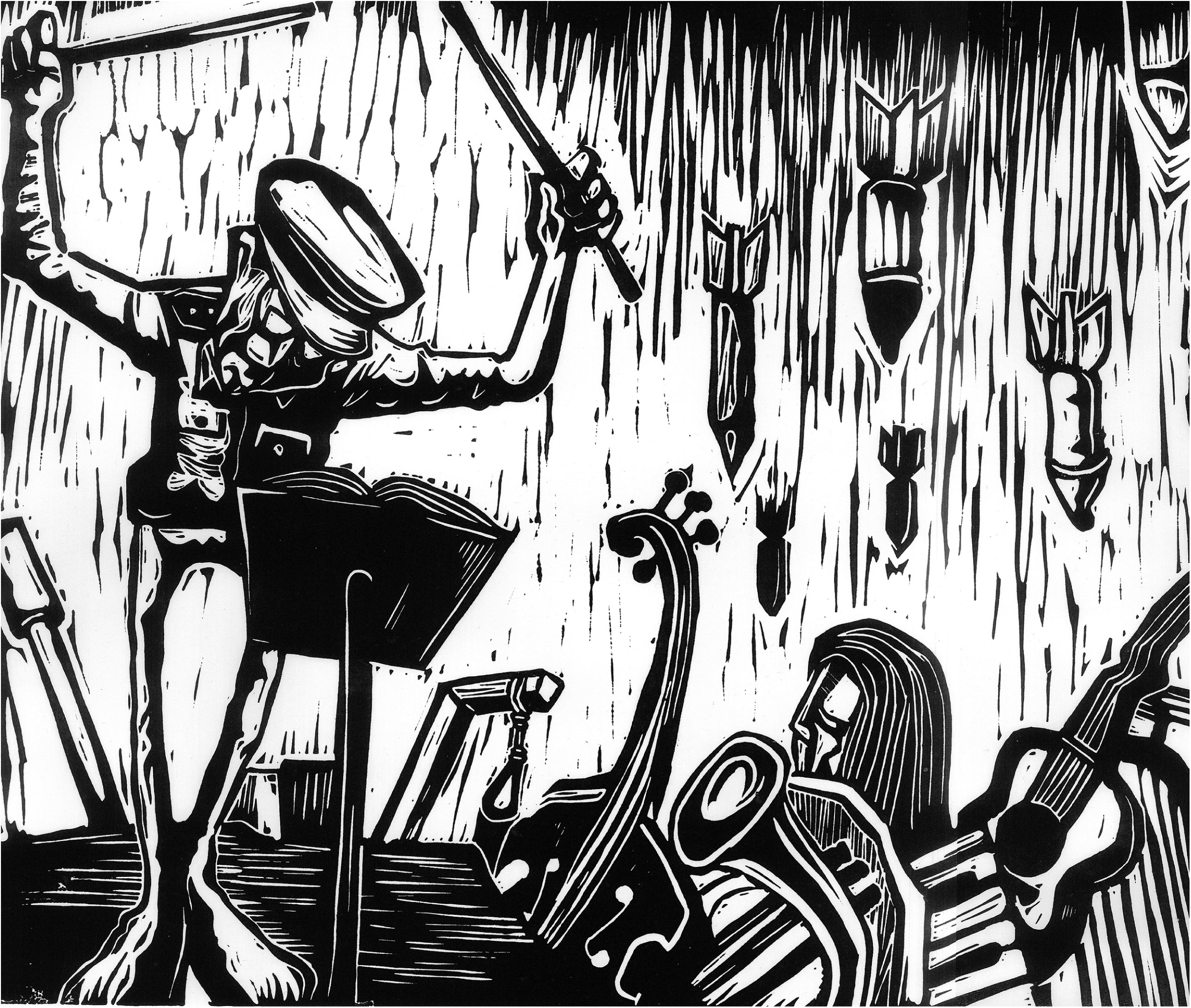
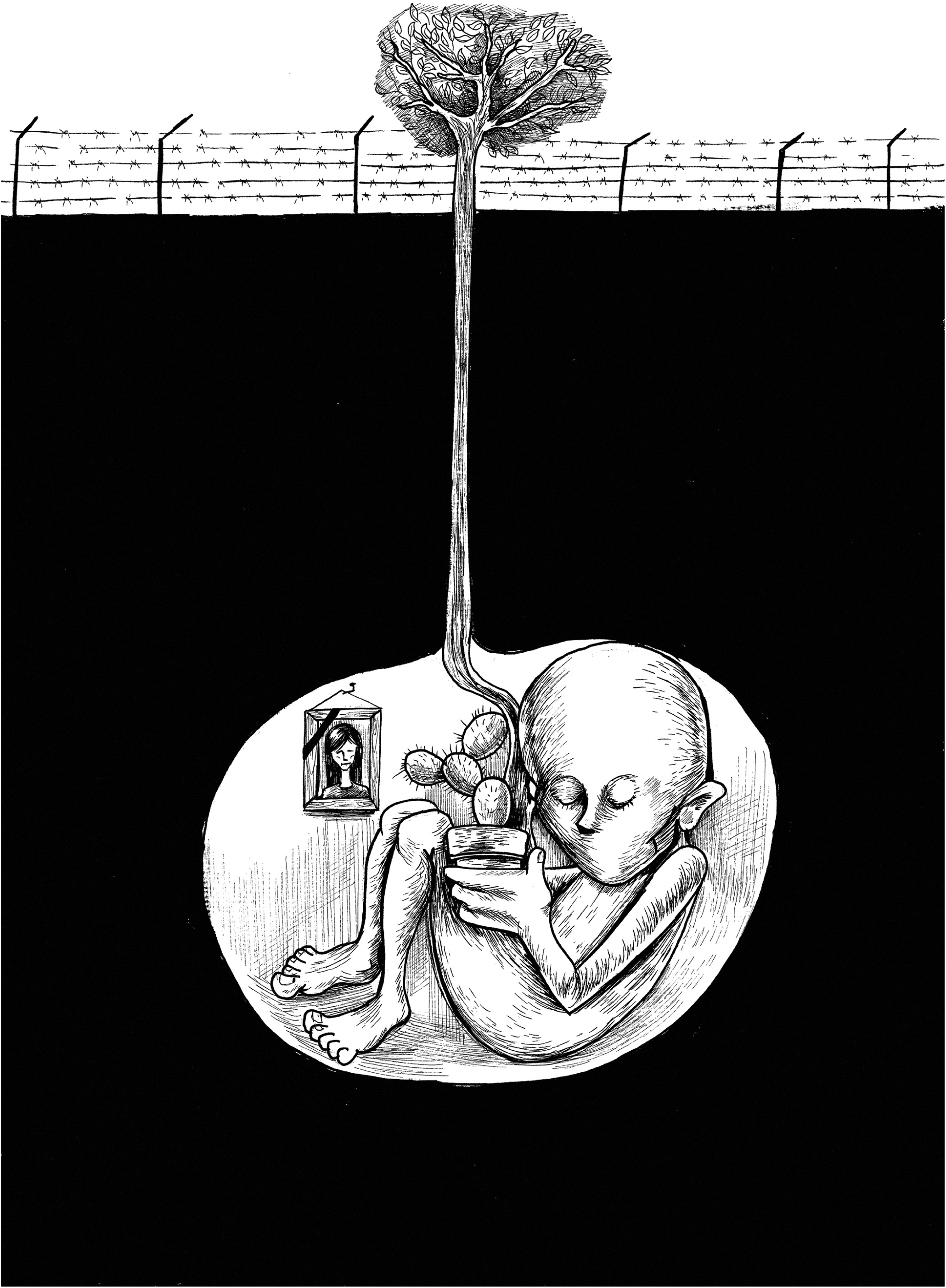
Black-and-white images opposite and on following page are from Palestine in Black and White, a new collection bringing together 100 political cartoons by Mohammad Saabaneh (Saqi Books)
CREDIT: Mohammad Saabaneh
My thoughts strayed so far that I had no idea what Aya was actually saying, as if she was talking to someone else, and tuned back in only when she asked me a question.
“What are you planning to do?”
Without thinking, I replied with an answer that hadn’t crossed my mind before.
“I want to carry on studying… abroad.”
My response was surprising and powerful; it silenced both Aya and myself.
We walked through the campus in silence. She looked at me and tried to say something but without any words.
“When will we see the end of all these loudspeakers and the rallies getting in the way of our classes?” she eventually blurted, after struggling to find something new to talk about. The topic was predictable; like all Palestinians, it seemed that talking about politics was a way to kill time. Then she didn’t know what else to say so she started criticising the student movements. I didn’t comment. My thoughts wandered to the days when it was harder to be critical or candid, to my school days at the height of the Second Intifada.
There were rifles being brandished all over the place during the first year of the intifada. Demonstrations were like forests of rifles, raised high in the air by masked men who fired all their ammunition. Intermittent bursts and a drawn-out burst. The crowd surged with excitement, and uproar and chanting flooded the country.
Everyone was preoccupied with waving their rifles about and I was discovering the joys of my own little weapon. That’s what I called it for a few days, inspired by the general atmosphere. Then I felt humiliated and berated myself for calling it that. The raised-up rifles remained, brandished by their owners who would show off, go wild and discharge them into the skies. And I withdrew to a remote world where I even became disgusted by my own erections, terrified of everyone and everything that stood erect.
At the time, Fatah Youth activists put up posters of their leader, Yasser Arafat, everywhere. They were plastered all over the school entrance using messy, cheap glue. On my way out of school one day, I stood looking at a poster pasted across the entire iron gate: Yasser Arafat in his military uniform standing over a heavy machine gun. Arafat was higher than everyone else in the poster and the gun was at the level of his waist. The angle the photo had been taken from made the gun look like an extension of Arafat’s penis. There was a smile on his face and the other armed men in the background were staring down at their own dangling rifles, with some sidelong glances towards Arafat’s erect gun, as if proof that they had all conspired in staging the photograph and that they were pleased by it, even if only secretly.
The cheap white glue was seeping out of the corners of the posters. But with the photo I was looking at, the glue was trickling out near the mouth of the rifle. The composition was perfect; the long rifle was dripping a sticky, white discharge.
The stupidest thing I ever did was to glance over at the other students who stood there looking at the photos with me, when my face said it all. Suddenly, we all burst out laughing. We laughed without having uttered a single word, but in full view of all the students leaving the school. Within minutes, a group of Fatah Youth students were darting towards us. I recognised them from afar by their clothes and the way they moved. What happened next was enough to stamp that image of them in my mind forever.
The students who had been laughing with me quickly distanced themselves from me as though singling out the one mocking the revered leader. Then our school’s Fatah students gathered round me and started shoving me towards the wall, speeding up as they went along, until I disappeared within this army of trousers, keffiyeh scarves, black shirts and bulky boots. No one helped me and I didn’t return their punches or do anything at all to resist.
The beating died down quickly, maybe because I surrendered quickly, but then the largest guy in the group lowered his body towards me as I lay on the ground and kept trying to heave his waist at my head. He was leaning his torso backwards, shoving his crotch at my head. He thrust himself so hard at my face that his large belt buckle gashed my forehead.
It was as if he was confirming to me that my reading of the poster was accurate, that the movement’s members were very capable of hitting their target and that no one was allowed to do anything about it.
Had he not done what he did in front of students who were in fits of laughter and howling, I might still be branded the boy who mocked the Old Man and his gun and accused of being unpatriotic – a heavy charge for someone of my age. But his response shifted the spotlight instead. In fact, the whole drama earned me a little bit of sympathy from those who had been targeted by a similar weapon in the school toilets, behind the school fence and in the classroom at the end of the day, when the school thugs exercised their power and sexually harassed their fellow students until they made them feel like helpless little girls. I even got an interested response from some people who were curious about my submission in the face of such cruel actions.
I woke from my daydream to Aya’s voice telling me that she wanted to go to Ramallah. We had reached the university’s taxi rank; I hadn’t paid attention to where we were walking. She asked me if I wanted to go with her. I told her that I had some things to finish off at the university. It was clear from her expression that she knew I was trying to avoid her. She left and I carried on threading through the cars and students to get a seat in any other car heading towards Ramallah. I would go to work, even if it was a few hours before my shift was due to start, since there was nothing for me to do and I wanted to finally get Rauf off my mind.
Footnotes
Translated by