




Abstract
Songs banned by the Nazis will be performed on the London stage this summer.
“I had him down as an erudite, serious music collector,” recalled Haas.
Humphries, now 84, has been fascinated by inter-war German and Austrian music since boyhood, his curiosity piqued by music he found in a second-hand bookshop in Melbourne in the 1960s.
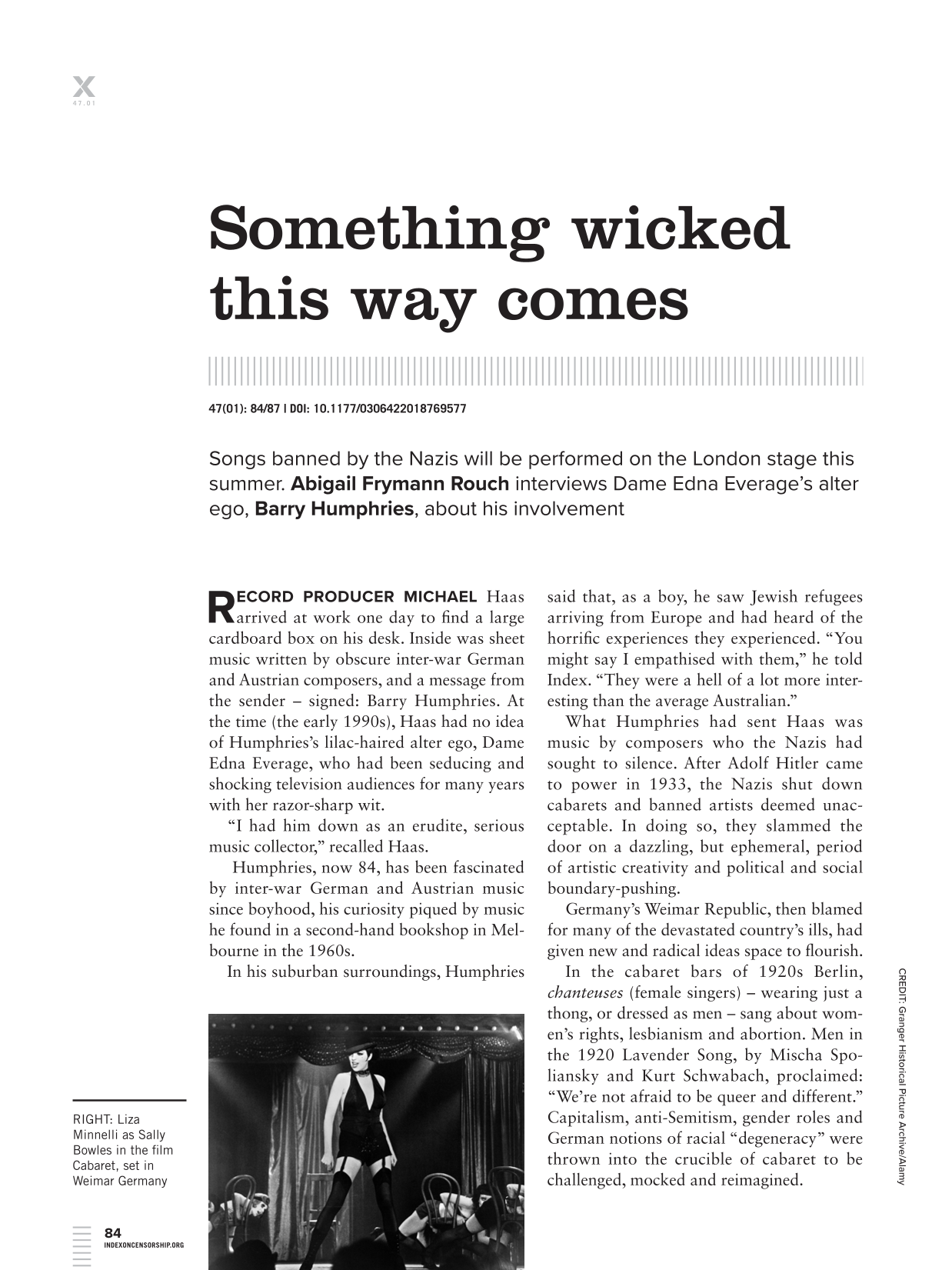
Liza Minnelli as Sally Bowles in the film Cabaret, set in Weimar Germany
CREDIT: Granger Historical Picture Archive/Alamy
In his suburban surroundings, Humphries said that, as a boy, he saw Jewish refugees arriving from Europe and had heard of the horrific experiences they experienced. “You might say I empathised with them,” he told Index. “They were a hell of a lot more interesting than the average Australian.”
What Humphries had sent Haas was music by composers who the Nazis had sought to silence. After Adolf Hitler came to power in 1933, the Nazis shut down cabarets and banned artists deemed unacceptable. In doing so, they slammed the door on a dazzling, but ephemeral, period of artistic creativity and political and social boundary-pushing.
Germany’s Weimar Republic, then blamed for many of the devastated country’s ills, had given new and radical ideas space to flourish.
In the cabaret bars of 1920s Berlin, chanteuses (female singers) – wearing just a thong, or dressed as men – sang about women’s rights, lesbianism and abortion. Men in the 1920 Lavender Song, by Mischa Spoliansky and Kurt Schwabach, proclaimed: “We’re not afraid to be queer and different.” Capitalism, anti-Semitism, gender roles and German notions of racial “degeneracy” were thrown into the crucible of cabaret to be challenged, mocked and reimagined.
Did they appeal to Humphries’s mischievous side? “Yes,” he chuckled in response.
In the 1970s, Humphries met Spoliansky, who had fled to London and gone on to write film music for the Rank Organisation. “I looked him up because I wanted him to write a song for Dame Edna,” he said. But the project didn’t mature. “I told him the kind of song I wanted and I sang it to him and he said, ‘I couldn’t do better than that’, which was very complimentary.”
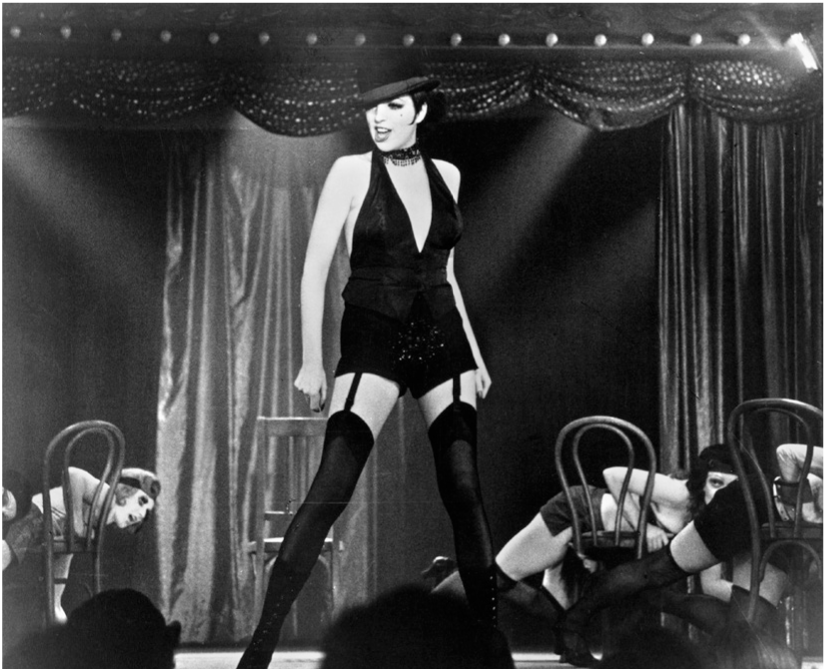
Having brought a selection of the songs back to the stage with cabaret singer Meow Meow in London in 2016, Humphries is preparing for three weeks of performances of his Weimar Cabaret at London’s Barbican this July. One of his favourites is a duet about escape called Benares, by Kurt Weill and Bertolt Brecht from 1927.
“It is a desperate, beautiful song on the dilemma that would soon confront so many people in Europe,” he said.
Its pleading phrases make for uncomfortable listening because of our knowledge of what would follow. And even the more upbeat songs carry a foreboding that the good times would not last.
The Nazis had clear views on what made for wholesome music and what made for music it termed “degenerate”. Acceptable music was German or Austrian (Hitler adored Wagner, Beethoven and Bruckner) and not Jewish. “Degenerate” included styles considered foreign: US jazz, which they called “nigger music”, avant-garde atonality, and, of course, anything written or performed by Jews or people of Jewish heritage. It could include classical music as well as cabaret.
Barry Humphries performs music from Germany’s Weimar Republic with cabaret singer Meow Meow at the Edinburgh International Festival, 2016
CREDIT: Brian Anderson/Getty
In 1938, an exhibition starkly called Entartete Musik (Degenerate Music) opened to enable the public to experience, and be suitably disgusted by, such works. (The more famous exhibition of “degenerate art”, of which Humphries is also a defiantly keen collector, was held the year before.) A promotional image for the music exhibition shows a black saxophonist depicted as a monkey, wearing the Star of David and a gypsy earring. It parodied a poster for a provocative, jazz-influenced opera Jonny Spielt Auf! (Jonny Strikes Up) by the Austrian composer Ernst Krenek.
Finding their works exhibited signalled the beginning of the end for artists in Nazi Germany or Austria, if they had not already fled. Jewish and communist performers, songwriters and composers found themselves barred from the stage or having to leave their jobs. Many fled to France, Britain or across the Atlantic. Krenek fled to the USA in 1938 after years of harassment by the regime. Others who did not manage to leave Europe – such as singer and film director Kurt Gerron, who had performed opposite Marlene Dietrich – died in concentration camps.
Krenek’s music was among the second-hand manuscripts Humphries stumbled across, along with works by Kurt Weill, most famous for the Threepenny Opera; Erich Korngold, who turned to writing film scores for Hollywood; and avant-garde composer Wilhelm Grosz, who died on reaching New York in 1939, aged only 45. Humphries, presenting a Sky Arts documentary last year, said: “The art and the music of a country before disaster strikes takes on a kind of intensity, a glow, a radiance.”
A key figure in reviving this musical legacy is, of course, Haas, who has researched the composers and works banned by the Nazis, and publicised many of them by making recordings. Haas has been a music curator at Vienna’s Jewish Museum and co-founded Vienna’s Exil.arte centre, a repository for the music estates of exiled composers. He said that while some music and related documentation was lost, much was hidden in plain sight, poorly archived by institutions that lack the language skills to get to grips with it. “Hostlands,” (as opposed to homelands), he explained, “often only took what was relevant to them, and that was often the least important part of their output.”
European exiles had to adapt to the Hollywood tastes of their new employers and abandon the edgier styles they had been crafting.
Today, younger artists are discovering and interpreting these works for a new generation. Peter Brathwaite, a black baritone who performed a programme of Entartete Musik in 2014, was shocked by the lyrics’ rawness. While he was performing Weill’s Song of the Brown Islands, which uses grotesque racial stereotypes, he said it hit home that “I am the black man, singing this!”, and he found himself shaking on stage.
“Had I been around then, I would have been sent away. I wouldn’t have been able to perform or collaborate with other artists,” he told Index in an interview at London’s RSA.
Separated by a generation, the performers approach the songs differently. Humphries, along with Meow Meow, argued that “the defiant mood of these artists and composers is called for” because “we’re living now in an age of a new Puritanism, of betrayal, of people telling on each other; of absurd political correctness carried to ridiculous extremes.”
In May, Brathwaite will perform a show named Effigies of Wickedness at London’s intimate Gate Theatre in collaboration with the English National Opera, alongside mezzo-soprano Katie Bray and a consciously diverse line-up of artists. The show’s artistic director, Ellen McDougall, believes some communities still suffer exclusion by “invisible structures” such as gender-binary language. Gay rights have taken a step back, thanks to “a swing to the right” in the USA, Europe, Russia and Ukraine, she told Index. And women’s rights, access to abortion, the links between war and capitalism, and over-reliance on oil are as much issues today as when the songs were written.
Will today’s listeners give the Weimar cabaret songs, with their warnings of imminent destruction, a different reception, I asked McDougall. “I live in hope,” she said.
Composing the Right Notes
Dmitri Shostakovich photographed in Germany, 1950
CREDIT: Deutsche Fotothek
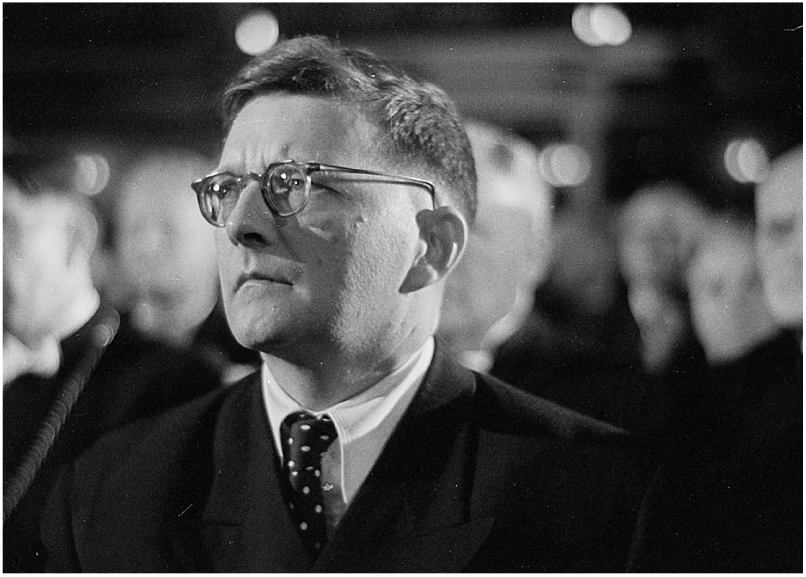
“Music has a profound effect on people, and that is not something dictators tend to like,” said Stephen Johnson, BBC music broadcaster and author of How Shostakovich Changed My Mind. The book, published this April, explores the power of Dmitri Shostakovich’s music during Joseph Stalin’s reign of terror.
Like other composers in the Soviet Union, Shostakovich’s music was judged first and foremost on its political values, and he had to tread a fine line between what was acceptable and what was not.
His musical career was defined by the harsh censorship he faced under Stalin, described as a “personal terror campaign” by Johnson. The composer himself once said that life in Stalin’s regime was “unbelievably mean and hard”.
Stalin didn’t just censor music. He used it as a tool to control the masses and help further his ideology.
“During the siege of Leningrad, many people were removed; Shostakovich wasn’t,” said Johnson. “I think this was partly because he was such a valuable cultural exhibit in a way, because he was popular abroad and useful as a propaganda tool. They wanted him there, but on their terms.”
Despite the restrictions, artists such as Shostakovich managed to hide their rebellions in plain sight. Arguably his most famous piece, his Symphony No. 7, also known as the Leningrad Symphony, is an example of how his music spoke volumes across the country and around the world. His longest piece, lasting 75 minutes, it demands an enormous amount of stamina from its performers. Viewed by those in the West and the Soviet Union as a rallying cry of the Russian people during the war, it had a double meaning for the composer.
Performed while Leningrad (now St Petersburg) was under siege by Nazi forces, it was outwardly a piece against the city’s invaders, but Shostakovich also used it to subtly attack Stalin’s brutality.
Stalin simply saw the symphony as a tool for the Soviet Union’s propaganda machine. Performed in the Grand Hall of the Leningrad Philharmonia, it was broadcast by loudspeakers across the city in August 1942.
The usefulness of Shostakovich, however, was limited.
“I wouldn’t say Stalin liked people, but if he thought they were a good thing, he would play horrible cat and mouse games with them,” said Johnson. Shostakovich fell foul of Stalin in 1948, denounced for “formalism” and “Western influences”, after which most of his music was banned. The denunciation hit the composer hard.
In today’s climate, his work is not played nearly as much in Russia as it is in the West, according to Johnson.
“Perhaps he’s a bit uncomfortable for people out there. I think maybe he’s talking about things a lot of people don’t want to be reminded of,” the author said.
“He can still make people feel uncomfortable. I really think he can. That’s something else that’s marvellous about his music. He can still speak to people in power and cause discomfort.”