




Abstract
Refugees try not to speak out of turn, wary of upsetting people in their new homelands,
Self-censorship by asylum-seekers often starts with the psychological shock of finding what awaits them in places they thought would be safe, and in order to avoid the shame of having to recount the unspeakable.
Radwan and his roommates in Bergamo, Italy, are wary of recounting the reasons they came to the country, and of explaining why Italy is not their desired destination. Fathi Mohammad mentions a fiancée in the Netherlands and said he’d like to join her there.
“Many asylum-seekers self-censor their stories, at least until their first meeting with the Territorial Commission, which will decide whether or not to grant permission,” explained Michele Spadaro, a lawyer working on refugee asylum requests in Italy.
Riad Kadrawi has been a Syrian refugee in Italy since 2014. He is one of those who has made it. He obtained asylum, and today teaches Arabic and works with refugees and asylum-seekers. He is from Ghouta, where part of his family still lives. “I am considered by many people to be the perfect refugee: I learnt Italian quickly, I began working after obtaining asylum,” he said.
“But I have censored myself many times, especially about what happened to my family members in Syria. We Syrian refugees in Italy come from many realities and have differing pasts. I am always afraid that there may have been other Syrians in the reception centres who were spying on me.”
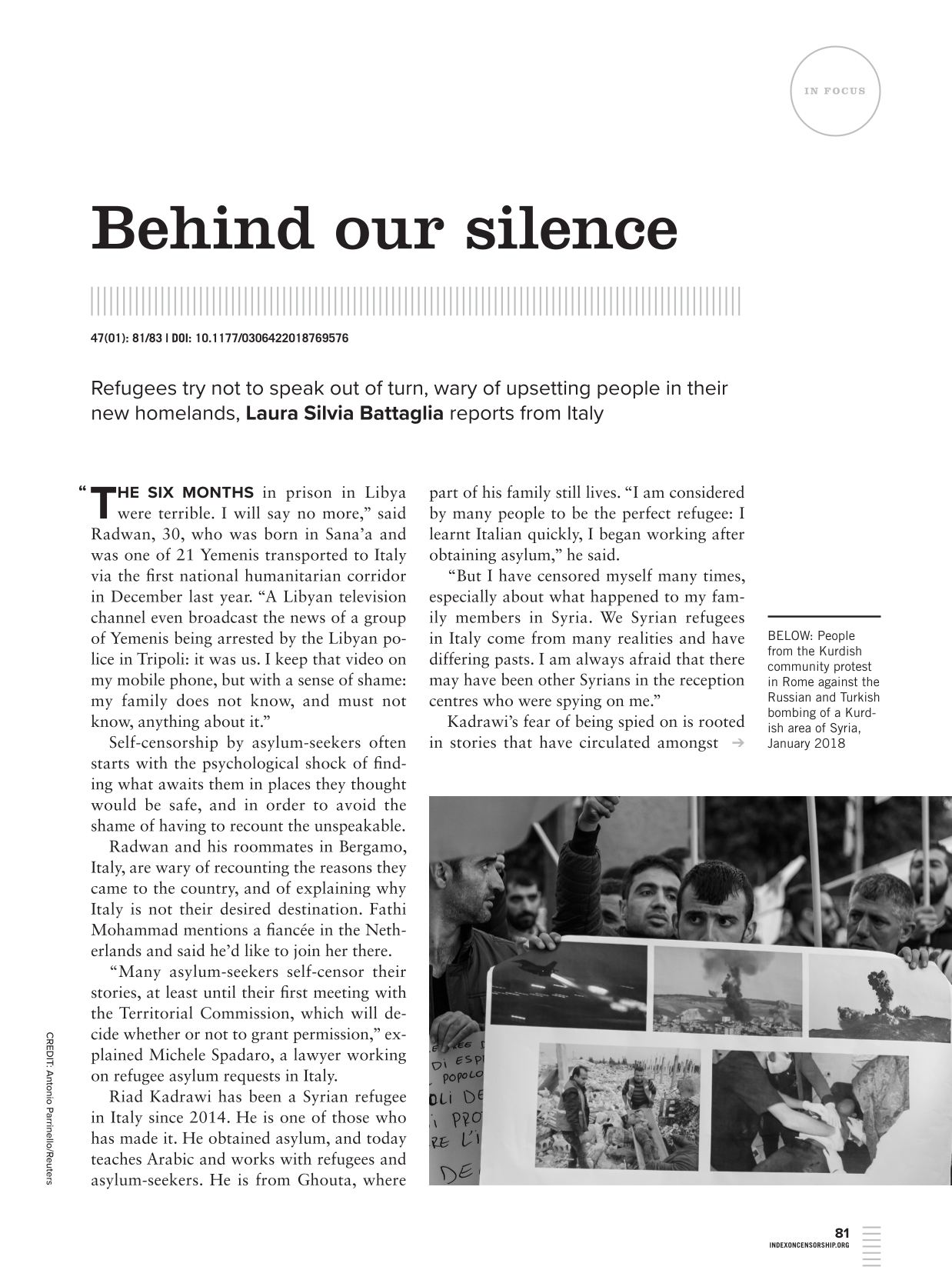
People from the Kurdish community protest in Rome against the Russian and Turkish bombing of a Kurdish area of Syria, January 2018
CREDIT: Antonio Parrinello/Reuters
Kadrawi’s fear of being spied on is rooted in stories that have circulated amongst refugees in Turkey, Greece and Italy about supporters of Syria’s President Bashar al-Assad infiltrating their communities. In Turkey, for example, there were allegations that a former member of the Turkish intelligence services abducted a former Syrian military officer from a camp and sent him back to Syria, where he was reportedly executed. In other parts of Europe, there are rumours of informants collecting information, informing secret services and punishing relatives still in Syria.
For Kadrawi, being the “perfect refugee” can come at a cost. He feels pressure to change his habits and assimilate, starting with not praying five times a day. Still, when it comes to his free speech, he appreciates that in Italy he can be critical about the authorities without it leading to his arrest or torture. Recently, when some members of his family were killed in Ghouta, Kadrawi was outspoken in his condemnation of the attacks.
“I feel freer now to say what I think of Assad, but I also feel like someone without a homeland: I do not belong anywhere, in fact. Or perhaps I belong only to some middle land which is mainly inside myself,” said Kadrawi, weighing up the pros and cons of his current situation.
Amin Wahidi, 36, arrived in Italy in 2007, obtaining political asylum within a year. He is from Afghanistan and is a Hazara. Back home, he was a television anchorman at ATN. “One of my female colleagues, an ethnic Hazara, Shaima Rezayee, who worked at Tolo TV, was killed by the Taliban. They also wanted to kill me,” he said.
Wahidi, who was a screenwriter in his own country and had founded a production company, fled Afghanistan after beginning to shoot a film, The Key to Paradise, about a potential suicide bomber. In Italy, he began all over again, spending time at the cinema school in Milan and producing four short films, as well as Behind Venice Luxury, the story of a Hazara refugee in Italy.
“One’s original identity and one’s new identity rebalance themselves only after many years,” he said. “My heart is still in Afghanistan, but Italy has given me freedom of expression and has enabled me to be reborn as a director.
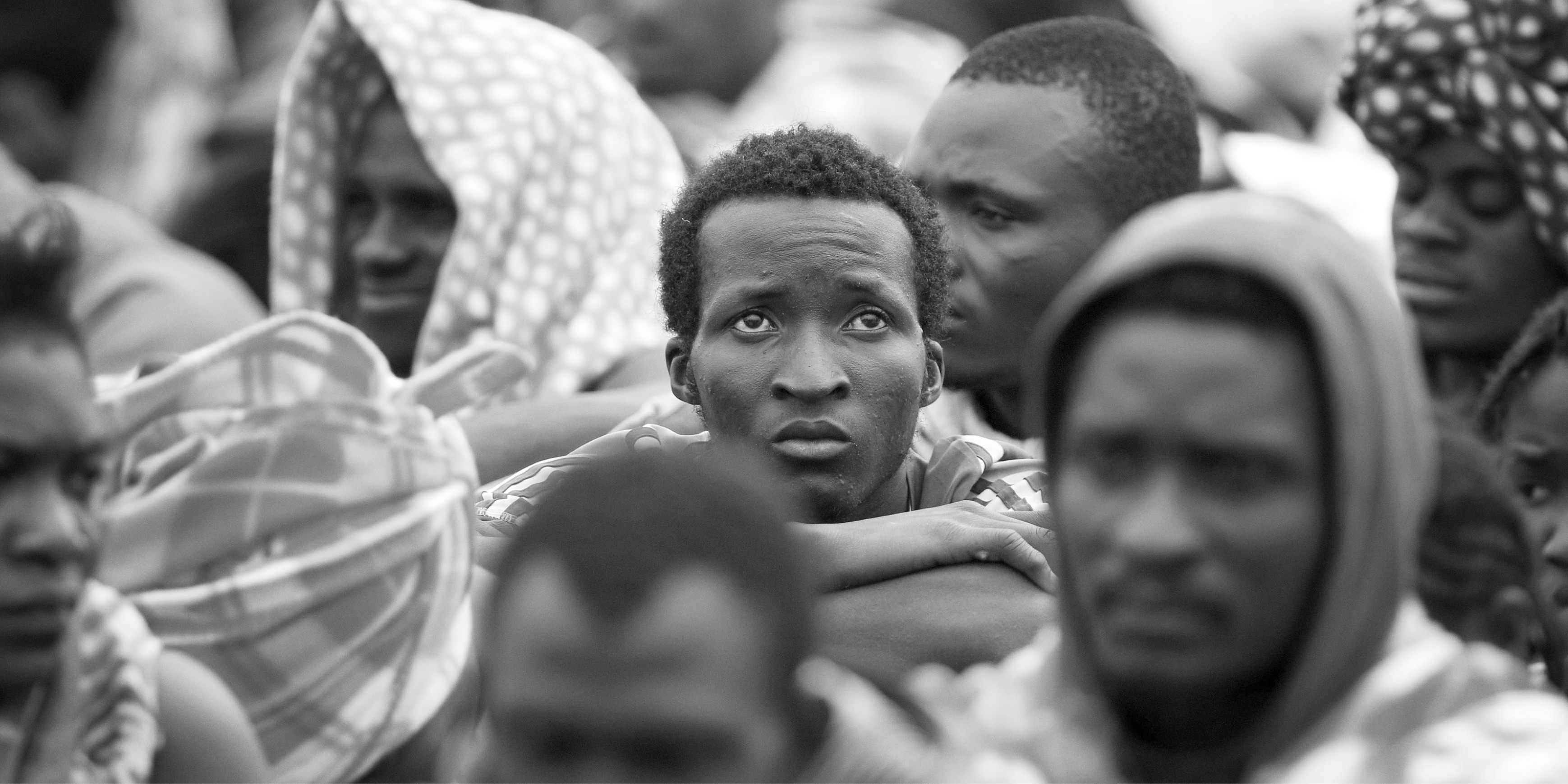
Migrants arrive in Augusta, Italy, June 2016
CREDIT: Stefano Montesi - Corbis/Corbis/Getty
“Art has enabled me to stop censoring myself, but what I can testify is that it has not been easy. At the beginning, when you arrive in Europe from a distant world, you are in shock from what you have been through. And self-censorship is a necessary rite of passage. In fact, if you talk, you don’t even know whether people will understand what you have experienced. And you prefer to keep quiet.”
Wahidi knows that feeling able to speak freely doesn’t apply to everyone. “There are people who leave the path of free expression altogether, even if they were artists or intellectuals before, because there are people for whom it is enough just to get out of difficulty. I have learnt that for many people it is enough just to feel alive,” he said of those who might be so relieved to be away from danger that they don’t want to rock the boat.
Wahidi is currently working on a film called Milestone, which tells the story of an Italian street singer, Manuela Pellegatta, who lives in Milan. Wahidi’s move away from refugee stories and those concerning his country of birth is partly because he fears that production companies will change his story or force him to deliver different messages. He had a bad experience with a US production in Afghanistan, when he felt he was being used to get across a certain message.
Herein lies the flipside of the censorship story. It’s not just what refugees feel they cannot say or have to hold back. It’s also what they feel forced to say, feeding into certain narratives which are often politically motivated. In this instance, Wahidi said he was not willing to do so because “I don’t sell myself to anyone”.
Footnotes
Some last names have been left out for security reasons
Translated by