Abstract
Spain’s ruling party has been censoring Catalan musicians for years, which stoked calls for independence, writes
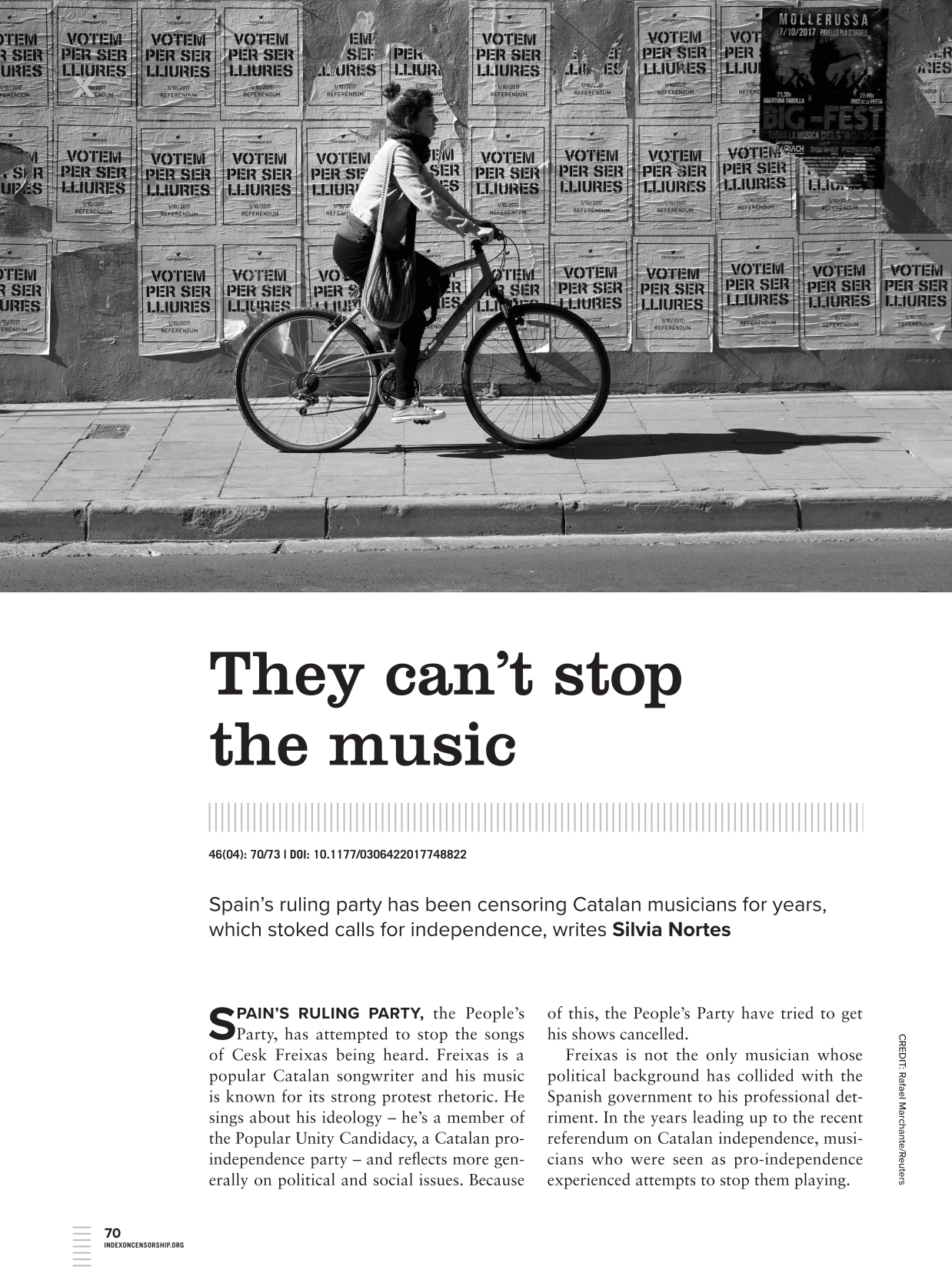
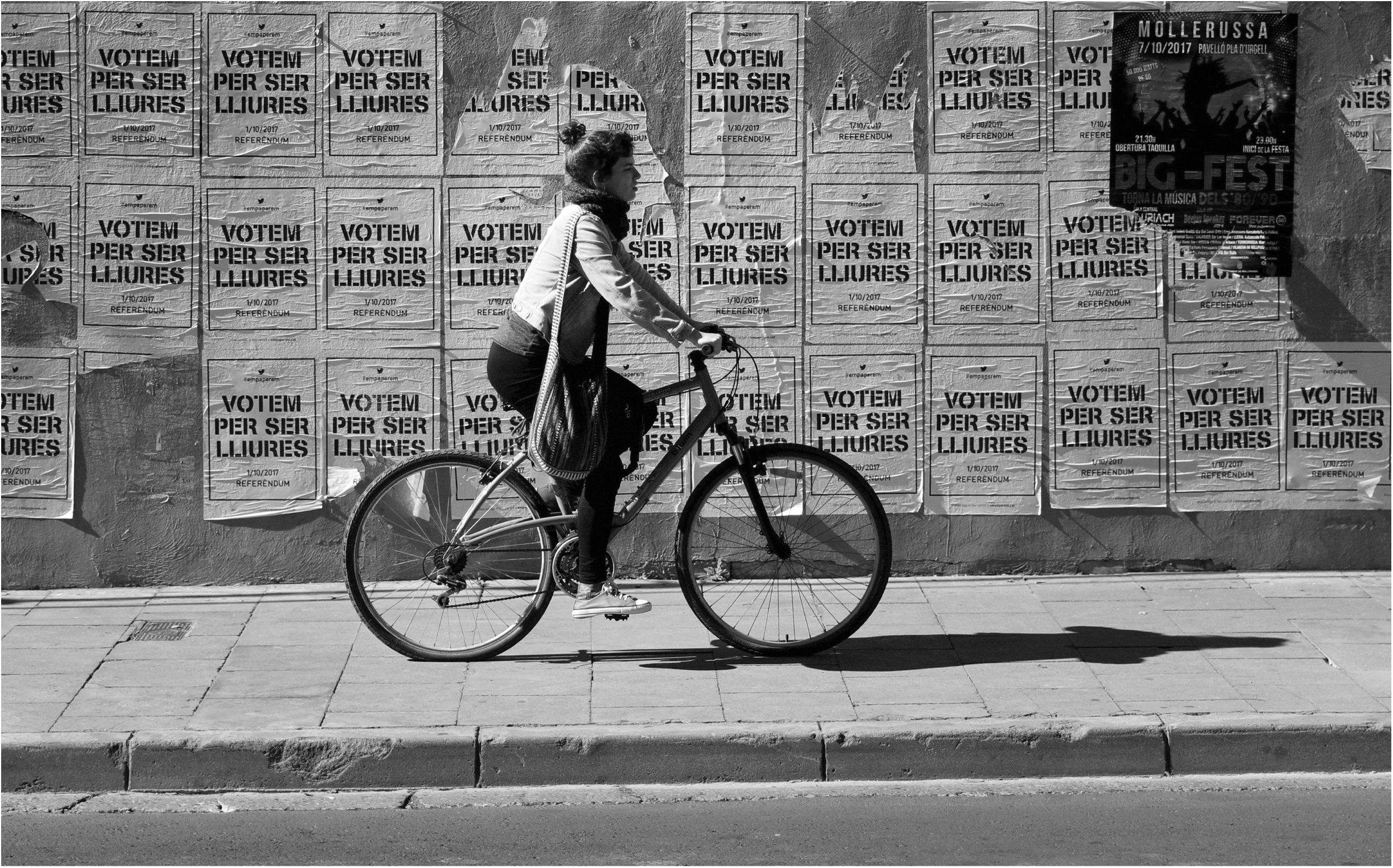
A woman cycles past Catalan posters that read “Vote to be free” in Barcelona, Spain, October 2017
CREDIT: Rafael Marchante/Reuters
Freixas is not the only musician whose political background has collided with the Spanish government to his professional detriment. In the years leading up to the recent referendum on Catalan independence, musicians who were seen as pro-independence experienced attempts to stop them playing.
Back in 2009 and again this year, Freixas was accused of “singing unconstitutional songs, inciting hatred and violence, being in contact with terrorist groups, and ‘boasting’ the Catalan language”, he told Index.
He said extreme-right groups had turned up at his shows three times, “trying to cause panic”, but they had achieved the opposite of their intentions. They had wanted the concerts to be cancelled, but Freixas had drawn bigger audiences than the fascists had expected, and the only thing they achieved was heightening the “emotional and political levels” of the crowd.
He added: “I do boast about something in my concerts: justice, respect, equality, solidarity.”
He believes that attempts to stop Catalan musicians playing has added to the feeling of not being heard, which has consequently fed dissatisfaction with Spain’s central government amongst a large part of the Catalan population.
“There is constant and structural discrimination by the Spanish state towards songwriters who use Catalan,” he said. “We do not usually perform out of Catalan-speaking regions, but also we do not get played on radio stations, neither [do we] appear in newspapers or magazines, nor state TV channels… No surprise independence is gaining so many supporters.”
As the recent referendum revealed, the Catalan pro-independence movement is growing. According to a poll by the Centre for Opinion Studies from 2016, the number of people who support independence has tripled in 10 years.
The Catalan language, which is not recognised as a national language in Spain, is central to Catalonia’s social identity and cultural output. Catalan political scientist Gabriel Garroum Pla told Index that “systematic attacks on the normal and regular use of Catalan in the media” shows “contempt towards Catalonia”. He said: “Obviously, this is linked to the perception of Spain as a one-nation state, and this generates a really basic but very productive sense of ‘whatever is Catalan is not Spanish’.
“Catalan language is the cornerstone of Catalanism,” added Garroum Pla, who thinks that Spanish nationalism shows a lack of respect towards the language, which causes grievances.
Songwriter Albert Pla, whose lyrics are characterised by irreverence and satire, has had similar treatment to Freixas. Pla was forbidden from performing his show in Gijón in the Asturias region of northern Spain in 2013, because he said he was “disgusted with being Spanish” and he would like “Catalans to be independent and people to be forced to learn Catalan, in the same way that we are forced [to learn Spanish]”, in an interview published in digital newspaper La Nueva España.
A People’s Party councillor, Francisco Rodríguez Cubiella, said it was not acceptable for a local theatre to host “an artist that shows an absolute lack of respect towards people from Gijón and Spain”.
At the time, Pla said on Spanish radio that he was “used to being censored”, but admitted that, had he known the consequences, he “would not have said what I said”.
History repeated itself in April 2017. Pla was set to perform at Oviedo’s Philharmonic Theatre. The culture ministry had to approve the use of a local space for the show. It is a simple procedure that doesn’t usually involve any controversy, but this time MPs from the People’s Party and the Citizens party voted against it. Pla finally got permission to use the space, but the point had been made.
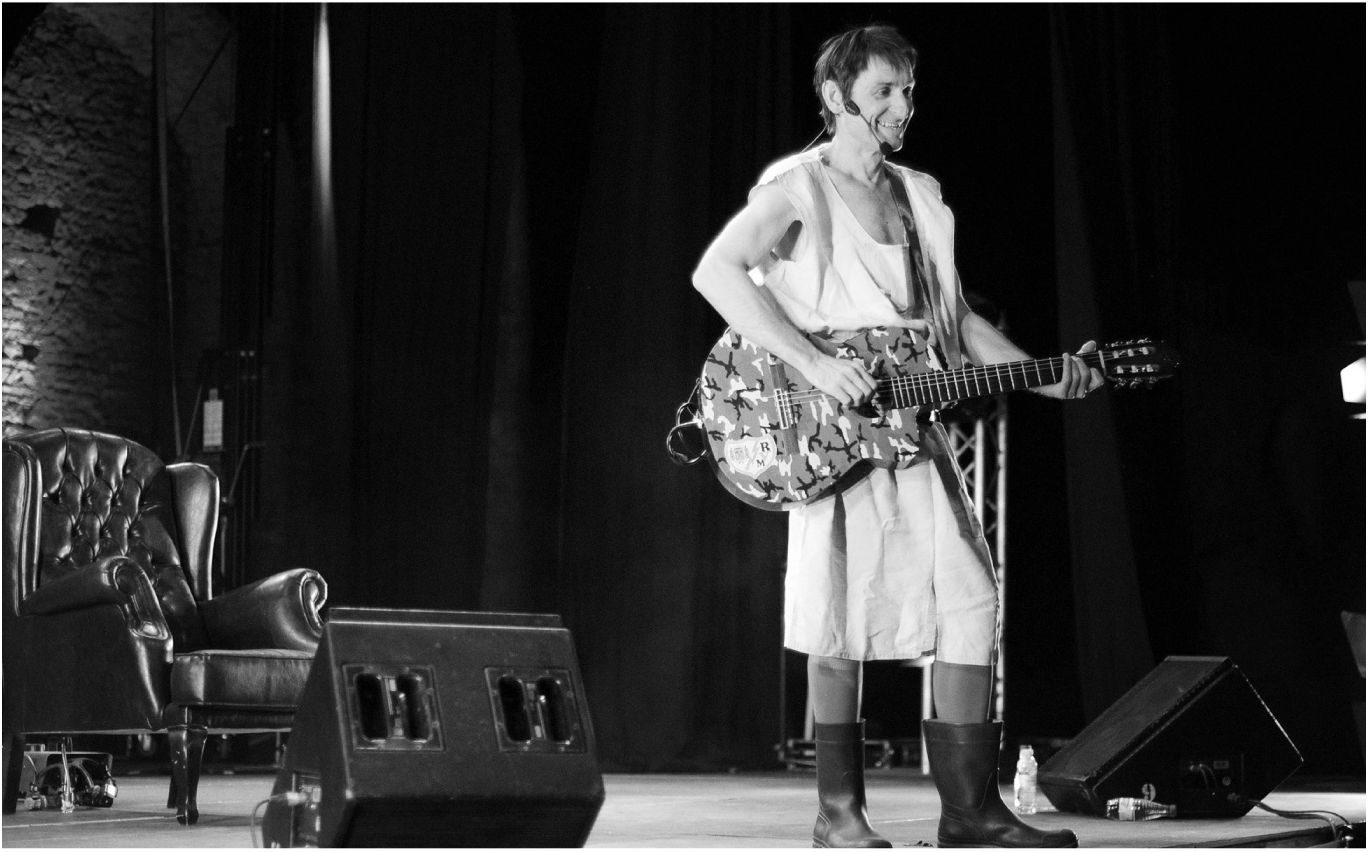
Catalan musician Albert Pla
CREDIT: Festival Castillo de Aínsa/Flickr
Pla wrote a letter to Albert Rivera, the president of Citizens, a political party that describes itself as post-nationalist, arguing that Rivera makes “people believe that our work is subsidised by the government and that, in some way, these concerts are anti-system acts paid for with everyone’s money. It is not true. The theater, even if it is public, does not hire us, nor does it even cede its facilities for free. It is clear that the concert is done through a private promoter who rents the theatre… You and your party have presence in the government, in the senate, in the parliament, in the banks, in the courts, on all the TV channels, newspapers, radio and digital media… Your presence is so invasive that, in order not to know about you, I have to lock myself in the house and cut off the light, and even then, I find you in the soup.… Sometimes what I say is the truth disguised as a lie. What you say is always a lie disguised as the truth.”
Culture and politics go hand in hand when dealing with Catalonia’s independence movement. “Politics is ethics, moral standards,” Freixas said. “And anything we do will be based on those ethics. Decoupling politics and culture is a further demonstration of how interested the powerful are in workers and society staying far from the real spheres of decision-making and debate. They want us to be quiet.”
But Garroum Pla believes that “these occasional episodes of censorship towards artists are not deep or systematic enough as to be the root of the problem”. “There is a structural contempt from almost every layer of the state towards Catalonian language and identity,” he said. “There is a layer of Spanish/Castilian exclusive nationalism that sees diversity and difference as a threat and not as a constituent part of its identity.”
Freixas agrees that “these are not isolated events”. He added: “This is happening year after year, and it makes it evident that it is a structural problem of Spanish institutions. I would even say there is a Francoist-rooted problem that stays alive in these institutions and at the centre of the idea of what Spain is.”
This denial of diversity, Freixas believes, will only aggravate the problem. “There are plenty of elements that build in a very normal, plural and diverse way what Catalan culture is. Such a diversity is what really bothers the Spanish state, as well as the impossibility of homogenising its national project. There will never be a democratic coexistence without respect and inclusion.
“Without the recognition of the right to self-determination and the respect for structural minorities, Spain is doomed to disappear. I believe time will prove us right.”
Independent Thoughts
The Scottish and Catalan independence movements have long watched each other with interest. Catalan flags are a regular sight at Scottish independence rallies, but the Catalan experience of censoring artists who advocated independence was not something they had in common.
Scotland’s own independence referendum in 2014 was a remarkable time in the country’s political history. Following a gruelling two-year campaign, the day itself was respectful and relatively subdued. Both sides chatted and took selfies outside polling stations, and though there were a few minor scuffles, foreign journalists who covered the referendum were often shocked by how little vitriol was on display.
Instead, much of Scotland’s energy was directed into an explosion of cultural activity and dialogue. There was a genuine feeling that the campaign was a chance for conversation rather than a battle. Several prominent writers began to organise and appear at events discussing what an independent Scotland might look like, for better or worse. Playwright David Greig hosted a month-long show called All Back to Bowie’s – a reference to David Bowie coming out against independence – with guests including now First Minister of Scotland Nicola Sturgeon.
There were also The James Plays by Rona Munro, a grand theatrical cycle about three generations of Stewart kings who ruled Scotland in the 15th century. The plays were shown in both Edinburgh and London in the lead-up to the vote, and often framed a discussion about the upcoming referendum.
The Assembly Rooms at the Edinburgh Fringe featured the comedy cabaret Aye Right? How No? which had been running for a while in other parts of Scotland. The Edinburgh leg was hosted by standups Vladimir McTavish and Keir McAllister and had appearances from comedians such as Frankie Boyle to Rory Bremner, who debated independence and cast their personal votes on it.
Indeed, the Edinburgh festivals a month before the vote provided platforms for prominent cultural figures to voice thoughts from both sides.
The campaign finished with a concert at Edinburgh’s Usher Hall by the Glasgow post-rock band Mogwai, co-organised by National Collective, a pro-independence arts network that sprang up in the early days of the campaign and covered the country from top to bottom.
Though artists and writers have played an important part in the story of Scotland’s push for political autonomy, in 2014 there were few arguing that Scotland’s languages or culture were being silenced. In fact, the opposite was demonstrably true. The mission for the pro-independence side was not so much to make Scots proud of their country but to get them to talk to each other about its problems.
This conversation has carried on in Scotland in the years since and has given Scottish voters a renewed sense that they have both the right and the ability to speak up about their own future, however they see it.
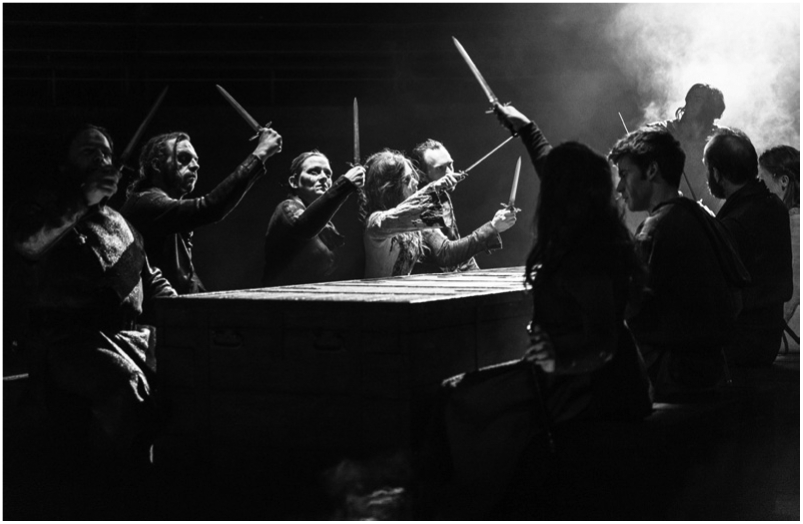
A scene from The James Plays, which look at Scottish history and were shown in Scotland and England in the lead-up to the referendum
CREDIT: Manuel Harlan/National Theatre of Scotland