




Abstract

Egyptian journalist
Journalists protest in front of the Press Syndicate, Cairo, in 2015 against the detention of photojournalist Mahmoud Abou Zeid, who has been imprisoned since 2013
CREDIT: Mohamed Abd El Ghany/Reuters
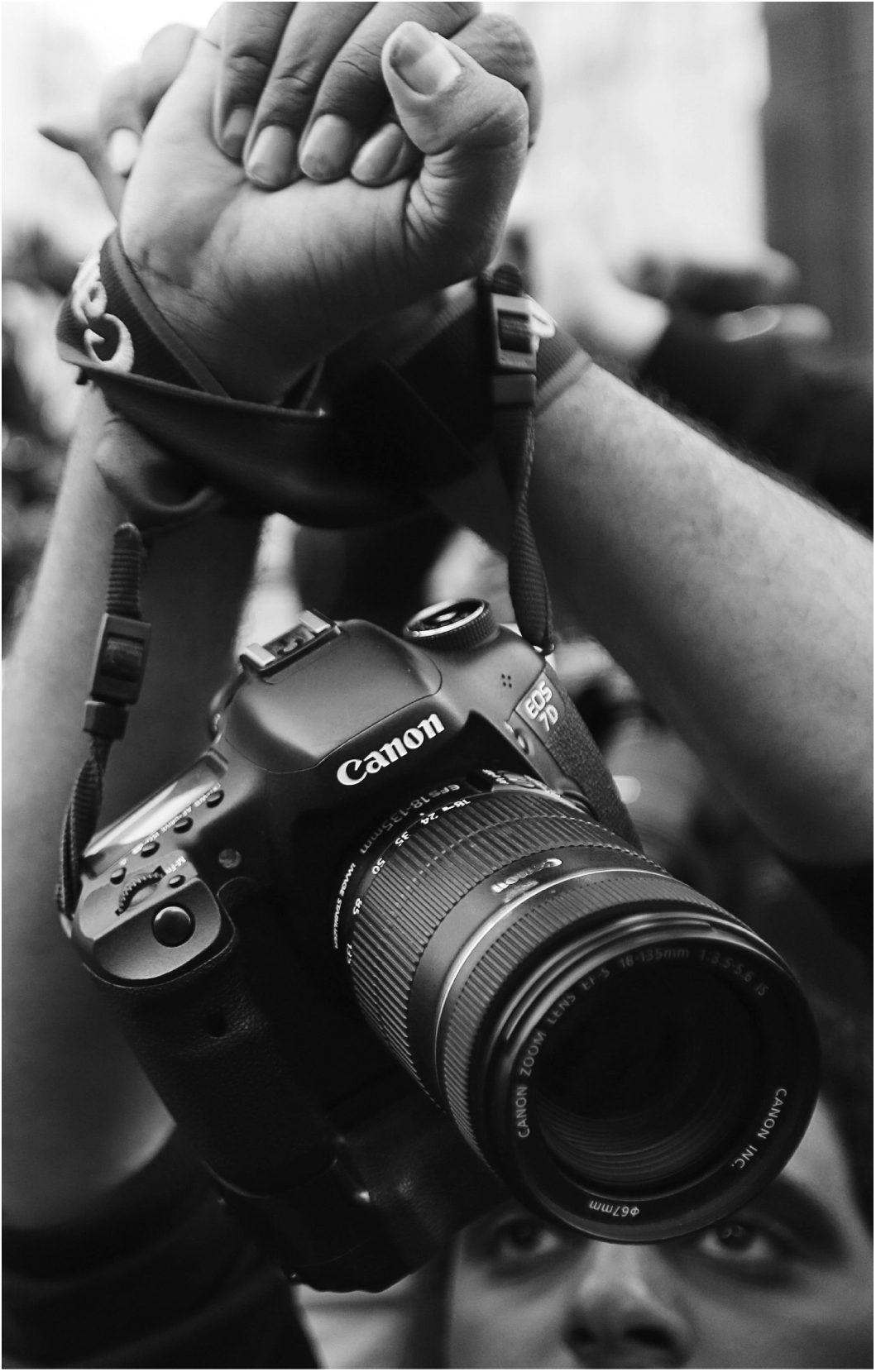
At the time of the first major protests in January 2011, I was working with Ahram Online, a new digital paper. The editor-inchief at the time encouraged us to cover the protests. That’s exactly what I did, and there were many to cover. Some outsiders remember the Egyptian revolution as an 18-day period that ousted Hosni Mubarak, but the reality was three years of constant protests in a fight against decades of Mubarak-rule. The demonstrations were not just the largest and most sustained in its history, they were creative, subversive and, to some extent, effective.
In 2012, Mohamed Morsi was elected president. Throughout this period, there were continuous attempts by the authorities to reclaim public space. Yet journalists and citizens fought hard to protect them. By June 2013, plenty had rallied against his party, the Muslim Brotherhood, in massive protests across the country, fighting against what was seen as their preoccupation with power over actual positive social and economic change.
Perhaps the writing was on the wall then. Military choppers hovered over Egyptian skies and informants infiltrated protests to ensure anti-military sentiments were crushed. In the days leading up to the military takeover, I remember how morbidly jubilant everyone was. I visited the protests with an activist and I recall saying: “Three days and the army will take over.” As we moved near the presidential palace, we saw people dancing. The activist said to me: “I can’t believe they’re dancing here; this is where Kristi [a revolutionary killed under Morsi] died. This isn’t a revolution to remove the Muslim Brotherhood, this is a coup against the January 25 revolution.”
Morsi was ousted by the military on 3 July 2013, his place filled shortly by Abdel Fattah al-Sisi. Things got progressively worse after that. In that same month, more than 50 Islamist supporters were killed outside the Republican Guard headquarters in Cairo and more than 70 were killed by police in Nasr City. There were no repercussions. There was no outrage. By 14 August 2013, the stage was set for the largest massacre in Egypt’s history. Nearly 1,000 people were killed. On 16 August, marches that protested the massacre were crushed and 173 people were killed. On 6 October, more people died in clashes outside my parents’ house, which I witnessed from above. I saw policemen in plain clothes draw their weapons, take aim and fire at a retreating crowd. I saw people abusing someone they captured. At least 70 people died that day. Still no outrage. People gloated over the spectacle of murdering protesters as they would in a gladiator arena.
Brutality comes first in the form of an arrest, a baton, a teargas canister, a pellet and then a bullet. You prepare yourself, but you also try to avoid such an encounter. As you witness lies and brutality, slowly you forget whether you’re meant to report on the protests or merely survive. The risks for journalists were too high and the end result lost meaning. For the first time in my life fear prevented me from reporting.
A great part of me did not want to believe we were going through this again. I hoped people would hold the military accountable like they had the Muslim Brotherhood. But by this stage many had grown tired of protests and feared the return to Muslim Brotherhood rule. Even more so, people had been consistently punished for protesting and saw no hope of change through direct action.
Today, the space for demonstrations is dead, lost for citizens and journalists alike. The number of journalists imprisoned in Egypt is surpassed only by the numbers jailed in Turkey and China, and Egypt ranks 161 out of 180 countries in the Reporters Without Borders’ freedom index. As many as 16 new prisons have been built since the military takeover in 2013.
Freedoms die a slow death. They don’t necessarily die when people are arrested and killed. They die when people walk away from fighting for them. They die as soon as many decide they do not want them for others. They die when the elements that comprise them are dismantled bit by bit.
But opposition remains, albeit in the corners rather than the squares. Dissidents attempt to utilise mediums, such as social media, that are not entirely controlled by government. The government is ridiculed constantly by young people who find their rule unconvincing.
Sisi’s policies are also catching up with him. Prices have risen dramatically while income rises slowly. There is massive discontent. Elections are set to take place in 2018, which, if they happen, Sisi will aim to win. Will people protest? Ultimately, no one knows what will happen in the future. January 2011 was unexpected. Perhaps because of that, there’s still value in trying to fight and, in so doing, reminding ourselves that we are not alone, that there are still many willing to stand up for our rights.