




Abstract
New data from the Mapping Media Freedom project reveals a rise in attacks on journalists covering protests,
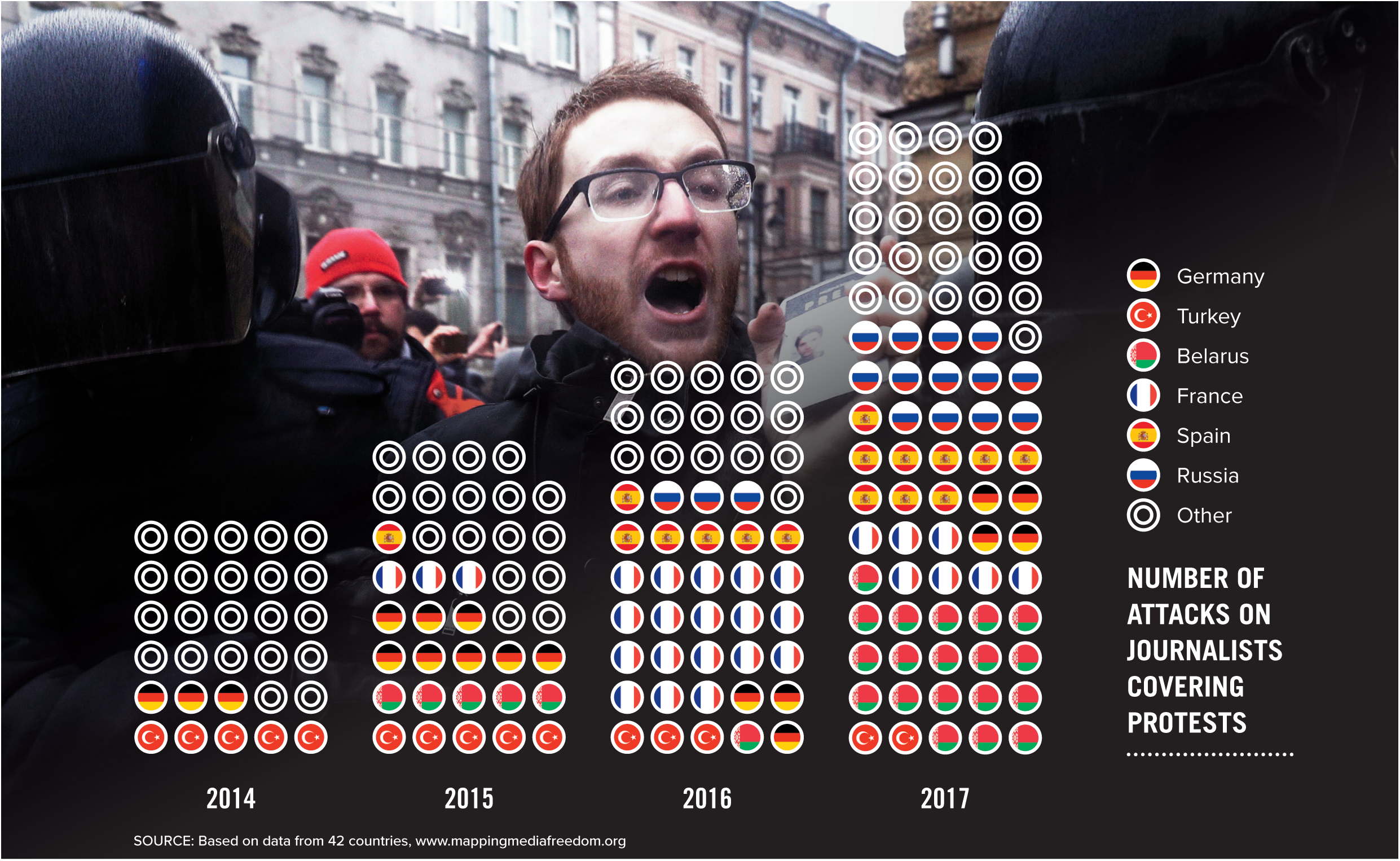
Between 1 January 2016 and 10 November 2017, the Index on Censorship-run MMF platform, which records media violations throughout 42 countries, saw a major increase in incidents relating to protest. Attacks on journalists covering protests grew from 50 reports for the whole of 2016 to 79 reports so far this year.
The bulk of this increase has been down to the treatment of reporters in Belarus and Russia. In 2016, there was just one protest-related Belarusian violation reported to the platform, when, on 8 December, two journalists working for the independent newspaper Nasha Niva – Mikita Nedaverkau and Iryna Arakhouskaya – were detained by police. Their crime? Filming a protest organised by a Christian-democratic youth group, Youth Front, which police said impinged on the privacy of participants.
In 2017, there have been 19 such Belarusian reports recorded by MMF so far, including the mass detention of 30 journalists in three cities while covering protests against a proposed jobless tax on 25 March – an unofficial holiday in Belarus known as Freedom Day. Seven of the journalists reported being beaten by police.
A total of three reports detailed attacks on Russian media while covering protests were made to MMF in 2016. Up to 10 November 2017, there were 13, including on 7 October when eight media workers – six journalists and two bloggers – were detained in Moscow during protests in support of opposition leader Alexey Navalny. On the same day, photojournalist David Frenkel was detained in St Petersburg, again at a mass rally in support of Navalny.
Since the project began in 2014, MMF has recorded 198 instances of journalists experiencing different types of attacks when covering protests. In all, there were 97 cases of violence against journalists, including the murder of Vyacheslav Veremiy, a Ukrainian journalist working for the newspaper Vesti, who was severely beaten and shot on February 2014 after covering the Euromaidan protests in Kiev. News reports alleged he was attacked by pro-government protesters who he had filmed. There have also been 52 cases of detention, often of more than one journalist at a time, and 23 instances of charges being fi led against media workers.
Perhaps surprisingly, the country with the most reports since 2014 hasn’t been an ex-Soviet state or an illiberal democracy, but France, with 28 reported violations in all. And although the country has seen a significant improvement between 2016 and 2017 – from 18 to seven recorded violations (up to 10 November 2017) – it remains a difficult place for journalists to cover demonstrations safely. For instance, on 1 May 2017, video journalist Henry Langston, who works for Vice UK, was injured by police while reporting on a May Day march in Paris.
A journalist is detained by police during a protest in St Petersburg, Russia, where thousands gathered in opposition to the government, March 2017
CREDIT: Dmitro Lovetsky/Rex
Langston, who told Index that the protest was “very violent on both sides”, said his crew were following a group of anarchists during the protests. “Police officers were aiming flash-balls at people’s heads, firing tear gas canisters directly at people,” he said. “They weren’t differentiating between protesters and journalists.”
Langston was hit across the knee with a baton by an officer and hit in the leg by what he says “was a mechanism from a teargas canister”. His cameraman Devin Yuceil was also hit in the stomach with a piece of a flash grenade. Langston was treated in hospital for injuries, where he received stitches.
France isn’t an anomaly in western Europe. Germany may be ranked 13th in the The Economist Intelligence Unit’s Democracy Index 2016 with a near-perfect score on civil liberties, but personal freedoms are not the order of the day when covering protests. In July 2017, for example, 32 media workers, some of whom appear to have been blacklisted for working in Kurdish Turkey, had their accreditation revoked by police ahead of the G20 summit in Hamburg. Some of the journalists were pepper sprayed by police and even attacked by protesters.
MMF project manager Hannah Machlin said: “Such attacks are stifling the public’s knowledge of what is going on in the world.
And it is something that needs attention.”
The MMF data shows that journalists are being singled out and targeted, very often with violence, by police and protesters alike. And when the dissemination of knowledge on political movements is stifled by such attacks, we are all the poorer for it.