




Abstract
Anti-apartheid campaigners who thought they had put away their placards forever are back on the streets.
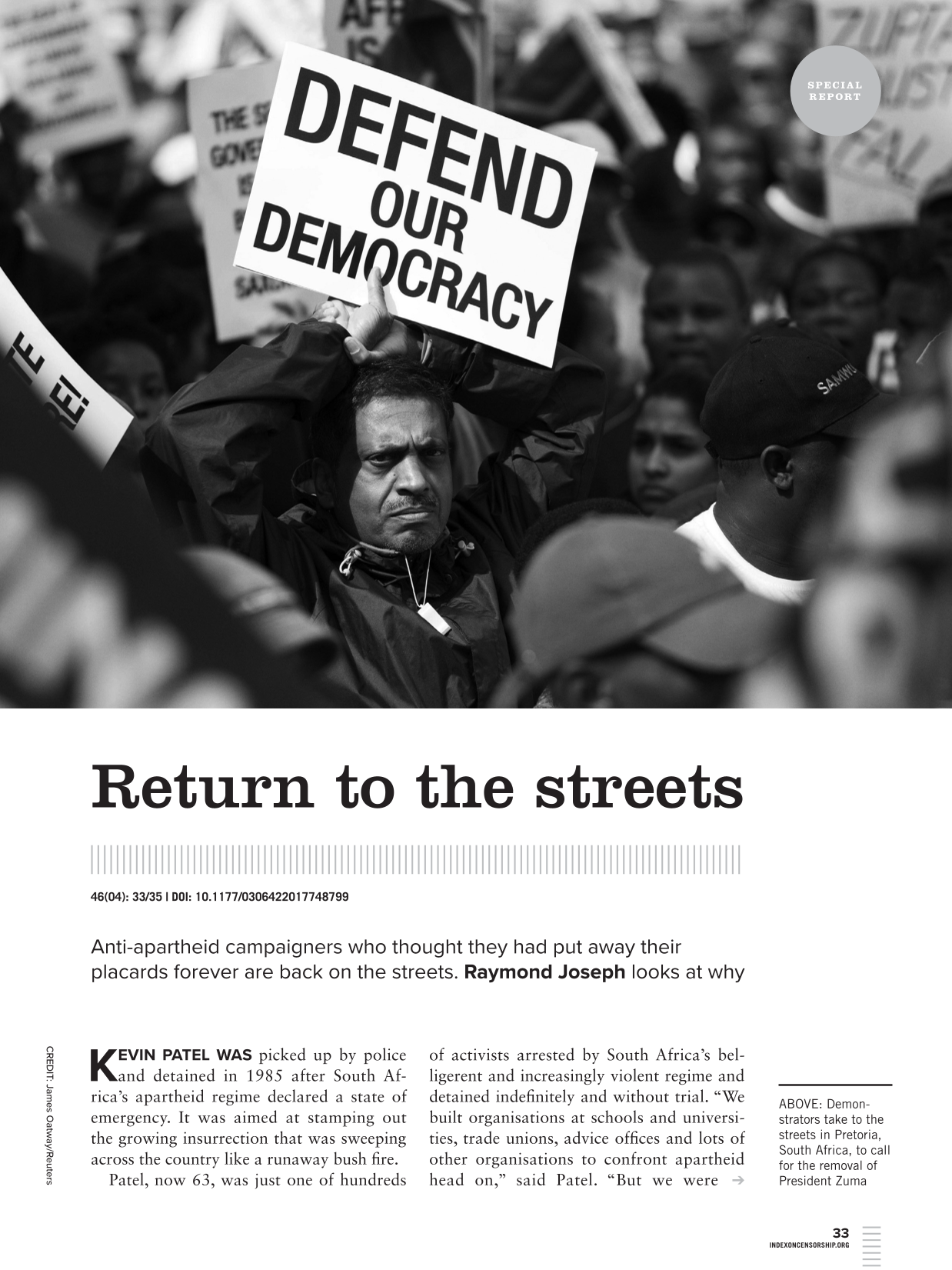
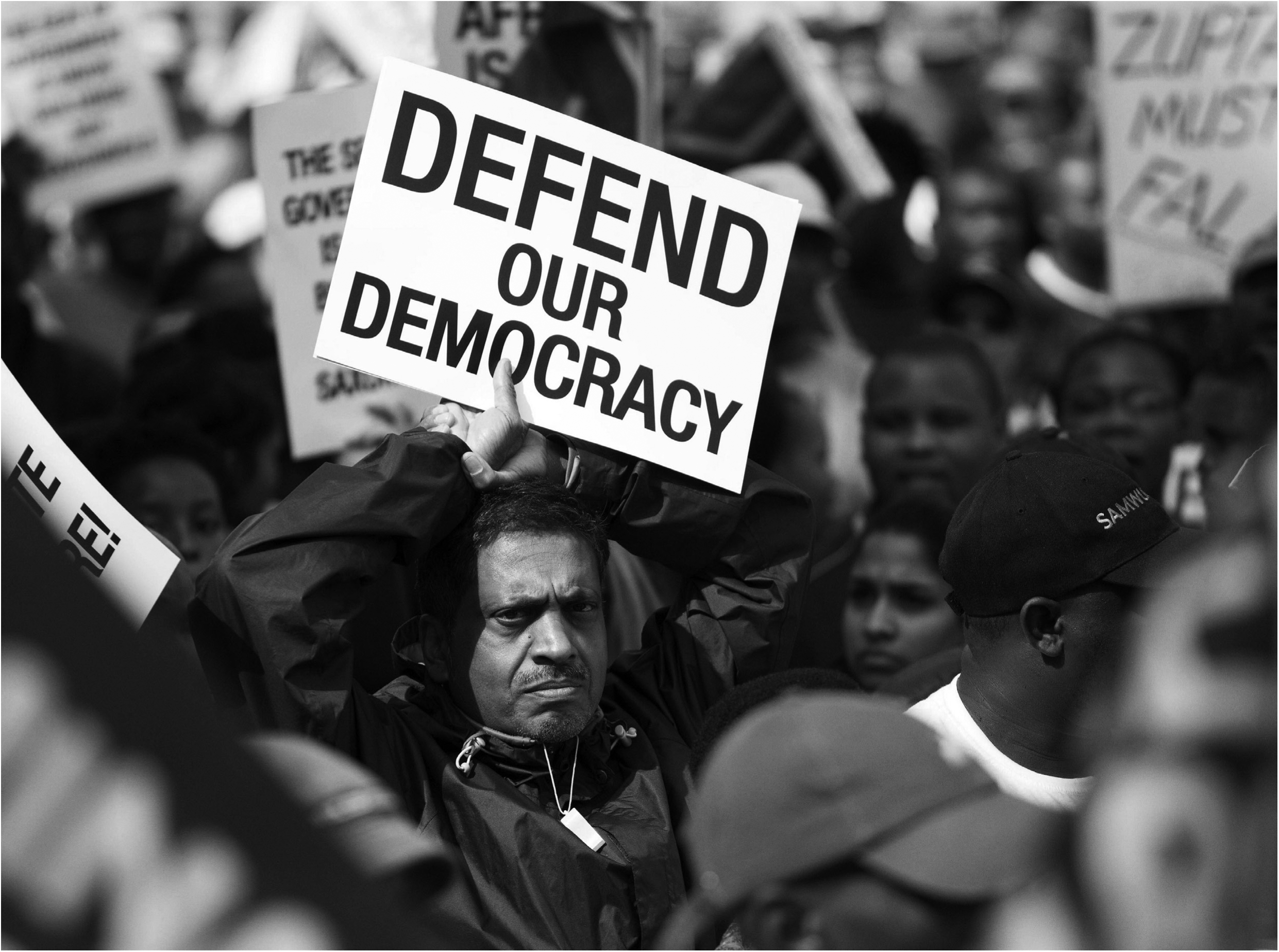
Demonstrators take to the streets in Pretoria, South Africa, to call for the removal of President Zuma
CREDIT: James Oatway/Reuters
Patel, now 63, was just one of hundreds of activists arrested by South Africa’s belligerent and increasingly violent regime and detained indefinitely and without trial. “We built organisations at schools and universities, trade unions, advice offices and lots of other organisations to confront apartheid head on,” said Patel. “But we were disciplined and well organised. We did not burn and destroy, as often happens these days with protests.
“When we held protests and marches, the police were brutal in smashing them. The cops would just block us and just start shooting with buckshot, stun grenades and tear gas.”
Now, more than three decades later, Patel finds himself involved in protests once again.
He is just one of many anti-apartheid activists who are “back in the trenches” as South Africans take to the streets to protest against a variety of issues, including state capture, corruption and poor government service delivery.
“People are confused, they are not being listened to, councillors do not report back and are not accountable,” he said. “Our institutions of government are not working, but no one is listening. It means we need to hold them to account. I am filled with anger at the course we are on at this time.
“We should have been much further and living in a prosperous country. The corruption we see is not acceptable and we need to raise our voices to say it is not OK. But it is really strange to be protesting again.”
Protest is an important part of the DNA of South Africa, and once again people are using protests and marches to make their voices heard, just as they did during the apartheid era.
The country’s history is littered with protests, many of which became defining moments in the long march to freedom. They include the historic civil disobedience campaign that began in 1950 and continued with the 1952 Defiance Campaign; the 1956 Women’s March on the Union Buildings in Pretoria, the government’s seat of power; the peaceful 1960 march on a police station that culminated in the Sharpeville massacre; and the 1976 student uprising. More recently, there is the (still ongoing) #FeesMustFall campaign for free tertiary education and the mass #ZumaMustFall protests in April 2017 that saw tens of thousands of South Africans line roads in towns and cities across the country to call for the resignation of President Jacob Zuma.
It was no surprise when the rights to publicly protest, stage demonstrations and go out on strike were entrenched in South Africa’s post-1994 democratic era constitution.
The Regulation of Gatherings Act gives effect to this right by providing the legal framework through which it is regulated by the state, says researcher Karen Heese.
An economist at Municipal IQ, a data and intelligence service that monitors and assesses municipalities in South Africa, she wrote in a recent briefing: “The RGA in its preamble states ‘every person has the right to assemble with other persons and to express his views on any matter freely in public and to enjoy the protection of the state while doing so’. In addition, an increase in political participation is widely regarded as a constructive and conventional form of participation in a democratic state.”
Yet, 23 years into democracy, South Africans who take to the streets to exercise their right to protest and to raise grievances often find themselves the targets of heavy-handed policing that reminds those with long memories of the violence of the apartheid-era police.
“Often permission (to hold a protest) is not granted, even though no permission is required,” said Lizette Lancaster, who manages the Institute for Security Studies Crime and Justice Programme. She also maintains an ISS tool that tracks protests and their causes.
And all too often, when permission to protest is sought with municipal and other authorities – who are often the target of the protest – extreme conditions are imposed on applicants. These range from attempts to make organisers pay deposits to limiting the number of people taking part.
An “illegal checklist” issued to the Right2Know campaign to try to stop a recent protest against the Johannesburg Metro Police highlighted the issue. Ironically, the protest was organised to highlight “illegal” methods employed by that force to stop protests.
“In many municipalities across SA we see officials in small offices inventing unconstitutional reasons to undermine our right to protest and stop us from exercising our voice in this democracy,” R2K said in a statement. “We call on all across the country who experience these kinds of abuses to join us in saying NO. We demand the right to protest!”
But protests are becoming more violent as protesters have failed to bring their grievances to the attention of the authorities. And these are taking a heavy toll.
In 2016 alone, violent protest action resulted in more than a billion rand (more than $70m) in damage to state and private infrastructure.
Former higher education minister Blade Nzimande revealed last year that student protests in the #FeesMustFall campaign led to property damage of more than R460m (more than $32m) at universities since they began in October 2015.
Exacerbating the problem around protests, said Lancaster, are heavy-handed responses by public-order police, who are trained to think in a military way and have no interest in the community or knowledge of its issues.
She said police often respond with disproportionate force, arresting people or intervening too quickly with the use of rubber bullets, stun grenades and tear gas, and escalate rather than resolve an issue.
“People we’ve spoken to say that the moment they arrive on the scene of a protest, things escalate. They say it’s because they are heavy-handed and dressed like the military,” said Lancaster. “The police inevitably become the face of a non-responsive government, and the public-order policing units with their riot gear spark memories of the apartheid police force at the frontline of state oppression.”
Veteran anti-apartheid activist Peter John Pearson, the Catholic church’s vicar-general, also believes that protest plays an important role in South Africa. His position as the church’s vicar for justice and peace in the turbulent 1980s placed him on the front line of the battle against apartheid, and he was arrested on several occasions.
“We earned the right to protest the hard way. But I never believed it was going to be over for a long time and that change would only happen as long as we kept up the pressure on people in power, as there was the capacity for power to corrupt,” he said.
“We need constant pressure on government, corporates and monopolies. Most of us thought we would have a government that would understand intuitively, as we came from the same trenches.
“Myself and many other activists never stopped protesting post-1994. I take part in protests about climate, refugees and nuclear deals… Protest is very much part of our lives. It’s in the DNA of South Africa. We need to sustain the energy and we are rediscovering the organisational and moral foundations of protest. In history we can see how protest presaged change.”