




Abstract

New laws are increasingly restricting protests in Latin America, with minorities worst hit.
Scenes during a demonstration against the treatment of indigenous people, in Brasilia, Brazil 2017
CREDIT: Gregg Newton/Reuters
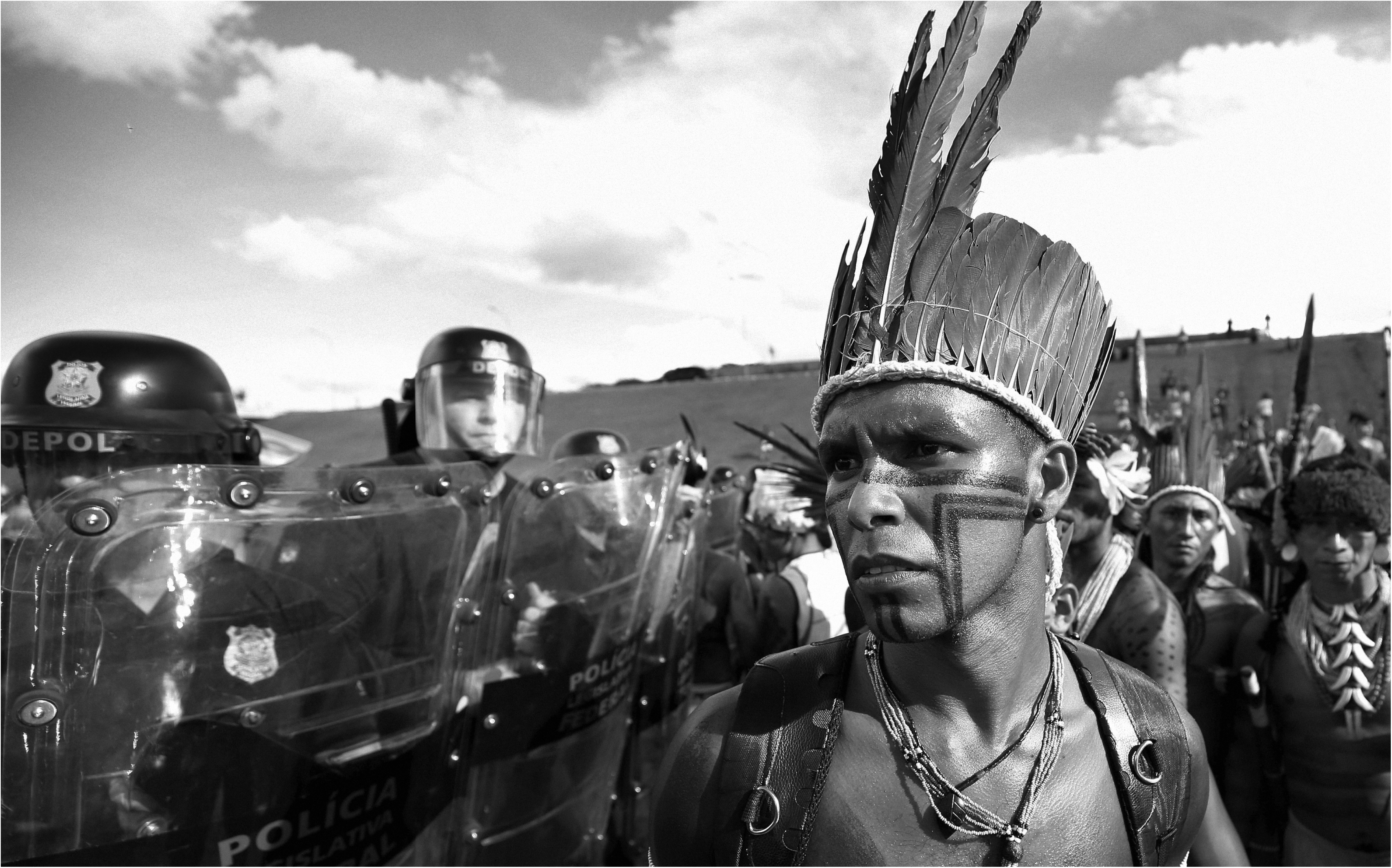
With freedom of expression increasingly under threat, demonstrating in Caracas’ packed plazas, Rio de Janeiro’s hillside slums or Mexico’s rural towns can mean risking one’s life at the hands of oppressive, and largely unrestrained, security forces.
The socialist “pink tide” of the early 2000s has subsided in recent years, giving way to broad public anger at corruption and authoritarianism on all sides of the political spectrum. Latin American governments have responded by criminalising protesters and creating pretexts for violent crackdowns, and with 14 countries due to hold presidential elections in the next two years, observers fear this cycle of unrest and repression will continue.
Luciana Pol, who co-authored the 2016 report Latin American State Responses to Social Protest at Argentina’s Centre for Legal and Social Studies, warns of the increasing use of legislation and judicial rulings to regulate the act of protest. She told Index that governments were trying to make protest legally and socially unacceptable by dictating under what terms it could take place and emphasising collateral damage to public spaces or free transit.
Pol also found that the worst state aggression was usually directed at those with the least political capital and strongest motivation to protest: the environmental activists, human rights defenders and rural, indigenous, black or LGBT populations. “When demonstrations involve the middle classes we often see less repression,” she said. “When they’re sectors that have been marginalised for decades, the repression is much stronger.”
These trends are particularly pronounced in Venezuela, Brazil and Mexico – three of the region’s most politically and economically influential countries – where rampant violence, corruption and inequality are set to shape their respective elections in 2018.
As opposition to Venezuela’s socialist president, Nicolás Maduro, has hardened this year, so too has the state response. Faced with mounting public anger over severe inflation, insecurity, political repression and desperate shortages of food and medicine, Maduro’s government has passed several laws to criminalise protesters.
Recent legislation has limited the movement of protesters and justified force against those who block traffic or hold demonstrations without prior permission. Other new laws allow armed forces to establish order during demonstrations, even permitting use of deadly force if soldiers feel at risk.
Jonathan Planchart, a lawyer from Caracas, told Index that this year’s demonstrations began with peaceful demands for free elections, the release of political prisoners and better management of the economy. But as tensions boiled over, the protesters began to clash with security forces, leading to fatalities.
“The Venezuelan state has practically been kidnapped for 18 years by a political group that took power and doesn’t want to give it up,” Planchart said. “The government is criminalising those who violently resist the state security forces. However, the violence [protesters] inflict by pushing people, throwing stones or, at worst, launching Molotov cocktails is incomparable with the excesses committed by the state.”
Since 2012 the government has also increasingly used military courts to try civilians, including indigenous activists and union members, in violation of Venezuela’s constitution and international law.
“This isn’t normal,” Planchart added. “Military tribunals are only supposed to judge soldiers, not civilians.”
Erika Guevara Rosas, Americas director at Amnesty International, told Index that the government was painting civilian protesters as militants to undermine their legitimacy and justify violent repression.
“The government is trying to portray these massive demonstrations as being organised by the opposition, as a plot against the government or an attempted coup,” she said. “The reality is that you have normal citizens just going out and trying to hold the government accountable.”
The state has also begun deploying armed civilian groups to confront protesters, despite reports of them committing abuses. Guevara warned that this has created “an incredibly volatile situation that can really escalate into a very in-depth human rights crisis”.
In September the government dismissed allegations that it was repressing demonstrations as “lies” aimed at destabilising the country.
Brazil has recently experienced major protests over government corruption and the handling of global sporting events. The right-leaning Michel Temer administration has responded aggressively to the protests, with security forces using truncheons, tear gas, stun grenades and water cannons against demonstrators and journalists.
The government has defended the deployment of soldiers to “restore order” during demonstrations, but the CELS report notes that security forces are inadequately trained for this work. Military police are often accused of extrajudicial executions and unnecessary use of force, but rarely face charges.
Activists have denounced police surveillance of social networks and the phone tapping of protesters, who risk conspiracy charges over the mere possibility that they could commit violent acts. Other common charges include contempt, threat, resistance or disobedience for resisting or verbally denouncing violent or illegal police behaviour.
There have also been reports of agents provocateurs infiltrating protest movements and committing violence to justify repression and arrests.
Rafael Rezende is an activist from Rio de Janeiro who has worked with favela residents on social projects and political campaigns. He told Index that locals faced rising levels of repression in the build-up to the 2014 World Cup and the 2016 Olympic Games.
The high costs of hosting both events provoked major demonstrations across Brazil, with the most violent clashes occurring in the favelas, where armed forces were deployed to “pacify” locals protesting against forced evictions, police brutality and broken promises of investment in their communities.
Rezende said the authorities treated dissent in the slums and in wealthier areas very differently. “When the police arrive in the favelas they bring much heavier weaponry,” he said. “They use rubber bullets in rich neighbourhoods and they use live rounds in poor neighbourhoods.”
Rezende believes there is a racial aspect to this discrepancy, as the favelas are predominantly black areas. According to Amnesty International, 79% of victims killed by police in Rio de Janeiro from 2010 to 2013 were black, despite people of colour comprising less than half of the city’s population.
Rezende added that a 2016 anti-terrorism law has given police greater powers to repress protests, while the war on drugs provides a pretext for clampdowns in the favelas. “Anti-drug legislation is used much more against young black people from the slums than young white men like myself,” he noted.
In Mexico, the centrist Enrique Peña Nieto administration has taken significant flak over corruption scandals, a stagnant economy, record levels of drug-related violence and the disappearance of 43 student activists in 2014. The state has sought to limit dissent through stringent regulations and faces accusations of using violent intimidation tactics.
Mexican authorities have passed or submitted at least 17 local and federal initiatives to regulate demonstrations in the past three years, including legislation that gives authorities broad powers to break up protests, restrict the movement of participants and demand advance notice of demonstrations.
In parts of Mexico, the lines between the state and organised crime are so blurred that journalists and activists are at almost equal risk from corrupt security forces and drug cartels. In extreme cases, demonstrators have suffered torture, sexual violence, forced disappearance and extrajudicial execution.
Speaking from her office in Mexico City, Guevara noted that Mexico has developed a more sophisticated response to public protest than most countries in the region. The government is suspected of infecting activists’ phones with advanced spyware (it denies the allegations) and deploying legions of bots on social media to manipulate trending topics and discredit peaceful demonstrations by inciting looting and violence.
Aggressive trolls also attack Twitter users who organise demonstrations or criticise the government. After tweeting about marches that were planned to demand the president’s resignation last year, I was sent a picture of a man brandishing an AK-47 with the message: “Stop talking shit about Mexican government. I’m not kidding. First warning, get out Mexico”. Inspection of the account revealed it was attacking people who used the hashtag for the planned demonstrations.
Mexican journalists and activists routinely receive threats of this nature. It is a way of discouraging participation and shutting down dissent before it’s even manifested in physical demonstrations, she explained. “In Mexico this happens more often than the protest itself,” Guevara said.
Recent cause for optimism in Latin America centred around social networks and independent online media making it easier to organise demonstrations and document abuses. Guatemalans also showed the power of protest by forcing the resignation and subsequent arrest of President Otto Pérez Molina amidst a corruption scandal in 2015.
Yet in countries like Venezuela, where opposition leader Leopoldo López is under house arrest, and Mexico, where allegations of voting fraud abound, Guevara expects 2018 to bring more repression as people take to the streets in defence of democracy.
“When you lack the ability to demonstrate and hold governments accountable, of course you are losing the ability to exercise your human rights,” she said.