




Abstract

In Mosul,
He had been pouring out his hatred towards Isis which, in 2014, had conquered part of central Iraq and established the Iraqi capital of the self-proclaimed Islamic State in Mosul.
“We will wait for the Iraqi army to rid us of their crimes. If not, we will think about cleaning up the city ourselves, drowning them in disinfectant,” he said on the radio.
After that, he was immediately arrested by Isis and a few hours later the video of his execution went viral.
In it, Ahmad was subjected to a special kind of waterboarding: drowned in a tub of Dettol, accused of being an infidel and accused of conspiring with the enemy.
When recounting this episode, the man whose Alghad FM radio station started in 2014 almost gags, then swallows, saying: “It’s the only testimony from Mosul which I would, perhaps, rather never have received.” Mohammad al-Mawsily (an Arabic pseudonym meaning Mohammad from Mosul) is the director of this station, situated in an anonymous house in Irbil, in Iraqi Kurdistan.
Inside, the furnishings are spartan. There is one floor for the radio station and one for the TV station, Naynawa Al Ghad. The newsroom is housed in the living room, the studio in one of the bedrooms on the floor above. There is a small kitchen where the crew (about 15 people) eat their meals and a white cat is the only guest allowed in.
The studio is equipped with two sets - one for the newsdesk, the other for interviews -with some chairs. A soundproofed area and pair of audio mixers from which the director rarely tears himself away are in the radio section. Al-Mawsily is 28 and does not tell journalists his real name, for security reasons.
“We remain a target because of everything we have done and continue to do for the population of Mosul. We have given a voice to those who had none and we will carry on doing so, wholeheartedly. The name of our station means ‘The Nineveh of Tomorrow’.”
Al-Mawsily is an electronic engineer, a graduate of Mosul university. He spent part of his career as a teaching assistant at the University of Denver and speaks fluent English. Isis cropped up in his life almost by chance. He said: “I had only just returned to Mosul for four months, prior to returning to the US, when Isis occupied the city, forcing me to flee to Irbil.”
The radio station was born immediately afterwards when, having to remain in Irbil, he decided to do something con-crete to help his fellow citizens.
A view of a part of western Mosul, Iraq, May 2017
CREDIT: Alkis Konstantinidis/Reuters
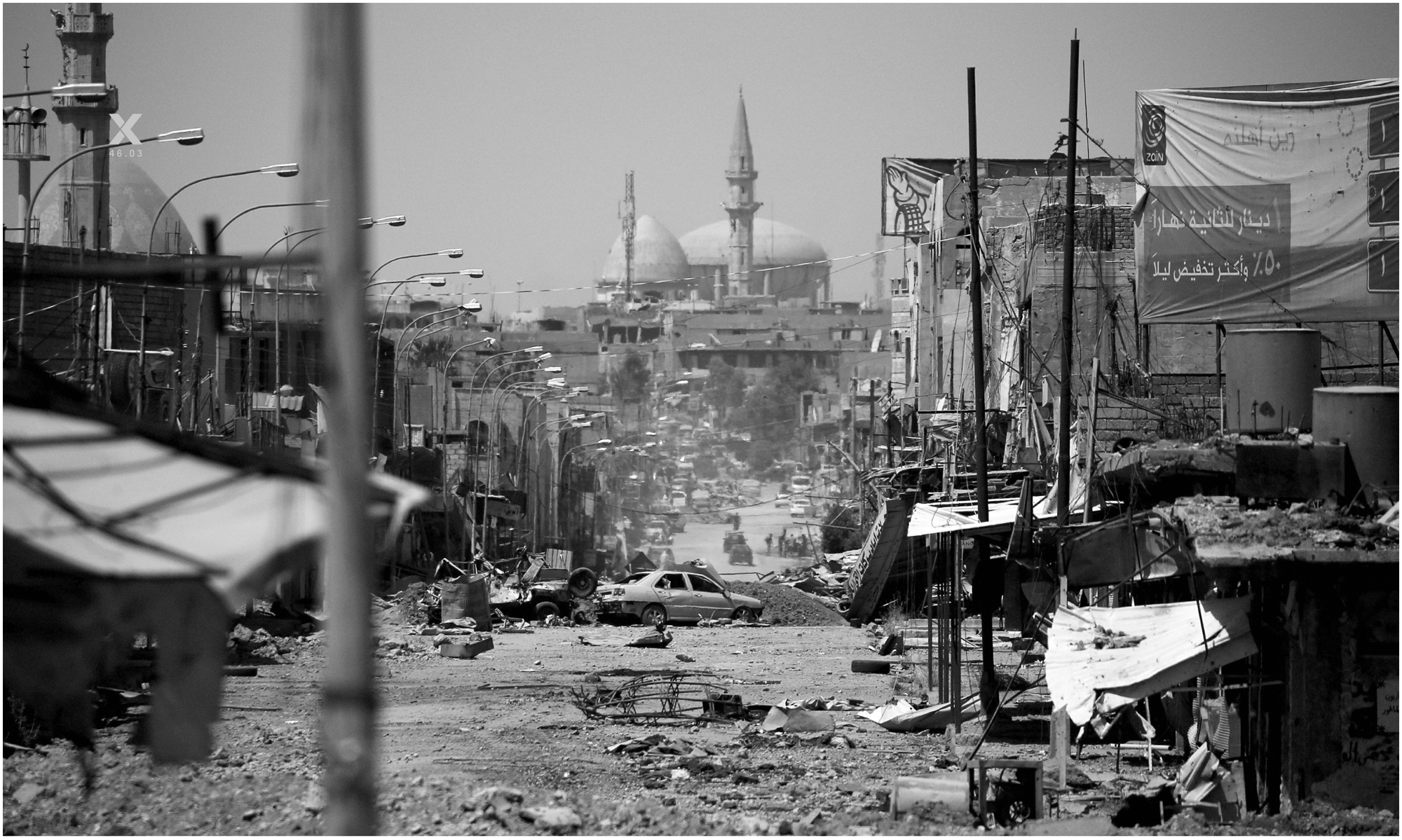
“I understood that I had to do some-thing,” he said. “I had no experience but I set up a communications company. We began transmission in March 2015, as soon as funds arrived from some NGOs and some exiled politicians from Mosul.”
The first difficulty was trying to change the frequencies often, or to obscure them so as not to be blocked by Isis.
“At the beginning, we had only one channel. Then we began to change it continually every four to five days in order not to be censored.
“Since then, the presenters of Alghad FM have received 45 testimonies in the form of long, live interviews and hundreds and hundreds of calls to the radio station, requests for help, eyewitness accounts.”
During the siege, the radio station also served as a means of identifying the location of many civilians, finding out their situation, what was happening in the besieged areas and what military action Isis was taking.
In some cases, it was crucial in discovering which of the coalition’s bombardments were having the worst effects and had caused the highest numbers of civilian deaths. Today, following the liberation of Mosul by the Iraqi army, which left more than 40,000 civilians dead, Alghad FM’s radio and TV presenters and reporters continue their work, gathering eyewitness accounts on the ground.
Hassan Omar al-Husseini is the man who, during the long days of the the liberation campaign, obtained the most eyewitness accounts in person, in addition to those received via radio.
“Abu Ahmad called us from Mosul, terrorised,” he said. “He was the owner of a shop next to the tomb of the Prophet Jonah and the mosque of the same name (at the site of Nebi Yunus), which were blown up by Isis.
“At that moment, he lost his shop and told us on air how it happened.
“Sixteen black pick-up trucks with darkened windows circled the sacred site and about 100 Isis militiamen armed with automatic rifles and grenades got out of them. First they looted the site thoroughly, then [they] blew it up using dynamite. His shop went up in smoke.”
Al-Husseini also obtained an eyewitness account from Abu Mohammad, a resident of the al-Jadida district of Mosul, which has suffered from violent bombardments. There was one, in particular, in which 170 people were killed at the same time.
“Abu Mohammad was sick to death of them all: of Isis which had placed car bombs in front of these houses in order to use the civilians as a human shield, but also of the Americans. He was convinced that the bombing raids over this area of the city had been more intense because this quarter did not have a good reputation at the time of the American occupation, as it was the Ba’ath Party’s stronghold.”
But these accounts also speak to us of extortion, abductions and inexplicable acts of violence.
Abu Dunia, the father of a teenage girl, Dunia Nabil Ahmad, called the station begging for help. His daughter had been captured by Isis at Mosul’s al-Salam Hospital, apparently by militiamen patrolling the wards.
The men ordered her to call her husband, to prove she was married, and to show them her marriage certificate. Since that day, nobody has seen her or her husband. The couple’s two children were left, orphaned.
“Some stories have also had a happy ending, if you can call it that,” said al-Husseini. One is the story of a woman who owned a beauty salon and was arrested three times by Isis for extortion purposes. The woman was incarcerated for three months and had to pay 35 million Iraqi dinars (US$30,000) to be released. Then the militiamen blew up her shop. Today, she has reopened her business in Mosul, in the new area of the city, and has begun living again.
“Her case,” the reporter said, “is very interesting and offered me the opportunity, at least this time, to follow a long, coherent story and to get to know this woman, who for me had previously been just a voice.”
However, Alghad FM has given a voice not only to the inhabitants of Mosul, crushed by the dictatorship of Isis. It has also given a voice to the militiamen, from start to finish.
“At the beginning,” said al-Mawsily, “it was often possible to debate on our frequencies with people defending Isis’s political and religious doctrine.
“In order to facilitate the broadcasting of information and debate, our presenters pretended to be Islamic State supporters themselves.”
Then, as the liberation progressed, the stories on the ground gave way to voices associated with people. Al-Husseini recalls when the Popular Militia Unit of Nineveh arrested a group of Isis militiamen in Mosul.
“I interviewed two of them, Abu Kutiba and Abu Kutada,” he said. “The first used to have the task of stoning adulterous women and began his service with Isis stoning his own cousin.
“The second was an imam from the central council. He supplied the ready-written Friday sermons to the imams of the twin mosques. The sermons dealt with themes dear to Isis’ political theology: infidels, apostates, how to behave towards Shi’ites, jihad. He told me that anyone who refused to deliver them would be killed; he had killed one, a disobedient one, himself. He was very proud of it.”
Some names have been changed for safety reasons
Footnotes
Translated by